Loading summary
Transcript172 lines
- [00:00]
Progressive Insurance Announcer
All of it is supported by Progressive Insurance. Do you ever think about switching insurance companies to see if you could save some cash? Progressive makes it easy to see if you could save when you bundle your home and auto policies. Try it@progressive.com Progressive Casualty Insurance Company and affiliates. Potential savings will vary. Not available in all states.
- [00:36]
Alison Stewart
This is all of it on wnyc.
- [00:38]
I'm Alison Stewart.
- [00:39]
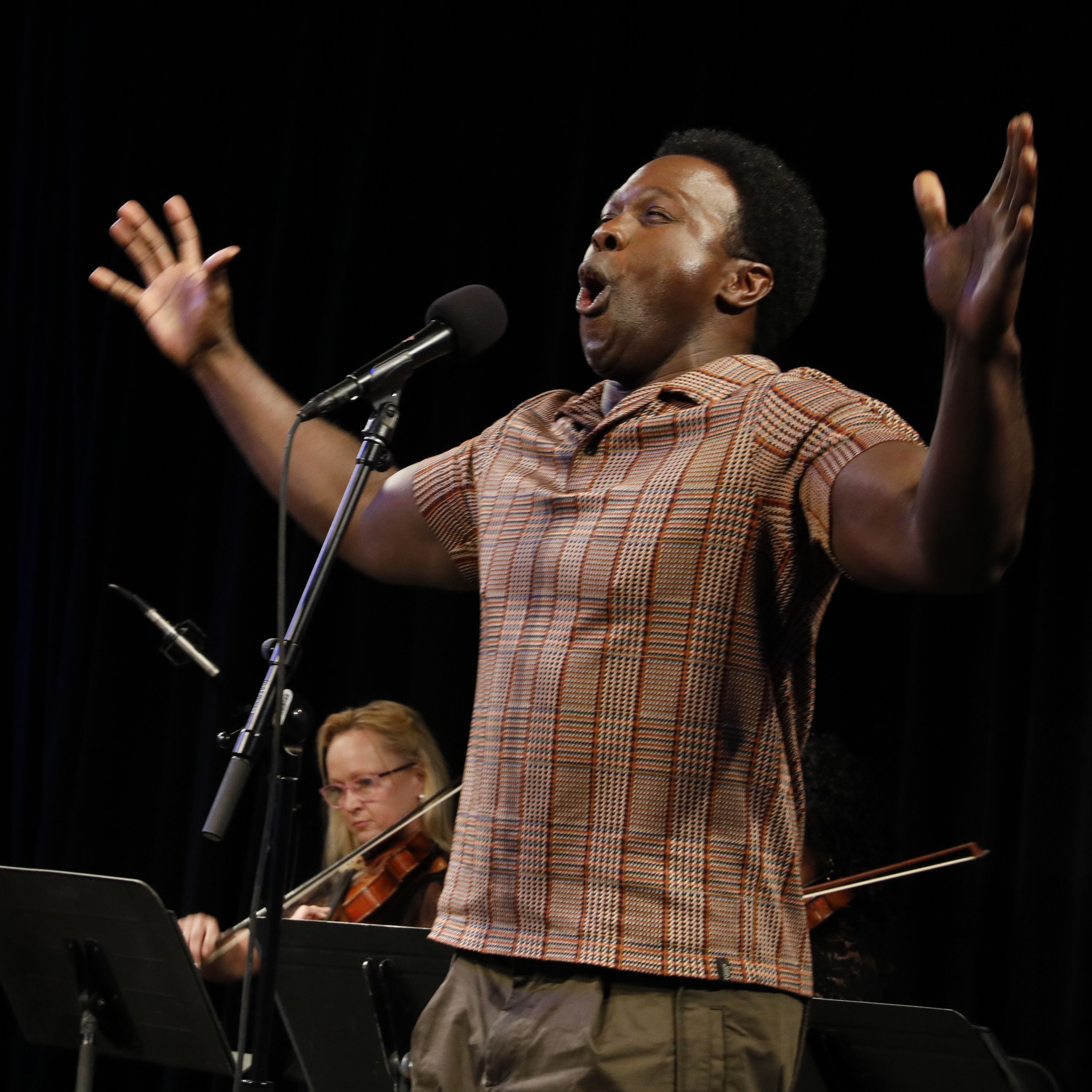
Broadway on the Radio is a series of live events we put on here at all of it where we bring the best and the brightest of Broadway talent to WNYC in person and on the air. And today we're bringing you an encore presentation of those events. Later today in the show, we'll hear from the cast and crew behind the musical Chess. But first, Ragtime, the revival of the musical based on E.L. doctorow's 1975 novel, is leading the pack this Tony awards season with 11 nominations including Best revival of a Musical, Best Director, Best Performance in their categories for Casey Levy, Brandon Uranovitz, Ben Levi Ross, Nichelle Lewis and Joshua Henry. It is also nominated for best Costume Design, Luke Lighting design, Sound design and choreography. So let's get things going and hear some music from Ragtime with a performance of He Wanted to say. We'll hear the voices of Joshua Henry who plays Cole House, Walker Jr. Shayna Taub who plays Emma Goldman and Ben Levi Ross, who plays a young man making a choice. It's a song about how and why we aren't that different from each other. Here's he wanted to say
- [01:52]
Joshua Henry
what is it you want?
- [01:56]
Ben Levi Ross
Um, well, I wanted to. I know that if I were he
- [02:06]
Nichelle Lewis
wanted to say I am here because
- [02:10]
Shayna Taub
I have to be he wanted to say I am here for what is right.
- [02:18]
Nichelle Lewis
Every day I wake up knowing what
- [02:21]
Shayna Taub
you've lost and what is I would shed this skin if I could to stand with you and fight.
- [02:33]
Nichelle Lewis
He wanted to say I am not
- [02:37]
Joshua Henry
who I appear to be he wanted to say do not blame me for my past we have different lives and faces but our hearts have common places. This was deep inside me and you helped me find it at last.
- [03:01]
Nichelle Lewis
Two men meeting for a moment in
- [03:05]
Joshua Henry
the darkness One turning from one waking to America
- [03:13]
Brandon Uranovitz
to a man of finding
- [03:15]
Joshua Henry
For a moment in the darkness they're the same. He wanted to say how I envy
- [03:28]
Nichelle Lewis
you, your innocence he wanted to say
- [03:33]
Joshua Henry
by your side I could be brave. If there's such a thing as justice, let me help you find your justice. This I do for you and for Sarah who lies in her grave.
- [04:00]
Shayna Taub
But all he said was
- [04:06]
Ben Levi Ross
I know how to Blow things up.
- [04:14]
Joshua Henry
Two men meeting For a moment in
- [04:18]
Brandon Uranovitz
the darkness For a moment in the darkness.
- [04:33]
Broadway on the Radio Host
Shayna Taub, Ben Levi Ross and Joshua Henry singing, he wanted to say from Ragtime for live in the green space for the stars and the creative team from our series Broadway on the Radio. Joshua, he's gonna rest his vocals a little bit.
- [04:48]
Alison Stewart
We expect a little more from you later on in the show. I'll talk to Shayna and Ben first. Shannon, you play Emma Goldman. How would you describe her?
- [04:56]
Shayna Taub
Oh, a joyful anarchist. I think Emma, you know, historically her vision of anarchy, I think from my understanding her writings was predicated on the idea that human beings, when left to our own devices, cooperate. And I think that's sort of a fundamentally positive, you know, anarchy can get a bad rap for being like negative. But I think that's beautiful, you know, and I think so. To me, I've tried to, you know, she is clear headed about the dangers and the violence and all the horrors facing the country at that time and our time as well, frankly. But I think that she brought a spirit of joie de vivre and humanity to all of her protests.
- [05:34]
Alison Stewart
In the show. Your character sees Emma Goldman, she sees her at a speech. How does that change your character?
- [05:41]
Ben Levi Ross
Seeing her speak, it's. Well, to quote the great music of Ragtime, it's like a firework, unexploded, wanting life but never knowing how. That, that's what mother's younger brother is. He. He wants to dedicate himself to something. And as you were talking, Shayna, I was thinking, well, he's not as clear headed. I think he's a little messy with it. He's like, let's just blow some stuff up. Let's just burn it to the ground. Like, he's a little crazier, but I think it's. His heart is in the right place. And. And Emma Goldman is that sort of. You say activist doula, right? Yeah, yeah, that's how you describe yourself for me.
- [06:22]
Shayna Taub
Yeah.
- [06:24]
Alison Stewart
You once said that Showtime is one of your favorite shows. How did it become your favorite show?
- [06:29]
Shayna Taub
I was me. Yes. Sorry. I'm so excited. I love Ragtime. I was a little kid growing up in a small town in Vermont. My mom got me the two disc set of the original cast album for Hanukkah, I think, in 1998. And it just opened my world. I just, it was my portal into the past, into my own Jewish identity and history and opened me up to learn about experiences that weren't my own. And it just, yeah, it gave Me a real, real context for American history that I wasn't finding anywhere else. And that's what art can do. Right? You can just like reach through the stage or reach through your CD player. Sorry. You know, from the eight. Let's bring back CD players. But yeah, it really.
- [07:03]
Broadway on the Radio Host
We're trying.
- [07:03]
Shayna Taub
Yeah, yeah.
- [07:05]
Alison Stewart
What's your history with Ragtime?
- [07:06]
Ben Levi Ross
My history with Ragtime is that when I was 11 years old, I remember being on a plane and my sister putting an earbud in my ear and playing for me and singing Daddy's Son. And I was like, A, I'm gay. And B, that is the most beautiful voice and most intensely. Just sort of absolutely all encompassing emotional experience I've ever heard in a musical. And then I did not do Ragtime until Lear Debessinet approached me about City Center a year ago. And I fell in love with this character very deeply because I didn't really know about mother's younger brother until this experience.
- [07:46]
Alison Stewart
For people who don't know, Shana wrote Suffs.
- [07:49]
Joshua Henry
Yes.
- [07:50]
Ben Levi Ross
Give it up.
- [07:51]
Broadway on the Radio Host
She won two Tony Short.
- [07:55]
Alison Stewart
Was. Was Ragtime an inspiration for Suffs?
- [07:58]
Shayna Taub
There would be no suffs without Ragtime. It was my central inspiration. It's what set me on a whole. It was my North Star, my Guiding light. Everything about McNally, Aarons and Flaherties masterpiece was just sort of my, like, holy book. It was my Torah, you know, like for this experience. Absolutely. I just hoped I could inspire another young girl or any kid, you know,
- [08:20]
Alison Stewart
the same way I'm sure you have. You play Emma Goldman in this. You played Alice Paul. Did you ever. They were on the opposite sides of women's suffrage.
- [08:30]
Nichelle Lewis
A little bit.
- [08:30]
Shayna Taub
It's quite interesting. I wonder what they would have to say to each other. I don't think Alice Paul was radical enough for Emma.
- [08:35]
Alison Stewart
Yeah.
- [08:35]
Shayna Taub
You know, like Alice, while a radical, was, I think, trying to work within a system where, you know, get win a right to enfranchisement within a government system. And Emma was, to Ben's point, burn it all to the ground. She thought, why fight for a right within a system that fundamentally won't support you? And I see, I see. I understand both perspectives.
- [08:55]
Broadway on the Radio Host
Just went to my next question. Which side are you on?
- [08:57]
Shayna Taub
Do you think I'd be somewhere in the middle? Yeah. All right.
- [09:00]
Alison Stewart
You played Nick Carraway.
- [09:02]
Shayna Taub
Oh, yeah, I did, yeah.
- [09:03]
Alison Stewart
And the Great Gatsby as well. And you're playing this part and you're thinking about Ragtime. And I was wondering, what do you like about playing historical characters?
- [09:10]
Ben Levi Ross
I guess they just find me. No, I don't know that it's something that I set out to do. But I think that specifically with Nick Carraway, there is some. You know, what I'm noticing between the two of them, like there is this sort of narrator figure that both, obviously Nick Haraway has, but that a younger brother actually takes on in this show, which I always find interesting because you get to sort of have like a direct line with the audience a little bit. We do break the fourth wall in Ragtime. Like, I direct address the audience multiple times in the show. And I think that that's cool to me.
- [09:54]
Alison Stewart
Yeah.
- [09:54]
Joshua Henry
Yeah.
- [09:55]
Alison Stewart
All right. When Seth was running in 2024, you were in Suffs and Ragtime at the same time. Election and the election. What was that like for you the
- [10:07]
Shayna Taub
day after the election in 2024? I did SUFFS in the afternoon, in the Wednesday matinee, and then Ragtime in the evening. And I was so grateful. I mean, to be in a theater, right. This is one of the places that we all get to come together and feel out loud in public. We're not sitting in our silo scrolling on our phone. And whether that's in a moment of big social celebration, social commiseration, an election that went our way, an election that didn't. The theater is here for us to not be alone in those feelings. And to me, the great works of art, which I think Ragtime is one, is expansive enough to contain how you feel on either day. So for me, I felt so lucky to be with my theater community, to be with my New York community on that day and process it together in one of our public spaces where in America we're still allowed to tell these stories on stage. And I think we need to exercise that right as much as we can.
- [10:56]
Joshua Henry
Yes, yes.
- [11:01]
Broadway on the Radio Host
And joining us now is Lear Debessonet,
- [11:04]
Alison Stewart
the director of Ragtime. Lear, you have a 28 piece orchestra, possibly the largest orchestra on Broadway. You have a huge cast. What was the challenge behind orchestrating such a huge group of people?
- [11:24]
Lear DeBessonet
Oh, I love making epic events. It's actually my favorite thing to do as a director. And I think that the really the epic nature of Ragtime is actually because of its subject matter. I mean, American history and the complexity, beauty, pain of the American dream I think requires. There's just. There is a grandness baked into the questions of this piece. And it feels like the only way to tell the story.
- [11:54]
Alison Stewart
Do you like performing with the huge orchestra?
- [11:56]
Ben Levi Ross
It's like a dream come true. It's amazing.
- [11:59]
Alison Stewart
What's interesting about it as a singer?
- [12:00]
Ben Levi Ross
Well, it. What's our stage at the Vivienne Beaumont is a thrust stage that sort of we feel encompassed by the audience and the orchestra is beneath us. And I swear sometimes I can. Like, maybe it's just an energy thing, but I feel it, like, rumbling up through me. And to have 28 brilliant musicians at the top of their game underneath it, it feels like something that I'm standing on. Like, it truly feels like I'm standing on the brilliance of this score and of this music. And you hear it in its grandeur with that many instruments.
- [12:37]
Lear DeBessonet
Part of what has been so exciting for me about this moment is Ragtime is the first production in my new tenure as the artistic director of Lincoln Center Theater. And coming in, I felt like there is this tradition at Lincoln center of being able do musical revivals with an orchestra the size that it was written for. And being able to step into that tradition and really honor this music felt like such an important way to begin this next chapter.
- [13:06]
Alison Stewart
Ragtime takes place in the earliest 20th century. The novel came out in the 1970s. The premiere of the original happened in the 1990s. What does the show have to say in 2026?
- [13:20]
Lear DeBessonet
I. The show invites the audience to hold space together in a uniquely live way where you're sitting there with over a thousand other people that are feeling and breathing at the same time as you. And we're invited to think about essentially the meaning of America in this moment, which is more Is so completely complex and different for every person in the audience. But I think the reason that I believe Ragtime is resonating even beyond what we had hoped or like, beyond our wildest dream, honestly, of how we hoped it would resonate is I think people are fine, people are hearing lines differently that actually have always been in the script. But many people have said, did you update anything? And we say, no. This is the every word is what it was originally. But we are hearing it differently because theater always is meeting us in the present moment. And this story looking at the early 20th century and the ways that different groups of people come together in pursuit of the American dream, some encountering, you know, great elation and promise and others really facing, you know, holding the wounds of this country. I think it just is meaning a lot right now, and we're so grateful for it.
- [14:45]
Alison Stewart
Shane, the show just got extended until August. I believe it is.
- [14:48]
Shayna Taub
Yes, August 2nd.
- [14:49]
Alison Stewart
And it will be running through the 250th anniversary of the United States on July 4th. How do you Hope people will think about American identity, whether they're watching it now or they're watching the show. What do you think they're going to think about American identity through ragtime?
- [15:05]
Shayna Taub
There's a quote I love by, I think, a theologian named Walter Bruggmann that says amnesia produces despair in the same way memory produces hope. And I love that, right? Like when we forget where we've been and we forget our country's past, then we despair and we fall into this seductive embrace of cynicism because we think we've never been here before. But memory and an active national memory, right? A national imagination where we're allowed to tell our stories on public broadcasts like WNYC and at the Smithsonian and on PBS and all these places that they're attacking because they know how powerful storytelling is, frankly. They know that's their show. They know how powerful it is when people get in a room and they reckon with the past, as Lira saying. She always says, the promise and the wound of our past. So I hope that the memory produces a hope that goes hand in hand with critical thinking. Not like a simple, easy, everything's going to be okay hope, but a hope that demands that we look at our past and ask ourselves how we're being complicit in the present.
- [16:11]
Alison Stewart
Ben, you recently performed in the New York City subway.
- [16:15]
Ben Levi Ross
Yes, but we did together.
- [16:16]
Shayna Taub
We're busters.
- [16:18]
Alison Stewart
How do you think about New York
- [16:19]
Broadway on the Radio Host
differently after performing in the subway?
- [16:21]
Ben Levi Ross
Well, after. I mean, that there are nice acoustics. I don't. You know, but. But I do think my grand great grandparents came through Ellis Island. And when we were first rehearsing Ragtime at City Center, I took a long walk after rehearsal, one of the early days, and I swear I found myself on Orchard in Rivington, which is a street that Tate sings about in Success. And I. I could not stop crying for, like, about 20 minutes. I called my dad and I was like, this is just. I feel, like, very connected to my ancestors right now. And so I think of New York through the lens of Ragtime every day that I'm performing the show.
- [17:01]
Alison Stewart
You are listening to Broadway on the Radio from All of it on wnyc. We'll have more after a quick break. This is all of it.
- [17:21]
This is all of it on wnyc. I'm Alison Stewart. Welcome back to our Broadway on the Radio event with the cast and crew behind Ragtime. And we'll pick things up with a song from Brandon Uranovitz, who plays Tate, a European Jewish immigrant to New York, explaining To his daughter why it's important to imagine. Here's the song called Gliding.
- [18:05]
Brandon Uranovitz
See the silhouettes? It's a little book of silhouettes. When you flip the pages, they move. Look how nice this is. You on skates turning pretty figurines on this smooth, cool ice. We are gliding, gliding on a pond. Close your eyes, close your eyes. We are gliding, gliding afar beyond. Close your eyes, close your eyes Feel the wind as you peer away. Are you happy yet? Are you happy yet? Your mama would tell you Imagine you're fearless Imagine, imagine you're fearless and soon you won't fear When I am afraid, I imagine your mama, she skates just ahead. Can you see her?
- [19:35]
Alison Stewart
She's here.
- [19:38]
Brandon Uranovitz
And we're gliding, gliding far away. You know, wet figure eights, silver skates just down the track. Glide with me, little one. Glide with your topic. We'll never
- [20:09]
Nichelle Lewis
look
- [20:11]
Alison Stewart
back.
- [20:26]
Broadway on the Radio Host
That was Brandy Uranovitz as Tate performing Gliding from Ragtime. This is Broadway on a radio event from wnyc. We're live in the green space. Let's give it up for the band one more time. And we're going to invite Casey Levy on stage, who plays mother.
- [20:43]
Alison Stewart
Aw, that's very sweet. Brandon, you play Tate.
- [20:48]
Brandon Uranovitz
I do.
- [20:48]
Alison Stewart
Let's put people in the show. What's been going on in Tate's life before he sings Gliding.
- [20:56]
Brandon Uranovitz
A lot of. A lot of discovery, I would say. He comes to America to pursue the American dream like so many of our ancestors did. And I think as an artist, he hopes that he will find self actualization and freedom in a country that allows. Allows him the space to be himself. And he learns pretty quickly that this may be not accessible to him and his daughter. And he's, you know, he's really looking for a better life for his daughter specifically, you know, it's different in the novel by E.L. doctorow than it is in the show, but in the show in Ragtime. Tate's wife is no longer with us. And so I think he's trying to start a clean slate for him and his. His daughter. And he learns very quickly that that's not necessarily possible. But the thing about Tate that I find so moving and I hope that, you know, reaches across the fourth wall and into the audience. And something that Shaina talks so beautifully about is despite the oppression, despite the roadblocks, despite all of the obstacles, despite everything in his way, he never gives up hope, ever for one second. And that's what this song is about, is teaching his daughter to how to hold on to hope. And I think that's what sort of launch is the launchpad for him in Act 2, when he finally succeeds and achieves the American dream.
- [22:40]
Alison Stewart
I think your character is Mother Casey, and she first encounters Tate early on in the show. What is she dealing with when they first meet?
- [22:49]
Casey Levy
She's dealing with quite a lot. She's been living in her house on the hill in New Rochelle for quite some time, very comfortably with her husband and her son. And her husband goes away on a trip and life begins to shift around her and she is opened up to the world around her. And she meets Sarah and Sarah's child, and Kohlhaas comes into her life and she meets Tate. And she is fundamentally changed by each of these interactions. And she, as she is, you know, we only know her as mother, as she is mothering everyone else. She is very much mothering herself and parenting herself through the biggest shift in her life. And in this next song that we're going to sing, this is a beautiful moment where Tata and Mother, who come from vastly different worlds, are finding common ground and watching their children innocently play and connect, unbothered by their differences, that we as adults often get so tied up in and what we can learn from them. So it's a really beautiful moment for
- [23:56]
Alison Stewart
people who don't know people who aren't ragtimers. This is not your first ragtime rodeo.
- [24:01]
Brandon Uranovitz
It's not.
- [24:01]
Alison Stewart
It's not.
- [24:03]
Broadway on the Radio Host
Do you want to tell people about that?
- [24:05]
Brandon Uranovitz
Sure, sure. So I was introduced to ragtime about 30 years ago when I played the little boy in the pre Broadway tryout in Toronto with Brian Stokes Mitchell, Audra McDonald, Peter Friedman, the late, great mayor Maisie. Yeah. And it was an extraordinary experience. I grew up just outside of New York City in New Jersey, and I had dreams of being on Broadway. And. And here I was part of this massive, beautiful, epic production that was going to Broadway. And, you know, the thing is, I was playing a character that did not necessarily align with my own identity. You know, Lea Michele was playing the little girl and I kind of looked like her twin brother. And it was, you know, I think just in terms of meeting the. The themes of the show, it just was not a good fit. And they didn't bring me to Broadway and I was the only one who they didn't bring. And it was. Yeah, yeah, yeah, yeah. Thank you.
- [25:14]
Nichelle Lewis
Yeah.
- [25:14]
Brandon Uranovitz
And it was. It was like a deeply traumatizing experience for me.
- [25:19]
Casey Levy
No big deal.
- [25:20]
Broadway on the Radio Host
And I can move on.
- [25:21]
Alison Stewart
It's easy.
- [25:22]
Nichelle Lewis
No, no, no, no.
- [25:22]
Brandon Uranovitz
It just.
- [25:23]
Ben Levi Ross
Okay.
- [25:23]
Brandon Uranovitz
This is very healing for me. No, but, you know, to me, this entire thing, it's so surreal coming sort of full circle now. And to me, it's just been a lesson in patience and meaning. And, you know, playing this character, Tate, who is so the opposite of what I was feeling when I was playing the little boy, I just so aligned with who I am. I feel him in my guts. You know, this is a man who lives. Who is not just sort of defined by his, like, Jewish identity, but he's. He's a character who sort of. I like to think he. He lives at the sort of intersection of, like, rage and buffoonery, and that is, like, exactly where I exist, I think. And it just feels like a cosmic realignment, and it's been an incredibly healing experience. So, Lear. Thank you. My God. Yeah, it's. So that's my history.
- [26:26]
Shayna Taub
Yeah.
- [26:27]
Alison Stewart
Well, thank you for being so candid. We appreciate that this is your first time with this crew because they've all been together since this first appeared at New York City Center. Yeah, you were there. You were there. I'm sorry. When you came into the show, you said you wanted to concentrate on your relationship with mother's younger brother. Yeah. What did you find when you wanted to concentrate on that?
- [26:50]
Casey Levy
I just found, you know, doing the show at City center was magic and so fast, and I had just come off of doing next to normal two weeks prior in London. And so I was doing a really hard gear shift, and we had, like, 10 days of rehearsal, and I felt like I was just scratching the surface of what my mother could be. And I've just been such a fan of Ben Levi Ross for so long, and I just love the dynamic that exists between mother and younger brother.
- [27:16]
Ben Levi Ross
But.
- [27:16]
Casey Levy
But there's not a whole bunch on the page, but what's there made me curious. And so it was one of the things I was looking forward to in coming to Broadway with the production is just the two of us getting to find those moments to connect and deepen this storytelling. And I think we've really done that, and it's enriched the way I see mother in such a deep way, because the loss I feel without giving all the spoiler alert, the loss I feel with my husband and sort of the fracturing that happens there. I then also lose this person. I've always been so aligned with my brother, and I have to go on without both of them and figure out who I am as a woman and a mother without the two most important men in my life. And so I feel like we've gotten to flesh that out in a really beautiful way this time around.
- [28:03]
Alison Stewart
I was thinking through the entire show how Mother is sort of confined by her gender and even her status in many ways. How does she try to affect change?
- [28:13]
Casey Levy
I think the thing I find inspiring about this character is that she is just trying to do the right thing at all turns. She is not trying to make a choice for people to notice and applaud her. She is literally just faced with challenges and people and trying to be a good human. And she doesn't really have an example to look to. We don't meet the women that might have influenced her in this story. So I have to invent that. And I think she's. Her moral compass is very strong. And it gets stronger as the show goes on, as she is making decisions and trying to do right by Sarah and by Coalhouse and by her husband and by herself, you know, and doing the right thing for her son. I don't know if that answered your question, but I find I'm learning things about her every single day because she's sort of incapable of lying. She's just telling the truth at every turn. Even when it's hard. Especially when it's hard.
- [29:11]
Alison Stewart
The next song we're going to hear is Our Children Next. Do you want to set it up?
- [29:16]
Brandon Uranovitz
Sure. Well, I think, yeah, Casey did a little bit. You know, this is us. Our connecting over the common bond that our children share and I think, reconnecting with our own innocence that has been sort of lost in some ways over the course of the show. And how seeing that in our children makes us see each other in a really special and unique way that ultimately. Well, I don't want to spoil anything.
- [29:48]
Alison Stewart
This is our Children from Ragtime. How they play Finding treasure in the sand they're forever hand in hand Our
- [30:22]
Brandon Uranovitz
children How they laugh she has never laughed like this.
- [30:30]
Casey Levy
Every waking moment bliss Our children
- [30:36]
Brandon Uranovitz
see them running down the beach Children run so fast toward the future from the past
- [30:48]
Nichelle Lewis
how they dance unembarrassed and alone
- [30:54]
Brandon Uranovitz
Hearing music of their own Our children One so fair and the other lithe and dark Solemn joy and the sudden spark Our children see them running down the beach Children run so fast toward the future from their past.
- [31:29]
Nichelle Lewis
Their they stand
- [31:32]
Brandon Uranovitz
Making footprints in the
- [31:35]
Nichelle Lewis
sand and forever hand in hand Our
- [31:40]
Brandon Uranovitz
children Too small Our eyes silhouetted by the blue One like me and one like
- [31:53]
Nichelle Lewis
you.
- [32:01]
Brandon Uranovitz
Our children. Our children.
- [32:24]
Broadway on the Radio Host
That was Brandon Uranovitz and Casey Levy singing Our Children from Ragtime. You're listening to a Broadway on the Radio event. We'll be back after A quick break.
- [32:56]
Alison Stewart
This is all of it on wnyc. I'm Alison Stewart. Welcome back. Let's return to our Broadway on the Radio event. With the cast and crew behind Ragtime Time, we'll pick things up with Nichelle Lewis, who plays Sarah in the show. Here she is singing her song. Your daddy's son.
- [33:55]
Nichelle Lewis
Played piano, played it very well Music from those hands could catch you like a spell he could make you love him for the tune was d you have your dance. You are your daddy's son. I knew that you were on your way he had other ladies of the batu stop lay up and left me I just am and run only thinking my head
- [35:12]
Shayna Taub
you.
- [35:34]
Nichelle Lewis
She was frightened crazy from the without no combat screams about nothing call me darkness and pain the anger and pain the blood and the pain I bow in my arm and the ground and the ground when I I. But he's playing steel mama can't forget him don't suppose I will God wants no excuse of I am. You are your daddy's hands. Forgive me, you.
- [37:48]
Broadway on the Radio Host
It's so nice to meet you. I wish you could have seen your castmates watching you sing that song.
- [37:56]
Alison Stewart
They were on edge when you sing that song. That song is a show stopping moment. You're on stage by yourself. Yes. What are you able to do in that moment on stage by yourself? What are you able to do creatively? What are you doing with your character?
- [38:15]
Nichelle Lewis
I mean, so hard. I'm like still kind of tearing up from singing. Feels. It feels surreal to be able to tell her story in such a beautiful way. And this song is one of those moments where she's first really speaking out about what she did and how she was feeling and why she did it and why it was so painful to go through. But also it's a moment of realization for her that she's going to be there for this baby. And you know, regardless of the circumstances, she's there for that baby. And it's a moment of visibility as well because I feel so many women go through what she's going through. And I just think it's so beautiful to tell that part of her story.
- [39:11]
Alison Stewart
It's so interesting because you really are cheering up.
- [39:14]
Yeah,
- [39:16]
you relax. I'll talk to Joshua. Joshua, you were introduced to ragtime by a professor in school. What did you learn that theater could do?
- [39:29]
Joshua Henry
Well,
- [39:32]
my first exposure to ragtime was in the music library, Right. Professor was like, oh, listen to this. I was like, sure. Didn't know anything. Didn't know much about musical theater, but I Remember hearing Brian Stokes Mitchell's voice and hearing him sing the iconic songs, the music rules of a dream, and I just felt something, like, open up inside my chest. And I remember where I was sitting when I heard it, and I was like, I didn't know one could make someone else feel that way with their voice and the power of storytelling and sound. To me, at that moment, at what I think was 18 years old, that was. Something was born in me that was like, that's what I want to do. I want to tell stories and move people in that way. That was my first exposure to it. So, you know, actually fast forward to three days ago, seeing him. We were doing this panel on stage at the Vivian Beaumont, just about his experience with the show. You know, I'm sitting there with Nichelle and Audra and Stokes, as we call him now, and I was like. I was like, I can't. One day, I'm gonna unload it on him. You know what I mean? One day. Not today, not now, but, you know, one day.
- [40:47]
Alison Stewart
That must have been an amazing moment for the two of you.
- [40:50]
Nichelle Lewis
Yeah.
- [40:50]
Joshua Henry
Oh, gosh.
- [40:51]
Alison Stewart
Tell us a little bit about that.
- [40:53]
Nichelle Lewis
I mean, I was sitting right next to Audra, so, you know, for me, I was just sitting there trying to keep my cool. I was like, yum. But it was incredible to be able to talk about the black experience in ragtime with people that we look up to so much.
- [41:10]
Alison Stewart
Oh, my gosh. So, Joshua, I know you have to. You kind of got nerd out about taking care of your voice. That's a very important thing.
- [41:17]
Joshua Henry
This is true.
- [41:19]
Alison Stewart
What is something that you've learned about the voice in doing this show you would like to share with the audience.
- [41:25]
Joshua Henry
Everybody lean in. One of the most important things that I've learned about my voice is that each project is specific. Right? Like, I went into previews and ragtime thinking, I'm gonna warm up like this every day. I'm gonna do these trills. I'm gonna do these scales. And then, like, two months in, I was like, no, because my voice was like, josh, we're not doing that. So each. What I learned is your vocal load for eight shows, you've got to really experiment with it from week to week and take inventory on. Well, I don't have to warm up. This part of my voice, for instance, this part of new music, if y' all really want to nerd out with me for a second, where he sings, Kohlhaas sings this high A. And it's like, I don't know. Feels like an hour into the show, before the show, I was warming up, like that part of my voice. And then when it came to performance, I was getting really tired and I was like. I was like, okay, we can't do that. So I've learned throughout the process to ebb and flow with my voice. And also being on stage with these technicians and vocal masters has also been inspiring to learn from them. So listen and listen to your body and hear your voice and observe the incredible folks around you.
- [42:47]
Alison Stewart
Michelle, this is only your second Broadway show, right? This gentleman has done a few carousel long rangers, we all know. What have you learned from working on this show?
- [42:58]
Nichelle Lewis
Oh, my gosh, I've learned so much. But I think something I've really learned is honestly more about myself, what I can and cannot handle. I think I doubted myself a lot. I mean, it's really hard doing Broadway, eight shows a week. And I think I just realized, like, I can do it. I can do this as long as I put my head to it, as long as I do my research. I've watched, you know, all of my castmates every single night, just getting up there and doing it and doing the work and putting their heads to it and also uplifting and supporting one another is. It is amazing to be a part of such a ultra talented cast, ultra talented group of musicians. It's wonderful. And our director, incredible. I've learned so much and I continue to learn more every day.
- [43:56]
Alison Stewart
Ragtime shows how people are subject to forces around them, especially true for black people in the earliest 20th century. We see it in the show Joshua. There's a moment when Coalhouse is asked to play a minstrel song on the piano and he plays ragtime instead. What does music mean to McCollhouse?
- [44:16]
Joshua Henry
What does music mean to Coalhouse? One of the reasons I love Cohouse so much is music is everything to him. And I say that about myself. I just. For Kohlhaas, his position in the community as an accomplished musician, there's a lot of esteem there. A lot of who he is is based around music. His community comes and watches him play. He goes and travels around with Jim Europe, an esteemed conductor at the time, to share the love and joy of music. So it means a lot to him. And the moment where this incredible woman comes into his life or the idea to go and find what is the highest representation of music for him means so much and it gives him a sense of purpose. And I just really connect with that idea that music is, for me, a big part of my purpose too.
- [45:22]
Alison Stewart
Coalhouse And Sarah don't necessarily get a happy ending the way Mother and Tate do. But, Nichelle, how do you find hope in Sarah and Coalhouse? His relationship?
- [45:35]
Nichelle Lewis
In their relationship, or just how do
- [45:37]
Alison Stewart
you find hope in them?
- [45:39]
Nichelle Lewis
I think they both carry a sense of hope throughout the entire show. They both. I mean, that is the ultimate goal. That's. I mean, we say the American Dream. That is what I think we all hold in our hearts. And I think they represent that so well throughout the show. And I mean, especially in Wheels of a Dream, it is the ultra moment of hope, of wishing, of grasping onto it and trying to hold onto it for as long as they can. And I think it inspires people because even though they don't get their dream at the very end, it still inspires people to move forward in a way that makes change and hopefully make some positive change in the world. And even if we have to fight for it, even if we have to hold on and not let go, no matter what anybody says to us, I think that's like. I think that is who they are as a couple. They are that hope in the show.
- [46:47]
Alison Stewart
That is the perfect segue to hear Wheels of a Dream. Ladies and gentlemen, Joshua Henry and Nichelle Lewis.
- [47:18]
Joshua Henry
I see his face. I hear his heartbeat. I look in those eyes
- [47:39]
Brandon Uranovitz
how wise
- [47:41]
Joshua Henry
they seem well, when he is old
- [47:48]
Brandon Uranovitz
enough
- [47:51]
Joshua Henry
I will show him America
- [47:57]
Brandon Uranovitz
and
- [47:57]
Joshua Henry
and he will ride. On the wheels of a dream. We'll go down south See your people Won't they take to hear. And we'll travel on from there California,
- [48:41]
Nichelle Lewis
who knows where and we will
- [48:50]
Alison Stewart
on
- [48:50]
Brandon Uranovitz
the wheels of a dream.
- [49:01]
Joshua Henry
Yes, the wheels are turning for a scale and the times are starting to roll Any man can get where he wants to if he's got some pirates in his soul we'll see justice, Sarah and plenty of men who will stand up and give us our due. Sarah it's more than promises, Sarah it must be true A country that lets a man like me Own a country Raise a child Build a life with you
- [49:48]
Nichelle Lewis
with you. Beyond that, beyond this lifetime that car, the. A sun will rise
- [50:41]
Joshua Henry
on the wind.
- [51:07]
Alison Stewart
That was our Broadway on the Radio event with the cast of Ragtime and director Lira Debessinet, who joined us as well. Ragtime is leading the pack for this Tony awards season with 11 nominations, including best revival of a Musical, best Director, best performances in their categories for Casey Levy, Brandon Uranovitz, Ben Levi Ross, Nichelle Lewis and Joshua Henry. It also has nominations for best costume Design, lighting design, sound design and choreography. Coming up, more Broadway on the radio with the cast and crew behind Chess, actors Aaron Tveit, Lea Michele and Nicholas Christopher joined us live in the green space alongside director Michael Mayer and librettist Danny Strong. We'll hear from all of them after the news. This is all of it.
- [51:56]
Liberty Mutual Announcer
Liberty Mutual customizes your car and home insurance. And now we're customizing this ad for your morning commute to wake you up, which could help your driving. Science says that stimulating the brain increases alertness. So here's a pop. How many months have 28 days. What gets wetter as it dries? What has keys but can't open? Locks? If you don't want to hear the answers, turn off this Liberty mutual ad now. 12 months a towel piano. Enjoy being fully alert.
- [52:27]
Marshall's Announcer
Oh my gosh. Have you been to Marshall's lately? They have all the brand name and designer pieces you love, but without the jaw dropping price tags. Alright, so here's the you should never have to compromise between quality and price. And at Marshall's, you don't have to. Marshall's believes everyone deserves access to the good stuff and that's why their buyers hustle around the clock. To make it happen for you, visit a Marshalls store near you or shop online@marshalls.com.