← All Of It with Alison Stewart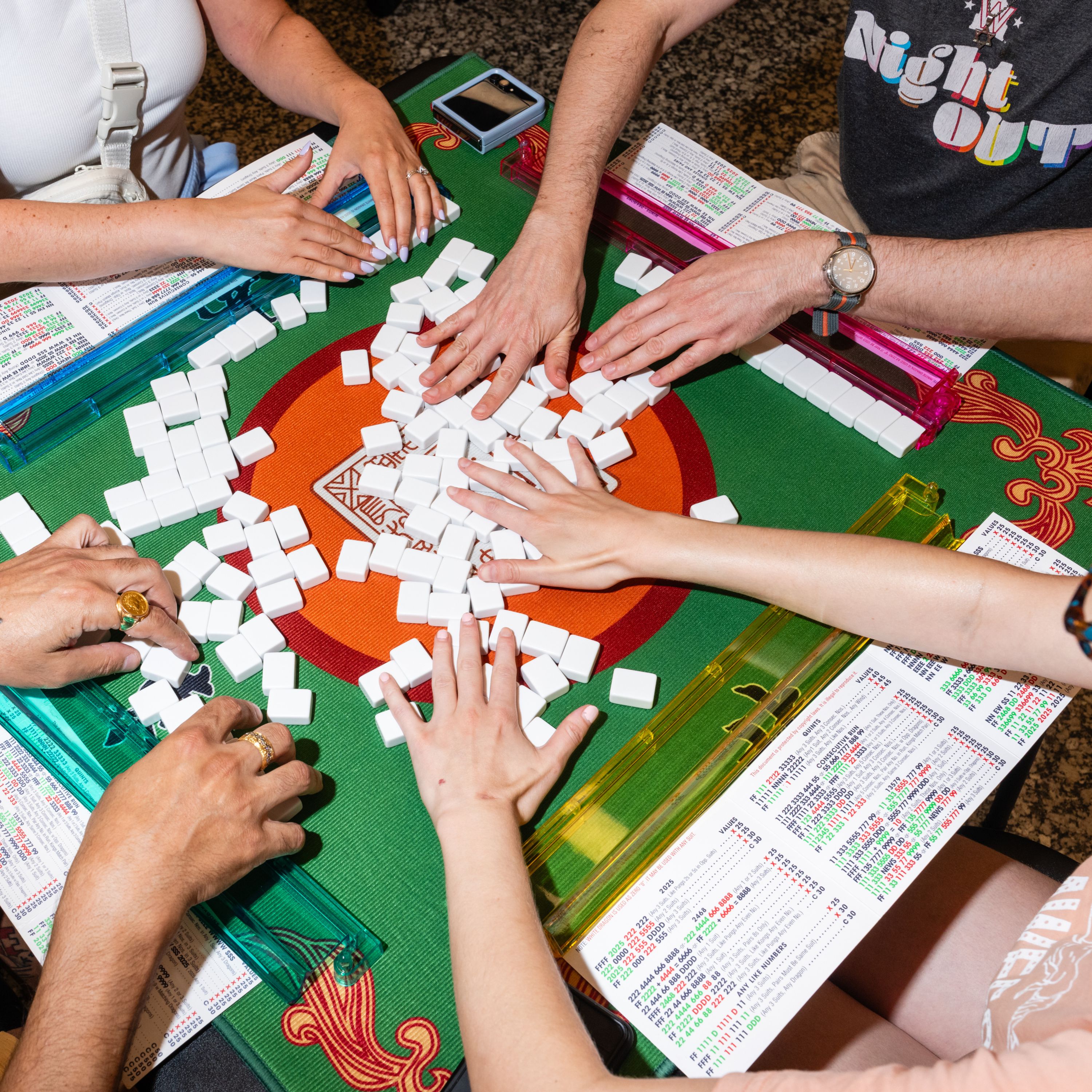
All Of It with Alison Stewart
Everywhere, All At Once: Why New Players are Picking Up Mah-Jongg
00:15:36
Loading summary
Transcript36 lines
- [00:00]
WNYC Studios Announcer
WNYC Studios is supported by Progressive Insurance. Did you ever think about switching insurance companies to see if you could save some cash? Progressive makes it easy to see if you could save when you bundle your home and auto policies. Try it@progressive.com Progressive Casualty Insurance Company and affiliates. Potential savings will vary. Not available in all states. All of it is supported by Memorial Sloan Kettering Cancer center in a small, groundbreaking clinical trial where 100% of participants with a specific type of rectal cancer saw their tumors disappear using immunotherapy alone. Researchers at MSK are now studying this approach in cancers of the stomach, liver and more, and a majority of tumors are disappearing. For MSK Giving day, all gifts will be tripled. Learn more@msk.org all of it.
- [00:57]
Alison Stewart
This is all of it on wnyc. I'm Alison Stewark. The clicks and clacks of tiles being shuffled and stacked in neat rows are filling living rooms and cafes across the country, usually accompanied by drinks, conversation and intense concentration. It's not a new pastime by any stretch, but more and more new players are picking up a game and getting lost in the tiles. Of course, we're talking about mahjong, specifically the American version of the game, which has seen an incredible resurgence among American women. Mahjong clubs, tournaments and brands have cropped up across the country to meet the new demand. This isn't the first time Mah Jong has come into fashion in America. After originating in China in the mid to late 1800s, it first became popular in the US in 1920s and then again in the late 30s when the official American version of Mahjong became Mahjong became standardized. People are drawn to mahjong for a fun, screen free way to slow down, relax and connect with friends and families. But some are raising concerns over the Americanization and commercialization of the game. Joining us to discuss mahjong's recent surge in popularity and her own experience is Atlantic staff writer Ashley Parker. Her article is titled My Descent into Mahjong. Ashley, welcome.
- [02:11]
Ashley Parker
Thanks for having me.
- [02:13]
Alison Stewart
Hey listeners, we want to hear from you. Have you started playing mahjong recently? What kind do you play? Have you been playing for a while? How did you get into the game? Our Phone lines are open. 2124-339692-21243. WNYC I want to start with an obvious question. 4 what does mahjong mean?
- [02:32]
Ashley Parker
Oh, the actual word? Yeah, that's a good question, and I'm embarrassed to say I don't know the answer to it.
- [02:40]
Alison Stewart
Well I knew the answer. It's sparrow little bird. It's very cute. You said in the, in your piece. I have played American mahjong, Chinese classical mahjong, and various online versions. They're all different. We should say which version are you talking about in the article?
- [02:56]
Ashley Parker
So I actually talk about both the Chinese version and the American version. I kind of get into the backstory of both because they're related. And one American is born out of Chinese and sort of Asian variations of mahjong. But in terms of my personal journey, I mainly stick to American Mahjong.
- [03:18]
Alison Stewart
What's the difference between American and Chinese mahjong?
- [03:22]
Ashley Parker
There's a number of differences. So China, and let's just for shorthand, I'm saying Chinese mahjong. But this sort of means all the different Asian variations. But Chinese mahjong more closely resembles a game like gin rummy. You're trying to get runs and sets and patterns, but there's an unlimited number of ways you can do that. And the real skill, which I as a novice did not really get to this phase in Chinese Mahjong lies in the scoring, right? Like you could have one hand, but you decide to try to aim for a different, more high scoring hand or block someone else. And that is sort of Chinese Mahjong and American Mahjong. You use the same set of tiles and you're, you know, the same suits and you're still trying to get runs and sets and the like, but American Mahjong uses a joker joker tile, which is what you imagine it to be, American Mahjong. Also, there is a card that you have to buy from the National Mahjong League. And this card contains a set number of hands. And so you can only make one of these, you know, several dozen hands on this card. And the card changes every year. So just once you've gotten used to a certain set and a certain strategy, it changes up on you. And I should note, you have to buy a new card. And then the final thing is American Mahjong. A lot of the strategy rests in something that occurs before tech technical gameplay begins, called the Charleston, which is named after the, you know, the 1920s dance where you have players who are exchanging tiles, passing tiles to the left, to the right, across. And you're trying to do that to set yourself up for the best hand, but for more skilled players, again, I am not at this level yet. You can sort of see what other people are hoarding, what's getting past, and that can help inform the hands you try to make or the hands you try to block your opponents from making.
- [05:19]
Interviewer/Host
That sounds really complicated for someone who's never played mahjong before. How did you do your first time out?
- [05:25]
Ashley Parker
I mean, I will say it was so daunting. I had a good friend come over. My mom had just had surgery, so my sister and I were over at our childhood home and a childhood friend came over who had gotten really into it and was like, I'll teach you. And it was daunting. And I was not immediately sold. I was intrigued, but it was hard. I think in my piece, I kind of liken it to my experience decades ago in B.C. calculus, right, where I could tell my brain was fully engaged and I was thinking and concentrating so hard. But like, the answer was still elusive. But I had the feeling that I, if I could just crack this barrier to entry, which like many things just comes with practice and repetition, I could sort of, I, I could crack the code and then it would become really fun. And that's what came me got me coming back for a second attempt.
- [06:15]
Interviewer/Host
Initially, it was played by men as a gambling game. And older Chinese Americans play it. They taught their children, those who choose to listen. Some older Jewish folks decided to play. But in your article you discuss mostly young and middle aged women, especially mothers, getting into this game. Why do you think this demographic is particularly drawn to the game?
- [06:36]
Ashley Parker
Yes. So the American resurgence is, you know, what I, what I sort of call in my piece and just in shorthand, either the lily Pulitzerization of mahjong or frankly, bougie white women mahjong. And what happened, what happened was, and a lot of these mahjong companies have sprung up in Texas, in Dallas in particular. And what they did was they made beautiful sets and beautiful mats and beautiful tiles. And they're expensive, right? Like most Chinese Americans who are playing have a much more affordable set that is much more utilitarian. But these sets became, as I started to experience it in my social media feeds, it became about hostessing, right? So a lot of people, you only need one cheap set to play. But a lot of this set we're talking about now of this resurgence, they have not just one fairly expensive set, but three or four different expensive sets of tiles and mats. Because it's not just about the game. It's about, say for Galentine's day, right, having a pink mat that you match with the beautiful pink tiles and you maybe serve rose. And so it really emerged in what I think of as the SEC belt of aspirational hostessing, sort of like a book club but without the pressure of having to have read a book and then discuss it. And I think that's part of the appeal among this resurgence. And you see it all over social media, and it becomes more than just a game. It becomes so social. I remember I started getting served ads on Instagram about, you know, come to this cozy mahjong retreat in the snowy winter in this little Wisconsin inn. And so there is a monetization aspect of it, but. But it can be a nice sense of. Of community, especially for people who. Who like to host.
- [08:33]
Interviewer/Host
As you were talking about it, the words cultural appropriation came wandering into my brain.
- [08:39]
Ashley Parker
Fair. Yeah.
- [08:40]
Interviewer/Host
How do you think the American version of the game can coexist with traditional versions of the game?
- [08:46]
Ashley Parker
I mean, the games, again, they sort of have the same root, but as I noted, they're very different. And I talked to a handful of Asian Americans who. Who have written about mahjong, who. Who have played mahjong, who host mahjong nights. And it really depends who you talk to. I think the place where the cultural appropriation has become the most problematic is a. If I was coming to you today, frankly, a bougie white woman of a certain age, which is middle age, and saying, I just discovered the greatest game. I didn't just discover it. This is a game that goes back to the river valley around Shanghai in the mid to 1800s. So first is just an acknowledgement of where this game came from. And the version that American women are playing now is already a version that was somewhat appropriated by Jewish women in the 1930s when they took the original game. So first, I think there needs to. For it to coexist, there needs to be an understanding of what you are doing and what came before it. And then where companies have gotten into trouble is, you know, there's three main suits in mahjong. Bams, cracks, and I'm now blanking on the third. Oh, and dots. Bams, cracks and dots. And some of these versions. So bamboo, for instance, is short for bamboo. Bam is short for bamboo. And on the tiles, the traditional tiles, they look like bamboo stalks. And you will see some of these versions where the bams have nothing to do with bamboo. Right. They're not. They're not green at all. Instead of bamboo, it's a New England version. And you have lobster claws or lacrosse sticks. And there was a sense that for it not to be appropriation, that anyone who is familiar with the original traditional tiles should be able to sit down with any set and play. And if you can't do that it has become so far appropriated, that it has, frankly become almost a different game.
- [10:54]
Interviewer/Host
I'm speaking with Atlantic staff writer Ashley Parker about her recent article, my Descent Into Mahjong. And it's about why the game has become so popular today.
- [11:05]
Alison Stewart
What happens to a person who sits down to play mahjong to get into it?
- [11:08]
Interviewer/Host
And let's say they're a competitive person.
- [11:11]
Alison Stewart
Is this the game for them?
- [11:14]
Ashley Parker
Yes, it can be. It's interesting. I was warned so much about, you know, people can be so competitive. And anecdotally, there are. There are certainly people. There's tournaments, right? I played in a tournament. There's people who play very competitively to the point where I, you know, I encountered people who said, I play in two games, right? I play in this more fun social game, and then I play in this very competitive game where everyone is there to win, the rules are followed to a T, and there's no small chat or polite chatter. But in my experience, I'm a competitive person, but I was not particularly competitive with mahjong because I'm such a novice. And again, what I personally experienced. And I played in a whole range of scenarios. I played at my local library. I played at a local coffee shop. I played with a group at our local Jewish community center. I played with friends. I played at a school fundraiser. I mean, I played all over the city. And every time I played, everyone was incredibly warm and welcoming, even the competitive people. And it felt to me if you sort of said hi because I was showing up alone, as many people will do, hi, I'm here to learn mahjong. And you were sort of genuinely curious and eager to learn. It could not have been more welcoming, which is a long answer to your question, but I think it is good for competitive and novices alike.
- [12:36]
Interviewer/Host
Let's talk to Fiona in Queens.
- [12:38]
Alison Stewart
Hey, Fiona, thanks for taking the time to call.
- [12:40]
Fiona (Caller)
All of it.
- [12:40]
Alison Stewart
You're on the air.
- [12:42]
Fiona (Caller)
Hi. Of course. So I am part of a mahjong club, and we meet roughly once every month, month and a half, I would say. And it's the same set of people, so it's a really great way to see the same faces over and over again and sharpen your skills at the game. When I first started, I had no idea what was happening, and I did not win for quite a while. But it was really fun to learn, and I really love it, and I really look forward to doing it every month.
- [13:14]
Interviewer/Host
Do you play Chinese or you play the American version?
- [13:17]
Fiona (Caller)
Chinese. Chinese Mahjong.
- [13:19]
Interviewer/Host
That's pretty amazing. Thanks for calling in. So someone wants to start. Ashley, how do you start? What do you think?
- [13:27]
Ashley Parker
I think the best way is. It's not for me, at least it's not something where you could sort of read the instructions on a box and figure it out yourself. So, you know, there's places now where you can take lessons. And I did take a few lessons, and those were helpful. Sometimes you can find a group of friends and pay for lessons. And oftentimes also there's groups like again, at your local library or local community center who offer lessons for free. Or they, you know, half the tables are devoted to lessons and half the tables are devoted to gameplay. So I would start with a lesson or at least a very experienced friend who is willing to be patient and teach you.
- [14:08]
Interviewer/Host
You also mentioned in your piece for the Atlantic that mahjong requires you to really slow down and to be present at the table. What makes mahjong work so well as a way to connect with the people sitting close to you?
- [14:23]
Ashley Parker
Oh, it's fantastic. I mean, I think of it as being in a state of flow, and it's a couple things for me, at least. It's the tiles again, as I mentioned, they're beautiful and they're very. They're very tactile, right? So it's sort of a physical, tangible thing. It's also, you know, it's. It's not impossible to learn, but there is this bit of a barrier to entry where you really do need to be focused. So I think of it as like doing a crossword or doing a puzzle. It engages you in that way, especially when you're just starting out, so you're really not checking your phone. Or at least I wasn't, because I couldn't. Right? I just had to be focused on what my hand was, who was discarding what. And my friend who taught me the first time, she said, because my mom, my sister and I, we all basically had our. Our hands on our heads just staring at our tiles. And my friend says, look, at some point, I promise you, you're going to be able to chat, right? Like, this will be a little more fun. You can make small talk. And one of the people I talked to is this Taiwanese American, Tim Ma. He's a chef and he own Chinese restaurant in D.C. that has a mahjong parlor and that offers lessons and also has free gameplay nights. And he was saying to me, this is just to say there's all different ways to play. But he was saying, it's so funny. I look at these white suburban moms coming in, and they just stare at their tiles, right? And they're totally focused, and they're in the state of flow. And he's like, look, my friends and I, you know, after our shift is over, we plonk down a bottle of bourbon. You know, we smoke cigarettes, not that I'm endorsing either of those necessarily. And we chat all night long and only glance at our hands. So you can sort of engage with it however you choose to at whatever level you're at, but it's all consuming. There's strategy, and then there's this social element because it takes four to play.
- [16:14]
Interviewer/Host
You should read her piece, the Descent Into Mahjong. My Descent Into Mahjong. It was written by Atlantic staff writer Ashley Parker. Hey, Ashley, thank you so much for joining us.
- [16:23]
Ashley Parker
Yeah, thank you.
- [16:25]
Icebreaker's Gum Advertiser
Need a boost? Sometimes all it takes is tapping into your inner cool. Icebreaker's gum helps you unleash the confidence within. Each chew releases a rush of icy flavor powered by cooling flavor crystals, sending a wave of refreshment to reinvigorate all your senses. Icebreaker's convenient pack fits everywhere, from car cup holders to backpack pockets, so you can find your cool wherever you go. Grab Icebreaker's gum online or at a store near you.