Loading summary
Transcript68 lines
- [00:00]
A
All of it is supported by Progressive Insurance. Do you ever think about switching insurance companies to see if you could save some cash? Progressive makes it easy to see if you could save when you bundle your home and auto policies. Try it@progressive.com Progressive Casualty Insurance Company and affiliates. Potential savings will vary. Not available in all states. WNYC Studios is supported by Odoo. When you buy business software from lots of vendors, the costs add up and it gets complicated and confusing. Odoo solves this. It's a single company that sells a suite of enterprise apps that handles everything from accounting to inventory to sales. Odoo is all connected on a single platform in a simple and affordable way. You can save money without missing out on the features you need. Check out odoo@o d o o dot com. That's o d o o dot com.
- [00:58]
B
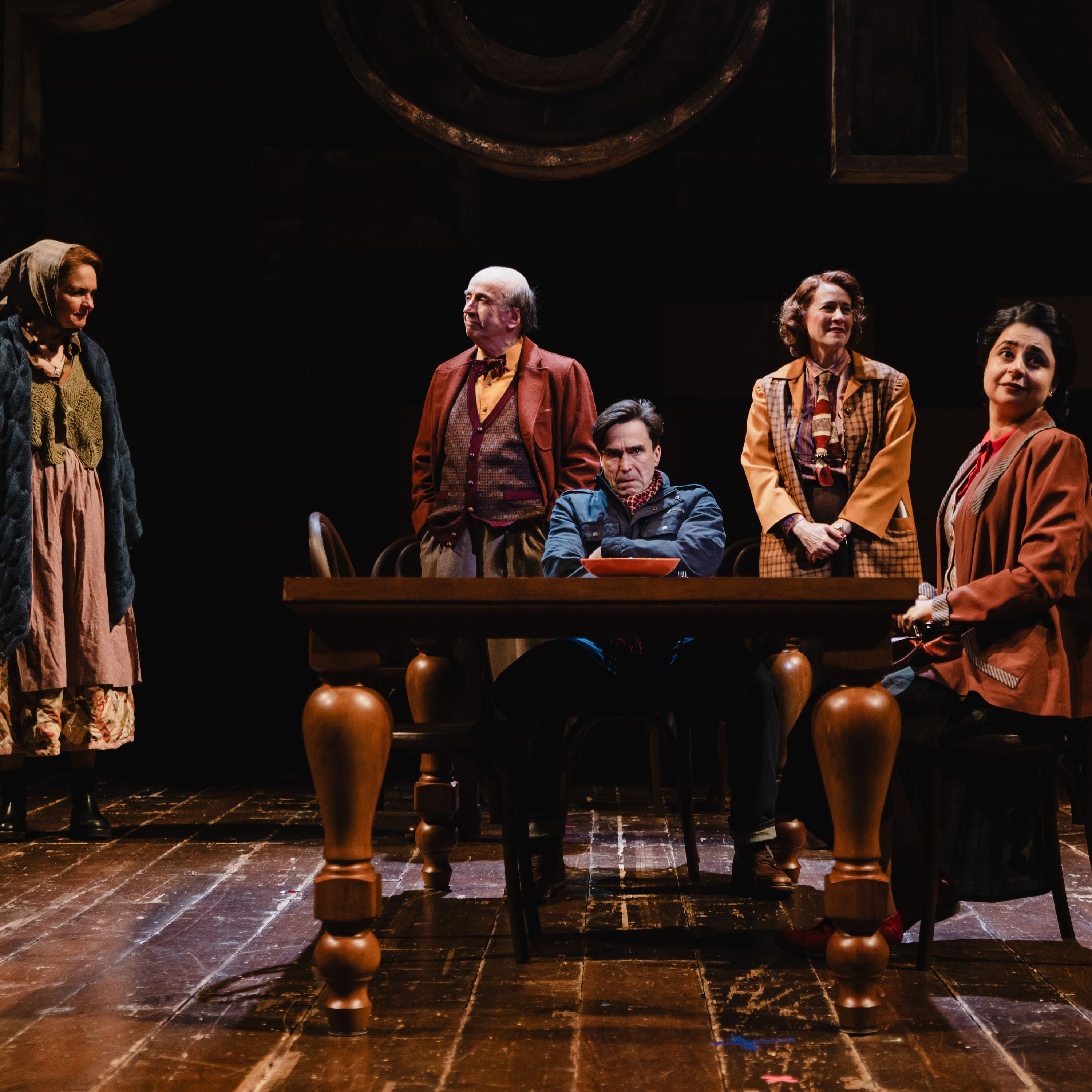
You're listening to all of it on wn. Hi, I'm Alison Stewart. Hey, A quick reminder. This Thursday we're hosting a special event with Broadway's Cats, the Jellicle Ball, right here in the green space at wnyc. It's the next installment of our Broadway on the Radio series and this event is shaping up to be a big one with a show that's up for nine Tony Awards. The co directors will be here, the choreographers, of course. We'll have live performances and Andre de Shields will be here as well. That's cats. This Thursday, May 21st at noon. There are a few tickets left. Go wnyc.orgcats to get yours now. And let's get on with this hour. Think about the last thing you left unfinished. Was it a puzzle? A piece of knitting? What if the last thing you left unfinished was a play? That's what happened to Thornton Wilder. It's what he left behind. He was the only person to win a Pulitzer for drama and fiction. And Wilder had been a work in progress called the Emporium. It was supposed to head to Broadway in the 50s, but it didn't. Fast forward to a modern day theater person who'd found 300 pages of Thornton Wilder's papers devoted to the Emporium. Kirk Lynn thought, what if I can bring this to life? Now playing at the Classic Stage Company is Thornton Wilder's the Emporium, completed by Kirk Lynn on the program. It describes the play as, quote, a young man journeys through the cities and beyond. He encounters a world of wonder, meaning and the elusive truths of of life itself. That man's name is John. He's played by Joe Tapper. And we're Both in the studio. Then they're both in the studio with me, Joe and Kirk. Welcome to all of it.
- [02:37]
C
Hi. Thanks for having us.
- [02:38]
B
Kirk, what was your first Thornton Wilder experience? What was it?
- [02:42]
C
The one I remember most is I saw Our Town at the Barrow Street Theater in New York City in 2008. And I was blown away. And at that point, I decided I was just gonna read all of Thornton Wilder, study everything, all the plays, all the novels. And that really led.
- [02:58]
B
This.
- [02:59]
C
Started this journey that led to the finding these pages in the Beinecke Library.
- [03:03]
B
What was your first Thornton Wilder experience?
- [03:05]
D
I think my first Thornton Wilder. So I'm from. I'm from a small town about 45, 50 minutes north of Chicago, which sounds way more glamorous than it is. Like, we had soybean farms. So as a young person, I didn't grow up in a theater. Theater family at all. So I was craving anything I could see. And I think on PBS or abc, I saw. I think maybe the Spalding Gray, Our Town that was recorded. And I'd never seen anything that was like a stage, a filmed stage that wasn't a musical. So it was so interesting. And then they were scraping plates that weren't there, but you could hear it and that. So that was my first experience in Gurney, Illinois.
- [03:53]
B
All right, so. So you go to look at his papers at Yale. What were you looking for?
- [03:59]
C
I knew. So the last. You know, I read all of his novels, all of his plays, and the last book I had to read was his journals, which I sort of grudgingly read. I was like, well, I guess if I'm gonna read it all, I'll read all of it. And in his journals, there are two scenes of this lost play. But then he also talks about in journal entries, reading it with friends working on it. And so I was like. I was looking specifically for the Emporium. I was like, if he read it with friends, there's a draft of it somewhere. And so I went to the library really specifically for, like, what. What shape is this draft in? What's available? And I keep describing it to friends as a Antiques Roadshow moment where it feels like I was just. You know, when you find a constitution on the back of an old painting. I was in this staid and quiet library, and I wanted to grab somebody by the lapels and be like, there's a lost Thornton Wilder play there. Suddenly I was, oh, my God. I had 360 handwritten pages. They were nine discrete scenes. I was like, there's a play here. It was amazing.
- [04:57]
B
And we see that in your play. Yeah. Joe, how would you describe this play when compared to his other works that most of us know? Our Town. Sure. Or the skin of Our Teeth.
- [05:07]
D
Well, first, I just want to express a lot of gratitude to be here again. It's wonderful to see you.
- [05:11]
B
Nice to see you as well.
- [05:12]
D
So when I think about this play, I think. So I think when I think of Our town, I think, like, perhaps, you know, reductive messages. The idea that, you know, the lesson of our town is, you know, we have everything that we need every day in our. In our everyday lives, we have it. And that's beautiful. And then I have been, you know, as. I've been thinking about the Emporium, and he was writing it as he was, you know, growing and aging. And the Emporium might be, maybe the message is, if it's true that we have everything that we need every day in our everyday lives, then the Emporium asks the question that, why doesn't it feel like it's enough? Why are we still striving for something that we can't quite reach or quite grasp? You know, it never lets us go. And that's what I think about when I think about the Emporium and how grateful I am to get to do this with all these wonderful people.
- [06:13]
B
When you found the play, what kind of shape was it in?
- [06:18]
C
What a great question. I mean, it was. I mean, there are scenes that work from beginning to end, and then there are single lines on a page with nothing else there. So it was sort of all over the place. It was a great grab bag, if. If seeing Our Town and thinking, oh, I want to read everything by Thornton Wilder, in part to study him. In some ways. I was given my greatest wish to, like, get to work with Thornton Wilder that I had. I could see under the hood into the engine of how he's working, what he's working with. And by reading the pages along with his own journal, I could think about. He could literally tell me what he's struggling with, what he can't solve, what he's trying to achieve. And his ambition was incredibly wild with the things he wanted for this play.
- [07:05]
B
That was interesting because when my next question was like, could you see where he got stuck?
- [07:09]
C
Yes. There's a few things that he was actively sort of puzzling. I mean, one thing he got stuck with, I think we solved in some ways and in other ways didn't solve. One of his dreams was to make a play that's a perfect circ. So that it ends where it begins. And you could start any night on, you know, one night, start at scene three and work your way back around through scene two. And the next night, start at scene seven and work your way back around through scene six. And so our play makes a perfect circle in some ways, but we don't start at random scenes on random nights, thankfully. Thankfully.
- [07:38]
B
That's interesting, because when you do start the play, and this is a question for you, Joe, you kind of tell the audience how it came about.
- [07:44]
D
Yeah.
- [07:44]
B
So when you come on the stage, are you Joe or are you John?
- [07:48]
D
I think I'm not John. I'm not sure if I'm Joe, but I'm not John until, until just a little bit later. I, I, that's something that I really enjoy that it's like I, I, I am this, this stage manager of sorts. And then, and then the play begins, and it's, it's a lot of fun. Yeah.
- [08:08]
B
We're talking about Thornton Wilder's the Emporium. It's playing now at the Classic Stage company on East 13th street until June 7th. My guest is Kirk Lynn, who completed the play, and Joe Tapper, who plays John, a man trying to figure out his place in the world. Joe, how did you first hear about stage?
- [08:25]
D
Well, I saw, I saw that it, I saw the announcement that Classic Stage was going to do it in their season. I was like, oh, wow, that seems really interesting. And, and then I, the audition came about, and I, and I read it, and I was like, oh, goodness, wow. I was, like, shaking, you know, because it was so intriguing. And then, you know, then it ended up being me that I got to do it, which I was, have so much gratitude for. And I was, I was like, how am, you know, how am I gonna figure this out? And I'm, you know, and I'm gonna figure it out. And I mean, and that may not be for several decades from now. Maybe someday I'll wake up and go, oh, that's what it was. But, but, but I was, I'm determined to try to work at it every day. This, this play is, you know, it's like, every day it's like, oh, goodness. Oh, that's that moment. It's so interesting, you know, it's so interesting. And to get to work with Rob and Kirk and the whole cast has just been pure joy.
- [09:24]
B
Kirk, were you ever intimidated by the work?
- [09:27]
C
Oh, lordy, yes. I feel like I'm still intimidated. I try not to think about it too much when I think about the audacity of touching Thornton Wilder's work, I hope, you know, on the best days. I think I'm just trying to bring honor to somebody that I really admire. And I'm definitely trying to study as a student of theater. And then every once in a while it hits me. Just the stupid audacity of it to even touch it.
- [09:52]
B
Well, it's interesting. Like I said this, not Joe or John. A person comes out and explains what's going to happen to the audience. Why did you want to do that? And what have you noticed about the audience? The way they react?
- [10:06]
C
I think. I mean, my sense is that the story of finding the Emporium has become a part of the play in a certain way. To sort of explain why we are getting a new Thornton Wilder play, the last new Thornton Wilder play now in 2026. And we were also just talking. We were still figuring stuff out in the Green. One of the things I think Thornton Wilder's playing with in this play is especially his appreciation and joy at having an audience. There's a lot of back and forth between the stage and what's happening in the play and using the audience to help the play move forward. And so by setting a sort of preface at the front, it also sort of primes the audience for the direct address, the way they'll be talked to. It warms them up gently for a strange show.
- [10:54]
B
How do people react to. Because it's not like, hey, join us on stage interaction, but it's like, be a background sheep, pretend you're a sheep and ba for five minutes. Or you have to hiss at a person who's just drinking tonic water one too many times. How has the audience been reacting to you?
- [11:12]
D
It is so amazing. I have so many people come up to me afterwards and they say, you know, I normally am so timid with audience participation, but for some reason it's. I'm so. I'm so eager to like jump in, full body jump in to what's being asked. It's so exciting and I love it. It's a blessing when they. When they start talking back to me at the front. I just. I couldn't love it more. It's a gift.
- [11:41]
B
Well, it's interesting because that's a thrush stage. It's a three sided stage. What makes this play work in that kind of space?
- [11:50]
C
I mean, because I think Thornton Wilder wants to show his appreciation for the audience, like having them all around. In the original pages of Thorn Wilder's, he casts the audience in every single scene. He says, if we're in the orphanage, the audience, the people gathered, are orphans. If we're in a department store, the people gathered are customers. And so being in a Thrust really puts the. You know, it's the definition of the word thrust. It moves the audience into the. It moves the theater into the audience, and so they're fully in the scene.
- [12:18]
B
What do you like about working in Thrust?
- [12:20]
D
The intimacy. I love it. You know, I've gotten to do it a few times. I love that. It's that. It's. That it's so dimensional, you know, like, it's behind me, it's in front of me, it's over my shoulder. It's every. You know, and there's no hiding, which I love. I love it.
- [12:38]
C
I'd love to jump into and say that when I first saw that our town, it was in a thrust. And there was a woman across from me. So the audience can also watch each other. And when I saw that art town, there was a woman across from me who was crying. And every time she would start crying, I would start crying. And we found each other at the first intermission. And she said to me, she was like, you need to get it together, because when you cry, I cry. And I was like, no, you're starting it. And so you also get that. That the audience can see other people being playful and join in. They can see other people taking pleasure. So the audience not only watches the play, but watches themselves.
- [13:07]
B
We're talking about Thornton Wilder's the Emporium. It's playing at Classic Stage Company on East 13th until June 7th. My guest is Kirk Lynn, who completed the play, and Joe Tapper, who plays John, a man trying to figure out his place in the world. John really wants at the Emporium.
- [13:22]
D
He does.
- [13:23]
B
Why does he want to work at the Emporium?
- [13:26]
D
He's drawn to it. He's got a history with it. It's. It's inside him. You know, that's part of his divine spark. You know, we all have it, you know, for whatever it is. And his is that he's got to go to this place called the Emporium. You know, he's an orphan. He's donated. And. But. But as he's growing up, it's. I have to make my place, and that's going to the Emporium. But how do I get in? And that is the question. I have two little ones at home, and I think about them so much. It's like, how is their life? How are they going to do it? You know? And how will I help and will they even want my help? You know, so this is that divine spark, watching them figure out what they want, what they're born with. So interesting. So exciting.
- [14:11]
B
I was also interested, Kirk, and I don't know if this is my interpretation of it, but it seemed like the colors blue and green play wildly in the play. Like the Emporium is all blue. And then Jonas takes a job at Craigie's and has to go dressed in green. And I'm curious about the blue and the green colors.
- [14:31]
C
I think it was our director, Rob Melrose, a wonderful director, who unlocked it for me. He suggested that maybe the blue is the sky and that the green is the earth, and that Craigie's is more grounded in certain ways and that the importance of the. As more of a dream space or your longing, and that that's what the colors might symbolize.
- [14:52]
D
Yeah, that's something I really love about the play is I don't think it necessarily, like says Craigie's is a bad thing either. You know, it's because it's not. You know, it's just like I said, people are drawn to things the way they're drawn to it, you know, And I think I love that about the play. Something that I. The play lives in ambiguity, which I really love. We figure it out together in every Night it's something different. That's what I love.
- [15:21]
B
Well, it's sort of interesting. I'm not going to give too much away. But there's a point when the audience kind of determines how the play will go. And they get to vote during the intermission.
- [15:29]
C
Yeah.
- [15:31]
B
What has the audience been telling you?
- [15:34]
C
The audience is eager to see. I mean, the thing I'll tell you is that Thornton Wilder himself came up with the idea that after intermission there could be a prologue. And he put it in all of his outlines for how the play would go, but he never actually wrote the prologue. And so the audience gets to choose whether they want to hear Just Work that's roughly adapted from Thort and Wilder, or if they want to hear our version of the prologue. And the audience is very eager to hear the prologue.
- [16:01]
B
Yeah, I think it was 42 to 8.
- [16:05]
C
I think there's one actor in particular that puts her thumb on the scale with a lot of enthusiasm for the prologue as we offer the choice. But, yeah, I'll just say if they don't choose the prologue, the first line after the vote is revealed is that they are remarkably bold. Yes, I think it's a bold audience who says, I'll Go forward without knowing what might be in that prologue.
- [16:26]
B
Do you have a preference or does that change day to day?
- [16:29]
D
Me? Yeah, it has changed. I thought before we got. Before we started working with an audience, I wanted. I was a non prologue person. I didn't want them to know. I didn't want to know either. But now that we've been working with an audience, it is such a joy for me to hear that scene every night. The audience's response to me being involved is so exciting. I mean, it lifts me out of. I start the second act. I'm not, you know, I started and I'm sitting backstage and by the end, every single night, I'm on my feet and just so excited to hear them, hear all the. The actors in the audience together. Just kind of enjoying that moment. It's so fun. So now I'm pro prologue.
- [17:13]
B
Pro pro. It's interesting because Thornton Wilder, you think about what he was writing at the time. It was. It was wild when you think about it. The mixing of surreal with the real, the fantastical. What was interesting to you about the way he mixed so many different kinds of writing?
- [17:31]
C
Oh, I think. I mean, I started wanting to study him because I felt like, oh, he's ahead of his time in the 20s. I don't know that the theater still caught up to him. He really understands what it is about theater that makes it so magical, that when it works, it's better than any film. It's better than any novel. There's something about being live together and having an aha moment. And then you get to retell people later, like, oh, this happened and then this. And so, as Joe pointed out, like, there might be plates that aren't really there. He understands the imagination and that the audience brings the rest of the play. I mean, I think that happens in every play and every musical, that the audience really brings the full event. But he really leaned into that and had a really muscular take on what can I leave to their imagination?
- [18:16]
B
What's challenging for you about handling that kind of a script?
- [18:22]
D
I always joke that it's my curse as an actor that I'm always like, speaking. You know, I've gotten the opportunity, but I'm always speaking directly to the audience and how like, surprising and unnerving that can be on an everyday basis. But I actually quite love it. It's so fun to look out and see people. You know, you see younger people in the audience who are so excited at experimental the writing is. And they're so lean forward and then you see longer Term theater goers who are, you know, we're talking about Our Town and Skin of Our Teeth and hello, Dolly and Matchmaker. And it's almost like I can see in their eyes when they saw it originally, you know, maybe a couple decades ago and, and kind of getting in a time machine and be like, oh, yeah. And then they get this new piece. They all, everyone gets this new piece. And it's so exciting. So. But yeah, it's, it's great text and it's every day, it's like today I was thinking there's a line that says it makes sense, that it wouldn't make any sense. And it's like this guy, he put that in there. It makes sense. It's like, oh, yeah, just let go. That's it.
- [19:33]
C
I think one of the things Wilder does is that he doesn't just make experimental theater or make well made plays, but he can do both at the exact same time that he's playing in these really fun theatrical inventions. And he wants to tell a good story about love, about heartache, and he does both at the exact same moment.
- [19:49]
D
A great gift of getting to do this play is I revisited Skin of Our Teeth and Our Town and Matchmaker. And I was squeaping, reading these plays and like in Our Town, I forgot that at the wedding scene that Emily looks at her father and she says, look at, look at George over there. I hate him. Incredible. Like, I was so surprised that that happened. Happened. Like she, she doesn't say that. Isn't it, Aren't we, aren't we uniform to believing that it's going to be all sweet and loving and, oh, this is the best time of my life. But look at George. I hate it.
- [20:28]
B
The name of the play is Thornton Wilder's the Emporium. It's playing at Classic Stage Company on East 13th until June 7th. My guests have been Kirk Lynn and Joe Taffer. Thank you so much for coming to the studio.
- [20:39]
C
Oh, thanks for having us.
- [20:40]
D
Thank you so much.
- [20:42]
C
You ever wonder how far an EV can take you on one charge? Well, most people drive about 40 miles a day, which means you can do all daily stuff no problem. Go to work, grab the kids at school, get the groceries and still have enough charge to visit your in laws in the next county. But they don't need to know that. And the best part, you won't have to buy gas at all. The way forward is electric. Explore EVs that fit your life at electricforall.org.
- [21:14]
D
And Doug, there's nowhere I wouldn't go to help someone customize and save on car insurance with Liberty Mutual. Even if it means sitting front row at a comedy show.
- [21:23]
B
Hey, everyone. Check out this guy and his bird. What is this, your first date?
- [21:27]
D
Oh, no.
- [21:28]
C
We help people customize and save on car insurance with Liberty Mutual together.
- [21:31]
D
We're married. Me to a human, him to a bird. Yeah, the bird looks out of your league.
- [21:35]
C
Anyways, get a'@libertymutual.com com or with your local agent.
- [21:39]
B
Liberty. Liberty. Liberty. Liberty.