Loading summary
Transcript56 lines
- [00:00]
A
All of it is supported by Progressive Insurance. Do you ever find yourself playing the budgeting game? Well, with the Name youe Price Tool from Progressive, you can find options that fit your budget and potentially lower your bills. Try it@progressive.com progressive casualty insurance company and affiliates price and coverage match limited by state law. Not available in all states.
- [00:30]
B
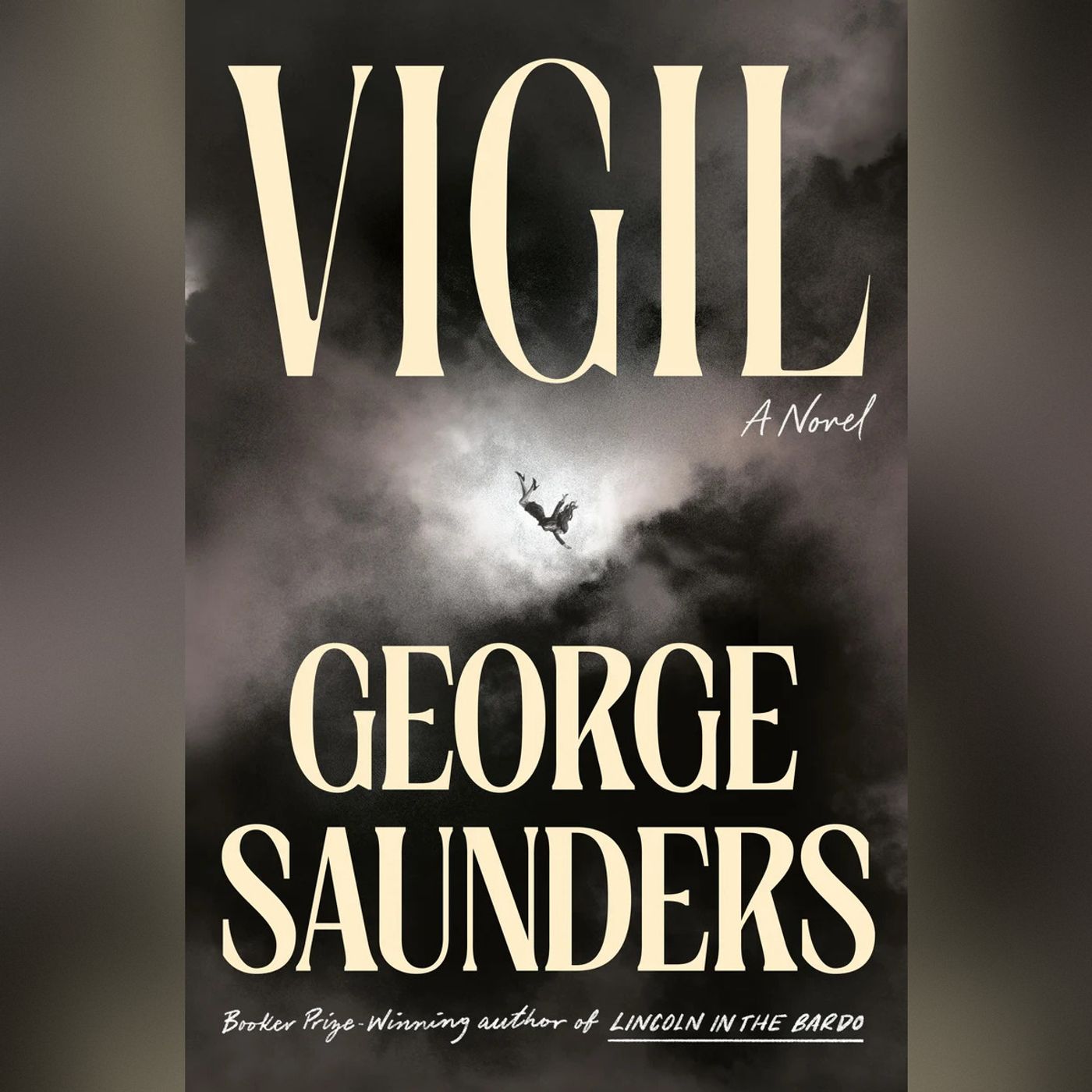
You're listening to all of it on wnyc. I'm Alison Stewart. The latest novel from Booker Prize winning author George Saunders is about a man who has spent his life doing very bad things. But the central question isn't how can you live with yourself? It's how can you die with yourself? You see, that's because oil tycoon KJ Boone is on his deathbed. Throughout his life, he has dedicated himself to lying to the public about the dangers of climate change. Now dying of cancer, Boone is stuck in the space between life and death. And spirits have gathered at his bedside to demand that he repent. All except one. The ghost of a woman named Jill Dahl Blaine. Jill's job is to come down from the beyond to help comfort the dying as they pass on. At first she thinks this job will be like any other. But soon she learns that KJ Boone has a lot to reckon with in his final hours. The novel is titled Vigil. It's the first novel from George Saunders since his acclaimed book Lincoln and the Bardo. It was published yesterday. Kirkus Review says Saunders has crafted a novel that feels deeply resonant, especially in these fractious times. And I'm joined in student now by George Saunders. It is nice to speak with you in person.
- [01:45]
C
It's so nice to speak with you in person too.
- [01:47]
B
You said you told the New York Times that when you were writing a book, this wasn't what was supposed to happen. The book that you wrote, what was your original plan?
- [01:58]
C
Well, the original plan was, I knew it was like basically a stinker dies. That was the idea. And I thought that this woman would be really good at her job and she would be comforting him in some way and he'd either take the bait or he wouldn't. And then once I got into it, she turned out to be so complicated and kind of, I think of her as someone who has the right idea but isn't that good at executing it. So then suddenly the book started being about this whole question of if you were going to comfort somebody who was pretty bad, how would you go about it? And that's something I'm not really, you know, I don't really know the answer to. So that makes for a fun writing session.
- [02:36]
B
As a writer, do your characters come first or does the story come first or does it just all happen at the same time?
- [02:43]
C
It's mostly like in this case, just this really bare outline. Stinker dies.
- [02:48]
B
Stinker dies.
- [02:48]
C
Stinker dies.
- [02:49]
B
That's what it says on the post.
- [02:50]
C
That could be the title. But then for me it's about language. So in this case, I knew I was gonna have to do the voice of the oil guy and the voice of the woman. And if that doesn't happen, nothing happens. And even all the ideas that I might have about the story get put on hold until they start talking to me. And I grew up in Chicago and we did voices all the time to amuse ourselves. So that's the first order of business, is find a voice that's kind of full of fun and then just start doing that and then the story comes out of that, basically.
- [03:21]
B
And so Jill Dahl Blaine, her voice comes from where?
- [03:25]
C
Well, this is originally. She was two different characters in an early draft. So there was two ghosts and one was this kind of haughty 19th century high diction guy like in Lincoln and the Bardo. And the other was kind of like I imagined her as sort of a woman from my neighborhood in Chicago in 1976. Just kind of a plain speaking sweetheart really. And so those two ghosts were in the book for a while and it, it just didn't seem like they were both needed. It seemed a little slow. So I just melded them together. So her voice is kind of a two parter. One is she's very articulate and high minded. And then every so often she slips down into this more kind of raucous person. So then, you know, in a certain way I had that voice. I'm like, why is she talking in two different modes? That becomes the story of the book. Why is this one person presenting in those two different ways?
- [04:15]
B
And how did you cope with the name K.J. boone?
- [04:17]
C
I don't know. I just kind of, I mean, maybe partly Boone Pickens. And it just. I knew a lot of oil guys and they never had. They were never like Tom Smith. They always had these kind of dramatic, weird names.
- [04:29]
B
Though, in your last novel, Lincoln on the Bardo, it also dealt with spirits, this sort of this in between life and death. What attracts you about that space?
- [04:40]
C
You know, I think you're always. I'm always looking for something to liven things up a little bit. So I'm a kind of not great guitar player, but I notice that when I play In D, things happen that are fun. In B flat, I can't do it. So with a dead person in a book or a ghost, I think that the temporal aspect gets interesting because suddenly you could have two young hipsters and somebody from 1460 shows up, you know, or you could have. Also spatially, you could have somebody from another continent come in. So I think it just broadens the rhetoric in a way that does for me what the most important thing is. It leads me to a zone where I'm not quite sure what I'm. And where it takes it from sort of being a smarty pants who knows what he wants to say to truly doing improv. And that improv is the place where I get the most energy going.
- [05:32]
B
I love that idea of people coming from different areas of different times and having to communicate with one another.
- [05:39]
C
Right. And it allows you to. I think it allows you to cut into the real deep question of the book. So. And you might not know what it is, but they do. Which is the strange thing in the book.
- [05:50]
B
Did you make rules or guides for yourself about how these people of our ilk, how they would behave as ghosts, as spirits?
- [06:00]
C
No, I try to not do any of that in advance because the theory is that this improv will tell me. And sometimes that's nice because you might have a moment where this rule of the world is working against this other one, and then your job is to go, oh, okay. It's a different world than I thought. It's more complicated. So this afterlife compared to the one in Lincoln and the Bardo, to me, a little scarier. It's a little. Maybe like the real world, a little less rules based than it used to be. And so there's a kind of. I picked up an element of chaos, the kind of chaos that one, you know, might feel after leaving this body. And in the Buddhist traditions, they say that when you die, all your life your mind has been like a horse on a tether. So it's wild, but it's contained. And some of these Buddhist texts say that when you die, that tether gets cut. So your mind is supersized and very powerful. But that means that your projections and your fears are also supersized. And I kind of felt that in this world.
- [06:58]
B
There was one detail I did notice is that you took care to describe what each ghost was wearing.
- [07:06]
C
I didn't notice that myself. I mean, you can look at me, you can see that I'm a fashion plate.
- [07:12]
B
But I thought it was interesting because it was very. It kind of gave Me a sense of who they were, but it was like ghosts wearing clothes. I don't know.
- [07:20]
C
Yeah, well, that also raised the question because in some ghostly worlds you would be dressed the way you were dressed when you died. But I think in this one, now that you mention it, thank you. They're kind of dressed in the way that's most emblematic of who they were maybe in their prime or something, or in their essence. Something like that. Thank you for that. That's interesting.
- [07:37]
B
My guest is Booker Prize winning author George Saunders. We're discussing his new novel, Vigil, which tells the story of an oil company man, a CEO, he's on his deathbed, and a ghost who comes to comfort and challenge. It is out now. Okay, so Jill is our spirit, our guide, our ghost she sent down to comfort the dying. Why does Jill do this, and is she particularly good at this job?
- [08:00]
C
She's not good at it, we find out. And I think she does it because her life ended young, traumatically, and for some reason in that moment, her instinct was to go directly towards the person responsible for her death. And she inhabits him, which means she becomes one with him. She can read his mind, she can partake in his qualia. And that has a profound effect on her, as I think it would on anybody. You know, if you could occupy someone else's mind even for a split second, it would have the effect of going, oh, I have a mind. You know, my mind is a bit of a trap. So for her, this has the effect of rendering her extremely. Maybe too merciful.
- [08:43]
B
Too merciful. Oh, interesting.
- [08:45]
C
So she has the feeling that having been inside that person, how could they have been anything else? In the womb, they didn't choose to be the person. So she. And I kind of. I sort of can believe that maybe not as much as she does. So her method of comfort then is to just come down and try to convey this kind of complicated philosophical idea to the person who's dying, which in this case doesn't really. It doesn't really work so well.
- [09:11]
B
Yeah, because K.J. boone, he's near death and he's still kind of a jerk.
- [09:16]
C
Yes. And I mean, for me, that was the other question. You know, there's this long tradition of deathbeds like the Scrooge and some Tolstoy, and the idea that someone could be transformed at the end is very nice and very comforting. But I think, like, well, as stubborn as people can be and as really like obnoxious in real life, is it possible that somebody could get to the end and Simply not repent. And I'm sure that's true, you know, so I. I went into it, most of the book, kind of open to either one. And just looking at him to say, you know, are you gonna. Are you gonna repent or not?
- [09:49]
B
Well, in a way, sometimes I think. Does he think he can escape this?
- [09:53]
C
He's pretty arrogant. I mean, he's never had much problem in his life. He's been so powerful, you know, and so can you escape death, dude?
- [10:00]
B
Do you really think that?
- [10:01]
C
Yeah, he kind of. He thinks he can maybe, you know, call somebody he knows, a guy, you know, something.
- [10:07]
B
We learn, though, that KJ comes from an impoverished background, and his career in oil was his way achieving the American dream. When you think about it, what power does the American dream and the pursuit of it, what power does it have on people?
- [10:22]
C
Oh, that's an amazing question. Yeah. I think for him and also, honestly, for many of us, I think you're in a culture that's intensely capitalistic and it puts a pressure on us. And I think, speaking for myself, I've always felt that if you drop below a certain line, it's going to really be costly and there might not be anybody coming for you. So I've known a lot of people in my life who, under that pressure, have just said, okay, it's never happening to me. I don't care what happens. And I think he's one of those. He got a little stung by some embarrassment when he was young at being not wealthy, stung by some parental harshness. And so his resolve was not, I'll find a community or I'll work against poverty, but I'm going to ironclad myself. And I think that's a kind of a familiar American error. And we're seeing it now in so many ways. If I just have power, enough power, then I don't have to engage with the realities of life. I can float above it, which is the greatest falsehood in the world, which we know, because Jesus was crucified. There's no power that can get out of this life unscathed. Accept the power of depending on other people and submitting yourself or kind of admitting your own weakness, then there might be a way out of it, but he doesn't have that power.
- [11:43]
B
You're going to read a little bit from the book, from us, set this up for us.
- [11:47]
C
Okay, so this is Jill kind of transitioning between voices. So usually she's kind of very philosophical and articulate, but there's a wedding next door, and she's kind of weirdly attracted to it. And so in this case, she goes over there and she starts to kind of regress, I guess into her human self. So she goes to the wedding and says, I found myself getting teary like I used to at weddings. It was all so dear. New dresses, suits, shoes, shiny ties in the torchlight, a man's large hand resting proudly upon the slender back of his date. Mingled smells of perfume and cologne. Memories arising of other weddings one had attended, of one's own wedding, of weddings one had seen in movie films. The clacking of plates set down upon tables recently unfolded. A feast spread out on a red cloth table. The beef, the ham, the turkey, Cornish game hens bundled, browned, sauced, steaming heaps of fried calamari. A color rich cluster of vegetable dishes, A heap of sliced bread, Massive white, brown, yellow dollops of custard beckoning from a second yellow cloth dessert table. And soon the dancing would begin. The dancers at first reluctant, made gradually bold by drinks and the sideways smiles of their fellow dancers, this collective feeling arising among them. Well, here we are, folks, together under the moon, still alive and though true enough for ruining our new clothes with spilled drinks and sweat. What the hey? Use it or lose it, right, kids? Goodness, I thought I was more Jill Dahl Blaine than I had been in quite some time. On the other hand, how fun.
- [13:37]
B
That was. George Saunders reading from his new book vigil. What did you want to contrast between the deathbed and this wedding that Jill keeps wandering towards?
- [13:47]
C
Well, you know, partly it's just kind of, you know, I was, dear reader, please sit by a deathbed for 100 pages. You're like. But, you know, years years ago, my wife and I went to Mantua in Italy and we were taken on a tour of this. I think it's called the Po palace or something. But it's this incredibly weird kind of pleasure palace that this guy designed so he could slip away with his mistress. And there are all these really strange kind of attempts at holography with these wall murals. And it was just, you could just see that, like being drunk in there would be amazing, you know, So I thought I just, that day was really rich. And I thought of how one thing I hadn't done in my writing much was represent the fullness of life, like the sensual pleasures and food and drink. And so I just had almost like a little box in my head, like try to get something like that. And I thought, oh, a wedding, you know, and so I just loved the discovered thing that she. She's a little bit like, you know, somebody who's, who's sober, who then walks through a bar. It's a real strong pull for her and she tries to resist and yet kind of can't.
- [14:53]
B
It's interesting in reading about K.J. boone because he doesn't seem to care too much about the environment. He's an oil tycoon and he goes off. First of all, when did you first start paying attention to the climate crisis and when did you know you wanted to include it in this book?
- [15:11]
C
Right. Well, I was in the oil business as a young person when I went to a place called the Colorado School of Mines to study geophysics. So I was sent to Asia and we were doing like real hands on, interesting oil exploration in the jungle. And it was very, for a young idiot, it was very glamorous. You know, it was like sort of like being Indiana Jones but getting paid for it. And so I thought that was a good entry place. But at that time I'd never heard it was in the 80s, so never heard about climate change. And honestly, you know, I. You kind of, as a writer, like, I am not writing a climate change novel because that's heavy. And who wants to. I don't want to read that. But that's sort of, as I'm getting older, that's kind of like catnip. If part of my mind says, you cannot write that, I'm like, ah, you know, a challenge is like with Lincoln. Who wants to write about Lincoln? That's too hard. But as you get, you know, sort of later on in your career, you think, oh, that might be. It reminds me of that joke, you know, the guy goes to the doctor and says, it hurts when I do this. And the doctor says, don't do that. Right. So it gives you something to kind of work with, you know, so climate change could be dull. But also I thought, you know, this is. I wrote it back when Biden was president and when I thought he would be president again. And so that seemed like the biggest, the biggest thing we had to worry about.
- [16:30]
B
What did you learn about denialism? Because he gives a good old speech in there about denialism.
- [16:36]
C
Yes. Well, you know, there's a wonderful book called the Merchants of Doubt. And that book shows us that this denial movement that was so active with oil started with tobacco. And it's the same moves, you know, so that was interesting to study that. But then, of course, if you want to know where denial is, you look at yourself and I can think, oh, yeah. So the things that I don't want to admit about myself or whatever. There is a pattern you go through. And so it was fun to write those sections and try to think, okay, if this was you, if I had been better at the oil business and actually become an executive, how is it that a somewhat reasonable person. He's not a demon. How can a somewhat reasonable person do a big, very heavy lie that has a lot of consequences? Internalize it, live with it, and live with it for many, many years? How does that actually work mechanically? Because it's not just him. I mean, we all do it to some extent. So that was interesting.
- [17:32]
B
My guest is Booker Prize winning author George Saunders. We're discussing his new novel, Vigil, which tells the story of an oil company CEO on his deathbed and the ghost who comes to comfort and challenge. It's out now. Throughout the novel, no matter what we learn about Boone, Jill is kind and she remains dedicated to comforting him. Why was it important to have her kindness remain even when it's challenged?
- [18:01]
C
Well, I came to see that that's kind of part of her problem. You know, in Buddhism they have this idea called idiot compassion, where you think kindness just means being nice and never getting angry or pushing back. And I think that's part of her deal. She had such a powerful experience of kind of empathy and universal love when she died that she's a bit addicted to it. So there's another character in the book who's saying, like, look, if you really want to comfort somebody, sometimes you have to break them down. You have to have some tough love. But for her, that just doesn't really. It doesn't resonate with her. So she keeps trying to comfort this guy who it's very easy for him to shrug that off and dismiss it. So in the end, it was. I mean, the book was kind of surprised me by being a bit tragic because I see her kind of like somebody who has a very powerful experience and makes a worldview and kind of goes on autopilot. Sweetly. I love her. But then she keeps repeating, repeating, repeating. This is a time when she should really realize that she's on autopilot. And not to spoil it, but I'm not sure that she does, you know?
- [19:05]
B
And our last moment, there's an operatic adaptation of Lincoln and the Bardo. What can you tell us?
- [19:11]
C
Oh, it's amazing. Composed by Missy Mazzoli and the librettist is Royce Favrek. It's gonna debut at the Met in October, and I believe it's the first premiere ever written by a woman at the Met. And I'VE heard two early versions of it, and it's just mind blowingly good.
- [19:28]
B
Are you, what are you excited to see on stage?
- [19:31]
C
Oh, so excited. Yeah. Because I've, I've heard it with the piano, I've heard it with orchestra, but I've never seen it fully staged. So it's gonna be wonderful.
- [19:40]
B
The new book is called Vigil. It's by George Saunders, and it is out now. Thank you for coming to the studio. We appreciate it.
- [19:47]
C
I love it. Thank you so much.
- [19:49]
B
It's the 250th anniversary of the American independence. And coming up, we'll learn about the family that helped make this country headed by a father who taught his daughters to read and write and think for themselves. Amanda Vale, the author of Pride and the Schuyler Sisters in an Age of Revelation. She joins us for this month's full bio conversation.
- [20:09]
C
That's next.
- [20:13]
A
Since WNYC's first broadcast in 1924, we've been dedicated to creating the kind of content we know the world needs. In addition to this award winning reporting, your sponsorship also supports inspiring storytelling and extraordinary music that is free and accessible to all. To get in touch and find out more, visit sponsorship.wnyc.org.