Loading summary
Transcript41 lines
- [00:00]
Odoo Sponsor
WNYC Studios is supported by Odoo. When you buy business software from lots of vendors, the costs add up and it gets complicated and confusing. Odoo solves this. It's a single company that sells a suite of enterprise apps that handles everything from accounting to inventory to sales. Odoo is all connected on a single platform in a simple and affordable way. You can save money without missing out on the features you need. Check out Odoo at O D o o dot com. That's O D o o dot com.
- [00:40]
Alison Stewart
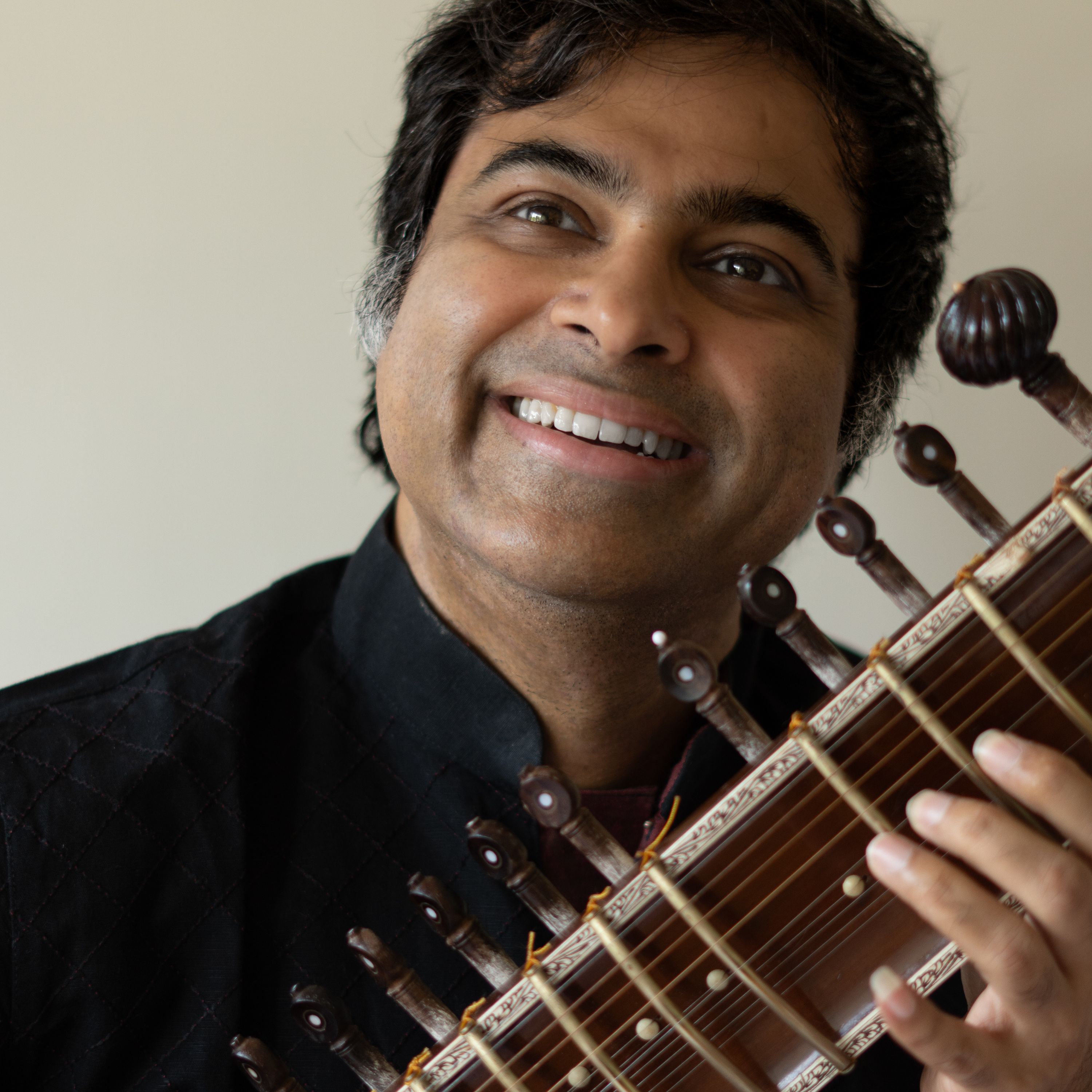
You're listening to all of it on wnyc. I'm Alison Stewart. Our march get lit with all of it book club selection was the novel A Guardian and a Thief by Megha Majumdar. The story takes place in a future version of Kolkata, India, that has been utterly transformed by climate change. So we were thrilled that for our get lit event we were joined by a musical guest who also calls Kolkata his hometown. Prabhayan Chatterjee is a virtuosic sitar player whose work combines Indian classical music with global genre fusion. He has played with Bella Fleck, Herbie Hancock and the late Zakir Hussain. He actually changed his flight from India in order to join us for our event. You'll hear my conversation with Prabhayan in just a moment. But first, here he is with a special performance alongside tabla player Vivek Bandia.
- [07:16]
Interviewer
That was extraordinary. What was the name of that song?
- [07:21]
Prabhayan Chatterjee
So this is a raga, which is called Raga Yaman and. And then we have various varieties of it. And this was actually called Yaman Kalyan.
- [07:31]
Alison Stewart
It almost sounded like.
- [07:32]
Interviewer
Can I say that you were shredding your sitar?
- [07:35]
Alison Stewart
Yes.
- [07:36]
Prabhayan Chatterjee
You're allowed to say that.
- [07:38]
Interviewer
I read in an interview that you said you watched guitar players and it changed the way you thought about how you could play the sitar. Could explain that a little bit.
- [07:47]
Prabhayan Chatterjee
Yes. Lots of guitar players, actually, I had the good fortune of. And that's how it all started. You know, my foray into jazz music or into other forms of music. I had the good fortune of hanging out and meeting Pat Metheny here in New York. Yeah. In his home studio. And he played my sitar and I played his guitar. And that's how it all started.
- [08:10]
Interviewer
It's interesting when you think about sort of, you play Indian classical music, but you, you have broadened out into this, this global genre of jazz and different kinds of music. When did your interest in jazz really start?
- [08:26]
Prabhayan Chatterjee
So I think early 2000s is when I started listening to a lot of, you know, Miles Davis, Ornette Coleman, all of that. And then onwards to this meeting with Pat. Pat Metheny was in 2009 and I think. And then I subsequently met people like Chick Coria, Bela Fleck and onwards to Snarky Puppy. And I got a chance to play with them very recently and they became great friends of mine.
- [08:56]
Interviewer
What's challenging about combining traditional music with contemporary music?
- [09:04]
Prabhayan Chatterjee
Well, I think, you know, if you forget the tradition and what is contemporary, I think you first need to look at musical language and genre. And every kind of musical culture has its own language and own building blocks. In our case, it's the raga. It's, it's more or less modal in nature. And when you try to connect with, with any Western form of music, then the, there's a whole world of harmony out there. But when I, you know, started to kind of look at trying to bridge the gap, I first started learning some of the other traditions of the world and, and I think I've come to a point where now I think, you know, because the word tradition is just so relative and I'm quoting the great Ustad Zakir Hussain and he said tradition is, is a point in time to which we feel like we are tethered. But it's also a moving point because we redefine tradition at, at, at several points in. So I try to kind of, you know, keep in mind when I compose or when I, when I write for an album, keep in mind the language that I've been taught. But I also try to keep in mind a language that will be relevant to, to larger numbers of people.
- [10:24]
Interviewer
How long have you been playing the sitar?
- [10:26]
Prabhayan Chatterjee
I started when I was five years old, so. Very long time.
- [10:29]
Interviewer
You're a prodigy. You were a prodigy growing up. When did it become clear to you that music was going to be your career?
- [10:38]
Prabhayan Chatterjee
So incidentally, I, I grew up in the same city as, as Megha, as you know, Kolkata. And I started learning music at the age of three. Vocal music and then the sitar at the age of five. And I went to a school which is called the Calcutta Boys School. And I fought, fought hard with my mom. You know, I always thought that I could do this and I could make a living. And I think she had her doubts about it. I got a lot of support from my dad, though, because he, he, he was, you know, he was my guru and he is my guru and you know, he, he's a musician himself. I think when in my first year of college I went to this College called Presidency College. In my first year of college, when I was hanging out with, with my peers and my, you know, college mates, I, I found this calling increasingly within me where I, I, I kind of decided that I was, it was either going to be this or nothing else.
- [11:40]
Interviewer
As you said, you're from Kolkata and you were involved with making a song for the city. Is that true?
- [11:45]
Prabhayan Chatterjee
I was. And I haven't published it yet.
- [11:48]
Interviewer
Oh, not yet.
- [11:50]
Prabhayan Chatterjee
You know, funnily enough, I wrote that song, finished the production, I got some 32 different artists, some of who are no more. And then as I finished mixing and mastering that song, I moved from Kolkata to Mumbai. So I guess I was a little ashamed to publish a song. Kolkata at that point.
- [12:08]
Interviewer
I understand you have a new album that's going to be coming out. What can you, it's not out yet, but what can you tell us about it?
- [12:15]
Prabhayan Chatterjee
This is very exciting for me because I've worked with Mark Lethierry, who is part of the Snarky Puppy Band, and we've created this album which is a potpourri of raga music, of funk, jazz, which is what Mark does, and a lot of modern electronica. So I can just say that this album has a lot of tradition and a lot of what's considered contemporary.
- [12:43]
Interviewer
It's interesting.
- [12:44]
Alison Stewart
What do you think people can learn
- [12:46]
Interviewer
about the way you make music, the way you break down between genres? What can people learn about human behavior that way?
- [12:56]
Prabhayan Chatterjee
I think human behavior, the way we
- [13:02]
Alison Stewart
deal with one another.
- [13:03]
Prabhayan Chatterjee
Yeah. I mean, it's so different, yet so similar in, in my travels across the world, I've seen that. I think the fundamentals are the same across cultures, across different countries in the globe. It's only the specifics which, which differ. There are, you know, protocol, which, there's protocol which changes and there's, there's maybe language and there's, there's culture. I think as you interact with larger number of people from larger number of cultures, you begin to learn more about yourself. And that's what goes into, you know, writing a book or writing a piece of music. It's all the same. I think you get better at it as you learn more about yourself.
- [13:51]
Interviewer
You're going to be at the Big Ears Music Festival in Tennessee on March 28th. What are you looking forward to about that gig?
- [13:58]
Prabhayan Chatterjee
I've heard a lot about this festival and I think I'm going to be reaching out to an audience which is probably relatively uninitiated to Indian classical music. So I want to be able to spread the word. Every time I perform for a new audience, I want to tell people how much fun Indian music is because people are always talking about how spiritual and how serene it is, which it is. But it's also a lot of fun.
- [14:24]
Interviewer
What are you going to play for us? The next song? What are we going to hear?
- [14:28]
Prabhayan Chatterjee
So I've thought about this raga called Mishra Pahadi, which has got folk, you know, undertones to it. And this is something that I have written for another album which I'm going to publish in the next couple of years once this one's out. And it's called Mishra Pahari. It's in a 6, 8 rhythmic cycle. Sa.
- [17:29]
Native Deodorant Advertiser
Sa.
- [19:09]
Alison Stewart
That was sitar player Pabayan Chatterjee with a special live performance from our March get lit with Olivet event. And that is all of it for today. Our April get lit selection is the novel Lake Effect by Cynthia Dupri Sweeney. To find out more, head to wnyc.org getlit I appreciate you listening and I appreciate you have a great weekend and I'll meet you back here next time.
- [19:40]
Tremphya Advertiser
For adults with Crohn's disease or ulcerative colitis symptoms, every choice matters. Tremphya offers self injection or intravenous infusion from the start. Tremphya is administered as injections under the skin or infusions through a vein every four weeks, followed by injections under the skin every four or eight weeks. If your doctor decides that you can self inject Tremphya, proper training is required. Tremphya is a prescription medicine used to treat adults with moderately to severely active Crohn's disease and adults are who with moderately to severely active ulcerative colitis. Serious allergic reactions and increased risk of infections and liver problems may occur. Before treatment, your doctor should check you for infections and tuberculosis. Tell your doctor if you have an infection, flu like symptoms or if you need a vaccine, explore what's possible. Ask your doctor about tremphya today. Call 1-800-526-7736 to learn more or visit tremphyaradio.com
- [20:40]
Native Deodorant Advertiser
hey girl, what's happen? Is that your antiperspirant?
- [20:45]
Prabhayan Chatterjee
Uh, yeah.
- [20:46]
Native Deodorant Advertiser
Let me see that can. Aluminum butane? I cannot pronounce that. You have to switch to native deodorant. Native's simple formula has only clean ingredients. It gives you effective 72 hour odor protection with no hydrocarbon propellants. Wow, this smells heavenly clean. Effective 72 hour odor protection isn't a myth.
- [21:08]
Prabhayan Chatterjee
It's native.