← All Of It with Alison Stewart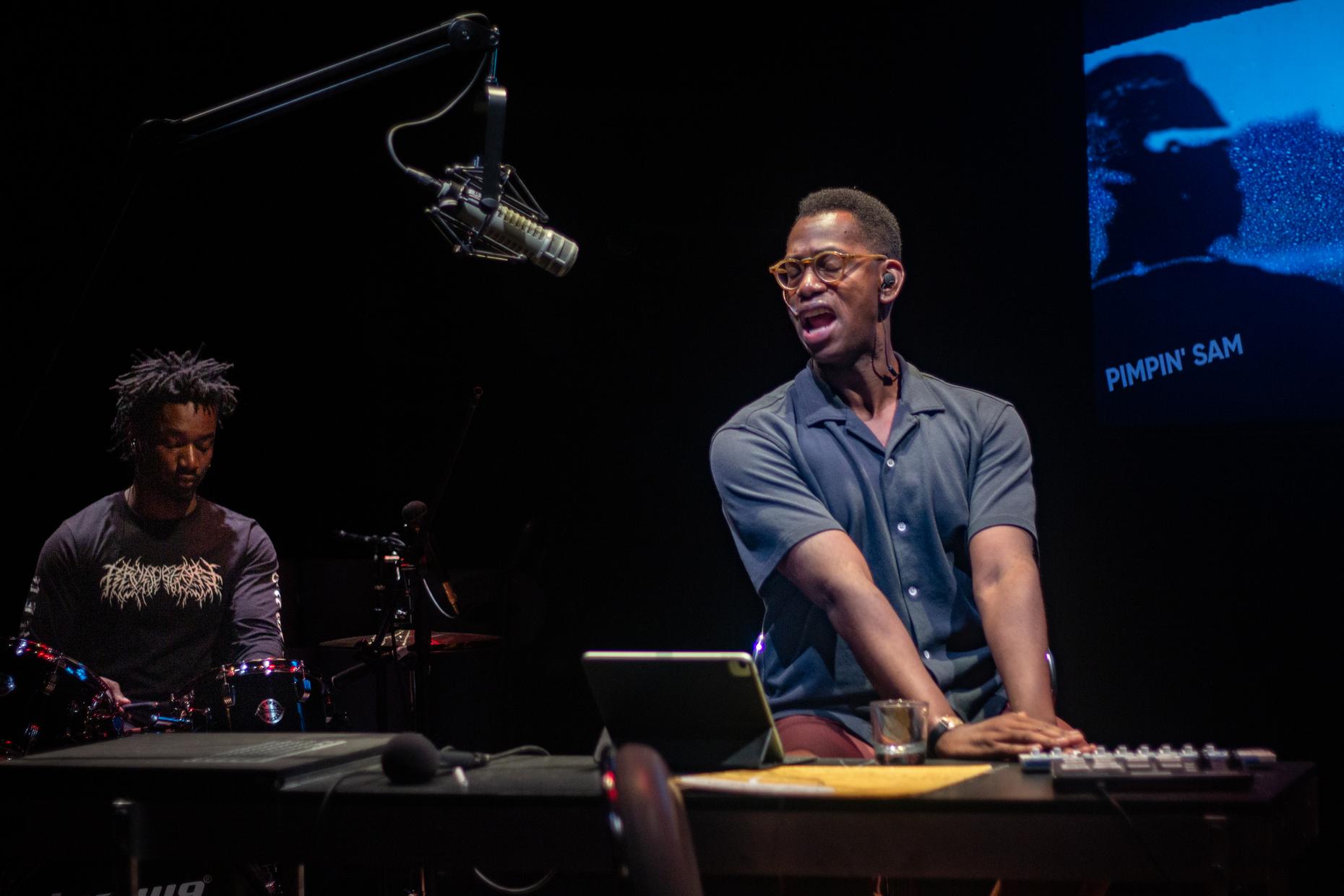
All Of It with Alison Stewart
'Get Your Ass in the Water and Swim Like Me' Adapts 'Toasts' for the Stage
00:19:20
A new play from The Wooster Group reimagines a 70s folklore album recording of 'Toasts.'
Loading summary
Transcript66 lines
- [00:04]
A
Listener support WNYC Studios.
- [00:18]
B
This is all of it. I'm Alison Stewart. You have just one more week to see a stage production inspired by toast African American oral histories told often in funny rhythmic poems. The show is called get your ass in the water and swim like me. That sentiment about swimming hearkens back to a fictional character aboard the Titanic. A black worker who saw the disaster coming, tried to tell people, was ignored, so jumped ship. And when white passengers called for him to come back and help them, he yelled, get your ass in the water and swim like me. You can hear that story in the show and on a folklore album put out in the 70s that inspired the stage piece. Here's an example from the album about a smart monkey who outwits a lion, the king of the jungle. And this monkey wants some respect.
- [01:04]
C
Back on 19 June, all animals gave a party down at Broccoon. When the monkey heard the news, he got all excited, but he was real hot. When he found out he wasn't invited, he said, I know when time come, I'll just go. The next morning at the crack of dawn he was up trying a brand new rig on. He had a red vest with a bow in the back. He had shirt and shoes to match. He had a yellow tie with a purple suit. He was clean and he knew it too. He went on down to the barbershop to get him a shave and a shine he looked at his watch and said, it's partying time. He went on to the party and they called him a disgrace and slammed the door and it's mother faith he said, I know. He went home and reached the old seal of dough and brought down a long 44 he said, Honey, give me a 10 I'm going to buy some gin. He went and bought a fifth of whiskey and a fifth of gin he put the whiskey in his pocket and he drank the gin he said, now I'm going to kick this party time door in.
- [01:50]
B
Give the engineer a little bit of a heart attack there. You can check out the live stage version performed by Eric Berryman, who created this show. Get your ass in the water and swim like me is running at the Performance Garage. Performing garage, excuse me. At 33 Worcester street through Saturday, February 3rd. With me now is the show's director, Kate Faulk, one of the founders of the Worcester Group. Welcome to the studio.
- [02:08]
D
Great to be on air with you, Alison.
- [02:10]
B
And in studio is Eric Berryman, who takes on the toast. Takes on the toast through the Persona of a late night radio DJ and If that name sounds familiar, you may recognize him from that awesome part he played in the Atlanta episode, the Goof who sat by the door when he played the black Disney CEO. It's a classic. Eric, welcome to the show.
- [02:29]
A
Thanks for having us.
- [02:30]
B
So I did my little description of a toast and its history. I'd love to hear yours. I'm sure it'll be much more thorough.
- [02:38]
A
No, no. It changes every time. Yeah. Toasts were oral narrative poetry. You know, that is what I think distinguishes it from other forms is that there's a beginning, a middle, and an end, oftentimes in rhyming couplet aabb. But then to see or witness a toast teller break that form, return to it, come back and forth, is interesting. These were things that were told amongst groups of men kind of hanging around. These were not written down originally. And they're kind of. They're Homeric in their scope. They're fantastical. They're meant to be. They're meant to be. They're not meant to be from reality. You know, if you're talking about the length of a character's member to, say, six inches, well, that's not funny, and that's not good. So one has to say 12 or 20 or 4 yards. Yes. In order so that we understand that this is fantasy.
- [03:48]
B
Kate, why do you think toasts. What do you think it is about these toasts that make them rich material for theater?
- [03:58]
D
Fantastic characters. These characters are larger than life and. But really, in answer to your question, I have to say, a lot of big part of my journey as director was finding out why Eric was so passionate about them. Because the material is outrageous. And maybe we're breaking a tradition by creating a show where a paying public comes and sits and experiences them in a theatrical production. But it was mainly Eric wanted so badly to perform them. And we were all in, all of them. Me, Elizabeth Lecompte, director of the Worcester Group, and the whole team, we're very in awe of them in terms of the clever wordplay, the rhyming couplets, what Eric was talking about, the wit and the rhythm. But a big part of the journey was contextualizing them. Sure. For the audience.
- [05:09]
B
How did you think about how you wanted to deliver them? Because I'm gonna describe the set a little bit so we can see you pretty on the set. I don't know if you can see us or not. I mean, see you, obviously, we can see you, but we're pretty close.
- [05:21]
A
Yeah.
- [05:22]
B
You look like you're in a setup a little bit. Like we are now in front of microphones.
- [05:26]
D
We're so inspired.
- [05:27]
A
Yes. Yeah.
- [05:28]
B
In a radio station. And I'll let you take it from here. How do you decided that would be the way you'd want to deliver?
- [05:32]
A
Well, you know, I mean, that was very much a group effort. A group from everybody in the room, obviously, you know, Kate and I being the first kind of the origin of everything, you know, we started working on this on Zoom in 2020, just the two of us. And then slowly began to come into the theater, just the two of us with fluorescent lights. And we decided to use to kind of think about how we would frame this. We began to think about storytellers and ways of modern storytelling that we love. Stand up was a huge influence, particularly stand up in the 60s and 70s and how that is. Then we started to look at. And I started to look at late night shows. The interaction between host and person, host and band.
- [06:19]
D
And that's why we wanted to have drummer in relationship to the host.
- [06:24]
A
And also that's inspired by Kate and I's love of a Korean folk form called pansouri. A singular storyteller and a seated drummer. This is an ancient form. Yes. So this was also something because as they're telling the story that is very musical and very, you know, that the instrument accompanying that person is not a chordal instrument, it is an accent, a drum, a percussive instrument. And that seemed to kind of go in the vibe.
- [06:51]
D
But I remember I remembered this morning how it got focused into the radio is we're working on this production now with the whole Worcester Group team. And Liz Lecompte came in with the obituary of Bob Fass.
- [07:09]
A
Ah, uh huh.
- [07:10]
D
And he was 50 years on BAI and had that incredible show, Unnamable Radio. In the middle of the night. He would talk about anything. And so she was like, you know where we're gonna spend our money before we have it on a radio mic. And that's when the space, when it got located there. And then as our conversation is always with Eric, he countered with Jack the rapper, who preceded Bob fast by like 20 years. He's from the Midwest, 40s black DJ who is considered the godfather of one of.
- [07:49]
A
One of, you know, as I started to get into black disc jockeys and just that world. And then even, you know, and then with the Bob Fast conversation, this kind of late night radio dj, not a noon show, she said, you know, a show that when you turn the dial on at 2am what are they talking about? What are the things you can say then? And that all just started to really kind of get us into this world of, well, where are we? And then what do we need to say in this world? And what gets said to the. To the kind of invisible radio audience and then what gets said to an in studio audience, which came about also from my looking at late night, kind of late night talk shows and thinking about when there goes the commercial, the audience is actually seeing, you know, the host and everybody else do something or that we're not witnessing. And also my interest in. Whenever an album gets recorded, like one of Eric Dolphy, the great Eric Dolphy, musician and composer's last album, his recording, there's a live little audience where he's recording it. And you can actually Google photos of them there inside the studio as he's recording this album. And there is no barrier between him and them. And there was also something about that. And that's why we chose to have some seating on the stage as well, so that people really are there with us.
- [09:11]
D
As if you invited anybody could drop by when you had your radio show going on.
- [09:16]
A
Exactly.
- [09:16]
D
And also back to the talk show thing. I love the part of the show where you ask the drummer random questions. Different every night.
- [09:25]
B
Are they different every night? Yes.
- [09:27]
A
That is the only unscripted part of the show.
- [09:29]
D
Because when I watch talk shows, we, Eric and I both share an obsession with talk shows and standup. So when I watch a talk show, when they do cut back from commercial and the guest and the host are talking and you don't get to hear it.
- [09:43]
A
Yeah, right.
- [09:44]
D
So they're having this intimate conversation. And so I feel like we get into that and make space and time very much so for a very casual banter and also for me as a director, you know, the men on this recording, Bruce Jackson, the folklorist who recorded this and by the way, couldn't release it until the pornography laws changed in the 70s. That's why it came out later than the Negro folklore from Texas state prisons. But yeah, that these were things that were created in groups of men. Now we have Eric and Jairis on stage, like, well, what do they talk about? You know, and so it's a little access to and, you know, a casual, intimate conversation between the two of you.
- [10:34]
B
Yeah, the night we were there and I was there, Jerris talked about your drummer, talked about excellent percussionist. Talked about being in love with this kindergarten teacher.
- [10:44]
D
Oh, and.
- [10:45]
A
And I just. I just. I'm so in love with Jairus because, you know, because we don't. I don't preempt the. I don't. He doesn't know what I'm going to ask him and I really have no idea how he's going to answer it. And nowhere did I think when I asked that question, which I try not to plan out too, too, too much, that he would. The question I asked him, for those that don't know, is I asked him, I said from year K through 12, which was your best year of schooling, whatever that means to him. I try to keep it specific but open ended enough that he can go wherever he wants. And he said kindergarten because he was in love with that teacher and he's been trying to find her and show her that he's a professional drummer who's doing very well.
- [11:26]
B
And he likes older women. Yes, that was the line he dropped because I've always liked older women.
- [11:30]
A
Yeah. And somehow, no matter what we talk about and I ask, it relates. It somehow relates. It somehow relates without us even ever saying masculinity or somehow us, you know, these ruminations on kind of black male masculinity and both breaking down what that means. Because I think there are things that he says and that I say that are. That provide a counterpoint to the black masculinity that you're hearing in the toast. We're providing a different facet of black masculinity in, in what we talk, what I talk about. And whatever he chooses to talk about, you know, this black, you know, he expresses some nights his love of anime. I asked him where would he want to go if he had ever had to have a destination wedding. He says, Greece. You know, these are, you know, and it's just, and it just adds a complexity to not only the modern black man, but makes you go, well, I'm sure that their forefathers must have also been this complex and to have other thoughts, but. And also be able to create the toasts as well.
- [12:36]
D
And so to have that casual conversation with Jairus the drummer, but then also your personal material, your rumination on your name, your rumination on your high school teacher, on. It's the counterpoint to these huge characters. Stagile Shine on the Titanic, signifying monkey. These big, huge archetypes.
- [13:04]
A
Yes.
- [13:05]
B
My guests are Eric Berryman and Katie Volk. We're talking about get your ass in the water and swim like me from the Worcester Group running at the performing garage at 33 Worcester street through February 3rd. I have a clip of you performing. We're gonna listen to a small portion of it. This is from the toast Titanic that kicks off the show. Let's take a listen.
- [13:25]
E
All the old folks say the 4th of May is a hell of a day. I was in a little seaport town and the great Titanic was going down. Now the sergeant and captain was having some words when they hit that big iceberg up comes shine from down below he said, captain, captain, so you don't know Said we got nine feet of water over the ballroom flow and the captain said, go on back and start stacking sacks and we got nine water.
- [13:48]
A
Pumps to keep the water back up.
- [13:50]
E
Come Shine from down below he said, captain, captain he said, you don't know said we got 40ft of water with a borrow room float he said, go on back and start stacking sacks Said we got nine water pumps to keep the water back Shine said, your is good and your is fine say, but this one time you white folks ain't gonna on shine.
- [14:08]
B
That's from get your ass in the water and swim like me.
- [14:11]
D
And you won't hear those beeps in our show, but maybe we need to.
- [14:15]
A
I kind of like them, actually.
- [14:17]
B
This is new. This is the new layer.
- [14:19]
A
Ooh. If we add another toast, we'll definitely add them.
- [14:22]
D
Yeah, we're not done yet.
- [14:24]
A
Maybe not. I don't know. That's great.
- [14:26]
B
What is the role of profanity in the toasts?
- [14:28]
A
Oh, man. What is the role of profanity in. You know, honestly, the role of profanity in the toast is one. It is the language of the people. It is the language of the street. But in my growing up, the use of profanity in part of black culture that I've known of it as. It is poetic. It is. You know, I had an ex who spoke three different languages. And sometimes I'd ask her when she would talk to her mother, you know, how do you know when you switch between what language? And she said, well, sometimes you can only. I can say something better in this language or I can get to the point of what I'm trying to say. And Samuel Jackson, I think, says a similar thing about the use of MFER is that sometimes it just really gives it the emphasis to really explain what I'm talking about. So not only is it a necessary emphasis to really understand, to get the. To get the point of my. Of my fantasy and of my folktale, but also it is rhythmic. There are times where you can point to. If I take the curse word out, it loses the rhythm. And I couldn't think of a better thing to substitute in it that would give it the Right rhythm and the right poeticism.
- [15:48]
D
Might it also be an act of liberation?
- [15:52]
A
Very much so.
- [15:52]
D
To be able, in your congregation of friends, that you can use profanity.
- [16:02]
A
Right.
- [16:02]
D
And I was thinking about that this morning, too. Like, what about the profanity? What about the misogyny that's inherent in a lot of these. What about. Yeah, sexual violence that some of these stories have. And then I'm thinking, well, these are outrageously witty and they rhyme. And in the face of. In all our culture, popular culture, there's all three of those things over and over again with images. But these, it's all. It's like incredible wordplay. And the virtuosity in the toast. Teller, who's not doing this with a pen and paper, is coming up with this stuff. And not to outdo. It's an act of one upmanship.
- [16:51]
A
To outdo, to boast, to incite laughter, to incite wow to one up. Because at times, say, I might tell my version of Titanic or Shine in the Titanic, and then I might finish and you go, no, that's not how it went. I heard it went like this.
- [17:10]
D
And then you do something more outrageous.
- [17:13]
A
And on the version we do, which we got from the album, when the folklorist Bruce Jackson recorded these, the man that tells this one, Benny Richardson, he said, this is the only version of Shining the Titanic where there was another black man on the Titanic. In this version, normally the crux of the toast is that there's one guy and he does these things and turns away people. But just to show how bad Shine is, this guy puts a guy on there called Jim. And Jim gets offered the same riches and the same thing.
- [17:48]
D
You can't say rewards.
- [17:50]
A
Rewards from ladies. Rewards from ladies. Jim gets offered the exact same thing. And instead of turning it down, Jim hops back on the ship, which of course is going to sink and he'll be dead. So that's how bad Shine is, is that. And you want to be like Shine. You don't want to be like Jim. And Bruce said this is the only version that he's ever recorded or ever heard where somebody put another person on the Titanic. And so that was his version to add that. Add that on there. In many versions of Signifying Monkey, it ends with the lion, you know, trouncing upon the monkey. But in our version, and in some, the monkey manages to do one last trick and gets himself back up in the tree. And then maybe that's the end. And then our version, no, he goes, no, actually, I'm gonna go one more and he's gonna fall down again. And the lion now gets him one one last time. So, you know, a toast teller had the ability, and with all folklore for it, for it to really become their own. And in many ways our production is yet another step in that direction as far as how these things get told and how we tell them and how we need to tell them for a 21st century audience, because in many ways we can't tell them the way they were told then for various reasons.
- [19:11]
B
The name of the show is get your ass in the water and swim like me. I was looking forward to saying that. All weekend long, Eric Berryman has been my guest as well as director Kate Volk. It is at the performing garage at 33 Worcester street through February 3rd. Thank you for coming in and sharing your work with us.
- [19:26]
A
Thank you.
- [19:27]
B
There's more. All of it on the way.
- [19:29]
D
NYC now delivers breaking news, top headlines and in depth coverage from WNYC and Gothamist every morning, midday and evening. By sponsoring our programming, you'll reach a community of passionate listeners in an uncluttered audio experience. Visit sponsorship.wnyc.org to learn more.