← All Of It with Alison Stewart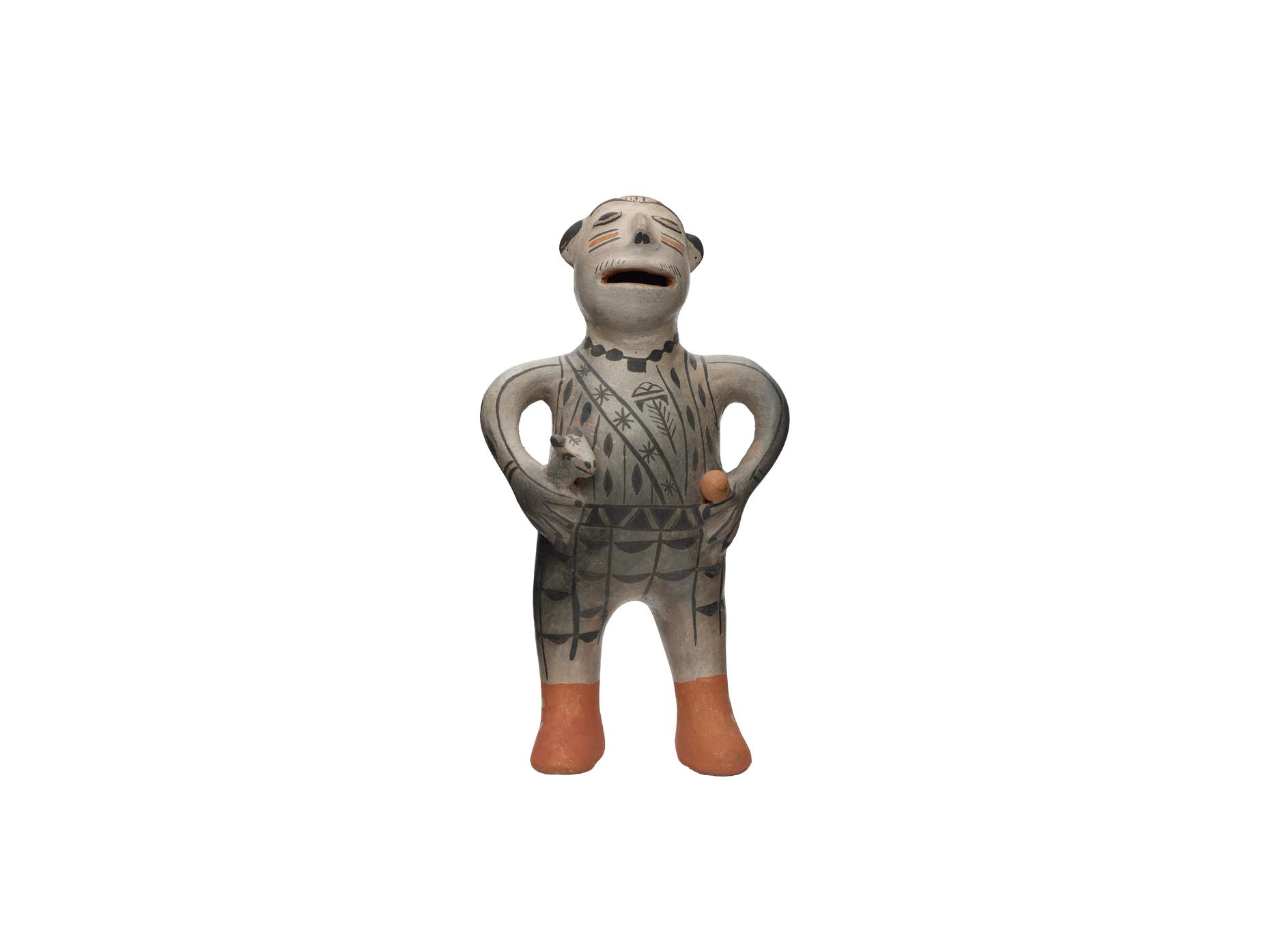
All Of It with Alison Stewart
Grounded in Clay: Community-Curated Pueblo Pottery At The Met
00:11:37
A new exhibition at the Met features more than one hundred historical, modern, and contemporary clay works.
Loading summary
Transcript42 lines
- [00:00]
McDonald's Advertiser
I' ma put you on, nephew.
- [00:01]
McDonald's Customer
All right, unc.
- [00:02]
Host/Interviewer
Welcome to McDonald's.
- [00:03]
Patricia Marroquin Norby
Can I take your order, miss?
- [00:04]
McDonald's Advertiser
I've been hitting up McDonald's for years. Now it's back. We need snack wraps. What's a snack wrap? It's the return of something great. Snack wrap is back.
- [00:17]
Liberty Mutual Advertiser
And Doug Limu and I always tell you to customize your car insurance and save hundreds with Liberty Mutual. But now we want you to feel it. Cue the emu music. Limu Save yourself money today. Increase your wealth mice and save. We say that may have been too much feeling. Only pay for what you need@liberty mutual.com Liberty Liberty Liberty Liberty Savings Very unwritten by Liberty Mutual Insurance Company and affiliates Excludes Massachusetts.
- [00:49]
McDonald's Advertiser
Listener Supported WNYC Studios.
- [01:02]
Host/Interviewer
This.
- [01:03]
Alison Stewart
Is all of it from wny. Welcome to nyc. I'm Alison Stewart. Now a conversation about the Metropolitan Museum of Art's first ever community curated Native American show, which reflects on the long standing tradition of Pueblo pottery. The show is called Grounded in Clay the Spirit of Pueblo Pottery. Through more than 100 historical, modern and contemporary pieces, this exhibition illuminates the complexities of Pueblo history, challenges stereotypes and centers the lived experience of people. There are small, intricately designed jars, figures depicting various peoples and creatures, and beautiful bowls with elaborate visuals and references to folklore. The creative process of Pueblo Indian pottery involves all of the elements earth, water, air, fire. A review in Forbes said the curator's firsthand knowledge of pots and potters, family rituals, traditional materials and daily use grounds viewers and a powerful sense of people in place. Also, the thread of ancestral memory connects individual pots to the pride, pain and legacy of Pueblo peoples. The exhibition, Grounded in Clay, is simultaneously on view at the vilcek foundation through June 4, and it's also showing at the Met now. Two of the curators joined me when the show first opened. Patricia Marroquin Norby is the first full time curator of Native American art at the Met, and Michael Namingha is part of the Pueblo Pottery Collective and is a curator in the exhibition. I began by asking Patricia to contextualize who we're talking about when we talk about Pueblos and the Pueblo community.
- [02:40]
Patricia Marroquin Norby
Well, it's a really straightforward question, but it's actually a very complex answer. So I'm going to answer in context with the exhibition. Great. So in grounded in clay, 21 Pueblo communities are represented. They include 19 Rio Grande Pueblos from New Mexico, the West Texas community of Isleta del Sur, and the Hopi tribe of Arizona. So to understand all of this and this wonderful, rich history, you have to first embrace the idea that all of the communities are sovereign nations. That means they have their own governments, religions, languages, and a nation to nation relationship with the US Federal government. Their histories reach back well over a millennium, and they predate the U.S. mexican and Spanish governments. So this is a very deep history.
- [03:28]
Host/Interviewer
I love that. That was a simple question with a very, as you said, complex and layered answer. Michael, when you think about this exhibition and you think about you partnering and the Pueblo Pottery Collective coming in as.
- [03:42]
Alison Stewart
Collaborators and as curators, what is some.
- [03:45]
Host/Interviewer
Understanding or some nuance that you all were able to bring to this exhibition?
- [03:52]
McDonald's Customer
I think when there's a book that accompanies this exhibition. And so each curator was invited to the School of Advanced Research in Santa Fe, New Mexico, to select a piece of pottery or from the Vilcek foundation here in New York City. And so it was about how we as curators, each connected with one of those pieces of pottery. And being Puebloan, a lot of us have representation by our family members in both of those collections. So for my essay personally, I chose a piece by my grandmother. Her name was Dexa Kwodzka Nampeo, and she passed away about three years ago. And so my essay was about my connection to her making pottery as a child with her. And then I'm an artist and so trying to find design language that links us together intergenerationally. And so when you go through some of the essays, they're all very personal, and some of them are about our history, but it's also this intergenerational relationships and what moves us and how this. These pottery pieces speak to us as a people.
- [05:11]
Host/Interviewer
Michael, what is something from that experience with your grandmother that's still with you every day?
- [05:18]
McDonald's Customer
A very vivid memory with her was when I was a little boy, I would travel out to the Hopi reservation. My parents live in Santa Fe, New Mexico, and I would spend some summers with her. And so to occupy my time while she was making her own pottery, she would give me a ball of clay to work with. And every time she would hand me something, her hands always had that dried clay on it. And there was also that smell of wet earth in her studio space. So that's a very vivid memory for me in particular, just because scent triggers, there's such a strong trigger in your memory. There's the word petrichor, which is the scent of wet earth after a rain. And so every time I smell that, I think about my grandmother Patricia.
- [06:16]
Host/Interviewer
When you were thinking, when you were working on this exhibition, you know, sometimes when you to your point, it's could. This could have been the entire museum.
- [06:25]
Alison Stewart
You have to sort of stay focused.
- [06:26]
Host/Interviewer
You have to come back to your touchstone about what this is about and what your goals are. What is this about? What were your goals for this exhibition?
- [06:34]
Patricia Marroquin Norby
Well, I'd like to go back. I want to touch on the exhibition concept, which is really important. It originated with the Vilcek foundation leadership, who then approached the School for Advanced Research in Santa Fe, New Mexico, about partnering on this project. Then, in 2021, the Met was approached to be one of the host venues, and we embraced this opportunity as. As a curator and as an Indigenous woman. It's my job to foreground Indigenous voices at the Met, and I. I saw this as a perfect opportunity to do this and to work collaboratively with both the vilcek foundation and SAR, as well as over 60 community curators. So I jumped at the chance to do this project.
- [07:19]
Host/Interviewer
Michael, the works are not only beautiful, many of them were functional. Would you share some of the functions of some of the pieces we see?
- [07:28]
McDonald's Customer
Yeah, we make seed jars. They make jars for vessels for carrying water. They make vessels for placing on top of the stove, for making pozole during feast days, and some for holding corn and grain. So there's all sorts of different methods that people use, jars and Hopi pottery and Puebloan pottery.
- [07:59]
Host/Interviewer
For Patricia, are there common design elements in. In the work?
- [08:05]
Patricia Marroquin Norby
I would say that there are aesthetic designs that have been passed down intergenerationally but also shared across communities that speak to one another. That's definite. But also the excitement of innovation, new ways to present the works is also encouraged in some communities and among some artists and families. So that's also exciting about this work as well. And although we didn't touch on the concept of innovation within the labels or in the gallery spaces, it's very present materially and also in the iconography on each of the works.
- [08:45]
Host/Interviewer
And would you explain what you mean when you say iconography?
- [08:48]
Patricia Marroquin Norby
The visual, the imagery on the pots. There are a number of pots that represent clouds and rain. There's. There's, as I mentioned, lightning. There's water falling. There are insects, butterflies, birds. All of these things that are so important to the natural environment and natural surroundings of the communities and ties them to a particular place. So the works themselves embody a very strong connection to place, which is tied to the histories of the communities.
- [09:25]
Host/Interviewer
We're discussing Grounded in clay, the spirit of Pueblo pottery. It's at the Met until June 4th. My guests are Patricia Marroquin Norby, as well as Michael Namingha. He is a member of the Pueblo Pottery Collective.
- [09:38]
Alison Stewart
Member.
- [09:38]
Host/Interviewer
And Patricia is a curator at the Met. So this is a wonderful bean pot with lid, I think might be one of my favorites. I took a picture of it and I put it on our. This fellow. It makes you smile when you see it. For folks go to Llovetnyc to see.
- [09:58]
Alison Stewart
A picture of this pot.
- [09:59]
Host/Interviewer
It's a brown pot, and the handles look like little. Look like foxes, I believe. Could you tell us a little bit about who made this pot and its purpose?
- [10:09]
Patricia Marroquin Norby
Well, that would be an example of innovation that I just touched on. And I believe that the handles on the lid as well as the sides of the pot are either foxes or coyotes. And I just love the personality of that pot. It has facial features, and it touches on what I just explained about each of the pots having their own energy, their own sense of being within the exhibition. So there's a lot of pots that are. The stories about them are very touching, and they reflect back on intergenerational relationships. And then some of the stories are very warm and funny. And so I encourage visitors to engage with the labels because all of the labels and all of the exhibition texts were written by the Pueblo community curators, the Pueblo Pottery Collective. And so it's their voices that are foregrounded throughout the exhibition.
- [11:06]
Host/Interviewer
And, Michael, before we wrap up, you know, we talked about the pots having the pragmatic purpose. We talked about actually, physically how we make them. Where does spirituality come into this conversation about Pueblo pottery?
- [11:19]
McDonald's Customer
A lot of these works that are not on display are also used during ceremonies for ceremonial purposes. So there is that spiritual aspect to them. And those are made for specific times of the year, for specific ceremonies, for rites of passage. So there is also that spirit and then the spirit of the person that's making the pottery piece themselves. A piece of them goes into each one of those works. And I think when you handle the pieces of pottery, you can feel that.
- [11:56]
Alison Stewart
Michael Namingha is part of the Pueblo Pottery Collective, and Patricia Maraquin Norby is the first full time curator of Native American art at the Met. The exhibition is called Grounded in the Spirit of Pueblo Pottery. Up next, editors Camilla Townsend and Nikki K. Michaels discuss the first ever collection of Lenape folklore, which was gathered more than 100 years ago, but not published until now. It's titled on the Turtle's Stories the Lenape Told Their Grandchildren. That's coming up.
- [12:28]
Host/Interviewer
This is all of it.
- [12:31]
McDonald's Advertiser
I'm gonna put you on, nephew.
- [12:33]
McDonald's Customer
All right, unc.
- [12:34]
Host/Interviewer
Welcome to McDonald's.
- [12:35]
Patricia Marroquin Norby
Can I take your order, miss?
- [12:36]
McDonald's Advertiser
I've been hitting up McDonald's for years. Now it's back. We need snack wraps. What's a snack wrap? It's the return of something great. Snack wrap is back.
- [12:46]
Ira Flato
I'm Ira Flato, host of Science Friday. For over 30 years, our team has been reporting high quality news about science, technology and medicine. News you won't get anywhere else. And now that political news is 24 7, our audience is turning to us to know about the really important stuff in their lives. Cancer, climate change. Genetic engineering, childhood diseases. Our sponsors know the value of science and health news. For more sponsorship information, visit sponsorship Wnyc. Org.