← All Of It with Alison Stewart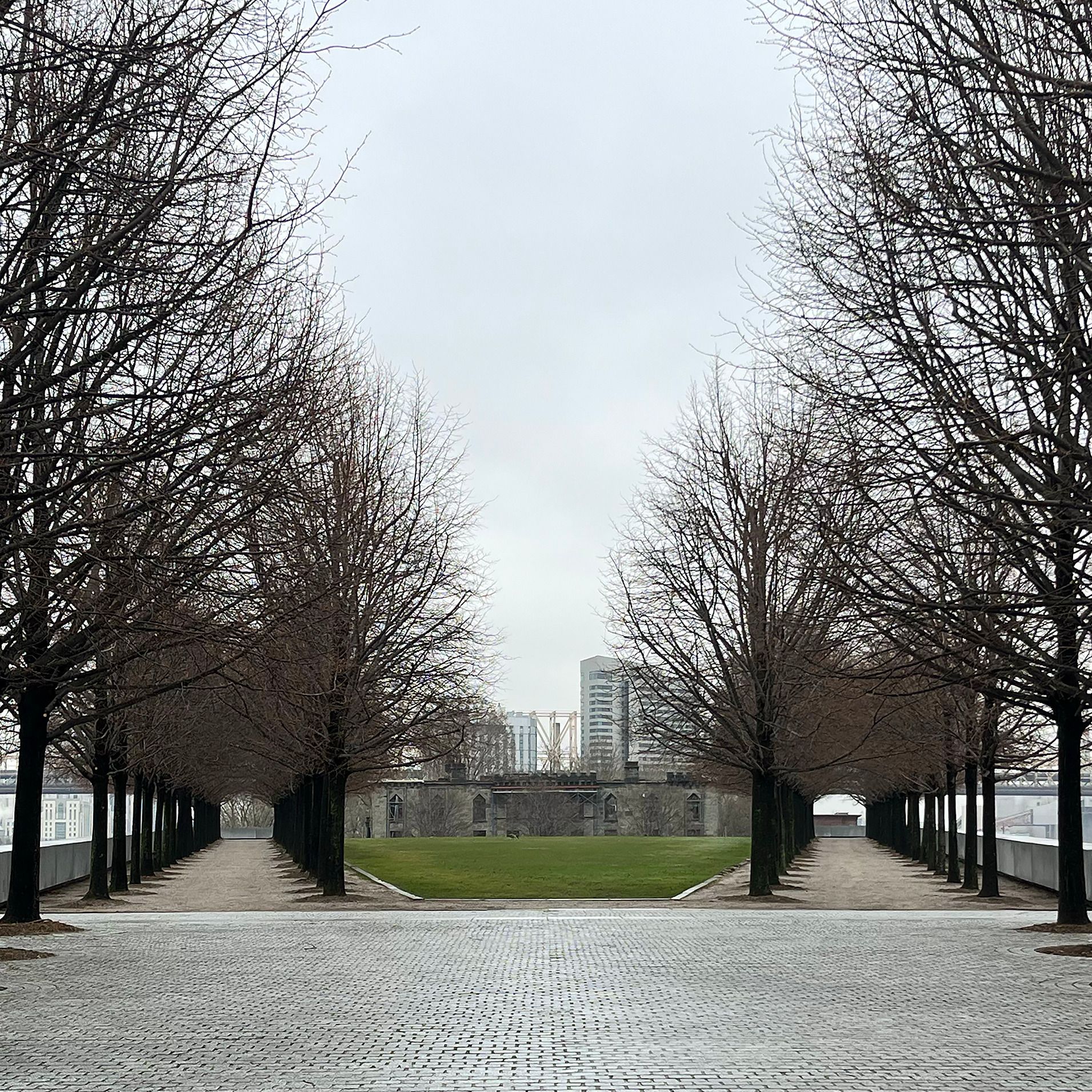
All Of It with Alison Stewart
Hans Rosenström’s Immersive Sound Installation on Roosevelt Island
00:12:29
Loading summary
Transcript38 lines
- [00:00]
A
All of it is supported by Progressive Insurance. Do you ever find yourself playing the budgeting game? Well, with the Name youe Price Tool from Progressive, you can find options that fit your budget and potentially lower your bills. Try it@progressive.com Progressive Casualty Insurance Company and affiliates Price and coverage match Limited by state law not available in all states. This is all of it on wnyc. I'm Alison Stewart. At the southern tip of Roosevelt island, right in the middle of the East River, Franklin D. Roosevelt 4 Freedom State park feels a bit removed from the rest of the city since 2011. The park has long rows of linden trees, giant granite walls with geometric patterns, and sweeping east river views that create kind of an oasis. Now imagine that scene with a site specific sound installation that threads voices through the park using hidden speakers tucked among the trees. It was created by Finnish artist Hans Rosenstrom and it's called out of Silen. It's inspired by the music of Estonian composer Arvo Part and by the architect of the park, Louis Kahn. The piece changes as you move through the space. At some moments you're swept into the wind and city noise. At others, the music surrounds you completely. It's on view now through June 21st. Hans Rosenstheim draws me now in the studio. It's nice to meet you. Nice to meet you too, as well as Alina Gurskovich, the curator of the exhibit. Hi Alina.
- [01:30]
B
Hello. Thank you for having us.
- [01:31]
A
Hans, your work is often site specific, so you take a lot of inspiration from the location locations you're working in. What were your first impressions of Four Freedoms Park?
- [01:41]
C
It's absolutely gorgeous, of course, but it's also, as you shortly mentioned, that it's detached from the city. So there's this distance to the city, but you can still hear sound from the city. And I like to work in public spaces mainly because they are shared spaces. So that often kind of plays like gives a lot to my work and things that I want to play with.
- [02:05]
A
Alina, you said you were the one to first conceive of this piece. What was your initial seed of inspiration?
- [02:11]
B
Yes, thank you. It was the trip that I took to go to Estonia about 2 1/2 years ago, and when I was there it was a curatorial trip. I had this incredible opportunity to visit the Avopert center, which is about an hour away from Tallinn, and it's nestled in the forest and in order to get to the actual building you have to walk through this pathway and you're surrounded by trees and it's intentional by design and it Sort of slows you down and creates this incredible feeling of peace inside that then primes you to the experience of Artobert and the music and the building. And so I was so mesmerized by this experience that when I got back, I started having conversation with Yannicka Perna, who was representing Estonian culture in New York. And she said, you know, why don't you put together a proposal for something that would create a similar experience for people in New York, combining, you know, the inspiration of and the space, the Louis Kahn design space for Freedman's Park. And as I was thinking through what it could be, I remembered that I really loved the work of Hans Rosenstrom and had a chance to do a studio visit with him when he was in New York at iscp. And that's kind of how it all came together. But the inspiration was this feeling that I had through the trip in Estonia.
- [03:30]
A
Hans, one of the notable pieces about this piece is that it depends on where you're standing, what you experience. Why is movement such an important part of this piece?
- [03:41]
C
I think it you become like, for me, the piece has a lot to do with you and your own presence in the space. So I try to create these sort of environments where you actually let play with your own body and your relationship to your surrounding. And therefore, I think movement engages you. And it's also more kind of awakens curiosity because you hear a little bit something that happens somewhere else where you're not standing, and maybe someone else hears something that you're not hearing, and it creates this sort of dynamics that I enjoy.
- [04:10]
A
You said that you started noticing parallels between the way composer AVO Part.
- [04:16]
B
Yes.
- [04:16]
A
Talks about music and the way that Louis Kahn talks about architecture. What were the similarities that clicked for you?
- [04:22]
B
Yes, absolutely. So both actually, very uncannily, both talk about silence. Silence as this field of potentiality actually said that the space between the notes is just as important as the notes themselves. And Louis Kahn, for him, architecture was a way, a portal into what he called the unmeasurable, which he also referred to as silence. So it's this space where you can have a transcendent experience, and when you can enter a space where you can sort of hear the internal voice and connect with what is inside of you. So that was one of the elements that was really similar between the work of Artobert and Louis Kahn. Also, the idea of the human voice and the humanness, and making the human kind of at the center of the experience was also important for both Adva Pat and Louis Kahn. And I would then bring this to Hans because he works so much with voices. And also, this work that we created, out of Silence, speaks to the power of the human voice. So that's kind of the overlap between all three as well.
- [05:30]
A
Our guests are curator Alina Gershowicz, an artist. Sorry about that. Hans Rosenstrom, who's worked together to create out of Silence, a new immersive sound installation at Franklin D. Roosevelt, Four Freedoms park on Roosevelt Island. It'll be up until June 21st. Now, Hans, you're not a composer?
- [05:47]
B
Yes.
- [05:48]
C
No, not at all. No.
- [05:50]
A
So what did you think that you could bring to this process? Because you came from the outside world of composition.
- [05:56]
C
Exactly. And that is, of course, it was a huge ask, or it felt like a big mountain to climb. But I felt that if we could work with people who know Arvo and who's worked with him for a long, long time. So we've proposed this to a choir in Estonia called Voxclamantis, who is directed by Jan Ektolwe and who has personally worked with Arvo over 20 years. And I basically wrote scripts and had this sort of spatial dramaturgy in mind. And I approached them and we together improvised. So it's not. The soundscape that we created is not based on his compositions, but it's a lot of like. It's inspired, like the way it's built. The singers kind of creates this inspired by the compositions of Part. But it's not like copying. It's something different.
- [06:56]
A
We actually have a little example of it. We can talk about it on the other side. Let's listen.
- [07:05]
B
To flame. Sh.
- [07:36]
A
You were going to add something, Elena?
- [07:39]
B
Yes, I was just going to say that it was indeed an improvisation. Right. And why it was important for us to work with Vox Climantis is, as Hans mentioned, they worked with AVO Part for many decades, and Advoir Part became really famous in the 70s after a period of silence. He spent eight years not composing. He sort of stepped away from composing, and then he came up with this innovative system called Itintinabouli, which is a very simple compositional structure. So the choir of Vox Clamantis, when we approached them to create this improvisational work, applied the system of Tintinoboli. And that was kind of the basis and was also a way to be inspired by the work of Artobert.
- [08:24]
A
All right, I understand there's an Estonian connection that was discovered later.
- [08:31]
B
Will you explain this to me? Yes, absolutely. So Arvobert is Estonian. He was born in Estonia and came back to Estonia. Now he's based in Estonia. And so it's actually Louis Kahn. Louis Kahn, who is known as an American architect, but he's actually an American Estonian architect. His family immigrated from Estonia a long time ago, so there is that. And then also, of course, Hans Rosenstrop is a Finnish artist, and Finland is right across the sea from Estonia. And actually, I'm originally from Latvia, so there's a Baltic connection all around.
- [09:04]
A
I've been talking to our guests, Alina Gurkiewicz and artist Hans Rosenstrom, who work together to create out of Silence, a new immersive sound installation at Franklin D. Roosevelt Four Freedoms Park. It's on view until June, or viewer sound till June 21st. Hans, you've described that you've noticed while the piece was developing, the tree shadows, they sort of create geometry. And I'm curious about the physical details. How did you take those into consideration? Or didn't you? It was just. Or was it just happenstance?
- [09:36]
C
I would say that everything played a role, especially in the beginning, while planning it. But I was very fond of the tree shadows because I was there in the winter without the leaves, and the shadows of the branches kind of create these sort of connections. And I started to imagine how voices also connect bodies with each other. And so kind of imagining these different trees as bodies and these branches that are kind of touching each other or the shadows of the branches. So. And then I started to see them as also as some sort of, like, repetitive patterns because they're a little bit also like musical notes and tones. So it was inspiring. But I don't have a very clear answer to you.
- [10:14]
A
That's fine. Alina, do you think of this exhibit as an escape from the city, or do you think of the city being a part of it?
- [10:22]
B
Oh, my gosh, both. Absolutely both. I think, first and foremost, of course, getting back to the original idea of silence and coming out of silence. But we wanted to create the space that would allow a moment of respite and rest for everyone in New York, for everyone who visits the park. As Hans was mentioning in the beginning, the space itself is already kind of. It's an island that exists in between Manhattan and Queens, and you can see both, and you can sort of hear the sounds of the city, but they're sort of in the distance. So you are both within the city and outside of it. So it's certainly something that is meant to not completely separate you from your surroundings, but to create a little an island within an island where you can be with yourself and also with Others.
- [11:13]
A
Hans, what have you observed about people when they are in this installation?
- [11:20]
C
I tend not to observe people too much. I tend to leave them to be by themselves. But of course I've peaked a little bit. And it is nice to see when it catches the attention of people and people actually stop and they start to follow it. So of course I try to do something that becomes a meaningful encounter for the people who visit the park. So of course I am curious. But I also don't want to be too nosy.
- [11:49]
A
Well, I'm nosy. I'm a New Yorker. What have you noticed about how people engage with the installation?
- [11:54]
B
Yes, I will say that Hans, many great artists is very humble. So this is where I have a chance to really talk about the experience. It was really touching when the opening happened on 28 April, and then throughout the kind of the following weeks and how people interact with it and how people were emotional. People came up to us thanking us for this experience, which was incredibly beautiful. That's interesting. And really even with happy tears in their eyes. So it's been extremely special because that's the best that we could have hoped for. And that's one of the reasons why we worked on this for two years. So hard it was to create this experience and to see people finally enjoy it is incredible.
- [12:37]
A
The name of the installation is out of Silence. It's at Franklin D. Roosevelt Four Freedoms park on Roosevelt island until June 21st. Thank you so much for joining us.
- [12:46]
B
Thank you.
- [12:46]
C
Thank you. It's our pleasure.
- [12:48]
B
Thank you so much. You're great at protecting your data, but lots of places could still expose you to identity theft.
- [12:55]
A
I thought it was safe.
- [12:56]
B
If that happens, LifeLock gives you a US based restoration agent who will stick by your side from start to finish. Phone calls, filing documentation, preparing insurance claims, your agent handles it all. In fact, we're so confident restoration is guaranteed for your money back. Isn't it nice to have someone like that on your side? Save up to 40% your first year@lifelock.com Pandora terms apply.
- [13:20]
A
Whether it's news from around the world or the latest from your neighborhood. New Yorkers engage with WNYC studios for the information and connection they can only get from our programming. Be a part of that conversation through your business support. Learn more@sporship.wnyc.org.