Loading summary
Transcript70 lines
- [00:00]
Progressive Insurance Announcer
All of it is supported by Progressive Insurance. Do you ever think about switching insurance companies to see if you could save some cash? Progressive makes it easy to see if you could save when you bundle your home and auto policies. Try it@progressive.com Progressive Casualty Insurance Company and affiliates. Potential savings will vary. Not available in all states.
- [00:29]
Alison Stewart
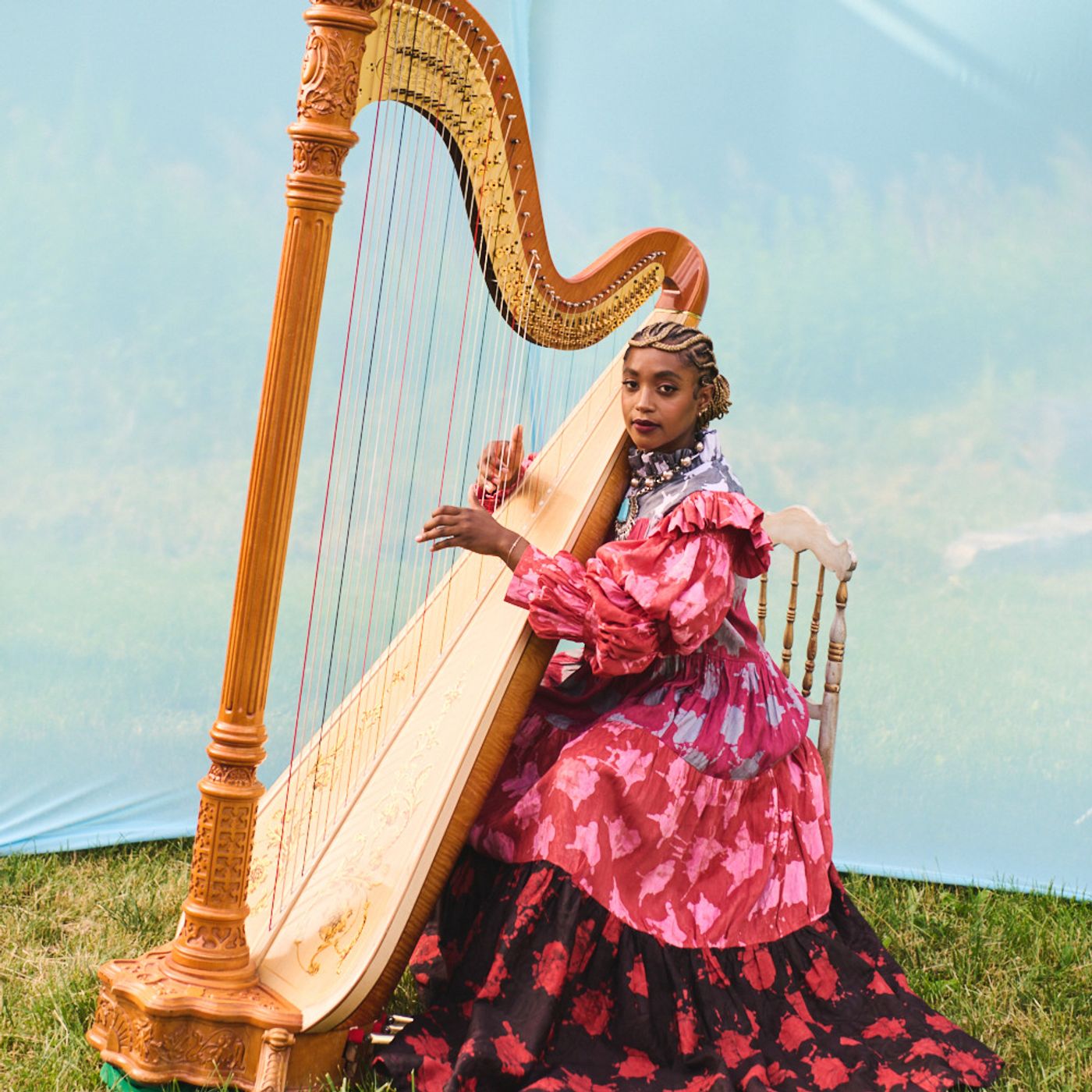
This is all of it on wnyc. I'm Alison Stewart. Musician Ashley Jackson is helping redefine the harp, lending the instrument to spirituals and contemporary music. Her latest EP is named CoverGirl. The project revisits classic hits such as I'm Every Woman and Dreaming My Dreams. Tomorrow night, Ashley Jackson has a show at BAM at 7:30pm but before that, she's here with me to perform a few songs. Live from WNYC's Studio 5, Ashley Jackson joins me now. Ashley, welcome to all of it.
- [01:01]
Ashley Jackson
Thanks so much for having me.
- [01:02]
Alison Stewart
So tell us a little bit about the first song you're going to perform for us.
- [01:04]
Ashley Jackson
Yes. So I'm going to kick things off with my arrangement of Nina Simone's Don't Let Me Be Misunderstood.
- [01:11]
Alison Stewart
Let's hear it.
- [01:11]
Ashley Jackson
All right, Sam. Foreign. Sam,
- [05:04]
Alison Stewart
That was beautiful. That was Ashley Jackson. She's performing at the Brooklyn Academy of music at BAM tomorrow night at 7:30pm we have her in studio with us now. That's from Nina Simone from 1964. You reinterpreted that song Don't Let Me Be Misunderstood. What do you remember about the first time you heard Nina Simone?
- [05:24]
Ashley Jackson
Oh, my gosh. I would say I really started to do a deeper dive into her music when I was recording my last album, Take Me to the Water, and I listened to her version a lot over and over again. And then I started reading children's books about her to my daughter and just trying to absorb as much as I could. And with that, knowing I wasn't quite finished with her music, I was really intrigued by her upbringing as a classical pianist and aspirations to pursue that career. But understanding that in the 1960s there really wasn't a space for African American women to be classical artists, that's so interesting.
- [06:04]
Alison Stewart
You weren't done with her music yet? How did you know you weren't done with it yet? That's so interesting.
- [06:09]
Ashley Jackson
It's kind of like, I don't know, you get into something and then it plants a seed that hasn't quite fully grown yet. Maybe you don't have the time to fully kind of explore what that interest is. And so I just kind of thought, you know, I really want to know more about her. I will Revisit her work once I get Take Me to the Water out.
- [06:29]
Alison Stewart
Yeah. On your new ep, Cover Girl, all of the women you've arranged and performed songs for are very, very different women. Who's on the album?
- [06:39]
Ashley Jackson
So it starts with Nina Simone. And then the second track is I Am Every Woman by Whitney Houston. And then we play a contemporary piece called Udharo Na by Arooj Aftab, and that was arranged by the flattest, Emmy Ferguson. And then I conclude the album with Dreaming My Dreams by the Cranberries.
- [07:01]
Alison Stewart
What was challenging about interpreting these songs for a harp?
- [07:05]
Ashley Jackson
Yes, these are. I liked choosing this music because I felt like they really represented each of the artists in their beautiful, unique voices. And so the challenge was also the inspiration for me to think about what the harp can provide that the originals didn't, and really kind of make the music my own. What does it mean for me and how can I get that through the instrument?
- [07:30]
Alison Stewart
How do you know when a composition is done, when you are finished with it?
- [07:35]
Ashley Jackson
So usually when I have a deadline, in this case, that was what happened. But the beautiful thing about live performance is that I can always make little tweaks along the way. And so I'll present the songs tomorrow pretty much as they are in the program, but I'll recontextualize some of them so that they feel fresh.
- [07:54]
Alison Stewart
We're talking to harpist Ashley Jackson. Her latest EP is titled CoverGirl. She's here to perform a few songs live in WNYC Studio 5 ahead of her performance at the Brooklyn Academy of Music.
- [08:05]
Ashley Jackson
Bam.
- [08:05]
Alison Stewart
For most folks, that's tomorrow night at 7:30pm You've spoken about how you took piano growing up. How did you transition into the harp?
- [08:15]
Ashley Jackson
Yes. So I have two sisters. All three of us took piano lessons when we were young. And my first piano teacher noticed that I loved music from an early age. So a couple of years later, she mentioned to my parents that I might be interested in another instrument. And. And she had a niece at the time who was a young harpist looking for students. And I think because of the similarities between the piano and the harp, she thought that might be a good transition for me to make. And that's how it started.
- [08:44]
Alison Stewart
Do you remember how the harp felt to you the first time you played it?
- [08:49]
Ashley Jackson
I can only imagine, Alison. I was 7 years old when I first began. It was a much smaller instrument. The way I felt about music in general was kind of like my happy place. No matter what I was doing with music, piano, harp, or listening, that's just Where I felt comfortable.
- [09:08]
Alison Stewart
What sound can you get from a harp that you really can't get from another instrument?
- [09:13]
Ashley Jackson
I think one of our most unique sounds is the glissando, and that's kind of strumming the strings quickly and lightly. Sort of the quintessential harp sound.
- [09:22]
Alison Stewart
Please show me.
- [09:23]
Ashley Jackson
Yeah.
- [09:28]
Alison Stewart
Love it.
- [09:29]
Ashley Jackson
Thank you.
- [09:32]
Alison Stewart
First of all, it's a beautiful harp. Will you tell us about this?
- [09:35]
Ashley Jackson
Yes. So this is a salvi. Minerva and I purchased this almost a year and a half ago, and I had to travel around the country to sort of find the instrument that would allow me to be the most musical and be my most authentic self. So it was a really interesting process, actually. Very challenging. But I love her. She doesn't quite have a name yet. Okay. But yeah, we're. We're getting along pretty well.
- [10:01]
Alison Stewart
What were you looking for in a harp?
- [10:04]
Ashley Jackson
Really? The sound? Yeah, that's the most important thing. Harps are beautiful. Does it really kind of matter what they look like? So for me, it really is the sound. And I was looking for something that was earthy, that was soulful, that had a beautiful kind of middle to low register.
- [10:19]
Alison Stewart
We're talking to Ashley Jackson. She's performing for us in WNYC Studio 5. Okay. Our next song is Dreaming My Dreams. Can you give us a little context for this?
- [10:30]
Ashley Jackson
Yes. So I was introduced to the Cranberries by my older sister who had their cassette tapes, and she would play all kinds of music. But I remember the Cranberries. I loved the sort of song, the strong singer, songwriter spirit that they bring to their music. So this is Dreaming My Dreams.
- [10:46]
Alison Stewart
This is Ashley Jackson.
- [10:52]
Ashley Jackson
It.
- [12:34]
Alison Stewart
Sa. You are listening to all of it on wnyc. I'm Alison Stewart. Harpest. Ashley Jackson's latest album is titled Covergirl. She's here to perform a few songs live from WNYC Studio 5 ahead of her performance at the Brooklyn Academy of music. That's Bam. Tomorrow night at 7:30pm okay. I'm gonna give all your bona fides. You received your musical. Your doctorate of musical arts from the Jul School, a master's degree in music from Yale School of Music, as well as from Yale. Wow, that's a lot of education. What's a piece of history that you've learned about the harp that most people don't know?
- [15:05]
Ashley Jackson
So when we are preparing for our comprehensive exams as doctoral students, we are studying music history from the beginning of time to the present, and we are encouraged to also learn about the history of our instruments. And I recall studying and learning about how the harp was refurnished and brought back to life in France at the turn of the century, 1800s. And I remember thinking, this can't be the beginning of the history of this. And if Juilliard isn't the place to explore that, I will come back to that later. And so while it's not a surprising piece of history, I think it's an important one that often gets overlooked. The harp is one of the oldest instruments in the world with roots in Africa, and it has always been associated with storytelling and spirituality.
- [15:55]
Alison Stewart
Part of your research has been around black composers and around Negro spirituals. What do these songs have in common? And how is the harp used in them?
- [16:06]
Ashley Jackson
Wow, Alison, that's such a great question. I think what ties the music together is that thing that can't be explained. Maybe it's eche. It's just sort of an essence, a sort of being of double meanings, of sort of coded layers of understanding. But it also beautiful music lyrics wise and melodically.
- [16:33]
Alison Stewart
Who are some of the harpists who inspired you as a kid?
- [16:37]
Ashley Jackson
Wow. I remember being quite young still, so maybe 11 or 12, and my parents took me to Carnegie hall to see Anne Hopson Pilot, who was then the principal harpist of the Boston Symphony. And she was the first African American to hold that position. And I remember meeting her backstage and being very nervous, meeting her years later and still being quite nervous. But my parents were very intentional about that moment, just to show me that even though there's so few of us who look like me playing this instrument, it is possible to be out in front doing it at a high level.
- [17:13]
Alison Stewart
When did you realize you were going to be a professional musician?
- [17:18]
Ashley Jackson
This was in ninth grade. Right? It's that awkward, you know, beginning of high school, end of middle school, and you're trying to figure out who you are, which, you know, who. What cliques you'll be in. And I was studying at Julia Pre college on Saturdays, where I took harp lessons as well as theory and history, and I won a concerto competition. So I remember sitting backstage before the concert began and just being so grateful that I am surrounded by all these musicians who are my age. We all have this thing together. And for me, that was the moment when I was like, I always need to have my life surrounded by music in some way.
- [18:00]
Alison Stewart
It's interesting. You said you were studying theory and music history. How do those that study help you every day?
- [18:11]
Ashley Jackson
This is a lesson I'm still working on with my students today, but I rely so heavily on my ear first, especially when Making arrangements. You know, I'm hearing songs that I love. I'm trying to figure out the chords and the melodies on the piano and then transferring them to the instrument. So using your ear is crucial, whether you're playing by yourself or with other musicians, so that you can be always speaking the same language. Right. And then for history, it's grounding to know what you are playing and then why you are playing it, to realize that there are humans behind the creation of music, which is something that sometimes gets lost in the study of music. So it just puts the humanity back into the story.
- [18:54]
Alison Stewart
When you're teaching students now, what is it that they want to know? I'm curious about the 21st century students.
- [19:01]
Ashley Jackson
Yes. My students at Hunter College are so knowledgeable already about the world around them, and they want to understand the relationship between what we do in the classroom and all that is happening. And that's hard to do. And so I'm fortunate that I'm able to teach courses that I've designed to try to tailor it to the moment. And so there's one course I'm teaching this semester called Storytelling through Performance. And I'm basically allowing students or reminding them that their own experiences are uniquely theirs, and they are very powerful, and they can translate to a unique voice in performance. So they write their bios, they write artist statements. We do some, you know, values. You know, what are your values? We explore sort of all parts of yourself to remind them that they can bring that individuality to music.
- [19:56]
Alison Stewart
That's interesting. You have them write their values. What's the value of doing that?
- [20:02]
Ashley Jackson
Well, I mean, the course was really designed based on where I am in my career. And Alison, I think a lot about how I've been able to navigate the nonlinear path that is music. And it really is standing on your principles, regardless of what situation you find yourself in, what is always important to you. So that when music can be tough, and it is, sometimes you can always go back to who you are and what you believe in.
- [20:30]
Alison Stewart
That's interesting. That must be hard for young people to hear.
- [20:32]
Ashley Jackson
Initially, it feels a little bit like a therapy session, a little bit. But at the end, I think they're very grateful for that exploration and for the time to reflect on those things.
- [20:44]
Alison Stewart
We're talking to Ashley Jackson. Her latest album is called Covergirl. She's here to perform a few songs live in WNYC Studio 5 and ahead of her performance at BAM tomorrow night at 7:30. What are we gonna hear tomorrow night at 7:30 at BAM?
- [20:58]
Ashley Jackson
That's a great question. So we'll hear, of course, music covergirl, but as well music from my other projects. So I'll play a few tunes from Take me to the Water, which was released in 2025. I will throw in a couple of pieces from Ananga, which is my debut solo album, and perhaps preview what's coming up next.
- [21:18]
Alison Stewart
It's sort of interesting. CoverGirl made me laugh when I first heard it. And then I listened. I was like, oh, I understand what this is about, CoverGirl. And I wondered what you thought a harp provides for these songs that are so recognizable from the women's voices. What does the harp do rather than having women's voices?
- [21:43]
Ashley Jackson
Honestly, Alison, I was mostly inspired by vocal music growing up, and that's where CoverGirl came from. Hearing how these women would bend notes, take their time, and just be put every feeling into every word. That's something that we can do as harpists, and it's an interesting exercise to take the meanings of words and try to play them as instrumentalists. I think it's a great exercise that we should all do.
- [22:11]
Alison Stewart
What's the last song we're going to hear today?
- [22:13]
Ashley Jackson
Yes. So we're going to hear the title track from my last album, take Me to the Water.
- [22:18]
Alison Stewart
This is harpist Ashley Jackson performing for us live in WNYC's C Studio 5.
- [22:49]
Ashley Jackson
Sam. Sa.
- [27:07]
Alison Stewart
Ashley, thank you so much.
- [27:08]
Ashley Jackson
Thanks so much for having me.
- [27:14]
Liberty Mutual Announcer
And Doug, there's nowhere I wouldn't go to help someone customize and save on car insurance with Liberty Mutual. Even if it means sitting front row at a comedy show.
- [27:23]
Alison Stewart
Hey, everyone. Check out this guy and his bird. What is this, your first date?
- [27:27]
Liberty Mutual Announcer
Oh, no. We help people customize and save on car insurance with Liberty Mutual. Together we're married. Me to a human, him to a bird.
- [27:34]
Alison Stewart
Yeah, the bird looks out of your league anyways.
- [27:36]
Liberty Mutual Announcer
Get a quote@libertymutual.com or with your local agent.
- [27:39]
Alison Stewart
Liberty. Liberty. Liberty. Liberty.
- [27:42]
Progressive Insurance Announcer
WNYC's journalism and storytelling is heard by millions of passionate listeners. Sponsors of our programming gain our listeners attention and their respect. Learn about how your organization can support WNYC and wnyc studios@sporship.wnyc.org.