Loading summary
Transcript79 lines
- [00:00]
Dr. Horton Advertiser
Your new home is now ready. Dr. Horton, America's builder, has new homes that are ready today. With new construction communities throughout the Puget Sound and Central Washington areas And more coming, Dr. Horton has the right home for you at Dr. Horton. We're still building with more construction, more communities and more homes available every day. Tap your screen now or visit drhorton.com to find your new home now ready. Dr. Horton, America's builder and equal Housing Opportunity Builder.
- [00:30]
Fidelity Go Advertiser
When you invest with Fidelity Go, it does all the work for you. So while Fidelity Go monitors the markets, rebalances your portfolio and tracks your progress to keep your investments aligned with your goal, you can invest your time however you want, all while paying no advisory fees. Under 25k. Invest your money, not your time, with Fidelity GO. Get started@fidelity.com go Advisory services offered by Strategic Advisors, LLC, a registered investment advisor. Brokerage services provided by Fidelity Brokerage Services llc, Member NY ISC and SIPC there's
- [01:01]
Dr. Horton Advertiser
an SUV that turns the unthinkable into the unforgettable. The new Nissan Pathfinder. Built for big adventures and all that family chaos. It's powered by a strong V6 engine with a nine speed automatic transmission. Inside, it's rugged and capable, but still premium and tech forward with room for up to eight passengers. It's also available with seven passenger seating and second row captain's chairs with massive hauling capability. Now you can bring all the gear you and your family need for unforgettable Adventures. The new V6 Nissan Pathfinder. Power your adventure.
- [01:40]
Alison Stewart
This is all of it on wnyc. I'm Alison Stewart. A new exhibition of artist Carol Bouvet's work fills the Guggenheim's quarter mile long spiral rotunda. Known for her monumental steel compositions. The New York Times calls Bovet one of the country's most imaginative and esteemed sculptors. The new show moves in sort of a reverse chronological order, reflecting on how Bovet's work has changed through the years. On the lowest level of the rotunda, it features colorful towering sculptures made in 2026 and then as you make your way up the spiral all the way to the top, you'll see early 2000s installations. The exhibit will be on display at the Salomon R. Guggenheim museum through Sunday, August 2nd. Joining me now is artist Carol Beve. Hi Carol.
- [02:28]
Carol Beauvais
Hi Alison.
- [02:29]
Alison Stewart
And Gunaheim Curator Kathryn Brinson, who organized the exhibition. It is nice to see you as well.
- [02:35]
Kathryn Brinson
Nice to see you.
- [02:35]
Alison Stewart
Thank you for having us and anybody who wants to take a look at some pictures. I took a whole bunch on Sunday, and I put them on our Instagram stories at Olive nyc. Kathryn, it's such a distinct layout at the Guggenheim. What were some of your earliest conversations with Carol about how you would line the walls with her work?
- [02:57]
Kathryn Brinson
We've been working on this for a long time, for many, many, many years. I mean, of course, it always takes some years to put together a major exhibition at the museum, but this one really has been a long labor of love and an ongoing conversation between us. So early on, there were different manifestations. At one point, I remember, we work in models. We have a series of round models where each of the ramps is out on a giant tabletop, and we play with miniature versions of the work. And I remember there was one version in the models that was completely achronological with these very intuitive pairings of the work. But ultimately, we felt like the unwinding through time was really effective. So you step into the current creative moment for the artist, and then you trace back the. The origins of how she got to the current moment. But there was also an element of necessity in that. The very recent works that you mentioned are large and very heavy. So it was great to have those at the bottom of the spiral. And then you have this natural feeling of ascension as the work's materiality lightens as you rise through the spiral up towards the light that's coming in from the skylight.
- [04:25]
Alison Stewart
Carol. Oh, please.
- [04:26]
Carol Beauvais
Sorry. I was just gonna say that it's the intention and the meaning of the building that there's a spiritual ascension. And so that, yeah, the story of my work backwards getting lighter. Yeah. Just seemed to sift things in this chronological direction. But I. We. We have actually been working on the show for about 10 years, but not full time. There was some, like, periods where it was more in the back of the refrigerator, and there was Covid. And in the last 10 years, of course. But we've had a lot of time to really think about it, and I suspected that you were wanted reverse chronological all along and that as a curator, I just want to say you're just so great, just such a genius, and really, like, let me play in the sandbox for, like, eight years.
- [05:33]
Kathryn Brinson
And then
- [05:36]
Carol Beauvais
applied a little bit of gentle pressure, firm pressure, as one knee, to sort of like, to direct in your very authoritative and sensitive way.
- [05:49]
Kathryn Brinson
Well, it has been a joy to be in that sandbox. Just pure joy. And Carol's generosity of spirit has shone through every moment of our work together over the course of that decade. But, no, I do think it really helps to have some Element of structure that the really broad audience that we have at the Guggenheim can kind of orient themselves through. And this was. This was the one that had a sense of, as Carol said, revelation. Even this sort of ecstatic ascension, which. Which does go back to this founding idea from Hilara Bay, our first director, and Frank Lloyd Wright, that the Guggenheim spiral should be a temple of spirit where you have this really luminous communion with art and architecture and your own imagination and have that really transcend encounter.
- [06:45]
Alison Stewart
How did you decide what work you would pick to be part of this exhibition, Carol?
- [06:53]
Carol Beauvais
Because it was such a long period of development, a lot of the work was made for the show. So the most recent work is at the bottom is new, and it was built for the building. And one of the features in the building is this two story high room. So I wanted something that was really tall. It was the right scale for that room.
- [07:29]
Alison Stewart
When you look at that piece and that sort of. That first gallery, it has two different perspectives because you can be in it and then you go up a little bit and you can look over the side at it down. Did you think about the perspectives from people who would be looking at it from the top versus people looking at it from the bottom?
- [07:46]
Carol Beauvais
Yes. I work in models, but I work in one to one models. So I built that room in my studio so that I could get on. I mean, in some ways it was very lightly inscribed. I didn't have to build the entire room, but I knew where the walls were. And then there was a platform where stand and see what the perspective was from the higher level. But, you know, otherwise without. So the architecture is modeled, but the objects are improvised in relation to that negative space.
- [08:28]
Kathryn Brinson
I would also add that Carol really works with space as much as she works with objects. And I've never known an artist be so sensitive to sight lines and the optical experience of being in a body in an unraveling spiral. And the way her decisions really surface the weirdness of the building. It's a really unusual experience.
- [08:53]
Carol Beauvais
It's true. And I think that people. I mean, people don't talk about the space that much. I mean, but if we could insure it or something, like if it had some kind of commercial, you know, comprehensibility, it would be a different story. And like, because it sort of is nothing and it resists language, then it doesn't really get talked about. But thank you. Because it is so. It's so important. So, yeah, the space. And also our body in space. And so, yeah, then the other. Some of the Other building blocks, aside from, you know, wanting to make something for this particular room was to welcome the viewer and have some resting points on the ramp. I always feel, I mean, I'm a sitting down in museum zealot. It's like, this is my cause.
- [09:55]
Alison Stewart
Right.
- [09:55]
Carol Beauvais
And I think that it, like, actually is. It can be part of the transformation of the world. Because when you're physically welcomed into a space, when you're accommodated as a human being who has a body, that means you're like, you exist. That we recognize each other, that we can then have sympathy for ourselves and sympathy for each other. Right. So it's a really basic but also just incredibly important accommodation.
- [10:35]
Alison Stewart
Yeah. It's funny to see the couches. I was like, that wasn't here last
- [10:37]
Carol Beauvais
time I was here.
- [10:40]
Alison Stewart
I'm speaking with artist Carol Beauvais alongside Guillen Gunheim curator Kathryn Brinson. They're talking about a new exhibit, new exhibition that includes everything from assemblages of paperback books on wooden shelves to paper collages to towering steel sculptures, all belonging to the artist Carol Beauvais. So I want to talk about the. The steel images a little bit, Catherine. They have a sense of movement. They're like all draped over one another, but they're obviously static. What's interesting to you about this juxtaposition?
- [11:13]
Kathryn Brinson
Yeah, I think something I got really hung up on when we were writing the wall text was the word monumental. Because as you say, they're 14 foot high, towering totemic forms, and they are made from this immensely rigid, heavy, intractable material. And yet they are so playful and kinetic, and they do appear to be dancing in space. And their colors are gorgeous and glorious, but they're also slightly clashing and slightly unsettling. So it's not this austere sort of monumentality that stands on its dignity. To go back to what Carol was saying in terms of the larger spirit of the show, it does invite you into that space. And there is an interesting play with the idea of sort of impressive or awe inspiring scale, because they're crowded into that fairly constricted space, even though there are these two partial viewpoints from the bottom where you can see the dancing feet and the half moon overlook where you can sort of see the quote unquote heads of the sculptures. And I think that's an interesting discussion we had about your play with scale.
- [12:37]
Carol Beauvais
Yeah, yeah. Well, in general, you can't with monumental sculpture, it has. It's dominating. And with these or the things that I'm interested in, they tend to Be more something that you empathize with. I think. I think empathy is an important entry point for them. And with these large scale works in the high gallery, you can never really get a handle on the whole. On the whole. So you're always sort of like seeing part of it or being part of it. And I think this is like a non dominating mode. But I think this scale is monumental, undoubtedly.
- [13:30]
Kathryn Brinson
So we did use it in the context as a factual statement, but they play with monumentality and anti monumentality at the same time.
- [13:39]
Carol Beauvais
Right.
- [13:40]
Alison Stewart
Something I thought was interesting and I would love to get your take on it, Carol, is there were a lot of children at the exhibition.
- [13:47]
Carol Beauvais
Yeah.
- [13:48]
Alison Stewart
Tell me what you think of that.
- [13:50]
Carol Beauvais
There are children all over the Guggenheim. Children are the best audience. Tell me about the smartest.
- [13:57]
Alison Stewart
What makes you say that?
- [13:58]
Carol Beauvais
No, I don't know. They just haven't been hypnotized into like some of our maladaptive ideas. And they're really curious. Right. And I just think that if you could feel welcome in a museum, like I'm a zealot. Right. I think art can change the world. And I think sitting down in a museum would also add to that. And kids, of course, need to sit down. And if you're a mom or a caregiver and you have little kids with you, it would help if there could be like a tumbling zone. That would make it easier for you to go as well. But. Yeah. So if you're a kid and then you feel welcome in a museum, then you feel welcome forever. And I think there's a lot of invisible barriers with museums. There's so many people I know who have so much education, but not in art, who feel dumb in a museum. And this is a problem.
- [14:55]
Alison Stewart
Yeah. You shouldn't feel dumb in a museum.
- [14:57]
Fidelity Go Advertiser
Right.
- [14:58]
Carol Beauvais
And people do. And I think a lot of people have secondary education won't even go in a museum because it just seems too intimidating.
- [15:05]
Alison Stewart
Where are they? Let's go get them.
- [15:07]
Kathryn Brinson
I know.
- [15:07]
Carol Beauvais
Come welcome. Because it is gonna be so. There's plants and there's tea and everybody's gonna be really friendly to you. Yeah. At the museum. At this museum.
- [15:18]
Kathryn Brinson
Carol and I are both, you know, in the trenches of parenting. We're both moms, and on a practical level, we're used to being with kids in. In those spaces which sometimes have an institutional formality. And we were interested in. In breaking that down a little bit. But I'd also say in a more philosophical sense, I think a lot of our greatest artists manage to retain access to that more open ended and flexible way of thinking that a child has, which you alluded to, that capacity of, for wild imagination and wonder. And I think in some ways great work takes us back to that state.
- [16:03]
Carol Beauvais
And don't you think that the kids mentor the adults? Totally. In the exhibition, yeah.
- [16:11]
Alison Stewart
I'm speaking to artist Carol Beauvais and Guggenheim curator Katherine Brinson. We'll have more after a quick break.
- [16:17]
Kathryn Brinson
This is all of it.
- [16:28]
Alison Stewart
You're listening to all of it on wnyc. I'm Alison Stewart. I'm in studio with artist Carol Beauvais and Guggenheim curator Kathryn Brinson. We're talking about Carol's exhibition at the Guggenheim Museum titled Carol Beauvais. A Lot of New Yorkers, Carol, will know you from your glyph on the High Line. First of all, explain what a glyph is.
- [16:50]
Kathryn Brinson
Right.
- [16:50]
Carol Beauvais
So a glyph is the smallest unit of a language, written language. And I was looking at Plaza Art. When Was this? Around 2012, 2011. And for some reason got the idea that I wanted to make a letter in this Alphabet. I perceived it as an Alphabet because you know how artists will have a signature style. But when you're a Plaza Artist artist, you have like a, like a glyph. You. It's so succinct that your style needs to be legible as this one unit. So Calder has such a great glyph and you know, there's different ways that you express your Calderness, but it's very legible. So I wanted to make one of those. So it had certain rules. This, my glyph and this glyph. Turned out that the rules are that it is, you know, tube, round, tube, steel, has a certain turning radius and can be a circle or a half circle or a quarter circle and make sort of a bit of a tangle out of this material. Painted white and very glossy, no hand. That's sort of like part of the rule. It just looks glossy, like it's sort of photoshopped into the landscape.
- [18:19]
Alison Stewart
And we see glyphs in this exhibit. I'm curious, lots of different colors are used. How do you decide when a color is to be used on your steel work?
- [18:29]
Carol Beauvais
Well, with the glyphs, they have to be white.
- [18:31]
Alison Stewart
Glyphs are white.
- [18:34]
Carol Beauvais
And then the colorworks came out of this idea of like, well, I'm not going to make a new letter for this Alphabet. And it didn't really go that way. But that was where they came from, was trying to make the second type of glyph. And the colors Come from? I think I really couldn't say, do
- [18:54]
Alison Stewart
they just come to you?
- [18:55]
Carol Beauvais
They don't just come to me. It's as if I have the feeling that there's a set of colors that I can use, but I have to discern them. That exists, that I'm not inventing it, I have to discover them, but that they already exist somewhere.
- [19:15]
Alison Stewart
Katherine, in an interview with Vogue magazine, you said traditionally steel sculpture was thought as a very masculine endeavor. How does Carol disrupt that?
- [19:27]
Kathryn Brinson
Yeah, I mean, I want to be careful to not be too simplistic about a kind of gender based binary. But I think something we've, we've talked about a lot is this idea of effortlessness in Carol's work. You know, again, this need to not, not impress upon the viewer how difficult the process was, how immense the material is. Instead, that is almost deliberately erased. And it's made, as you said, much more human. People often respond to the collage sculptures, which are these manipulated steel forms, as having something of the body about them, perhaps, you know, a draped fabric. Some people perceive them to be made of paper or a crumpled piece of paper. So, you know, you're really not inviting that tradition of, as you said, domination or a demand for attention. It's more of a entangling you imaginatively in that moment, which I think is a very different effect.
- [20:57]
Alison Stewart
Carol, how do you know when a sculpture is finished?
- [21:05]
Carol Beauvais
I. It's. I have a. Yeah. Voice in my stomach that says it's finished.
- [21:13]
Alison Stewart
You just know.
- [21:14]
Carol Beauvais
I mean, I hear the voice.
- [21:17]
Kathryn Brinson
Intuition.
- [21:18]
Carol Beauvais
Yeah. But do you mind if I tag something on? Hook something onto this idea that, you know, a lot of the sculptures have, are illusionistic and they look soft, but they're, they're hard. And so people really want to. People want to verify the material by, you know, touching them, which I am so flattered by, because that means it's working. It's like that you actually, you're, you're drawn to it. You want to touch it. And, and again, like I've, as I've already stated, like, I believe in people being whole and having a. Being an embodied awareness, but not everybody. If people touch the sculptures, then they're going to get damaged. So this is why we have a tactile gallery. I was going to ask about that and the museum. So you can go touch. You can verify what the surface would be like and explore with your hands and manipulate the materials and sort of like, feel what they would be.
- [22:32]
Alison Stewart
Kath. I was gonna ask about the touching library. Describe the touching library to You. Which is part of the exhibit. Exactly.
- [22:38]
Kathryn Brinson
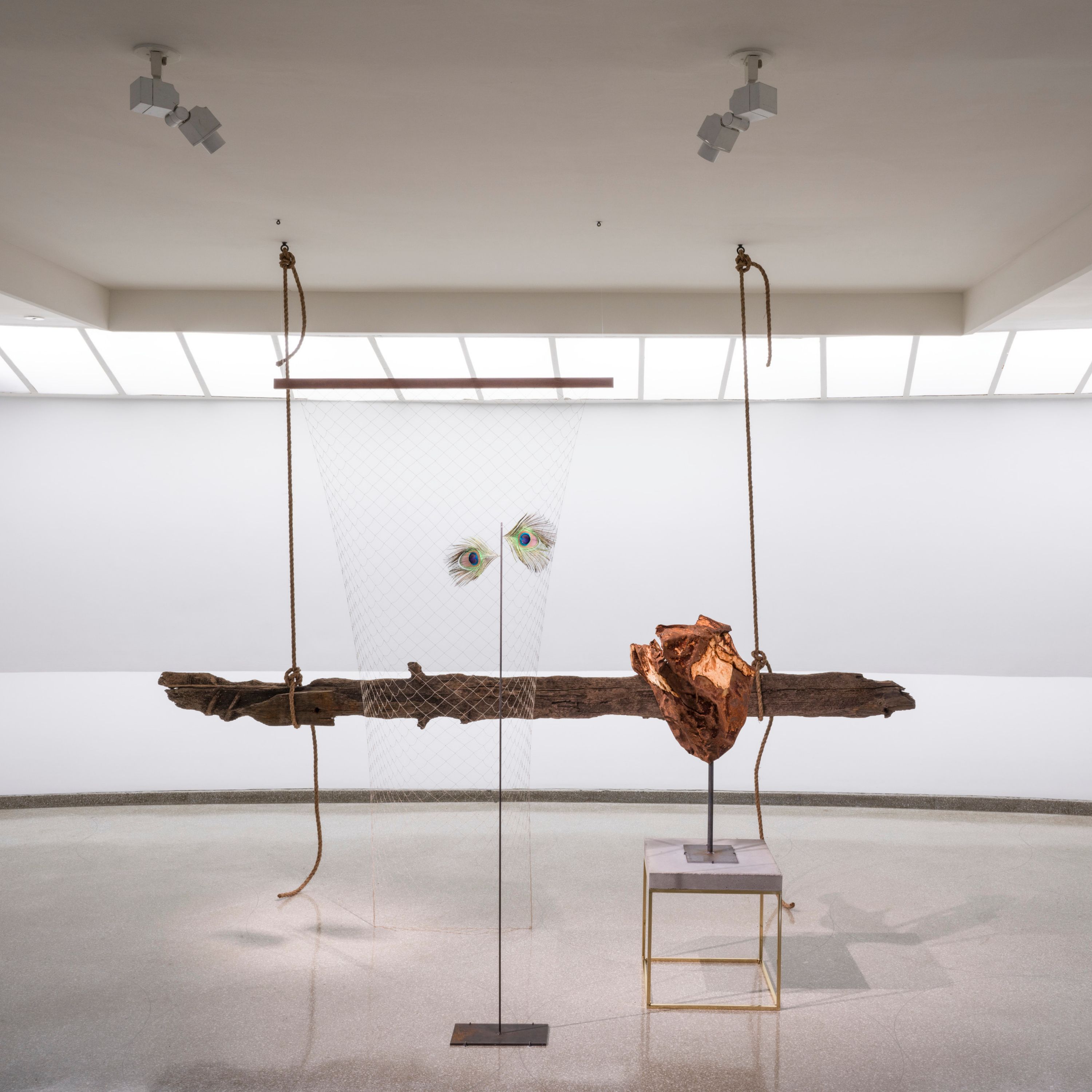
It absolutely is a very core part of the exhibit. So if anyone's visited the Guggenheim before, you might remember that halfway through the second ramp, there's a little keyhole shaped door. It's very Alice in Wonderland. And it's always this very cozy little library room, a reading room, where we have supplemental material to help you understand the shows and take a breath. But Carol has really transformed it into this wholly interactive space. So not only can you touch a peacock feather or a piece of driftwood or a piece of the painted surface of the. Of the manipulated steel elements, you can also create some of the beadwork that's featured. There's a little mini hydraulic press that both adults and kids have been very delighted by so far. You can read the books that are featured in Carol's early bookshelf sculptures because it is very tempting to interact with that material, although they very much become sculptural elements in those early assemblages. So, you know, Carol and I have talked a lot about how, while, as mentioned, it is very necessary that we keep our work safe and don't encourage touching just because the surfaces are really, really fragile. To achieve that illusion of a suede like skin, like finish in the paint takes an enormous amount of effort. But there can feel like this sense of subtle loss or frustration that you can't fully bodily interact with things. So we hope to redirect that. That desire to the tactile library, as we're calling it. And I have to say the response has been surprisingly glowing. Just the sheer novelty of being able to have that insight into what it feels like to work with materials in the studio. Carol's really generously provided all of this material from her studio. And even. Even your colleague, as we were, as we were waiting to join you, was speaking so eloquently about the experience of the tactile library. So we were very happy to hear it.
- [24:57]
Alison Stewart
I want to ask you about one of your older pieces before we run out of time from 2011. You have the foamy saliva of a horse, and you use all kinds of different medium in a piece like that, a seashell. What drew you to those objects? At that time?
- [25:18]
Carol Beauvais
I think I was working with ambivalence about. Well, I could enter it in so many different ways because. But one of the things was ambivalence about work that I had struggled with as. As a younger person that I thought, I don't know, that I'd kind of disavowed like this. This in The Bay Area where I grew up, that I. There was this kind of junk assemblage artwork that I knew about. And so then. And when I came to New York in the early 90s, then I disavowed it. But then after having been here for a while, I started to just like. I mean, I'm always very drawn to the thing that I'm embarrassed about. That seems like a taboo. And so it was partly like being drawn towards a taboo. And at the time, this is hard to. It's always, like, hard to remember, you know, how trends unfold and how certain things look good now, but they didn't look good at the time. At the time, surrealism was pretty taboo. And now it seems like there's not. It doesn't have that same. People don't have that same inhibition about it. But at the time, surrealism seemed like off limits. And so I was like. That made it very sexy to me.
- [26:41]
Alison Stewart
It was really interesting because you see these things at the top of the rotunda of, like, driftwood and peacock feathers. And then you remember, six floors down, I was looking at these huge sculptures. When you look at it as a whole, I'm just curious, like, what do you feel about your work when you see it as a whole 25 years?
- [27:01]
Carol Beauvais
I mean, I'm really. I was scared to look at the early work. And of course, as an artist, I always want to look. We want to look at the latest thing, you know. And this was part of Catherine's wise counsel, where she was like, okay, so you've been playing for a while, and now why don't we do this chronology? And also she really advocated for the storytelling of how. Of demonstrating how one thing folds into
- [27:32]
Kathryn Brinson
or sort of unravels back.
- [27:35]
Carol Beauvais
Yeah, yeah. One thing leads to the next or unravels, depending on which way you're going. And that. She told me I hadn't really thought about it because I don't think about myself from the outside, but that people. I don't know. Some people that she knows think that there was a radical pivot in my work, and she wanted to demonstrate that there actually wasn't. That actually one thing just follows from the next.
- [28:02]
Alison Stewart
I've been speaking.
- [28:03]
Carol Beauvais
Is that right?
- [28:03]
Kathryn Brinson
Yeah, absolutely. No, I think just because things look very different on a superficial level doesn't mean that the way they're kind of functioning as artworks is that different.
- [28:13]
Alison Stewart
The name of the exhibit is Carol Beauvais. I've been speaking with artist Carol Beauvais and curator Kathryn Brinson about the new exhibition at the Guggenheim. It's on display through Sunday on August 2nd. Thank you so much for being with us.
- [28:28]
Carol Beauvais
It's been a pleasure.
- [28:29]
Kathryn Brinson
Thank you.
- [28:31]
Alison Stewart
On the way. Cybil is a duo consisting of sisters Chloe and Lily Holgate. We'll hear them perform live in WNYC Studio 5. That's right after the news.
- [28:44]
Dr. Horton Advertiser
Your new home is now ready. Dr. Horton, America's Builder has new homes that are ready today with new construction communities in Ellensburg and throughout the Greater Seattle area. Dr. Horton has the right home for you at Dr. Horton. We're still building with flexible living spaces, smart home technology and two and three car garages. More communities and more homes available every day. Find your new home in Ellensburg now ready@dr. Horton.com Dr. Horton, America's builder and Equal Housing Opportunity Builder when you Invest
- [29:15]
Fidelity Go Advertiser
with Fidelity Go, it does all the work for you. So while FidelityGo monitors the markets, rebalances your portfolio and tracks your progress to keep your investments aligned with your goal, you can invest your time time however you want, all while paying no advisory fees. Under 25k. Invest your money, not your time, with Fidelity GO. Get started at fidelity.com go Advisory services offered by Strategic Advisors, LLC, a registered investment advisor. Brokerage services provided by Fidelity Brokerage Services, llc, Member NYSE and SIPC.