← All Of It with Alison Stewart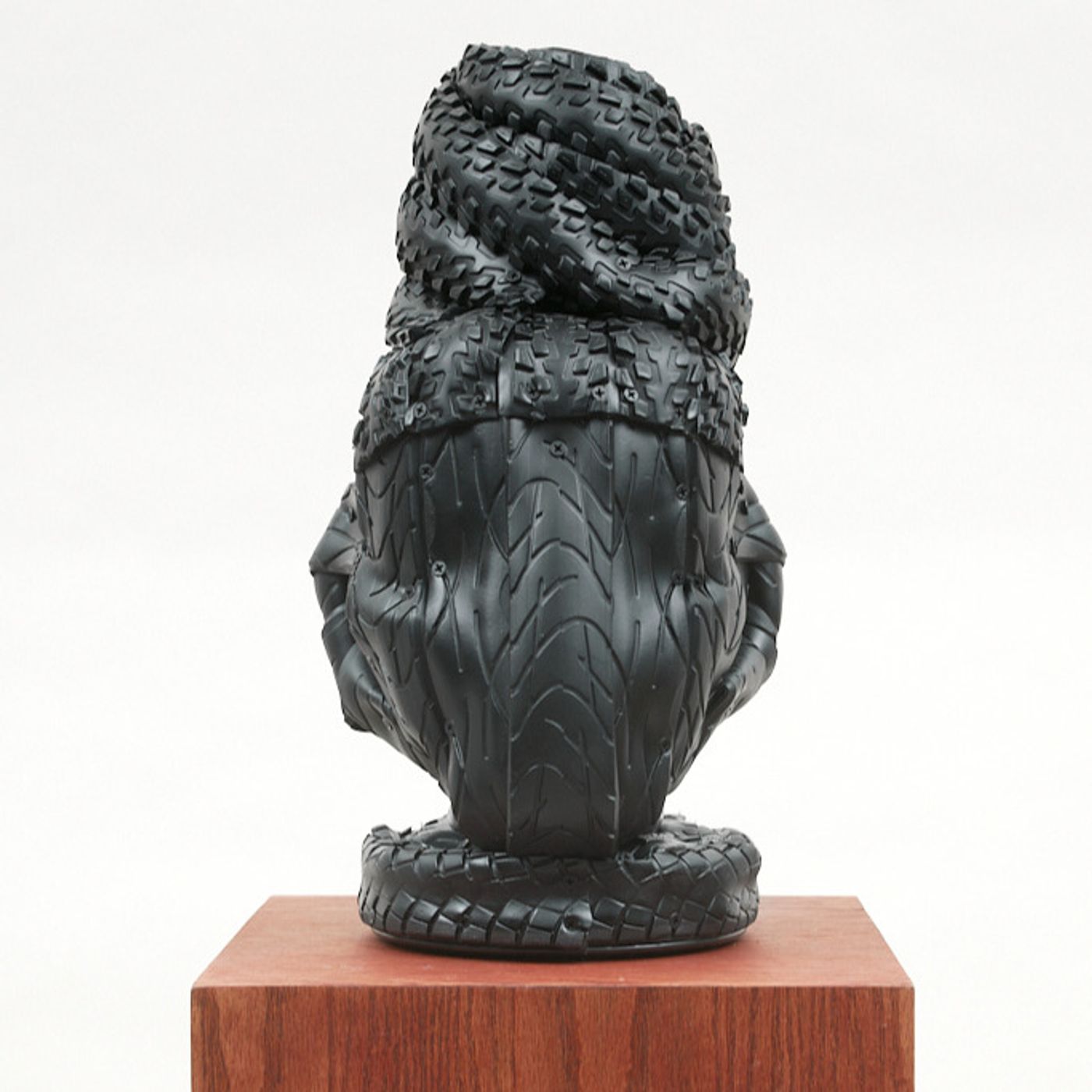
All Of It with Alison Stewart
How Artist Kim Dacres Combined Love Songs and Tires into Sculpture
00:15:56
Loading summary
Transcript53 lines
- [00:00]
Alison Stewart
Foreign.
- [00:09]
Interviewer/Host
This is all of it on wnyc. I'm Alison Stewart. Artist Kim Dacre usually begins her day into the studio with music. And recently, in response to the stress and turbulence of the world, Dacres has turned to love songs. That's why many of the pieces in her latest solo show are named after Kim's favorite love song. Find out which song in just a minute. Kim's makes sculptures out of rubber and discarded tires that she sources around the city. Specifically, she uses the tires to create busts of black women featuring intricate weavings of different hairstyles. Her latest work is on view in a solo show called Lost on a Two Way Street. The show features Kim's first works with color and new pieces she calls Medallions. The show is on view at the Charles Moffat at 396 Broadway on the second floor. And it's up through June 20th. You can see some of the work on our Instagram at Olivend. And with me now is Kim Daicres, who first joined us back on May 19, 2023. It's nice to see you again on May 20, 2026.
- [01:13]
Kim Dacres
Oh, thank you for having me, Alison. I appreciate you.
- [01:16]
Interviewer/Host
So you usually begin your day with music in your studio, and you've been listening to love songs. Why did you gravitate towards this kind of music for these specific pieces?
- [01:26]
Kim Dacres
Well, I think I'm an old soul in general, and music is always something that's been ongoing in my home, from the radio to albums playing viny and love songs have that kind of, like, yearning and desire, but also a tinge of, like, rage and anger and the desire to be better. So it just felt like it's something I can sing along to. And it's a cathartic release from my heart when I start my day.
- [01:53]
Interviewer/Host
If you read the title of the pieces in the show, until the ocean
- [01:56]
Alison Stewart
covers every mountain high we dream of life and life becomes a dream. You realize we're talking about Stevie Wonder,
- [02:04]
Kim Dacres
the legend, the poets, the awesome, amazing, the song as.
- [02:09]
Interviewer/Host
Why is that special to you?
- [02:11]
Kim Dacres
Well, Stevie Wonder, again, just a musical and poetic genius. And I love the song as because of the inversions that you see in there, the metaphors that he's using. He's saying, I'm loving you until everything is upside down, inside out the world is turned upside down until the rainbows burn the stars out in the sky. And that loving you is the same as loving me. That is something that I feel like I needed to feel every single day. Like, okay, I can love. The love has no limits.
- [02:41]
Alison Stewart
Yeah, I'm talking to Kim Dacres. We're discussing a new exhibit of her work called lost on a two way street. It's on view through June 20th at Charles Moffat at 396 Broadway. When you look at your sculptures, I mean, it just shows you how. How intricate they are, how intricate the hairstyles are. First of all, what's required of the material to get to the point where it's that flexible to be woven into the level of detail that you do?
- [03:12]
Kim Dacres
Well, there's a lot that goes into the process. I, as you know, collect on tired Tuesdays. So all the work isn't an example of an accumulation over the last few weeks, Months, in some cases years. So in the cutting and cleaning of the process, I have to cut away the tires from the rim so they become a ribbon that I can use and hold them in place with screws and layer them to form the skin and the muscle. So it's very labor intensive. It's not an easy process, but in each one, each tire allows me a chance, an opportunity to, like, contemplate the texture of a person and where that person may have been or where the material has been in the journey and how those things all come together.
- [03:52]
Alison Stewart
Why do you keep coming back to that particular material?
- [03:55]
Kim Dacres
I really think there's the olfactory aspect of it, the smell.
- [03:59]
Alison Stewart
Oh, really?
- [04:00]
Interviewer/Host
Okay, wait, tell me more.
- [04:03]
Kim Dacres
There's something really particular about the smell. It reminds me. Me of home. It reminds me of going places. It reminds me of, like, motorcycle riders, like rough riders going through the streets in Harlem. It just reminds me of a sense of, like, unabashed freedom and joy. So the smell, I never get exhausted by it or tired of it. Yeah.
- [04:24]
Interviewer/Host
So when you're on Tire Tuesday, that's what you told us last time. You know, it's the. But you. You. You have this concept of collection season. But I'm wondering about this. Winter was kind of rough.
- [04:34]
Kim Dacres
It was not just kind of rough. It was super duper rough. How did that affect you? Well, made me double down on my routine. Okay. So I. Especially when we had to go through, like, the plowing and the snow. I don't want to trigger anybody by going back to the wintertime, but it made me double down. It's hard today to go back to the wintertime, but go ahead. You're right. 95 degrees today, but it made me double down on my routine and really realize that Tuesday is an anchor in my week and that seeing the gentleman in my community who I collect tires from regardless of whether they have salt on them or glass or pebbles or whatever. Like, they bring me joy. My boyfriends at the bicycle shop, they know who they are, and they know why I call them my boyfriends. So treating that day as sacred, it made it feel like everything was like a nice fresh start and I was able to work at my own pace, even though, like, the environmental world is so distracting and was so overwhelming during the winter.
- [05:36]
Interviewer/Host
The show also features the use of color.
- [05:39]
Kim Dacres
Yes.
- [05:39]
Interviewer/Host
In your work. Why did you decide to introduce color?
- [05:43]
Kim Dacres
Well, it's something that I've been playing around for a little bit in a few ways. First, there's, like, the valves that you use to inflate, the brass valves that you use to inflate the inner tubes. I've used those as a kind of, like, sense of release and a crown in different decorative ways. And then that started to be gravitated towards this, like, brownish reddish color that felt very ancestral, very terracotta, and was inspired by this famous cemetery in Jamaica where my parents are from. It's called Dovecot, and it's characterized by having this very reddish, brownish color. So I was like, ooh, this has the ancestral calling that I really am looking for. And then when I was listening to AZ and seeing until the oceans cover every mountain high, I was like, okay, this piece has to be blue. This piece has to be blue. And it's gotta be the kind of blue that reminds me of, like, that expo whiteboard color blue and ocean blue. It's gotta be very, like, not just cerulean, but, like, it's gotta have that rich feeling. So that way it brings out the patterns in the tires.
- [06:53]
Interviewer/Host
You also, your sculptures are in the form of sort of the classic bust. What interested you about making busts of your subjects?
- [07:05]
Kim Dacres
It's an automatic elevation of a body, a spirit, an idea. It's saying that there is. This is an example of something or someone who is knowledgeable, who's respected, and I think we need more of that, universally respect. And I think we need more of that in our community, especially in my community.
- [07:26]
Interviewer/Host
My guest is Kim Dacres. We're discussing a new exhibit of her work called lost on a two way street. It's on view through June 20th at the Charles Moffat Gallery. You list a bunch of sort of inspirations, whether it's like, the Miseducation of Lauryn Hill or. Or a lecture series by Jelani Cobb. What do you like to consume? When you're creating media, do you like to consume?
- [07:52]
Kim Dacres
I think it depends on Every day starts with music, full stop. But throughout the day, like, it could be anything from watching all seasons of the Pit so far. It could be the 20 seasons of Grey's Anatomy. It could be the Wire, it could be podcasts, it could be authors, or like Octavia Butler. And listening on audible. Something that I find very engag that in some ways wrestles with a lot of the things that we're wrestling with in our society right now, like healthcare, like policing. All types of the stories that touch on those themes are the things that usually consume during the day when I'm working.
- [08:33]
Alison Stewart
This just in. The Charles Moffat gallery is at 394 Broadway. Not 396.
- [08:39]
Kim Dacres
394 Broadway.
- [08:40]
Alison Stewart
394 Broadway. And we'll make sure we put that on the when this re airs.
- [08:45]
Kim Dacres
Thank you.
- [08:46]
Alison Stewart
My guest is Tim Kim Dacres. The name of the exhibition is lost on a two way street. It's on view through June 20th at the Charles Muff Gossip Gallery at 394 Broadway. All right, I love that there is Patrice Russian. We can bring her up. Hands up in the air. Right, right, right, right.
- [09:05]
Kim Dacres
Saying you forget me, not. The clap is essential. The clap is so essential.
- [09:15]
Alison Stewart
Oh, my goodness. This just made me laugh. They are part of your wall based series, medallions. Talk to me about medallions. How'd you get started?
- [09:26]
Kim Dacres
Well, two things. First, I had the blessing and privilege of being able to show in Paris this past fall and take my mom. So we went to the Louvre and I got a chance to see, like, these mementos and see these, like, paintings and figures that are like, love, love representative of love songs or love letters across space and time. So I was really obsessed with the shape and I was like, oh, this is something that I can do where I can have a combination of like a bas relief and this, like, love song or love letter to people in Harlem. And I would be walking down the street and see a hairstyle and then hear that clap in my head that's like, okay, this is top bun and two chains. You've got that going on. You've got a great energy. So I want to make sure that I can place that and honor that presence in my community. The shape of the medallions is inspired or the template of it came from a mirror that I was gifted from a friend of mine who also lives in Harlem. And I have a rectangular mirror that's almost the same shape and size. So I used it as a template because it reminded me that there are actual people in my community who love and adore me. And there are people in my community who I love and adore, even though they don't know that I love and adore them.
- [10:44]
Alison Stewart
Oh, that's kind of sweet. I'm gonna switch gears a little bit, and I'm gonna talk about the political nature of our world right now. Because you made these in the past 18 months.
- [10:57]
Kim Dacres
Yes.
- [11:00]
Alison Stewart
I have to imagine you had to respond to certain issues in certain ways as an artist, because it comes through you. What in particular did you feel needed to be responded to and why?
- [11:12]
Kim Dacres
Well, I think that's where the Jelani Cobb Half Life of Freedom lecture comes in. So it's weird to be in a space that you're supposed to be a citizen of, and yet you feel like you cannot exercise all components of said citizenship to the same degree, and that it impacts your daily life, from where you go to the supermarket, to what snow removal looks like in your community, to voting and representation, to whether or not I am policed going into a bathroom because of a masculine presentation. So all of these things, I feel like an incredible rage. And the rage has to go somewhere, and it has to go to a place where I can use the material to talk about something that's incredibly disturbing in a way that people are going to receive it and to soften my range for acceptance so folks can understand the change that I would like for them to have. So when Jelani Cobb is talking about, like, counterfeit and contingent citizenship, he's like saying, oh, you know, this is like fake money. He's like, looks like real money, feels like real money, but when you go to utilize it, it doesn't have the same value as actual currency. So that lecture, I heard him do it at Williams College in 2016, is where I went to. Where I went to school. And it was so. It resonated with me how much a message from 10 years ago was still. Still so pertinent, and still so pertinent in so many ways, especially when it came to immigration, when it came to how we're working through, like, the EPA or natural disasters and just so many different challenges in our society. So I was like, okay, this is not something new. This is something cyclical. And I want to make sure that in the work that I'm taking, taking this rage and this intellectual conversation and putting them together in a way that's like, well, this is the end. This is where we are, but it doesn't have to be where we begin. Does that make sense?
- [13:19]
Interviewer/Host
Yeah. Does that help you deal with your
- [13:24]
Alison Stewart
stress and Deal with your rage, having your art.
- [13:27]
Kim Dacres
Yes, there's a. There's a. The material is difficult to work with. And when you are. Feel fulfilled at the end of the day because, you know you worked really hard on something, I think it can ease some of the stress and some of the frustration that I feel. Like, in terms of how I wish I could manipulate our world, I know I can manipulate my world, manipulate the material that is representative of a lot of, like, industrialization and things that we're dealing with environmentally and socially and in terms of, like, movement of people from one place to another. If I can channel that frustration at the end of the day and then also bring someone some joy where they're like, you did what? How did you make that? And bring a little bit of laughter and music that I think it makes it makes it feel like a solve and not like a stressor.
- [14:20]
Alison Stewart
Can we talk about the Knicks?
- [14:22]
Kim Dacres
Listen, I'm scared to talk about the Knicks because I watched overtime on mute last night in terms of reducing stress to watch some overtime on mute.
- [14:34]
Alison Stewart
Tell me how you're feeling this morning about the Knicks.
- [14:36]
Kim Dacres
Well, I am a lifelong, lifelong Knicks fan, born and raised, so I'm so proud. I am so, so proud of my team. We have. It has been so long since we've seen a championship. It's so long since we've had this level of consistent pride in our team season to season. And we're able to see the growth. The defense we're playing is impeccable. So all of it are all around. I'm just super proud.
- [15:04]
Alison Stewart
I have five boys in my house. Jamin, Peter, Josh, crowded around the tv. They were so excited.
- [15:14]
Kim Dacres
I was in distress at the beginning of the third quarter. And then I was like, okay, we're mountain our. We're getting it together. And then one. And then I was, like, clenched at the last shot because they had the Cavs at the last shot. And I was like, okay. I said, I can't do this to myself. I have to be ready for my interview tomorrow. I need to get some sleep. So I watched the rest of it on mute, and then when I saw the lead just increasing, I was like, all right. Okay, we can breathe. It's gonna be okay.
- [15:41]
Alison Stewart
It's all good. Lost on a Two Way street is on view through June 20th at the Charles Moffett Gallery at 394 Broadway. My guest has been Kim Dacres. Thank you for being with us.
- [15:55]
Kim Dacres
Thank you, Alison. I appreciate you.
- [15:57]
Progressive Commercial Narrator
Why does progressive work so hard for truckers? Because truckers unite the world. They unite kids with their first drum sets and parents with earplugs. But truckers can't do this if they're not on the road. That's why Progressive has over 360 heavy truck employees to help truckers stay on time and on track. Quote Truck insurance today in as little as eight minutes at progressivecommercial.com, progressive Casualty Insurance Company and affiliates, all new drinks
- [16:27]
McDonald's Commercial Narrator
are now at McDonald's with refreshers like the Strawberry Watermelon Refresher and the Mango Pineapple Refresher with Popping Boba. To crafted sodas like the Sprite Berry Blast with berry flavors and cold foam. Who knew ice cold drinks could be so fire? Try them all now at McDonald's.
- [16:50]
Kim Dacres
Refreshers contain caffeine. Copyright 2026 the Coca Cola Company. Sprite is a registered trademark of the Coca Cola Company.