← All Of It with Alison Stewart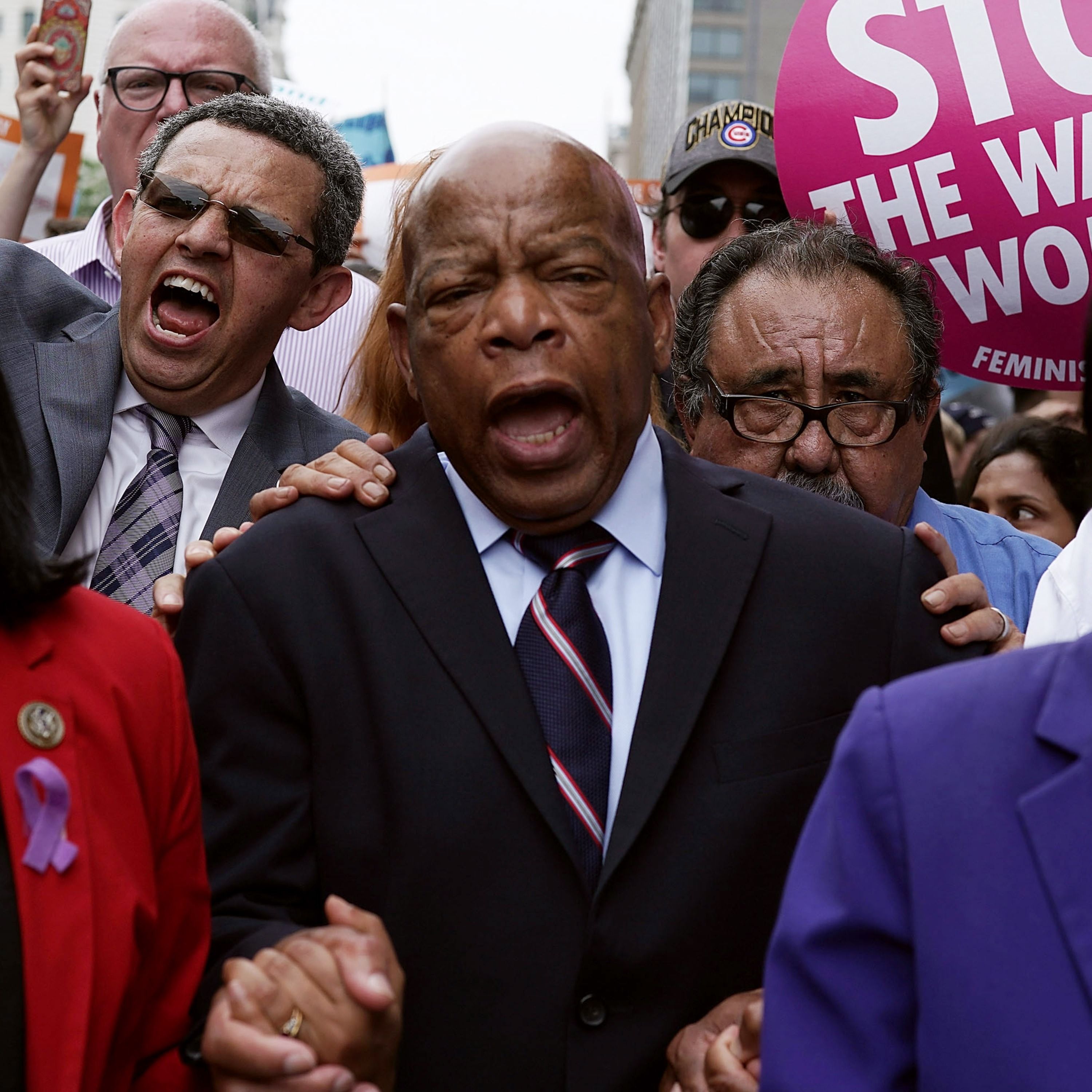
All Of It with Alison Stewart
Juneteenth Weekend: John Lewis's 'Good Trouble'
00:51:50
'John Lewis: A Life,' written by author David Greenberg, is a comprehensive biography about the US Congressman, civil rights activist, and preacher getting into, as he called it, "good trouble."
Loading summary
Transcript56 lines
- [00:00]
Progressive Insurance Ad
All of it is supported by Progressive Insurance. Do you ever find yourself playing the budgeting game? Well, with the Name youe Price Tool from Progressive, you can find options that fit your budget and potentially lower your bills. Try it@progressive.com Progressive Casualty Insurance Company and affiliates Price and coverage match limited by state law not available in all states.
- [00:26]
Alison Stewart
This is all of it on wnyc. I'm Alison Stewart. Happy Friday as we continue into a Juneteenth weekend with celebrations and reflections. We're going to look at the lives and careers of civil rights icons. Later on in the show, we'll hear about Bed Stuy's own Shirley Chisholm, the local kid who would grow up to become the first black woman to be elected to Congress, the first black candidate and also the first woman to run for the Democratic Party's presidential nomination. We'll hear more about Shirley Chisholm in a bit, but for now, let's get things started with our A Little Good Trouble. Full bio is our book series where we spend a few days with the author of a deeply researched biography to get a fuller understanding of the subject. Today we start with the book John A Life by David Greenberg. Greenberg is a professor at Rutgers University and has written biographies of former presidents Richard Nixon and Calvin Coolidge. Now he takes on an icon of the civil rights movement, John Lewis, who fought for integration and voters rights. Here's Congressman Lewis from a 2018 in front of Congress on the power of voting.
- [01:38]
John Lewis
In a democracy, the right to vote is the most powerful non violent tool we have. Many people marched and protested for the right to vote. Some gave a little blood and others lost their lives. Some of you have heard me say that the right to vote is precious, almost sacred in my hearts of hearts. I believe that we should make it simple and convenient for all of our citizens to be part of the democratic process.
- [02:14]
Alison Stewart
We begin today before he was a congressman, when John Robert Lewis was a southern bookish kid who dreamed of being a preacher until he went to college in Nashville and became part of the sit in movement to integrate lunchrooms. So let's get this started with David Greenberg, the author of John A Life. David, you worked on this book with John Lewis for a year or two. How did you come to meet him?
- [02:48]
David Greenberg
Well, it took some effort. You know, I didn't know him at all when I started the project. I really wanted his cooperation before, even before I wrote the book proposal because I just, I just knew it would be a better book to both have interviews with him. But then also, you know, the Cooperation of friends and family, which would be a lot easier if he were on board. So it was just a kind of long belabored process of thinking, who do I know who might know someone who knows John Lewis? And phone calls and emails. He was at the time a very busy man. You know, when I finally did get my first interview with him, it was early 2019, the week before he had done the coin toss at the super bowl in Atlanta. And the day after I met with him, he had flown to Los Angeles to introduce the film Green Book at the Oscars. So between the Oscars and the super bowl, he. He found a little time for me. We did an initial interview and then I had a couple of follow up interviews with him later on. But by then he was already ill, sad to say, and it was Covid times, so we did them by phone. And yet still I'm grateful to have met him and to have had that opportunity.
- [04:13]
Alison Stewart
You interviewed 250 people for this book, from President Obama to Speaker Pelosi. What were you looking for from the people you interviewed?
- [04:24]
David Greenberg
Well, you know, this was really a combination of historical archival work and more journalistic interviewing work. And it was, you know, having been a journalist before I became a historian, it was really great to be able to use both sets of skills. You know, sometimes you really have to trust the paper and the documents. People's memories of things long ago tend to be imperfect, and archival material can often set the record straight. But for the more recent years, there was a lot less documentation available. His congressional papers had not yet been sorted or donated anywhere. And so really, especially for the last 34 years or so, his years in Congress and even the years in Atlanta before that, the interviews were just indispensable in understanding what the important moments were in his congressional career. And I would say even more so interviewing his friends, close friends of his and his wife's staff members. I just got a feel for him as a person, little qualities, the way he loved playing with children, and in his congressional office would sit down on the rug and play Legos with young visitors or, you know, his love of art. He became a tremendous collector of African American art, something that really hadn't been written about much at all. But I talked to people who enjoyed his art in his house, his art dealer, an auction house representative he worked with. So those kind of interviews were really indispensable.
- [06:11]
Alison Stewart
Let's start at the beginning. John Robert Lewis was born in southeast Alabama on February 12, 1940, to Willie May and Eddie Lewis. He was their 10th child what was John Lewis like as a little boy?
- [06:26]
David Greenberg
You know, it was a very hard life, as people might imagine. Born into really abject poverty in 1940s in rural Alabama, they worked hard on the farm. The family had scraped together enough to own their own land, which was something of achievement, but they still were out there every day picking cotton, peanuts, corn. Lewis, from an early age, decided he did not like the life of the farm, and it was not going to be his future. He was drawn instead to school. He was also, from a young age, just a voracious reader again, something readers might not know that they'll get from this book. He first was reading the Bible, but then became interested in current affairs and biography and politics and poetry. And, you know, there were days when his parents said, you have to stay home from school to work on the farm because it's in harvest time. He would hide under the porch, wait until the bus pulled up in front of the house, and then dart out to catch the bus to school. So some kids would trick their parents and skip school. John Lewis did the opposite.
- [07:43]
Alison Stewart
Well, as a child, he was put in charge of the chickens on the farm. And you write that he would preach to them. Do you have any idea about what?
- [07:52]
David Greenberg
Well, you know, this is a famous story that he loved to tell, and it captures something kind of eccentric about John Lewis as. As a boy. And first there was his devotion to. To the church, and he wanted to be a minister. And so, you know, this was a way of kind of play acting as. As a young minister with these chickens, literally as his flock. It also, I think, speaks to kind of his love of all things living and his recognition of, you know, even these chickens as. As God's creatures, as he understood it. You know, so he would read Bible verses. You know, he would, you know, just give the kind of prayers you might in an ordinary sermon. He performed funerals when a chicken would die and he would have all his brothers and sisters, sometimes his cousins, there were a lot of family and, you know, nearby their own land who would come and he'd have them all participate as the chicken got a burial. So it was a very elaborate set of rituals for him. And, you know, one. Yeah, he talked about it his whole life.
- [09:09]
Alison Stewart
My guest is David Greenberg. He has written John Lewis A Life. It's our choice for full bio, John Lewis would be the first in his family to go to college. When he was at the Greyhound bus terminal getting ready to go to Nashville, his father dropped him off. They shook hands, and you write from a seat in the back of the bus, Lewis pressed his face against the window, hoping for a final moment of eye contact. His father had already driven away. What was his father thinking about school? Was he not approving of it? What was going on?
- [09:41]
David Greenberg
Well, I think there was an understanding that this was the beginning of a real separation. And of course, John Lewis did remain close with his family. And later in life, he was always going home for holidays and family reunions. But his going off to Nashville marked a break. He was 18 years old, leaving home, other than one trip to Buffalo as a young teenager, which was an important experience for him, really had not been away from home. And I think there was a sense for him and for his father that he'd always talked about doing bigger things, doing better things, finding a brighter future than this life on the farm. And there was a sense that that was about to begin.
- [10:34]
Alison Stewart
He arrived at the American Baptist Theological Seminary originally. What was John Lewis's goal with his studies?
- [10:45]
David Greenberg
Well, you know, he was a very devout young man. As I mentioned, he actually had already in high school been ordained as a minister. So he was there to, you know, to learn about Christianity, theology, homiletics, you know, be trained as a minister. But pretty early on he realizes that unlike some of the boys at school who, you know, want to become ministers and go home and lead a congregation in their small town, he's kind of left cold by, you know, the pure religion business, saving souls, as he calls it.
- [11:26]
Alison Stewart
Is that this when he had to decide to be a whooper versus someone who believes in the social gospel? A whooper, someone who's given himself to emotional parts of faith and the social gospel, are people who bring in the current events.
- [11:37]
David Greenberg
Exactly. And for him, he has professors who are also leading ministers in town, including a very important man named Kelly Miller Smith, who is part of Martin Luther King's Southern Christian Leadership Conference. And under the tutelage of Smith, Connecticut, Vivian, and then a bit later, a man named James Lawson, who's a divinity student at Vanderbilt. He really throws himself into the social gospel, as you say, which is sort of applying the teachings of Christ to the social and political problems, particularly of segregation and racial discrimination and oppression. And it's a whole movement. Of course, King, we know Martin Luther King is associated with this movement, but there's many other ministers around the south, and indeed in other parts of the country too, who are sort of achieving this fusion of political change and Christian doctrine, as well as with Gandhian non violence, an important part of the mix. And all of this really appeals to John Lewis in his, you know, late teens, early 20s.
- [12:49]
Alison Stewart
My guest is David Greenberg. He wrote John A Life. It is our choice. For full bio, let's talk about the sit ins in Nashville. Students decide to take Nashville's segregation of lunch counters as well as department stores to task. What they would do is they would. They would go in, they would. They would sit fairly quietly. The escalation of events included being thrown out of places, having coffee, dumped on them to brutal violence. From your reporting, why did it escalate in such a way?
- [13:26]
David Greenberg
Well, in a way, it was by design. You know, they could have gone in and just sat there, and if no one reacted, then there would be no news story, there would be no public attention to it. You know, it might become a conflict with the store owners here and there. So in a way, the. The hope was that the deep anger toward these efforts would. Would provoke a confrontation, so they would return time and time again. Sometimes the resistance was just, you know, the store owners would put up, you know, garbage cans or other things on the counters as if to say, it's closed. You can't sit here. But then other times, people who were, you know, quite ready to take matters into their own hands, or these local vigilante types, usually young men, sometimes not even from Nashville, but kind of from outlying areas, they would sort of come in and start beating up these kids on, on the bar stools. And that, of course, did galvanize attention. You know, what would happen at first is it would be the black students and their white allies who would be carted off to jail, often not the assailants. And the students would be charged with trespassing or other kinds of misdemeanors. There would be attention to their trial. They often took the strategy of forswearing bail, so they were kind of remaining in the jails. And that would present a problem for local police. You know, how long do we want all these college students clogging up our jails over this political protest? And then think too, that this is spreading across the South. So Nashville is one of the first cities to really get going with the sit in movement. But they start in the late winter and early spring of 1960. Spring up everywhere. And so this too really galvanizes the nation. John F. Kennedy, who is running for president on the Democratic ticket, endorses the sit ins, says the way of standing up for your rights is sitting down. And his. His support for the sit in movement and for Martin Luther King that fall is a big reason he does so well with the black Vote and wins the presidency. So they're starting to see political change both at the local level by, say, getting the stores, the five and dimes in Nashville to desegregate, but even. Even starting to see it in national politics.
- [16:06]
Alison Stewart
John Lewis was at the head of these sit ins. It started to grow. The number of people started to grow, and he worried about maintaining discipline. So he had the instructions typed up by his friend's wife. And it said, if you go on one of these sit ins that you won, you do not strike back or curse if so abused. You do not hold conversation with the floor walker. You do not leave your seat until your leader has given you permission to do so. You do have to show yourself as courtesy and friendly at all times. Sit straight, always face the counter, report all serious incidents to your leader. As it grew, as the civil rights demonstrations grew, how did they maintain order? These were young men and women.
- [16:52]
David Greenberg
Well, this was a real challenge because the initial group of maybe 20 or even a bit more in the Nashville organization had been training for months before they did any sit ins. And so they were really steeped in these teachings. And James Lawson and other ministers like Metz Rollins and Andrew White would lead them and helping them, you know, develop this discipline. But once the thing starts getting popular, new students are rushing to join the movement. They want to be a part of this, too. And they, of course, haven't been through the months of training. They haven't been reading Gandhi in reading King. And so Lewis and others are worried about will they stick to the rules, you know, because if a few students, all it takes is a few start hitting back, you know, then that immediately changes the storyline. It changes the whole picture and the perceived moral equation that outsiders will be seeing. So Louis kind of takes it upon. He's a very serious young man, even, you might say a bit moralistic. And some of his friends said uptight, and they would sort of tease him about that. But he and his friend Bernard Lafayette, who also goes on to be an important figure in the movement, type up, as you say, have it typed up, this list of rules. And these days, respectability politics has kind of acquired a bad name. But they really thought this was important. They thought it was important to be dressed in your Sunday best, to be impeccably polite and decent, to show yourself you know, better than, you know, the people who were attacking you and that you were not going to descend to their level, to their base instincts, not just of violence, but of other ways of degrading other human beings. So there was no nasty. You couldn't curse, you know, you couldn't be nasty toward other people. You had to just model impeccable behavior. And to a remarkable degree, they managed to do so. Yeah, as the movement grew and there were people who were kind of less committed, didn't always stick. But by and large, the Nashville movement and some of these other sit in movements succeeded because they did stick to adhering to those very high standards.
- [19:21]
Alison Stewart
You're listening to my conversation with biographer David Greenberg, whose book is called John Lewis A Life. We'll have more good trouble in a minute. This is all of it. This is all of it. I'm Alison Stewart. Today we're revisiting a pair of full bio conversations about civil rights icons in honor of Juneteenth Weekend. Later on, we'll get into the life of Brooklyn's own Shirley Chisholm. But this hour we've been hearing about another trailblazer, John Lewis. I spoke with biographer David Greenberg about his book John A Life, a finalist for the Pulitzer Prize. So let's dive back into that conversation. We're going to look at 1961 and the freedom Riders. They were following up on the 1960 Boynton vs. Virginia, which basically said there shouldn't be segregation in interstate bus terminals. And you write that Lewis needed no persuading to become a freedom rider. We tend to think of John Lewis as a civil rights leader, but at this moment in his life, where is he?
- [20:39]
David Greenberg
So he's still a college student. This is 1961. He's 21 years old. They're sort of fresh off this victory from 1960 with the sit ins, although there's a lot more work to be done in Nashville even after that first year. And my book actually gives a much more detailed account than we've had in other civil rights histories of the years of 61, 62, 63, where Lewis is fighting in Nashville. But he learns of a project sponsored by a group called core, the Congress of Racial Equality that is going to have black and white teams of riders go from Washington, D.C. all the way through the Upper south, the Deep south, winding up in New Orleans to test this Supreme Court ruling that says you cannot segregate not only the buses, but also the bus terminals and the dinettes at the bus stations and so on, which were routinely being violated across the South. So John Lewis just, you know, I think it's Metz Rollins, who's one of the ministers in the Nashville group, thinks he just knows John Lewis would be perfect for this, that this would be his kind of project and even though he needs to kind of cut out of his school semester and maybe wind up missing graduation, he decides that this is something he wants to do. So John Lewis is a member of that original Freedom Rides leg. Then he actually leaves the trip for a couple of days because he's under consideration for a fellowship to study abroad, much as Jim Lawson had, either in India or he really wants to go to Tanzania. And while he's away, one of the buses is firebombed by a group of Klansmen and white vigilantes in Anniston, Alabama. And then the other bus is met with violence when it arrives in Birmingham. The violence is so bad, so horrific, that the leaders of the Freedom Ride decide they're going to abandon the project. At this point, Lewis has returned to Nashville. For a moment, he's with all his old friends, and it's these students, you know, 21 year old, 20 year old, who decide, no, no, the show must go on. And they, the national movement, revive the Freedom Rides, get people together to continue them and carry it through to completion.
- [23:17]
Alison Stewart
Those who participated in the Freedom Rides, they wrote wills and letters to their families. They were really headed into danger. What was the level of danger for these young adults?
- [23:31]
David Greenberg
Well, look, especially after that Anniston bus bombing where someone threw a cocktail, Molotov cocktail onto the bus and the whole thing erupted in flames. After that, they knew that their lives were very much on the line. John Lewis had been beat up once already in Rock Hill, South Carolina.
- [23:53]
Alison Stewart
Can I stop you there? Can you describe the scene in South Carolina where he was beaten up?
- [23:58]
David Greenberg
Yeah, and that was actually one of the lesser ones. But it is sort of early on in the Freedom Rides. Go into the bus station as kind of is their plan. And he goes into the white area, the white waiting room area, the white restroom area. And there's a few young thugs there. One of them is a man named Elwyn Wilson, who's a member of the Klan. They probably all are clan members. A lot of young guys would just join the clan like that. And Lewis gets slugged in the mouth, falls to his knees. He's bleeding. Then his white seatmate, a somewhat older man named Albert Bigelow, who was a peace activist and the former hockey player at Harvard, he steps up, he gets. They start pounding on him, too. A young woman then, you know, steps up. They hit her. And at that point, the police finally put a stop to it. John Lewis says, no, no, we don't want to press charges because these people too are a victim of a system of a corrupt segregationist system. So they. They go on their way. Louis with his bloody mouth. Years later, I'll just sort of digress to tell this story. The same man, Elwyn Wilson, just after the inauguration of Barack Obama, is feeling this remorse over how he treated these people. And he realizes the wrong, he realizes the evil of his former beliefs. And. And anyway, through an intermediary at the local paper, he gets in contact with Lewis's office. And they're on Good Morning America where he apologizes, he cries, Lewis forgives him. I'm sorry for what happened down there.
- [25:56]
John Lewis
Well, it's okay. It's all right. It's almost 48 years ago. That's right, yeah. So remember that day, Will.
- [26:10]
David Greenberg
I try to get it out of my mind.
- [26:12]
Alison Stewart
Did you ever imagine this moment?
- [26:16]
John Lewis
I never thought that this would happen. It says something about the power of love, the power of grace and the power of people to be able to. To say I'm sorry.
- [26:32]
David Greenberg
And in a way, it does show Lewis is right about nonviolence, that you can change people's hearts. Maybe it takes 47 years, but, you know, it can work. So, you know, Louis is quite ready to endure this violence. I found this remarkable press conference. I think it's his first national press conference where he's there with Martin Luther King and James Farmer and some of these other titans of the movement. And he's asked, John Lewis has asked about the violence he's going to confront. And he says very frankly, look, I don't want to die. It's not like I'm going into this wanting to die, but I'm ready to die because I believe in this cause of human equality and freedom. And it's an incredibly sort of mature and courageous thing for a young man to be saying with such kind of equanimity. And then of course, he does go on to endure even worse violence. Once the Freedom Rides are revived in Montgomery in particular, the local police basically get out of town. They hide out while a mob is awaiting the Freedom Riders. When they arrive in the Montgomery bus station, there's a sort of full on riot and, you know, Lewis is smashed over the head with a Coca Cola crate. Another friend of his, William Barbie, is beaten so badly he had permanent brain damage. So this is, you know, this is not just getting smacked around. He nearly lost his life then, you know, as. As he nearly lost it again in later years. It took an immense amount of courage and dedication to the cause to know you could face that kind of violence and even death and go forward with it.
- [28:30]
Alison Stewart
Anyway, let's listen to a little bit of John Lewis at the march on Washington.
- [28:35]
John Lewis
We do not want to go to jail, but we will go to jail if this is the prize we must pay for love, brotherhood, and true peace. I appeal to all of you to get in this great revolution that is sweeping this nation. Get in and stay in the streets of every city, every village and hamlet of this nation until true freedom come, until The Revolution of 1776 is complete. We must get in this revolution and complete the revolution. For in the delta, Mississippi, in of spite, southwest Georgia, in the black belts of Alabama, in Harlem, in Chicago, Detroit, Philadelphia, and all over this nation, the black mass is on the mark for jobs and freedom.
- [29:24]
Alison Stewart
He really believed there was a southern black person experience and a northern black person experience and that they really shouldn't be considered the same thing. Can you explain the southern black person experience and the northern black person experience as John Lewis might have described it?
- [29:43]
David Greenberg
Yeah, I mean, I think there were a lot of differences as he understood it. And, you know, he was drawn to, you know, both in Nashville, but then, you know, throughout his years in the South, a vision that started with the church, started with people like Martin Luther King was initially focused on segregation because the segregation in the south was not just a matter of separate water fountains and not being able to use the library. I mean, that was bad enough, but was really an order where whites were on top, blacks were on the bottom. And this kind of strict separation was ruthlessly and often violently maintained.
- [30:30]
Alison Stewart
March 7th through the 25th, 1965, was the Selma March. What was the purpose of the Selma march?
- [30:41]
David Greenberg
This was after the passage of the 64 Civil Rights act, which, as I mentioned, did not do as much as many people had hoped to make voting and voting rights a reality for blacks in the South. As I think listeners probably know, even though the constitution guaranteed the vote, was supposed to guarantee the vote for people regardless of race, that was not the reality in the south, where all kinds of methods, poll taxes, literacy tests, and often just raw assertion of power, prevented blacks not only from voting, but even from registering in the first place. So the people of Selma had been organizing for some time. SNCC had been there as early as 1963. And in late 1964, feeling frustrated with the lack of progress, they asked Martin Luther King and his group, the Southern Christian Leadership Conference, to come in to help out and that maybe King, with all of his sort of media attention, he had just won the Nobel peace prize. This could draw attention to Selma and this drive for voting rights. Well, some of these splits that we've been talking about now start to rear their head. In particular, splits between SNCC and sclc. King's group. Initially, SNCC was almost like a youth auxiliary to King's group. Its first offices were in a corner of SCLC's offices. King was there at the founding meeting. But again, it's sometimes a north, south distinction. Some of the SNCC members begin to develop a certain amount of scorn, you might even say, for Martin Luther King.
- [32:37]
Alison Stewart
Generational differences, even.
- [32:39]
David Greenberg
Generational differences. You know, one woman I talked to, you know, just, just a couple of years ago while interviewing for this book, it was. If it was yesterday, she said, I could not believe King was such a conniver and a manipulator. And this is a. I never heard anyone talk about Martin Luther King that way. And this is someone, you know, kind of, you might say, from the left, who felt he was, you know, you know, not strong enough on civil rights issues. So these conflicts emerge. And at one point, some of John Lewis's old friends from Nashville, Bernard Lafayette, James Bevel, Diane Nash, they're all working for King now, interestingly. And they decide we need to have a march, a march from Selma to the state capitol of Montgomery. 50 something miles, I think. And, you know, it was the kind of classic tactic that could. Could galvanize attention. Lewis compared it to Gandhi's famous march to the sea. And the problem is SNCC really doesn't want to participate because they're kind of feuding with King and sclc and they think this is one of his kind of vanity projects. But Louis, you know, who had met King at a young age and always remained loyal to him, would never say a bad word about King. Louis wants to march.
- [34:12]
Alison Stewart
Yeah.
- [34:13]
David Greenberg
So he convinces SNCC to say, okay, whoever in SNCC wants to march as an individual can march. I won't be representing the group. So he and a number of others decide to participate. And on March 7, the day of the planned march, he's at the forefront of the line, along with Jose Williams, who's representing sclc. And they begin to cross the Edmund Pettus Bridge, which is what kind of leads out of town and will take them on the road to Montgomery. And there they're confronted by a sea of the local sheriff and his posse and also state troopers of George Wallace's Alabama National Guard.
- [34:58]
Alison Stewart
And I think we've seen the footage of this, this terrible beating that John Lewis takes initially. I mean, how far did they think the protests were gonna get. Did they really believe they were gonna be able to continue on?
- [35:13]
David Greenberg
Well, some people that day brought backpacks and toothbrushes. Others kind of came, you know, for a day long march. You know, people were kind of dressed and ready for different expectations. But certainly the hope was that they were gonna, you know, march on to Montgomery. And that, you know, plan is cruelly and brutally interrupted by this police violence that sends John Lewis and other people like Amelia Boynton and others to the hospital. I found, I should say a photo researcher I worked with found this rare footage, I don't know anyone who'd seen it before, of Louis in his hospital bed that afternoon talking to reporters. And what's he talking about? Non violence. It's the most amazing thing.
- [36:09]
John Lewis
But I will never forget that day as we crossed that pettish bridge crossing the Alabama river and seeing the sea of blue below, the hundreds of state police officers, the state troopers, Sheriff Clark, Jim Clark, the sheriff of Selma, and members of his posse with billy clubs and bull whips and chasing us with horses and tramping us and releasing the tear gas. I almost died, I think on that Sunday afternoon. I saw death when I was being beaten.
- [36:47]
David Greenberg
This, of course has the effect of once again outraging the nation. Footage of the beating is shown on television that night. Photographs run on the front pages everywhere. The next day, Lyndon Johnson is moved to action to finally introduce that voting rights bill which he wanted to introduce. There's a film about Selma that kind of got that wrong, a Hollywood feature film. Several years ago, Johnson favored the voting rights bill. He just wasn't ready to introduce it yet because it was so soon after the 64 bill. But now he realized he had to move. The time had come. So in that sense, John Lewis's beating and heroism led fairly directly to the passage of the 1965 Voting Rights act, which remains critical pillar in ensuring the vote.
- [37:43]
Alison Stewart
Today we're talking with biographer David Greenberg, whose book is called John Lewis A Life. We'll have more on John Lewis after a short break. This is all of it. This is all of it on wnyc. I'm Alison Stewart. Today we're sharing a pair of full bio conversations about civil rights trailblazers. In honor of Juneteenth, the holiday marks the day In June of 1865 when the Union army began enforcing the Emancipation Proclamation in the state of Texas. Over two full years after President Lincoln's proclamation was issued, the last enslaved people of the Confederacy were liberated. The end of slavery was a key turning point for the nation but it marked the beginning of a different struggle, not for the freedom from brutal bondage, but freedom from discrimination and the more subtle and insidious kind of racial hierarchy. That fight for equality continues to this day. Now we'll get back into our conversation about one of the pioneering civil rights icons, Congressman John Lewis, who picked up the mantle of the struggle in the 1960s and didn't put it down again until his death in 2020. So let's get into the final stretch of my conversation with biographer David Greenberg about his book, John a life. 1968 was a hard year for John Lewis. MLK was assassinated. So was Bobby Kennedy. Lewis had worked for both men. This was a hard time for him. What did he need to figure out?
- [39:29]
David Greenberg
John Lewis had a lot to figure out in 1968. You know, he had left SNCC in 1966 under very unhappy circumstances. One night he had been reelected as chairman only in the middle of the night for people to object to his reelection and conspire to hold a new election in which he was deposed. That obviously left a bad taste in his mouth. And he left SNCC a short while later. He then spends a year in New York, which I write about, a sort of fascinating little known chapter of his life. He's living in Chelsea and commuting to Fifth Avenue, where he's working at a foundation and sort of a fish out of water in a suit behind a desk. But in 68, he finds some hope in Robert F. Kennedy's presidential campaign. You know, he's known Kennedy since those Freedom Rides days, but has developed a much more positive relationship with him and has come to see Kennedy as someone who learns, who has been won over to the cause, who has grown as a man and as a politician. And he's with Robert F. Kennedy in Indianapolis on April 4, the night that Martin Luther King is shot. Utterly devastating to Lewis. And then he's with Kennedy two months later, or he's just upstairs in the Ambassador Hotel when Kennedy himself is murdered. And these events kind of together really leave John Lewis at his wit's end, at a loss. He's always someone who's run himself hard. There are memos I found from his SNCC days where staffers would say, we need to give John Robert Lewis a restaurant and let him take a break because he's exhausted. So he's actually hospitalized for exhaustion, or maybe it's depression. In the summer of 68, he's just started dating a woman named Lillian Miles. John Lewis never really dated much all Those years he's 28 by now. There's really no indication of anybody serious in his life before Lillian. And she's there each day, coming to the hospital, bringing him his mail, bringing him his newspaper. He remains an avid reader, and very unromantically, he proposes to her from the hospital bed. And one of John Lewis good friends, a Georgia congressman named Buddy Darden, said to me, you cannot understand the second half of John Lewis's great career without understanding Lillian, because she helps him find that second act of where he goes into politics.
- [42:15]
Alison Stewart
In 1985, he ran for Georgia's 5th congressional district. And it, it cost him a friend. It was Julian Bond and John Lewis. They had a little bit of a tumultuous relationship. First of all, what was Bond's pitch? And what was Lewis's pitch?
- [42:30]
David Greenberg
Right. I mean, it's amazing that these two dear friends ran against each other. It's almost hard to believe. When John Lewis first moves to Atlanta in 1963 as chairman of SNCC, this is the big city for him, bigger city than Nashville even. And it's Julian Bond who comes from a well to do family. His father was a famous educator. He had met people like Paul Robeson and Albert Einstein in his youth. And so it's Julian who teaches John Lewis things like, how do you order in a fancy restaurant and what's a mixed drink I can order? And things like that. And their families became close. They would take vacations, do birthdays together. So for them to run against each other was quite a thing. Julian is dashingly handsome, incredibly articulate, silver tongued, witty, can have a command of policy. And he's kind of the celebrity candidate. I mean, we think of John Lewis today as having this kind of iconic status. But in 1985, 1986, Julian was far more famous. He was hosting SNL. He was in movies with Sidney Poitier. I mean, it was a different level of fame. And John Lewis people, of course, knew his civil rights activities, but he was kind of this rumpled, squat, roly, poly guy with a thick accent again. And some people felt, is that who we really want representing us? It was clear now that after Weish Fowler's term, the seat was going to again go to a black representative. And a lot of people took the view that Julian Bond should be the face of black Atlanta, if you will, that, you know, a more handsome face, a more polished presentation. But over the course of the campaign, a few things happen. One, John Lewis just works harder. Julian Bond, in a previous campaign, had left a voicemail message or actually in those days, answering machine tape message saying, you know, don't leave a message here. I get too many calls. It was a kind of dismissive thing that an elected politician should never be saying, you know, on his message. But it left the impression that he wasn't really that interested in serving the public. But John Lewis would be out there, you know, at sunrise at the factory gates, and he would be there after sunset, like in the aisles of the 711 or the 24 hour convenience store, just shaking hands with whoever's still around. Then there was also the issue of drug use. This was the summer of 1986, when the election really heats up. It's the summer of just say no. Drugs are listed as number one concern of Atlantans and other Americans in all kinds of surveys. And it's an open secret in at least parts of elite Atlanta that Julian Bond has a pretty serious cocaine problem. And the FBI investigates the police. That's not widely known, but it's known to a number of people, and it's known to John Lewis.
- [46:06]
Alison Stewart
What would you describe as his first big test in Congress?
- [46:12]
David Greenberg
Part of it was just, you know, the challenge that all freshmen or new members of congress face about how you have an impact. And very wisely, he decided to tend the home district, bring home the bacon. He got onto committee, something like transportation and interior affairs. That might have been the other committee, seemingly a backwater. But from transportation, he delivered money for Atlanta's airport, which, of course, was emerging as a major hub for air travel, also for its MARTA public transportation system. So that kept him in good standing back home. He also began to use his power to preserve and promote the memory and legacy of the civil rights movement itself. So, you know, he's on a national parks subcommittee and passes legislation to make the Selma to Montgomery trail a national park. I don't know that anyone had ever made a highway a national park before, but it was a way of giving it, you know, an official federal status and federal funds. And now if you drive that highway, you're very much made aware of the history that that took place there. So he starts doing a lot of things like that. But it still is. The challenge is then, as you know, a junior member, how do you have influence? And the next step is he's really tapped by Tom Foley, the democratic speaker, to become part of the party leadership, because Foley realizes that the moral authority that John Lewis already commands will be very useful to him if, say, he's going to the white House to argue with George Bush senior over a civil Rights bill. People forget this. George Bush Sr. Was the first president to veto a civil rights bill since Andrew Johnson. You know, he kind of has gotten this warm and fuzzy makeover, but he was not a friend of civil rights. And Lewis comes with Foley. He's now part, he's made, you know, one of the deputy chief whip. It's, it's, you know, several people hold this title, but he's an important one. And he tells President Bush, you can't keep demagoguing this bill and calling it a quota bill. You're fanning the flames of division. And Bush, who had vetoed the bill one time, the second time around, capitulates and signs it. And it's not only John Lewis who achieves that, but partly his strong words and moral example help bring the pressure that bring Bush and other Republicans around to support a civil rights bill in 1991.
- [49:16]
Alison Stewart
As you said, he was the moral center for many people in Congress. And one of his last acts was a sit in at the Capitol. He staged a sit in to force action on a gun control bill. It was shortly after the Pulse nightclub shooting which killed 49 people. First of all, how old was he when they did that?
- [49:36]
David Greenberg
He would have been already 78 years old. And David Cicillini of Rhode island, who was one of the Democrats sort of organizing it, they were very frustrated at the Republicans refusal to pass even what the Democrats like to call common sense gun legislation. The Pulse nightclub shooter, people may remember, was a sworn adherent of isis, the Islamic State. And so the Democrats said, how about we just pass a bill? If you're on a terrorist watch list, you can't buy a gun. Seems pretty straightforward. It should appeal to national security. Types like the Republicans style themselves, but no dice. So they're brainstorming what to do. And Cicilline says, maybe we should just each go up to the well of the Congress and make a speech, but not leave. Just stay there. And then Lewis says, and then we should sit down. And Cicillini says, to me, it just all clicked, you know, in that one comment he fuses this issue of gun violence and our plans to, to the whole history of the sit in movement and the civil rights movement. And it was a masterstroke. And people may well remember, you know, for the next few days, Congress and the political coverage is consumed with covering this sit in on the House floor. You know, it goes against House rules, but that's civil disobedience for you. And you're not supposed, you know, C SPAN was told to shut off the cameras, but people start live streaming it from their phones. And, you know, you could say, well, it didn't actually produce the legislation they wanted, but it did. It did return attention to this very devastating issue of gun violence that, you know, we continue to grapple with. So Louis, he's brought protest into politics. We've seen him bring politics into protest. What's really amazing about his life is he was a master of both. And he knew when it was right to shake the system from the outside and when it made sense to work the levers from the inside.
- [51:47]
Alison Stewart
That was biographer David Greenberg. His book is called John A Life. And that's all of it for this hour. Coming up, we'll talk about New York City's own trailblazing civil rights icon, Shirley Chisholm with University of Kentucky professor Anastasia Kerwood, whose book is called Shirley Chisholm, Champion of Black Feminist Power Politics. That's coming up. Stick Around.
- [52:11]
Progressive Insurance Ad
NYC now delivers breaking news, top headlines and in depth coverage from WNYC and Gothamist every morning, midday and evening. By sponsoring our programming, you'll reach a community of passionate listeners in an uncluttered audio experience. Visit sponsorship.wnyc.org to learn more.