← All Of It with Alison Stewart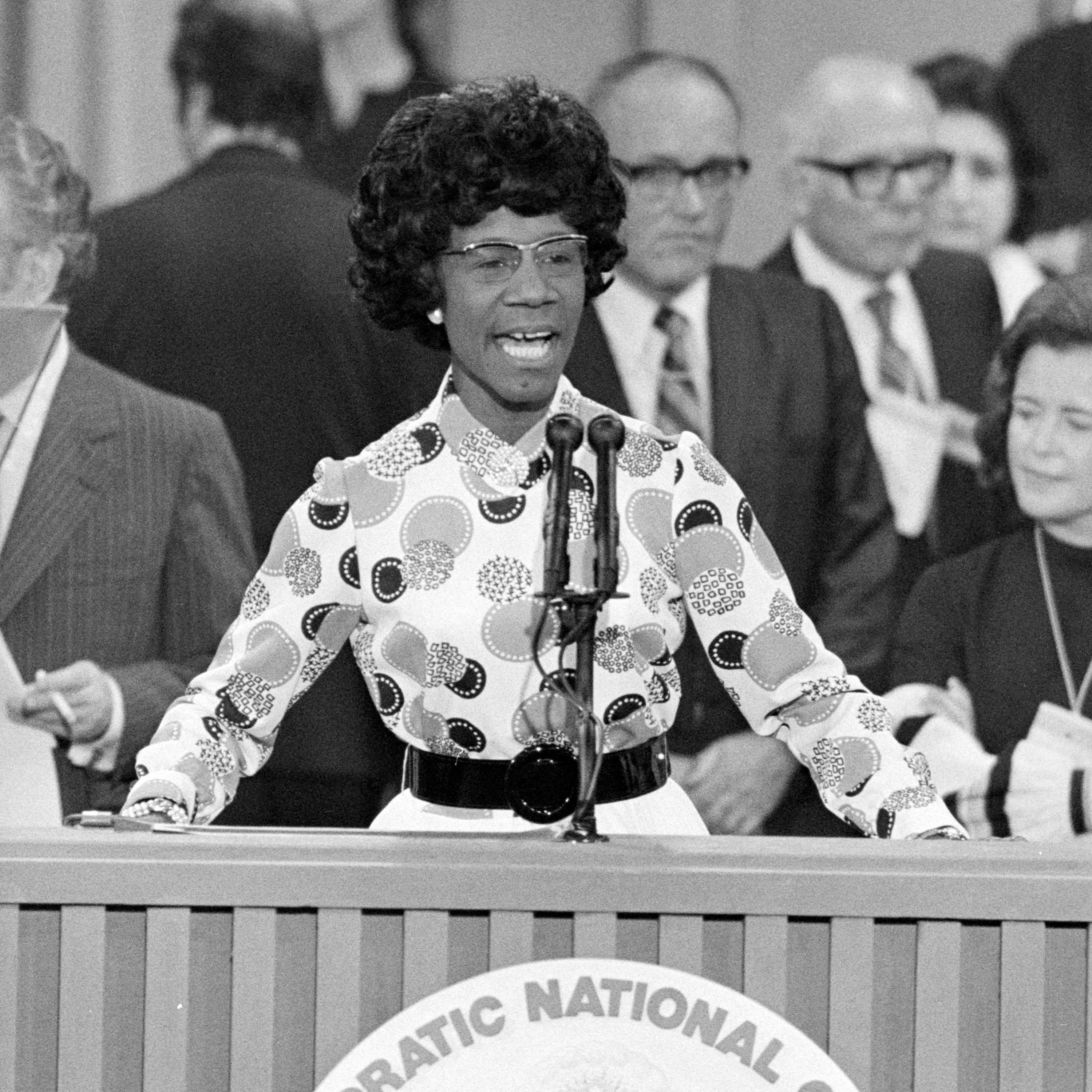
All Of It with Alison Stewart
Juneteenth Weekend: Shirley Chisholm's Life and Trailblazing Career
00:50:09
Anastasia C. Curwood, author of the new biography Shirley Chisholm: Champion of Black Feminist Power Politics.
Loading summary
Transcript57 lines
- [00:00]
Alison Stewart
All of it is supported by Progressive Insurance. You chose to hit play on this podcast today. Smart choice. Make another smart choice with Auto Quote Explorer to compare rates from multiple car insurance companies all at once. Try it@progressive.com Progressive Casualty Insurance Company and affiliates not available in all states or situations. Prices vary based on how you buy. This is all of it on wnyc. I'm Alison Stewart. Thank you for spending part of your day with us. I'm grateful you're listening. We continue today's celebration of civil rights icons in honor of Juneteenth celebrations. Before the news, we heard about the life and work of Congressman John Lewis of Georgia. This hour we'll be talking about a local legend, Shirley Chisholm of Bed Stuy. Chisholm was born in Brooklyn on November 30, 1924. After attending Brooklyn College and Columbia University, she became the second African American to serve in the New York state legislature. Later, she became the first black woman elected to Congress. And after that, in 1972, Chisum became the first black candidate to run for a major party's nomination for president. She was also the first woman to seek the Democratic nomination. For this hour, we'll talk about a biography called Shirley Champion of Black Feminist Power Politics by University of Kentucky professor Anastasia Kerwood. We begin today's conversation with some information about Chisholm's family background that informed her political career. She was the oldest of four girls. During the Great Depression, Shirley was sent to Barbados to live with her grandmother for a time and went to school there. Was learning to read and write at a very young age. Her grandmother was her hero and instilled in her great confidence that at times would cause friction with Shirley's mother Ruby, once her daughter returned to New York City. So let's get into that conversation about Shirley Chisholm with author Anastasia curw.
- [02:25]
Anastasia Kerwood
Shirley Anita St. Hill was born in Brownsville, Brooklyn, November 20, 1964. Her family was from Barbados. Anastasia what was happening in Barbados in her parents generation that Bahans were leaving for the States?
- [02:40]
Yeah, yeah, yeah. So these folks are called Bajans because it's a way to say Barbadian quickly. Barbadian. And so what's happening in Barbados is economic stagnation for the majority of the working class and poor black people living in Barbados. Remember that Barbados, just like the United States was a was was founded with by England. It was a colony of England and also imported chattel slavery. Africans, chattel slavery. And so her family was a descendant of the enslaved people who had lived on Barbados and although emancipation had come a little sooner in Barbados and there was not the Jim Crow system that was in Barbados, still economics were pretty tough. And so her parents decided to try to make their fortune in the United States.
- [03:46]
What is something about Shirley Chisholm that lets you know she was from Barbadian roots?
- [03:56]
Well, I would say it was her sense of just of capability that she could do things the best that anybody could do. She was very proud person and she just had this unfailing belief in her own abilities. So I think that confidence and almost sort of swagger or some people might say egotistical. But I don't know that it was something like that. I think it was just that that was kind of her, who she, who she was and just she really did believe in herself.
- [04:34]
What was an event in each of her parents lives that really shaped the way that Shirley was raised?
- [04:42]
Oh, that's a great question. I mean for both of them it was the trip to the United States. But let me, let me, let me give you one thing from her father's family that was, that was a little bit different. That he was born in Guyana, but he was Barbadian. He was descended from Barbadian folks. He was baptized in Barbados and he, he, and then he was orphaned at a fairly young age and raised by his grandparents. And he sort of was a very independent person very early in his life. He also, eventually he became involved in labor politics and with Marcus Garvey. And so he was a mentor to his daughter. And his name was Charles Faint Hill. Ruby Seal was raised by her mother, who was a single mother in Barbados. And her father had gone to work in the Panama Canal Zone and brought back a good bit of money. And her parents divorced because her father gave away so much of that money that, that, that he really frustrated his, his wife by giving money away to people but not supporting the family in the way that she thought that, that they should be supported. So I would say both of those experiences, in addition to that migration to the United States was, was important to, to Charles and Ruby and would have left their mark on the family as well.
- [06:35]
My guest is Anastasia Kerwood. She's the author of Shirley Chisholm Champion of Black Feminist Power Politics. It is our full bio this month. The family settled in Brooklyn. Why Brooklyn? Why did the St. Hill family wind up there and how did they make ends meet?
- [06:54]
Yeah, so the family settled in Brooklyn because that was where most of the Caribbean people went when they came to New York. And you know, as, as you and your listeners all know New York is, is a city of cities. It's. It's full of neighborhoods. And so a lot of black people who had been born in the United States went to both Brooklyn, especially Bed Stuy, and to Harlem. But the Caribbean people tended to concentrate in Brooklyn and especially Bed Stuy. Brownsville Chisholm, the future Shirley chisholm. Then Shirley St. Hill was born. You can read the wonderful novel, classic novel by Paula Marshall, Brown Girl, Brown Stones, about a Barbadian family or Bajan family in Brooklyn. That this, this was right where they, where that family lived would have been right around where Shirley Chisholm's family lived. And so as it happened, they each. Charles met an uncle supposedly, although he. I don't know that he really was an uncle. I think he might have just told the, the immigration officials that he was an uncle in Brooklyn. And at that point, Ruby Seal, Shirley's mother, had a sister who was living in Brooklyn. And so they both wound up there. But what's important to know is that they actually grew up in the same neighborhood. Their families knew each other. They knew each other. So they already knew each other. It was just. The community was sort of gathering in Brooklyn and it had a snowball effect that a few people went and then a few more. So that was why they wound up there.
- [08:50]
My guest is Anastasia Curwood. The name of the book is Shirley Chisholm, Champion of Black Feminist Power Politics. It's our choice for full biology. Let's get into Shirley's career. How did Shirley Chisholm make the leap from educator to politics? What was the first step?
- [09:07]
Well, what I understand to be the first step was her involvement in tenants rights organizations. And unfortunately there is not a strong archival base for this. This just came from some interviews and a little bit of mapping that I was able to do that she was involved with the Albany projects in Brooklyn in New York public housing. But that was sort of how she got involved. And my guess is she got involved through parents and working with parents of the children whom she was teaching. What she says and what happened are actually different things. What she says is that she met her political mentor through her hairdresser just out of college. I'm not sure that it happened exactly that way, but eventually she did meet this mentor who was running in 1953. So about six years after she left college, was running a campaign to elect a black judge in Brooklyn. This came about because a midterm appointment was made and there was the opportunity to appoint a very well respected lawyer who was black as A judge. And he was passed over. And so a movement arose to get him elected to a proper term as a judge. And this evolved into something called the Bedford Stuyvesant Political League. And her mentor was a man named Wesley Holder, everybody called him Mack Holder, that he was the leader of Bedford Stuyvesant Political League. And she was involved with this group for years. For the better part of a decade. For about six, seven, six, seven years. She also started attending meetings of the Regular Democratic Club. And what I mean by that is that New York mid century had Democratic clubs in every one of the state assembly districts. So in that state assembly district, there was an assembly man or woman elected. Most of them were men in Chisholm's time. And there was also a district leader who sort of managed the processes of getting people elected. And also all the patronage that New York politics are famous for. Well, if you work hard to get me elected, then you can get a job as the sanitation official in Borough hall or in other places in government. So there's a strong patronage network. And Chisholm started going to the meetings of the regular Democratic, the Establishment Democratic Club. But we talked about this earlier, earlier in our conversation. We said that Brooklyn was a haven for migrants from the Caribbean. But also a lot of Jewish people were in Brooklyn and Puerto Rican people were in Brooklyn. There's a sort of Irish and Italian monopoly on political power and running these political organizations. And there starts to be an insurgent movement. And so she was coming of age, political age, at the time when some of these old established patterns were getting disrupted. And that was when she really got going in politics. Because eventually she got involved in the Unity Democratic Club. Which sought to unseat the existing District Democratic Club. And that's what launched her career in electoral politics.
- [13:32]
The mentor you mentioned, Mac Holder, his I believe New York Times obituary headline called him the dean of Black Brooklyn Politics. And he would be a great mentor to have. But she made a decision that sort of set a template for how she might move through her professional career.
- [13:49]
Alison Stewart
She decided to go for a position.
- [13:51]
Anastasia Kerwood
In the Bedford Stuyvesant Political Club. You write about this, which angered Holder.
- [13:57]
Sure. Yeah. She tried to take his job over. She was nothing if not ambitious. Shirley Chisholm was incredibly ambitious. And she really cared about the issues. In particular, expanding democracy, small D democracy. But she was also really ambitious. And she was pretty sure she could do it the best.
- [14:21]
Alison Stewart
The book is called Shirley Chisholm Champion of Black Feminist Power Politics.
- [14:26]
Anastasia Kerwood
Women.
- [14:26]
Alison Stewart
Hear more about Chisholm's life and career with University of Kentucky professor Anastasia Kerwood after a quick break. Welcome back to ALL OF it. I'm Alison Stewart, and we continue our extended Juneteenth programming since we know that many folks and families who who celebrate take the whole weekend to reflect on human rights, equality and the meaning of freedom. This hour we're talking about a key figure who helped pick up the civil rights mantle, carried it all the way to Congress and set her sights on the White House. That trailblazer is, of course, Brooklyn's own Shirley Chisholm. So let's pick up the conversation where we left off with University of Kentucky professor Anastasia Kerwood, whose book is called Shirley Chisholm and champion of Black Feminist power politics.
- [15:32]
Anastasia Kerwood
Shirley Chisholm was elected to the State assembly in 1964. And you write in your book she began to develop her brand of pragmatic radical politics. So what's an example of a position or a priority for her that fits this description of pragmatic radical politics?
- [15:54]
Well, the best example was her orientation toward women of color who worked and maybe were parents. And she tended to look at politics through this lens really throughout her 20 years of politics, that these women who were at the intersections of parenthood, womanness, blackness, they were tended to be poor. That she looked at that intersection of vulnerabilities and really geared her policies and political interests toward mitigating those. Now, that is a fundamental so radical with the meaning of going to the root. That is a fundamental change in how political power is and was constructed at that time. That political power has been the province of men who were breadwinners of their families and seen as the true economic and political citizens. So this is a very radical project that she's engaged with, but she's doing it through really pragmatic means of the party politics, New York state government. She's working inside these political systems and she's also in those systems. She's not just going in and throwing bombs on the floor of the state Assembly. She's using very carefully reasoned speeches. She's creating allyships. One of the very first allies she got was she made was Anthony Travia. So for her four years in the New York State assembly, they didn't always agree, but she really kept him as an ally. And you don't get much more establishment than the state assembly leader or speaker. This blend of practicality and okay, well, how am I really going to change how power works here? How am I actually going to put more economic and political power in the hands of these everyday moms who are trying to make ends meet. And I'm going to do it using the procedures in state government and later, of course, the federal government.
- [18:36]
What was one of her solutions? What was one of the things she prioritized?
- [18:41]
Well, so what she was trying to do in the state and then she expanded it into the federal government was to get full protection, full labor protections, so Social Security and minimum wage for domestic workers who tended to be overwhelmingly be poor women of color, many of whom had children. She successfully did so both at the state and at the national levels. She hosted women who were seeking to change the New York State's constitution to include reproductive rights, what we now call reproductive rights. She was trying to change New York State law to liberalize abortion. Now the law that she was working on, the New York State assembly was working on, was much more of an incrementalist law than what Roe v. Wade created a few years later. But they were trying to get a bill passed that really left the decision to get an abortion between a woman and her doctor. So it placed authority in the hands of physicians and women. As we know, Roe v. Wade also took away the gatekeeper of the doctor.
- [20:08]
My guess is Anastasia Kerwood. The name of the book is Shirley Chisholm, Champion of Black Feminist Power Politics. It's our choice. For full bio, I want to give a little context for people about what the world was like when Shirley Chisholm was trying to establish herself as a civic leader. Her ascent began around the time of the Moynihan Report titled the Negro the Case for National Action, written by Patrick Moynihan, then assistant Labor Secretary in the Johnson administration. And it was aimed at examining levels of black poverty. It contained some problematic analysis. We certainly, as we look back on it, and even at the time it was controversial and some of it really rankled Shirley Chisholm, especially his take on black women working outside of the home and contributing to the breakdown of the nuclear family. So it's a two part question. One is on a personal level, how did she feel about this? How did this affect her? And then on a perception level, the way people looked at her and talked about her, based on some of Moynihan's assertions.
- [21:20]
Yeah. So on a personal level, she found it really frustrating. She saw it for what it really was, which was a call for black women to cede some of their self determination so that black men could get ahead. And it saw that. It believed that equality between black men and black women basically amounted to matriarchy. And she, as somebody who thought that women were just as capable if. If at least as capable as men. It really rankled her so. And she did. She heard, Overheard some people call her the black matriarch a few times during her political career, and it really bugged her. I think the second part of your question. Can you please tell me the second part of your question again?
- [22:30]
I think you actually really addressed it, that idea that what Moynihan had put out there about the black matriarch some.
- [22:40]
Alison Stewart
People began to assign to her.
- [22:42]
Anastasia Kerwood
Mm. Mm. Well. And it really plagued her career. It plagued her career later on. Some tried to use it against her in the 1968 election. It didn't work. But then there was suspicion, especially when she was running for president, that she was trying to take authority from black men, and they were really mad about it. The Moynihan report really stung, especially for black men who. Who did not necessarily believe in women's equality or thought that women's inequality was a marker of status. Because, remember, this is a time before the feminist movement of the late 60s and 70s. It's just at the very beginning of it, people really thought that women did not deserve, shouldn't have the same level of power that men should. They just didn't believe it. And so these men really thought that she was out of line, and that did dog her.
- [23:51]
Yeah, this was a time when a woman to get a credit card, needed her husband to sign for it and.
- [23:57]
Mm, exactly. So, you know, and she thought that that was hogwash. And, you know, I can sit here in 2023 and say, yeah, you know, how silly is that? Like, that's crazy. But this is the context that she found herself in, and it's pretty remarkable that she stepped so outside of it.
- [24:19]
You write that by the end of 1967, there was a movement afoot to elect a black congressperson. Who else was in the mix? Shirley Chisholm was about to get into the mix. Who are some of the other names being considered?
- [24:35]
Well, one of the major ones was a man named William Thompson, who was a sometime ally, sometime rival of Chisholm. In this case, he was a rival, and it was an open secret that he was supported by that local party organization, by the Democratic Party in Kings County. And even though they said that, well, we're not supporting anybody, that we're not going to support any one candidate, that's actually where her slogan, unbossed and unmot, came from. Because she thought that the Democratic Party facilitated the buying of candidates through the trading of favors and patronage and that the Boss. When you're bossed, it's the party boss who calls the shots, says when you can run and what you could do when you run and how you should run. And because she didn't have the support of the party, she didn't really have a choice. But she embraced it. She said, okay, well, fine, I don't owe you anything.
- [25:41]
How did Shirley Chisholm think about her status or view her status as the first black woman elected to Congress?
- [25:49]
Well, first of all, she was very proud. She liked being a first. She liked achieving. Even though she wanted to be remembered, as she said, as a catalyst for change, as. As somebody who really made a difference. But in as much as she was this historic first, that was a source of pride, she also was the first. What's important is that she wasn't just the first black woman in Congress. She's the first black feminist in Congress. She has an unprecedented platform with which to advocate for black feminist ideas. And going back to that kind of bedrock idea that she had of protecting folks who are the most vulnerable. Protecting, for example, black women and women of color who were trying to make lives for themselves and their children on poor wages. Those are the people who were at the center for her. And those people had never had someone put them at the center in Congress before. So she really took up the mantle of trying to advocate for a larger purpose. Yes, the 12th district of New York. But also her being a black woman was at times secondary to the fact that she wanted to advocate for black women, if that makes sense. Now, what she does say is that she got some flack. She got a lot of attention as the first black woman. And she says that her black men colleagues sometimes resented the attention that she got.
- [27:53]
Alison Stewart
We're speaking with University of Kentucky professor Anastasia Kerwood. Her book is called Shirley Chisholm, Champion of Black Feminist Power Politics. We'll hear more after a quick break. This is all of it. This is all of it. I'm Alison Stewart. This hour, in honor of Juneteenth Weekend. We're talking about Shirley Chisholm, the trailblazing Brooklyn politician who became the first black person and the first woman to seek a presidential nomination on the Democratic ticket. So let's pick up the conversation where we left off with University of Kentucky professor Anastasia Kerwood, whose book is called Shirley Chisholm, Champion of Black Feminist Power Politics.
- [28:52]
Anastasia Kerwood
Let's talk about Congressperson Chisholm.
- [28:55]
Alison Stewart
His first term.
- [28:57]
Anastasia Kerwood
She unsurprisingly had trouble from Southern white congressmen. What was done to thwart her personally and Then what was an early sign that she would have professional hurdles?
- [29:14]
Well, so it's interesting, at first, when she got to Congress, she was dealing with a lot of racism and what some scholars call misogynoir. So the particular suspicion of black women that Americans historically have and still do have. So at first she gets. She gets a Congress, a Southern congressman who can't believe that she makes the same salary he does. Here he is, he's very likely employees at poor wages, black women in his own household back in his district, and here's this woman. So he's telling her that she. He told Chisholm that she should be grateful and kiss the floor and kiss the chairs and whatever she could be so grateful that you're making this salary the same one that I make. And she knew exactly what he was doing, so she told him to just vanish. And then. And then she. She told him. And then she told him, you know, by the way, I'm paving the way for a lot more people who look like me to make the same money as you. She disarmed people with humor a good deal, but sometimes they didn't get her humor. So the time that was really vivid for her, she talked about in her memoir and in several interviews, was that she was accidentally sat at the Georgia delegation's table in the congressional cafeteria. And an irate Georgia congressman comes up to her and says, this is our table. And she said, oh, well, can I just sit here with you? Absolutely not. I mean, these are segregationists. The Civil Rights act of 1964 was five years old at that point. But these are people who were. Who. Who were segregationists no matter what the law said. And so they refused to sit with her. And she said, fine, you know, go sit with somebody else. And if anyone asks you why you're not sitting at your regular table, you tell them why. And she thought that that would embarrass them, but it didn't. He told everybody who came in why he couldn't sit at his own table because she's sitting there. Of course, they look over and there's a black woman sitting there. And so they knew exactly what he meant. He's not going to sit at the table with the black woman. So those kinds of things were early on when she tried to find an apartment in Washington, D.C. she was turned away. This classic story of racism that many black people have told of. You call and you don't sound black, and you call and, yeah, the apartment's available, and you show up and you're black, and suddenly it's not available. And that happened to her. And then somehow the agent found out that she was a congresswoman and suddenly it was available again. She said, no, no, thanks. But as time went on, those kinds of overt expressions of racism lessened. And what she would say several times in the course of her career was that she experienced more obstacles in politics because of her sex than because of her race. So that the actual material or real impact on what she was trying to do was more affected by sexism and by racism. And I'm pretty sure she's referring to some black men colleagues who thought that she should be in her place. And so that, I think, was the case in terms of her presidential run especially. She felt a lot of sexism from black people, white people. She expected racism and sexism. Black people really, especially black men, really made their sexism felt in terms of what she was trying to accomplish. Yeah.
- [33:43]
What did Shirley Chisholm believe she would accomplish by not being a quiet freshman? She decided that she was going to be someone who would be involved. What were the risks of not being quiet?
- [34:00]
Well, the biggest risk, of course, is not being reelected and being sent home in the next term. But there are all sorts of hierarchies were and are all sorts of hierarchies inside the party caucus as well. And one of the first things that she did protesting her committee assignment was seen by some of her colleagues as political suicide.
- [34:33]
Explain. Just dive in here for a second. Explain her assignment.
- [34:38]
Yeah.
- [34:38]
Alison Stewart
Okay.
- [34:40]
Anastasia Kerwood
So her first committee assignment by the Democratic Party leadership in Congress was Forestry and Agriculture Committee. And so what she said was. She was. I had these one liners. She said, apparently all they knew about Brooklyn was that a tree grew there. Must be why I'm on that committee. Because her point was that, look, I have this particular expertise. She wanted to be on Education and Labor. I should be on Education and Labor because I have been an early childhood educator. And my legislative record in Albany was to fight for working people. So this is a really logical use of my skills. Why am I on this committee for Forestry and Agriculture? It just felt silly to her. It felt like a waste of time. So she protested it. She eventually got landed on Veterans Affairs. But the chair of Forestry and Agriculture, I guess, was really mad that she. That she was protesting being on his committee. You know, as a freshman congresswoman, if you want to put it that way, as she did, you know, you're supposed to just go along and get along and, you know, pay your dues and respect your elders. The seniors in the, in the House. And she had very little reverence for them. She, she thought that the House in general was pretty mediocre in terms of, you know, that she first got into that to the House and she saw that what's going on on the floor, people weren't really paying attention and members were just kind of giving the first couple minutes of their speeches and then just dropping them in the hopper to be put in the Congressional record. Like she just saw this lack of reverence and this mediocrity, like, okay, you know, here I am, I'm a black person in America. I've been raised to think that I have to put my best foot forward all the time and be impeccable in my credentials and my conduct. And look at these mediocre guys just kind of glad handing each other, shaking hands, visiting on the floor of the Congress, you know, where this, what we're trying to do here is really serious. So why should I go along with these silly rules? And you know, she just didn't have the reverence that she was supposed to have. So she did.
- [37:15]
So she didn't. Shirley Chisholm was one of the founders of the Congressional Black Caucus. What were some of the issues, what was important to the Congressional Black Caucus in its infancy?
- [37:27]
Well, initially they were trying to fight some of Nixon's most racist judicial appointments and actually get an audience with Richard Nixon. And he stonewalled for over a year. So then they all wound up sitting in the State of the Union address and refusing to applause. Sitting stone faced, actually. Now I'm trying to remember. I think they boycotted it. And they finally got an audience with Nixon. Chisholm said, well, you know, I'm hopeful he said all the right things in the meeting. And then of course, he didn't follow through. So initially the Congressional Black Caucus was really fighting back against Nixon because they could get some things passed in Congress. It's a Democratic majority Congress, but Nixon was in the way. And eventually they started as a Democratic select committee. In 1971, they had a big launch and became the Congressional Black Party Caucus. There was some hope that they would sort of fill a leadership vacuum left by Martin Luther King Jr. That they could speak for black Americans. That didn't really come about. There were a few things that they agreed on, like budget priorities. So sometimes they present a budget together and fall in line. But you know, as you know, Chisholm, Chisholm was very practical. She would collaborate with the Congressional Black Caucus on these issues. It didn't necessarily mean that she was Happy with how they treated her and especially when it came to her presidential run.
- [39:14]
My guest, Anastasia Kerwood, the name of the book is Shirley Chisholm, champion of black feminist power politics. It's our choice. For full bio, I wanted to talk about her black feminist power politics and where it intersected with sex. Second wave feminism. She made an interesting distinction between what white women feminists wanted and what black women feminists needed. She said black women were in it for the survival for things. Like you mentioned daycare and minimum wage. What were her challenges of navigating white feminism and black feminism?
- [39:50]
Well, I'll sum it up this way. When she was president, president at the founding of the National Organization of Black Feminists, or National black Feminist organization, rather, in 1978, she gets asked by a reporter from Off Our Backs, the feminist magazine, well, have you know, black women have, you know, you're creating your own organization, but have you ever really thought about what it is that white feminists really want and need? And she kept her patience and she said, you know, we have, we have some things in common, but there are a lot of things that black feminists understand, like economic precariousness, precarity and vulnerability that the middle class architects of what we call second wave feminism really just didn't get. And so this is the thing, is that you can be a feminist and you can be protesting the fact that women are not being admitted to the bar, women are not being admitted to a literal bar, a men's only bar, or not having these particular careers or are stuck washing the kitchen floor while their husbands get to have the career. But we are just trying to survive. We are trying to raise our children with enough resources to feed, house, clothe, and educate them. We don't have the same access as you do. Also, being a feminist didn't necessarily preclude someone from being racist. There are some, not just misunderstandings about what black women were talking about in terms of their needs, but racism, saying things, doing things, having expectations, that really denigrated black women's capabilities and voice. It's important to remember that just because someone is on the side of the vulnerable in one arena doesn't mean they're on the side of the vulnerable in every arena. Now, Shirley Chisholm really tried to take care of and protect the vulnerable in every arena, no matter who people were. LGBTQ people, women, poor people, brown people, Spanish speaking people, young people, all of those folks she saw as in need of protection and in need of increased power. And so it's a fundamental difference that not everybody shared in her feminist circle.
- [42:58]
On July 12, Shirley Chisholm was the first black person. To have her name entered into nomination. At a major party convention. The first woman to be nominated at the Democratic National Convention. What happened next?
- [43:14]
Well, what happened next was that she got about 152 votes. From the convention floor. During the first balloting. And then the ballots got revised, and she lost about half of those. She wound up with about 100 votes in the final tally. And then she conceded. What she'd wanted to have happen. Was, of course, for people to cast votes for her in the first ballots. Enough to tip the balance. So that McGovern and Humphrey would have to compromise. And would have to listen to her. And would need the votes of delegates who were voting for her. But she conceded in a very graceful way. She pledged her help to George McGovern. George McGovern asked for her help eventually, late in the campaign. When she couldn't do much. And she was a little bit put out that he didn't do. Not use her help as much as he could have. But she was a good. A good colleague. And she tried to get him elected. It didn't work. He lost in a historic manner.
- [44:35]
Shirley Chisholm remained in Congress for 10 years after the run. She was on a crusade for expanded definition of minimum wage. Obviously looking out for domestic workers. We've talked about that quite a bit.
- [44:49]
Alison Stewart
When she was at their height.
- [44:50]
Anastasia Kerwood
When she was at the height of her power in the House of Representatives. What did she do with it?
- [44:58]
This is a really important point. She used it to make sure that procedure advanced the rights of the people. The rights of the least of us. She did it as a member of the Rules Committee. In some ways, her career in Congress after the presidential run. Is far more important than has been understood. And is, in some ways, a more major political contribution. She worked behind the scenes. And so her name's not on a lot of legislation. Her name's on a bill to put up a Statue of Mary McLeod Bethune in Lincoln park. Which is a big deal. It's the first, you know, statue of a. Of a black woman in the nation's capital. And so that's important. But she's working in committees. And she became a very influential member of committees. She talked to her fellow congressmen and eventually women. Lobbied them to bring them around. Educated them about the bills and what was at stake in bills. And tried to get people to vote for policies. That would at least preserve the Great Society. Even if it wasn't possible to expand it as she originally hoped.
- [46:28]
You describe her as feeling free after she left office. She died in January 2005 after being free to retreat from public life. What is something you would like people to remember about Shirley Chisholm, and what do you think her legacy is?
- [46:52]
Well, something that people should know is that later in life she mentored a generation of black women in politics. She co founded the National Political Congress of Black Women. That was a mentoring organization that included people like Donna Brazile, Maxine Waters, Barbara Lee, of course, who was a really important mentee of hers, now is running for Senate in California. Her mentees both in that organization and on Capitol Hill, her staffers loved her because she gave them free reign to work on issues that they really cared about. As long as it sort of aligned with Chisholm's overall philosophy, they could work on whatever issue they wanted. And she really trusted them to do it. And so there's a whole generation of political workers who really who owe a lot of their. Their beginning to her. But as far as a larger legacy, I think it's this idea of black feminist power politics. It's how do you stand up for your ideals and take that into government and electoral politics? That she's unique in her generation of black feminists. There are other women who are writers and activists outside of the government. And she took a lot of inspiration from them. She read voraciously and she read their essays, and then she went and incorporated that into government. This is another really important legacy. She's bringing black feminism to Capitol Hill. But really what I want listeners and readers to understand is that she was a human being. She didn't sort of magically accomplish this. These historic firsts that, you know, came about as a series of decisions and her temperament and who she was, but she was just a normal human being as well. And so if you are a normal human being, you can accomplish really heroic and amazing things just as she did. I want people to understand that one needs to be human and needs to be heroic at the same time. It's that legacy of possibility that one human being can accomplish and make a tremendous impact.
- [49:48]
Alison Stewart
That was my conversation with University of Kentucky professor Anastasia Kerwood. Her book is called Shirley Champion of Black Feminist Power Politics. And that is all of it for today. All of it is produced by Andrea Duncan Mao, Kate Hines, Jordan Loff, Simon Close, El Malik Anderson and Luke Green. Megan Ryan is the head of Live Radio. Our engineers are Juliana Fonda and Amber Bruce. Luscious Jackson does our music. If you missed any segments this week, catch up by listening to our podcast, available on your podcast platform of choice. If you like what you hear, please leave us a great rating. I'm Alison Stewart. I appreciate you listening and I appreciate you and I will meet you back here next time. I'm Ira Flato, host of Science Friday. For over 30 years, our team has been reporting high quality news about science, technology and medicine. News you won't get anywhere else. And now that political news is 24 7, our audience is turning to us to know about the really important stuff in their livescancer climate change, genetic engineering, childhood diseases. Our sponsors know the value of science and health news. For more sponsorship information, visit sponsorship.wnyc.org.