← All Of It with Alison Stewart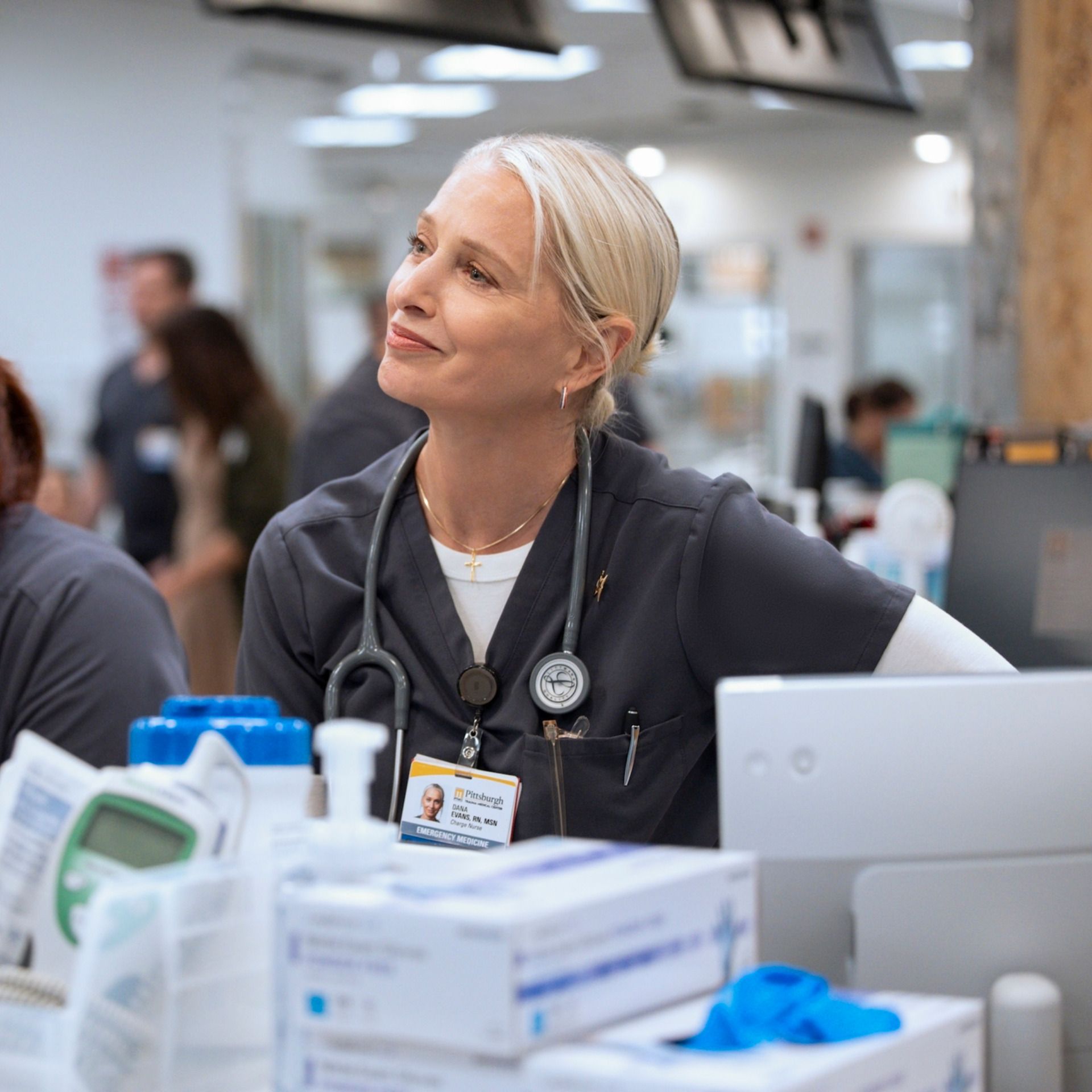
Loading summary
Transcript80 lines
- [00:00]
A
All of it is supported by Progressive Insurance. Do you ever find yourself playing the budgeting game? Well, with the Name youe Price Tool from Progressive, you can find options that fit your budget and potentially lower your bills. Try it@progressive.com Progressive Casualty Insurance Company and affiliates Price and coverage match Limited by state law not available in all states.
- [00:30]
B
This is all of it on wnyc. I'm Alison Stewart. In the hyper realistic world of the show the Pit, ER doctors and nurses take on everything from car accidents to kids with beads up their noses to mass casualty events. The senior attending doctor is supported by various specialists, interns, nurses, all with their unique specialty. But fairly soon into the series we realize that the heart of the show is charge nurse the Dana Evans. She's tough but fair, compassionate, funny and incredibly knowledgeable. Not just about medicine, but about being a good human. Here's a clip from this season when she and her new nursing student caring for a homeless man who is so unkempt that he's neglected to remove a cast, creating a harrowing outcome.
- [01:20]
A
Mr. Digby. Just Digby. Digby. Why'd you wait so long to come see us? I don't like going to doctors. Well, that makes two of us. We all need help from time to time. Think maybe we could arrange for someone going care? I just kind of want to get patched up, you know? I do know, but that's today. What's tomorrow? Sunday. Use the system. That's what it's there for. Buddy of mine, Dylan, knows all the angles, even works the occasional miracle. You think maybe I could have him stop by? I guess. Yeah, right. How about a sandwich? Yeah. Yes, please.
- [02:04]
B
Nurse Dana is played by the actor Katherine Lanassa, who's in studio today. She won an Emmy and a Critics Choice Award. And we're really glad to have you with us. Hey, Katherine.
- [02:14]
A
Hi.
- [02:15]
B
So Noel Wiley, who plays Dr. Robbie was here almost exactly a year ago and it was just the show was starting to get a little, a little buzz on it and I asked him, you know, like, why did you go back into tv? And he had a mantra and he said he wanted to go back into tv, but he wanted to, please put me in the company of first class artists with good hearts and minds doing meaningful work.
- [02:41]
A
Wow.
- [02:42]
B
What is working on the Pit? How does that mantra, what does that mean to you? Working on the Pit?
- [02:47]
A
Noah wrote something to the actors, all of whom were auditioning, and it said something like, bring your creativity, leave your ego. And that he wanted this like top to toe immersion. So I'll get to that part later. But I think that statement about bring your creativity, leave your ego. It's funny. It seems like a small thing, but so often in television, particularly in something like this, like a medical drama, you would feel that you were supposed to fit inside a box, and it let feel the freedom to make really kooky choices, like, even in my audition. And so I really appreciated that. It felt like it made me feel like I could bring all of myself. But I think the pit is a place where we really all work together. Everyone on the set even wears scrubs. We don't have actors chairs. We go into the family room on the show, and we hang out there if there's time to hang out. Or we just sit in the chairs around the hub, and we decide what shot we're gonna do. This kind of group effort, like an ongoing dance, and we kind of dance around like that until it's lunch, and then we take lunch, and then we do some more of it until it's dinner. And so I think we really try to help each other build the scene to make the best, most dynamic scene that we can make.
- [04:09]
B
So what was going on with you professionally before the pit came to you, before the audition came to you?
- [04:14]
A
Well, I'd had a couple of, like, really amazing, like, you know, blue chip roles, like opposite Will Ferrell in the campaign, Jay Roach's movie, or in Billy Bob's movie opposite Duvall Jayda Mansfield's car. But none of them had really, like, moved the needle forward on my career. I was in Octavia Spencer's show on Apple, so I'd done some really wonderful jobs with, like, wonderful, like, major talent, but they just hadn't been the thing to click. And so I found myself in Covid having a really hard time getting a job, because if you weren't a name, all of us journeyman actors weren't able to get into a room anymore. It used to be if there was a little room, how I got both of those films, they were only gonna say, see 10 or 15 people. If the casting thought it was right for it, I'd go in. But in Covid, there were no rooms like that and where you could, like, be the surprise and get the job. You know, it was just send in a self tape with now thousands of people sending in a self tape for your role. So it was really, really hard. I was having a really hard time since COVID started getting a job.
- [05:23]
B
But literally, I'm curious, like, the day that the audition came to you, what were you doing?
- [05:28]
A
It's funny. I had an audition for that. And I also had an audition for. I was living in Atlanta, where we were living, because my husband had been on Dynasty. He was the new Blake Carrington. And I also had an audition for the Righteous Gemstones, which was this over the top southern character, like my character in the campaign. And so I think everyone thought was a shoo in for that, but I didn't feel as connected to that. And when I read the Dana character, it said, like, she's a tattooed lifer. So I didn't really, when I read the description, think maybe that I fit it. But when I got together with my person that I run my lines with, she and I were having a conversation before we started. And when I opened up and started reading the lines with her, I had said some of the very same things that Dana says that's interesting in the script. And I thought, well, gosh, maybe this could be me. And, you know, the rest is history. But I remember saying to my agents, after I turned both of them in, of course I thought my audition for the Righteous Gemstones was mediocre. And I kind of thought maybe the pit was something. And they said, oh, the pit. They don't know what they want. They're reading thousands of people, they don't know what they want. But the Righteous Gemstones, we're gonna try to get them to offer that to you. That's yours. Look what happened.
- [06:42]
B
That's amazing. How was she, Dana, how was she written in the script?
- [06:48]
A
Well, you know, there was something that I actually didn't read. I don't know how it came to my attention later that it said that she was smarter than all the doctors and not afraid to let them know. And I think that I come with so much sort of directness and strength just as a person that if I had read that, I probably would have blown it out. So I'm glad that I didn't read that. I just saw her as a person who led with humility, which was her strength, her superpower and her wisdom. And I also, kind of, going back to your earlier question, sort of felt that that was the way for Catherine to operate on the set. That it just felt like that's what Noah was calling out of us, that we were all gonna work together. This top to toe immersion, meaning.
- [07:33]
B
What does that mean?
- [07:34]
A
It means that you're in it all the way. And it's like, for me, I really like being a dancer, to start working with my props and stuff like that, like before the camera rolls and sometimes, like I'll finish a conversation on the phone. When I'm in the background after they said cut, it's like so ridiculous. Or I'll keep walking the path that I'm walking, and I just keep doing it. But what happens is when the camera comes around to me, I'm so lived in that it looks lived in in the shot. But that's the kind of work I love to do. I was left on my own in a show called Judging Amy, where I was in the background as a all the time, and I had to think, well, what would a DA be doing now? And so I was hours in the background sort of figuring out what I would do. And that really led to me developing that part of my craft. You never know what you're gonna learn, you know what I mean? And I find it very grounding. And so when they said that, I thought, oh, that's me. I love to do that kind of work. I want it to just be like you just. The camera just popped in and you were already fully engaged, fully living there. I don't like it when it looks stiff or, you know, it. It bumps me.
- [08:43]
B
I'm going to now have a Katherine Lassa screen a thon the next snow day. We have. Oh, my God.
- [08:51]
A
I call them puppet shows. I call them puppet shows what we do in the background. Yeah. And so I go up to John. John. John Wells. I was like, john, would you like a puppet show over here? Or how's this puppet show working for you? And he'll. He'll say, like, we'll see you better if you're over at the door.
- [09:04]
B
So I'm speaking with Catherine Lanassa. She plays nurse Dana on the Pit. It's in its second season. Now, this is a story where we see the characters at work. It's hour by hour.
- [09:18]
A
Yes.
- [09:19]
B
We don't really know that much about their personal life. Do you know a lot about Dana's personal life?
- [09:24]
A
Well, they told me that her mother died when she was in her teens.
- [09:27]
B
Oh, interesting.
- [09:28]
A
Yeah. And then they also have written that Dana has been working there 32 years and that she started working there in high school. There was an earlier script. I don't know if it's in there. It might got cut out of last season, but that she started volunteering there in high school. And so I think that's why when she gets punched at work, it's just so humiliating and so kind of eviscerating and unexpected.
- [09:53]
B
Well, it's her home too. She's been there 32 years. It's not just work.
- [09:57]
A
No. And also that's. I have to think she's a blue collar person, that this is a place of pride. I'm sure her whole family's like, you want to, you know, go down to the hospital, see Dana, you know, like, Dana bosses all those doctors around, and then, like, have to have someone, like, hit her in the face there, I think was really, just really shattering for her.
- [10:18]
B
What kind of accent does Dana have? You're from Louisiana.
- [10:22]
A
I'm from Louisiana. Hopefully it's Pittsburgh. Okay. Okay. Hopefully it's Pittsburgh. Yeah, yeah, I'm trying for Pittsburgh.
- [10:31]
B
Did you work with a voice coach?
- [10:32]
A
I did, yeah. Yeah. From Pennsylvania.
- [10:35]
B
So tell me what, what a Pittsburgh accent is like.
- [10:38]
A
Well, there's like home and hoagie. You know, it's a different sound from home and hoagie. You know, Ravi instead of Robbie. You know, Ravi has a different sound sand at get a matt. You know, that doesn't sound right. So also, like, maybe your voice is also lower up. You might say, like, put it. You know, I'm fed up. I'm fed up. It's like flat, kind of flat. It's very forward. I gotta tell you, Alison, A lot of tears. A lot of tears. Learning Dana. A lot of tears. Yeah. Yeah. I literally was crying until I found this voice. Goes. Because I thought that if I. I really wanted her to be grounded in her blue collar ness and in her region. And I am a southerner, and people get all of our specific accents wrong. So often they'll do a Cajun in Atlanta or they'll do just a dead over the top accent for certain parts of the region. And I wanted to honor the people of Pittsburgh by at least attempting it. So I. Yeah, that was my mission. So when I finally found someone that could truly help me, it was quite a relief. But it was a lot of work.
- [11:48]
B
Your character went through a lot in season one, and there was tension between the doctors. You had a doctor who may have been overusing drugs. You got hit in the face or really hit in the face assault. And she's kind of ready to throw in the towel. We think, why does she come back?
- [12:09]
A
I don't think she knows anything else. And I think she gets a great amount of her self esteem from that. I think that there are few people that can do this kind of work, and I think that it's a calling. I know that. So I'm kind of good around when people are born and when people die, and for some reason, I just know what to do in Those situations and having been called into that a few times, it's something that I feel is kind of a gift. Not because I'm such a wonderful human being. And I feel a lot of. What's the word? Like, I feel very useful. It feels important to me. It's like some. A lot of things aren't that important, but, God, if you could help somebody die, like, that really matters. Right. And so a lot. A lot of the nurses that I've interviewed have that kind of a calling feeling, you know, where they. Maybe their mother was in the hospital and they were like, oh, I could do this better than them. And then literally went into nursing because of that. You know, I can imagine.
- [13:11]
B
My niece is a nurse, and there's something special about nurses. I've been in the hospital a lot. My sister's been in the hospital a lot. There's something, like, so extraordinary. The doctor comes in. He's the doctor. He tells you all he needs to, all he needs to, and then he leaves. But then the nurses not only care for you, but they also look out for you.
- [13:31]
A
Yeah. There's a humility, there's a wisdom. Yeah. Incredible. They're incredible.
- [13:37]
B
In the show, we've moved forward several months. How would you describe Dana's mind, state of mind when she returns?
- [13:46]
A
I think she is hypervigilant. Yes. Yeah, I think she's hyper vigilant and a little angry.
- [13:54]
B
How are we seeing that? What's an example of that? I guess three episodes in, we might have seen it.
- [13:59]
A
Yeah. Have we seen it yet? I don't know. I don't know. I don't know if we've seen it yet. It's good. It's coming.
- [14:05]
B
It is gonna. Okay.
- [14:06]
A
We don't give any spoilers. Well, you see the hyper vigilance, where it's like, the first thing she's telling Emma is, you know, what was that the acronym? Was it stamp? You know?
- [14:14]
B
Yes.
- [14:14]
A
Daring is scaring, you know? Yeah, yeah, those things, like, that's really, like, point of focus for her is that nurses stay safe. And I think she sort of feels betrayed by the system. Not enough is done to keep nurses safe. And, you know, all the nurses that I've interviewed have been punched or hit or kicked, and they say it happens all the time.
- [14:32]
B
Definitely.
- [14:33]
A
Yeah.
- [14:35]
B
There are new characters we see on the scene a little bit. Who are you excited for characters to watch that we are just getting to know?
- [14:43]
A
Well, Digby, that we see Charlie, he's there for a bit. He's wonderful. Wow. I really like Ernest that plays Louis, he's been like. Well, he's been there for a minute. Let's see, who else do I really like? I really like Narzema. She's like a new character. That's incredible. Yeah. And I also think Lucas Iverson playing Ogilvy, he's completely obnoxious, but, like, wonderfully so. Yeah. But I think Nurse Emma, she was just a recent Juilliard grad. This is her first job.
- [15:15]
B
Oh, really?
- [15:16]
A
Yeah. And she just crushes it. She just crushes it.
- [15:19]
B
Oh, that's so interesting.
- [15:20]
A
Leticia Holland. Shout out to Leticia.
- [15:23]
B
It's interesting. It's such a variety of age ranges on the set. What do you learn from people who, like, this is their first job?
- [15:34]
A
I have to say, I really feel in my heart just an overflowing towards these kids on the show because they did what they do so beautifully. The Pit is kind of, to your earlier question, it's a success because of all of us. Because of all of us working together as one really great unit and figuring out how to make each other's bits better or whatever, you know, helping each other. It's a very generous workplace in that way.
- [16:06]
B
It's interesting. When did you realize that it was going to be a success?
- [16:13]
A
When I saw the first episode with my friends. You know, it was during the fire. The first episode came on during the fire, and we were, like, at a friend's house, Manhattan beach, and watching it on the carpet, you know, and everybody was like, wow. Because we had seen a screening of it, but I couldn't make heads or tails of it because I'm in it, and everyone just loved it. And, I don't know, I just had a good feeling when I saw the first one.
- [16:38]
B
My guest is Catherine Linassa. She plays nurse Dana on the Pit. It's on hbo. By the way, you wrote a beautiful piece for Women's Health about your own cancer.
- [16:49]
A
Yes.
- [16:50]
B
About your cancer survivor, I should say.
- [16:52]
A
Yes.
- [16:53]
B
How did your experience with the medical field inform your character?
- [16:59]
A
Wow. You know, I think being a patient, you know, and being so vulnerable.
- [17:06]
B
Yeah.
- [17:07]
A
Really gave me that perspective. When I'm playing opposite patients in the hospital, I really know now what they feel like. And I also really got to see how much a nurse's small action or few words can change everything about how you feel. I had some complications after my cancer, and I needed to go back to the hospital, to the emergency department a couple of times, and then, you know, spend a few days and then go back again. And I had gotten through the Cancer and the cancer treatment. Okay. But I was starting to feel like my disease was a zombie and I wasn't going to be okay ever. And how did I go from being healthy to this person that just lives at the damn hospital? And I broke down in the second emergency visit for the first time during the whole thing, and this nurse was like, listen to me. The first six months after cancer are really bumpy, and it's not going to stay this way. Okay, do you need an Ativan?
- [18:14]
B
Every part of that is right on.
- [18:16]
A
So that mattered so much. But also, I didn't. So I didn't get the Ativan. They came to me later. They were like, I had a scan. I had a brain scan. And then they said, I didn't want to do another type of brain scan or some other type of scan on me that time. And they said, we see you didn't get your Ativan. Do you feel like you still need it? And I was like, yeah, I do. So they gave me an Ativan. They. I finally got in a room. I got off the wall, just like in the hospital. So I know what it is to be the patient in the hall. I got into a curtained off room. I had an Ativan. I had. They gave me some dinner, like some hamburger, like an ice cream cup or something. I took an IV bag. I took a long nap. I woke up at one in the morning, and I was like, are you sure I'm getting that scan? And they're like, we think so. And then I said, would you mind checking? They're like, oh, no, you had dye earlier, so they can't give it to you today. You can go home. So I took an Uber and I went home. But it's like, that's comedy, right? Like, I'm like, you know, barefoot, padding around the hospital, like, are you sure I'm supposed to be here? Like, where is everybody? You know, what are y' all doing? And so, you know, I got to see what that was like to, like, you know, you know, be that patient that's just in the ED for a really long time. Like, you know, all of it.
- [19:30]
B
So we're the same age, okay? And if someone is thinking to themselves, gosh, I just. I really want a role in in my 50s. I've been at this for a really long time. Can you give him a pep talk? What would you tell somebody?
- [19:47]
A
Gosh, you know, it was interesting. I saw Jeff Hiller talk about his. I love him, and I was so happy to see him. Win and get nominated and everything. He's really special. But he said, you know, it's no guarantee that you keep going and the thing's gonna happen. You know what I mean? But I know for myself, I had an unwavering belief in myself, and I had a rage about the fact that it was so hard. You know, I did. I was like, why have I been doing this this long? And I'm just still having to, like, duke it out for every single thing. And why am I now back to doing self tapes for guest spots on mediocre shows? Frankly, just so I can keep my insurance. How does it come to this? I mean, it was a lot because of COVID but I was mad about it. But I never stopped believing in myself. I really did. So I don't know. I guess just if you want to do it, if you have to do it, then keep doing it. But, you know, you have to work hard. You have to work really, really hard.
- [20:43]
B
You know, now you're high on the call sheet.
- [20:47]
A
I am.
- [20:48]
B
And you're winning awards at this point in your career. What do you think it means to have this kind of success at this point in your life?
- [20:59]
A
It's really beautiful, you know, I mean, honestly, anytime someone asks me that question, I almost feel like I'm going to get choked up because I just thought it had passed me by, you know, I thought it wasn't for me. I thought for whatever reason, doesn't matter really how good I am or how hard I work. I didn't. Not in a. Not in a negative, feel sorry for my way. That is just not my path. I have a beautiful life. I have a beautiful daughter. I'm just not one of them. And then all of a sudden, I was like, no. Hey, want to come to this party? We like what you do.
- [21:30]
B
I'm what I am.
- [21:31]
A
I know. Literally, it was like a door open. It was like, come over here to all the cash prizes. Would you like Louis Vuitton to dress you? You know, it just was kind of bananas. But I.
- [21:43]
B
What's your favorite thing about your favorite thing about it being so good right now? Gosh, it can be the silliest thing ever.
- [21:52]
A
You know, it has really been, like, the mutual respect of actresses that I love and have often loved for a long time. Like, Jackie Weaver hit me up on Instagram, and Jackie Weaver had been my, like, north star because she came onto the scene, I think, in her 60s. No one knew who she was in America, Got, you know, an Oscar nomination for Silver Linings Playbook. That animal kingdom at the same time, she was a powerhouse. Couldn't be denied. This fully formed actress who'd obviously been doing it for decades, you know, so for her to hit me up was such a full circle moment. I was like, are you kidding me? I kept going because of you.
- [22:34]
B
My guest has been Kathryn Linasa. You can watch her on the pit. She plays nurse Dana. It was really a pleasure to talking to you.
- [22:42]
A
Thank you so much, Alison.
- [22:44]
B
And that is all of it. I'm Alison Stewart. I appreciate you listening and I appreciate you. I'll meet you back here tomorrow. I'm Ira Flato, host of Science Friday. For over 30 years, our team has been reporting high quality news about science, technology and medicine. News you won't get anywhere else. And now that political news is 24 7, our audience is turning to us to know about the really important stuff in their livescancer. Climate change, genetic engineering, childhood diseases. Our sponsors know the value of science and health news. For more sponsorship information, visit sponsorship.wnyc.org.