Loading summary
Transcript86 lines
- [00:01]
Home Depot Announcer
Working on building a dream space but don't know where to start. At the Home Depot, we can help you bring your dream project to life. Whether you're building a backyard oasis, a podcast studio or a wellness space, we've got everything you need in store and online. With project guides and free delivery options, it's easy to go from dreaming to doing the Home Depot. How Doers get more done from premieres April 19th on MGM in a small, inescapable town, understanding the monsters may be the only way out. Desperate hope may lead residents toward even darker truths.
- [00:46]
Michaela Cole
I think they're doing it to make us afraid. Well, then, it worked.
- [00:49]
Home Depot Announcer
Something ancient is feeding off of their suffering, and it won't stop. Survival will demand impossible choices. From season four premieres April 19th on MGM.
- [01:01]
Michaela Cole
Your vehicle doesn't just get you from here to there. It's a bridge to the people and
- [01:07]
Julian Sklar (Character)
places that matter most.
- [01:09]
Michaela Cole
It's how you show up for your family, your community and everyone else that depends on you. That's why for 125 years, Firestone has been building tires with one thing in to deliver products that are as reliable as you are. Firestone always dependable since 1900.
- [01:38]
Alison Stewart
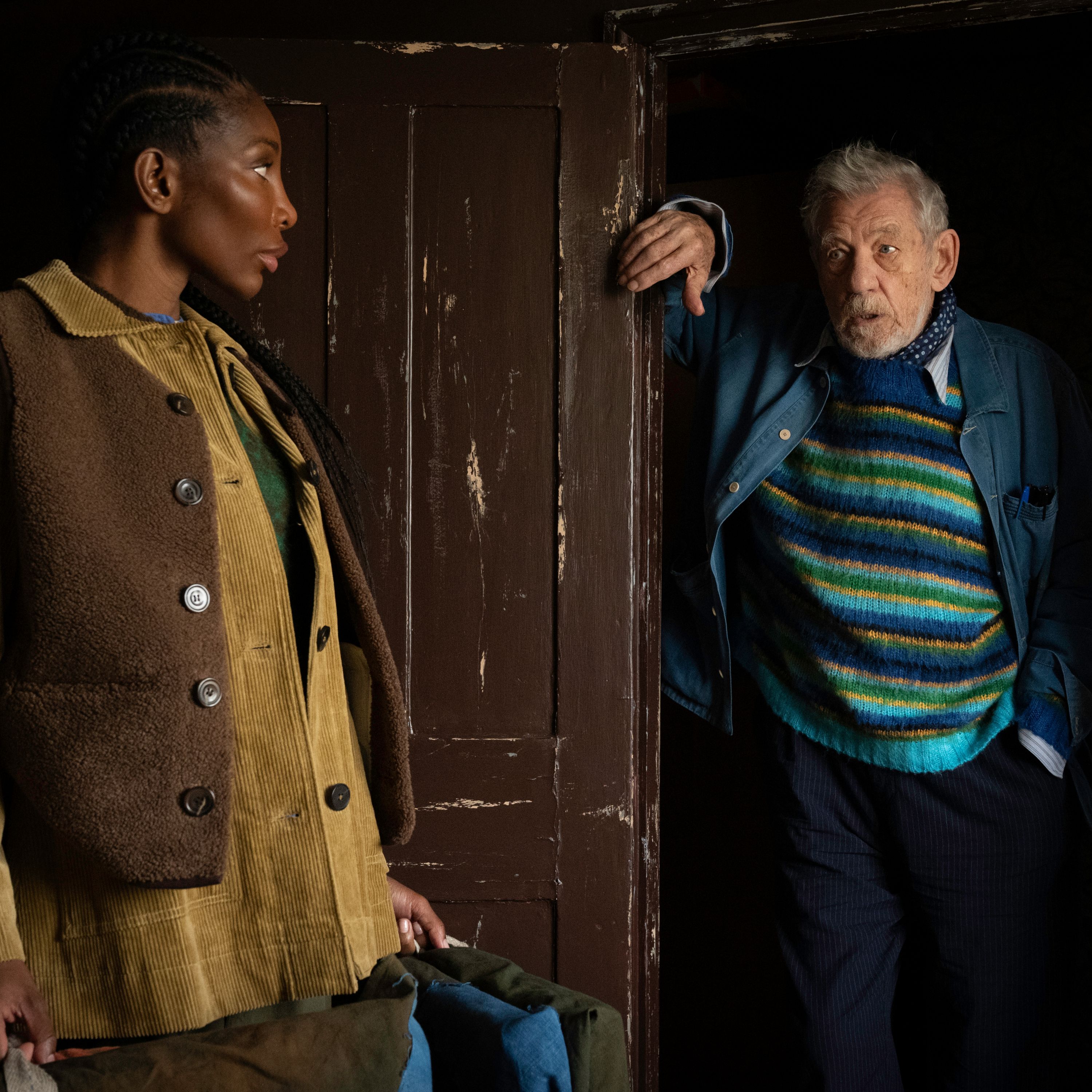
This is all of it. I'm Alison Stewart live from the WNYC studios in soho. Thank you for spending part of your day with us. I'm really grateful that you're here. On today's show we'll hear from actor Sean Hayes about his one man play. The unknown playwright David Kail and director Lee Silverman will join us as well. Plus, we'll continue to celebrate Poetry Month with Nick Offerman who joins us to share a poem. But this hour we're devoting to film. On the way we'll speak with the co directors and writers of the new indie the Travel Companion. So let's get this started with the lead of two films being released this month. My next guest, Mikayla Cole appears in two films which set on artists, each with a very different outcome. There's Mother Mary where Cole plays a designer who has a tension filled relationship with a superstar. Think Lady Gaga, she's played by Anne Hathaway. And the film that opens today, the Christophers. Cole is Laurie, a painter and a restorer who becomes an assistant to a great artist nearing the end of his life, Julian Sklar, played by Ian McKellen. Julian is kind of a mess. He's making cameos for money. Things are strewn everywhere. But he does have a sharp tongue. He can be funny, but biting. Laurie is private and keeps to herself, but the Real reason behind Laurie's employment is that Sklar's children have hired her to forge his unfinished work from a series called the Christophers so that they can sell it and make a nice profit after his death. What could go wrong? Who gets the best of whom is kept a secret until the very last moments of the film. The Christophers opens in theaters today. You can see it in the Village at IFC or up at Lincoln Square. It's directed by Steven Soderbergh and stars Michaela Cole, who joins me now. It's nice to meet you.
- [03:29]
Michaela Cole
Hi, Alison. Nice to meet you.
- [03:31]
Alison Stewart
You know, you are such a terrific writer, critically acclaimed writer for chewing gum, and I may destroy you, but this is written by someone else. What does it take for a script to catch your attention as an actor?
- [03:45]
Michaela Cole
Oh, I love that question. I think I need to be surprised. I need to get to the end and look back and realized that I thought I was going in one direction, but the writer has spun me around and I've ended up in a destination I couldn't have possibly imagined being in. That level of surprise and unpredictability is something I find very attractive.
- [04:17]
Alison Stewart
What did you think of Laurie when you first read her on page?
- [04:22]
Michaela Cole
She mystified me. I. I guess it was. I was really trying to figure out Ed Solomon. So as I read, I'm always thinking of, what are the writer's intentions? So I went through and I thought, what kind of person is Ed writing? Because she seems to perhaps have bad intentions. And, you know, I'm always intrigued. I know I'm a black woman. And I was like, what are we doing here? So I was like, okay, she's the thief. Okay, where are we going? But then I got to the end and I thought, oh, oh, respect. Respect. Ed. This has taken me somewhere that has surprised me. And I loved the delicacy with which he took me there. Yes.
- [05:31]
Alison Stewart
It's interesting to see how you look at a script as a writer and an actor at the same time.
- [05:37]
Michaela Cole
Oh, yeah. I think a script is a window to the soul of a writer. And so I find the script and the person who wrote it inseparable. And there's many different facets to us, and it's showing me one side. And I even think a director, when I look at how something is directed, I want to know who the director is, because it tells me something. Where did they choose to place the camera to shoot this scene? Who's the. Are they instinctively finding themselves in it? It tells me a lot about the
- [06:19]
Alison Stewart
person I'M wondering, I know from your writing that you do a lot of rewrites, that you believe in rewrites. Does that transform into acting as well, or is it a different beast?
- [06:32]
Michaela Cole
It's a different beast. And certainly in the Christophers, we didn't really get more than one or two takes.
- [06:45]
Alison Stewart
Right, right.
- [06:47]
Michaela Cole
We shot it in 19 days. And it's very nice to just trust what is instinctive to me as a performer and what comes in the moment, being with the other actor, the chemistry in the room, and not to overthink, because I just think everything is okay as long as you understand that script and that character is sitting in your stomach. I don't ruminate much over performance and notes, and I tend to trust the director. If he wants to go again or she wants to go again, I'll go again. Or if they want to go again. But I'm never saying, oh, can we go again? I just need to do this other thing.
- [07:34]
Alison Stewart
You're not too precious about it.
- [07:35]
Michaela Cole
No.
- [07:38]
Alison Stewart
My guest is actor Michaela Cole. She stars in the Christophers, which is in theaters today, and Mother Mary, which will be in theaters on April 17th. When we meet Laurie, it's an interesting sort of a fake out at the beginning because we think she's very much in the art world, but you discover she's got to make ends meet. She's a great painter, but she's working at a food truck. How is her career going?
- [07:59]
Michaela Cole
Oh, you know, not where she had dreamed when she was 15 years old. It's. She's. She's living a facade in a way. Doing restoration jobs are kind of the only credit she can give to herself. She has wasted a lot of years being too shy to show her work, but she still makes work in the privacy of her bedroom. And I guess the sad thing is work is supposed to be seen, but she has kind of just rested with the idea that her work won't be seen anymore, and she does it for herself. But does any artist really make art just for themselves?
- [08:47]
Alison Stewart
How would you describe her personal life?
- [08:50]
Michaela Cole
Mm. Lonely. Yes. She does live in a house share, but I think she's lonely. I was thinking about this actually this morning, because Julian Sklar also lives alone. I live alone as a real life person, Michaela. And she's lonely, and there's something about isolated characters that really draw me in. Hmm. Yeah. There's a likeness that I see.
- [09:18]
Alison Stewart
Do you think she's. Is she alone or is she lonely?
- [09:21]
Michaela Cole
No, she's not alone. I think she's lonely. She's dealing with customers all the time. She's dealing with phone calls all the time. She's dealing with housemates. She's probably watching movies with them sometimes. She probably could hang out with them and they're probably going to the pub. But she's very cerebral, she's very introspective, and maybe she likes to be alone, you know?
- [09:46]
Alison Stewart
Laurie's approached by Sklar's children so that she can forge his work and they can sell it after his death. They're played by James Corden and Jessica Gunning. Why do you think they've chosen Laurie?
- [10:01]
Michaela Cole
Well, they've chosen Laurie because when Laurie was in art school with Sally, she had a blog post that she kept online, and she was scathing about Julian Sklar. But, I mean, she read him for filth. It was so cutting, was such an intellectual tearing apart of an artist, and it was brutal. And it went on and on, and it was basically saying, you know, this man means nothing to anybody. Should he be allowed to live, essentially, is what that was. And his children are so greedy, perhaps because they haven't been taught selflessness, that they pick me because they feel my hatred and resentment is strong enough for me to bypass any sense of morals and join them on. On a very selfish journey.
- [11:23]
Alison Stewart
What did your director, Steven Soderbergh, tell you about their relationship, your relationship to his children that helped you with these interactions? Because your scenes are. They're both hilarious and they're horrifying.
- [11:34]
Michaela Cole
Steven Soderbergh honestly doesn't tell you much about anything, really. Oh, no, no, no. The guy.
- [11:39]
Alison Stewart
Tell me more.
- [11:40]
Michaela Cole
He is like, you know, before we started shooting, Ian wanted rehearsals, and Stephen's like, what for? No, I'm good. And so we instead just met in Ian's house. I'd never met Ian, and I got a phone call saying, Ian wants to go through the script. And actually, the writer, Ed Solomon, is the person who gives you more information about how you relate to the characters in the film. But also listening to. As he discovered who his character was in the kitchen, I kind of watched Ian McKellen find Julian Sklar within him over a period of five days. And when he would talk about his children, he would confess. He neglected them, he abandoned them, he showed them nothing. He didn't value his children, so of course they didn't value him. So as much as I see them as a little obnoxious maybe, and a little bit misguided, I don't think anything in Laurie wants to hurt them, you know, call the police, you know, or anything. She just wants to. She's following some path of goodness somewhere in the backseat of her consciousness that quietly guides all of her interactions with even his children.
- [13:21]
Alison Stewart
Had you ever worked with James Corden or Jessica Gunning before?
- [13:23]
Michaela Cole
No. Oh. But huge, huge fan of both of them, but particularly Jessica Gunning. I watched her in Baby Reindeer and I thought, wow, she was great. She was great. She delivered so much empathy to how she performed that character. And I had heard that she was a lovely, beautiful person from Mutual Friends. So I was really excited when I found out she was gonna play Sally.
- [13:54]
Alison Stewart
We're talking to Micaela Cole. She stars in the new film the Christophers, which is in theaters today. Let's listen to a clip from the film and we can talk about it afterward. This is Julian. He's quote, unquote, interviewing you for the. But he does most of the talking. This is from the Christophers.
- [14:12]
Julian Sklar (Character)
It's been a while since I interviewed an assistant. So tell me about yourself, Herbert. If you are a painter, I don't want to know about it. And do dispense with the big fan you were with me through whatever drudgery your life's journey has taken you. Heartbreak, blah, blah, grieving. Because we both don't. That's a lie. As I've done nothing. But in 30 years, nothing at all in 20. You made me want to be an artist. No, my dear, you're up childhood made you want to be an artist. I'm just what you tripped over as you scurried to freedom.
- [14:53]
Alison Stewart
What do we learn about Julian from that passage?
- [14:58]
Michaela Cole
What a calcified human being.
- [15:02]
Alison Stewart
Except he does know how to use the Internet. As we discover.
- [15:04]
Michaela Cole
As we discover. Right.
- [15:06]
Alison Stewart
We'll leave it there.
- [15:07]
Michaela Cole
Yes. Gosh. I think Laurie learns what she already knew, which is that he doesn't want to be a nice person. He doesn't want to be soft. He has. It's like he's resigned from kindness. He's mean, you know, and he doesn't even want to be nice to people who love him. And I think he's obviously. He's burned. He's been burned. And underneath that exterior, there's obviously a very sensitive. And what's great for Laurie in that moment is that she enters the space preparing to put on a performance and be somebody else. But then she realizes that he is busy doing all of the performing, and she can just sit back a little bit and download this very exhausting piece of art, which is Julian Skla.
- [16:20]
Alison Stewart
Yeah. He just sort of tries to bully his way through life I was curious about what is going on in Laurie's mind. How does she keep her personal feelings for him from coming to the surface?
- [16:33]
Michaela Cole
I think she's very mischievous, really. You know, she's very calculating and a little bit like a painter who is trying to figure out what the next brushstroke should be on a page or what color is quite right. She doesn't make a move. She's deeply considering everything before she acts. And I think that's her whole life. That's how she lives. She is not someone that wears her heart on her sleeve. She's not someone that acts impulsively. And so I think she's comfortable because he is kind of not seeing her and she's used to that. She's used to not being seen.
- [17:26]
Alison Stewart
She takes the job. Does she take it for money?
- [17:30]
Michaela Cole
Yeah, I don't think so. I think that she knows as soon as she meets Barnaby and Sally, she receives their pitch. She knows that she's not gonna go in that direction. She is not sure what she's going to do. But she knows that there is no way she's gonna align with those two because for reasons you know you will discover. Yes. She just needs to figure out what she is going to make.
- [18:05]
Alison Stewart
This is really a two hander. A lot of the film is a two hander between you and Ian McKellen. What do you like about being involved in a two hander and what can be challenging?
- [18:16]
Michaela Cole
Oh, I love two handers. I love how psychological they become. I love that thread between two people. It really allows you to go into relationship storytelling and not get too lost in action. Though miraculously, Stephen and Ed have managed to make this film which almost has these elements of a heist in an action film, but is deeply about the relationship between two people. I. It feels like theater to me and that's my background. I'm very comfortable in that space. Yeah, I like getting to know people as well. I really. And a two hander allows me to be someone else. Getting to know somebody who's also pretending to be someone else feels dangerous and real and like you can't sleep or be lazy with the relationship because it's just you and them and they're always watching you and you're always watching them and you're.
- [19:29]
Alison Stewart
And it's the two of you.
- [19:30]
Michaela Cole
Yes.
- [19:31]
Alison Stewart
Ed Solomon. For people who don't know about Ed Solomon, he did Bill and Ted's excellent adventure. Right.
- [19:37]
Michaela Cole
Isn't that fascinating?
- [19:39]
Alison Stewart
I find it fascinating after watching this movie and going down a rabbit hole about him. But again, that's like, in a sense, a two hander. It's about a relationship between two people. What does he understand about the dialogue between two characters?
- [19:55]
Michaela Cole
What does Ed understand?
- [19:56]
Alison Stewart
Yeah.
- [19:57]
Michaela Cole
Ooh. Yes. Yes. I think he. For example, monologues. I feel I see less and less in films, but actually, when I listen to people, that is how they talk. And there's something real that Ed is bringing into script writing that isn't. Well, we're not supposed to do that anymore. As writers. You can't write these long, winding monologues. We need dialogue. We need short, snappy dialogue. He doesn't care. And I like that. Julian Sklar's voice goes on and on and on. And you can tell that Ed is studying the character and the character is unaware that he's being studied. There's something I love about that. Yeah.
- [20:49]
Alison Stewart
It also gives us a chance to watch you react to the person.
- [20:53]
Michaela Cole
It's so nice to be able to listen to someone. And, you know, at times, listening to his writing through Julian, it feels voyeuristic. He talks for so long, it's almost like he forgets anybody else is in the room. And then you have this naughty view of somebody. Yeah, I don't. I don't experience that as an actor much. I think that's the. I've had that experience.
- [21:25]
Alison Stewart
Let's listen to another clip from the Christophers. This is where Julian says to Laurie, do you mind if I ask if you have a boyfriend? And Laurie says, yes, I do mind. We'll hear the result of it. Let's listen.
- [21:39]
Julian Sklar (Character)
It's not like we cease to be ourselves simply by crossing some conceptual boundary. Here I am at work, and here I am at home, asking away at work. Don't you dare. All yours.
- [21:51]
Michaela Cole
You can't ask me in either place because you are my employer, which means you hold the power and I should
- [21:59]
Julian Sklar (Character)
use it to ask if you have a partner.
- [22:04]
Michaela Cole
If you'll explain its relevance.
- [22:06]
Julian Sklar (Character)
The relevance is that I'm curious. And who wouldn't want to bring their life into their work unless. Well. Right. Well, never mind. You said that you weren't an artist.
- [22:20]
Michaela Cole
Actually, you said don't.
- [22:21]
Julian Sklar (Character)
Well, I swear that we had that conversation yesterday.
- [22:24]
Michaela Cole
Well, you know, there was speaking, if that's what you mean.
- [22:27]
Julian Sklar (Character)
Well, did I not ask questions? My children say that I don't ask questions. And actually, by definition, did I not ask questions is a question. My children are idiots. I have no problem with questions, Laurie. It's the answers that I can't be bothered with.
- [22:45]
Alison Stewart
It's so interesting. And listening to that clip, I hear generational differences.
- [22:49]
Michaela Cole
Yeah. I just think listening to that, I'm like, Ed, how did you do that?
- [22:54]
Alison Stewart
It's really interesting, right? There's so much in that one clip. Yeah, we learn so much about Julian.
- [22:59]
Michaela Cole
Yeah, you do. And also, you know, Laurie doesn't divulge her information and I'm sure there's a part of her that would love to, but I also think she's telling him that he has all the power even though he doesn't, you know, so it's a, it's a useful way of affirming she is innocent and has no power and he has all of it, even though she's, she's scamming him at that point. But his, his waffling is just so beautiful. It's like, Ed, who did you inhabit? Who are all the different people, you know, that you ate to give us this? It's just, it's stunning, honestly. I think. Yes, it is. It's so that generational difference is, is beautiful to behold. For me, watching Ian, hearing him with this was just great.
- [24:05]
Alison Stewart
It's interesting because your other film, which comes out I think in a week or so, in Mother Mary, your character, there's a different dynamic because she is a more successful person. She's a sought after designer. How did that power dynamic differ than in, than in the Christophers?
- [24:22]
Michaela Cole
Yeah, she's more successful and she talks a lot more. Yeah, I, you know, yes, she's talking to cover her pain. And in a way you could say that Sam Anselm is successful, but it's like an outwards success. So to the world of fashion, she's incredibly successful, but in terms of doing purpose filled work, creating work that involves her soul, there's this depth of creativity that she's been to with Mother Mary and she's starved of that for 10 years. So she isn't successful.
- [25:16]
Alison Stewart
What questions does the Christophers and maybe even Mother Mary raise about art and who makes it and who judges it?
- [25:23]
Michaela Cole
Yes, I think it's asking those very questions. Who is the author? Is there one author? And I don't think there is. And if there is one author, is that author human? Where are we receiving our ideas from? And also when an idea is finished and goes out into the world, do the audience, do the people who receive that art continue to shape that art? And actually, are we all the authors and creators of art?
- [26:13]
Alison Stewart
I've been speaking to actor Mikayla Cole. She stars in the movie the Christophers, which is in theaters today, and Mother Mary, which will be in theaters on April 17th. It was great to have you in studio.
- [26:23]
Michaela Cole
It was so great to meet you and thank you everybody for listening.
- [26:28]
Home Depot Announcer
Working on Building a Dream Space but don't know where to start at the Home Depot, we can help you bring your dream project to life. Whether you're building a backyard oasis, a podcast studio, or a wellness space, we've got everything you need in store and online. With project guides and free delivery options, it's easy to go from dreaming to doing the Home Depot. How doers get more done
- [26:58]
Alison Stewart
what would
- [26:58]
Bank of America Announcer
you like the power to do?
- [26:59]
Alison Stewart
Don't worry, you got this.
- [27:03]
Michaela Cole
Whoa.
- [27:03]
Bank of America Announcer
Hear that?
- [27:04]
Michaela Cole
I did it.
- [27:05]
Bank of America Announcer
That's the sound of you helping your child find confidence that lasts a lifetime. Bank of America invites kids 6 to 18 to join golf with Us for a limited time. Sign them up for a free one year membership, giving them access to discounted tee times at thousands of courses as we champion the next generation. Who dares to ask what would you like the power to do? Restrictions apply. Activation required. CBFA.com Golf with us for complete details.