← All Of It with Alison Stewart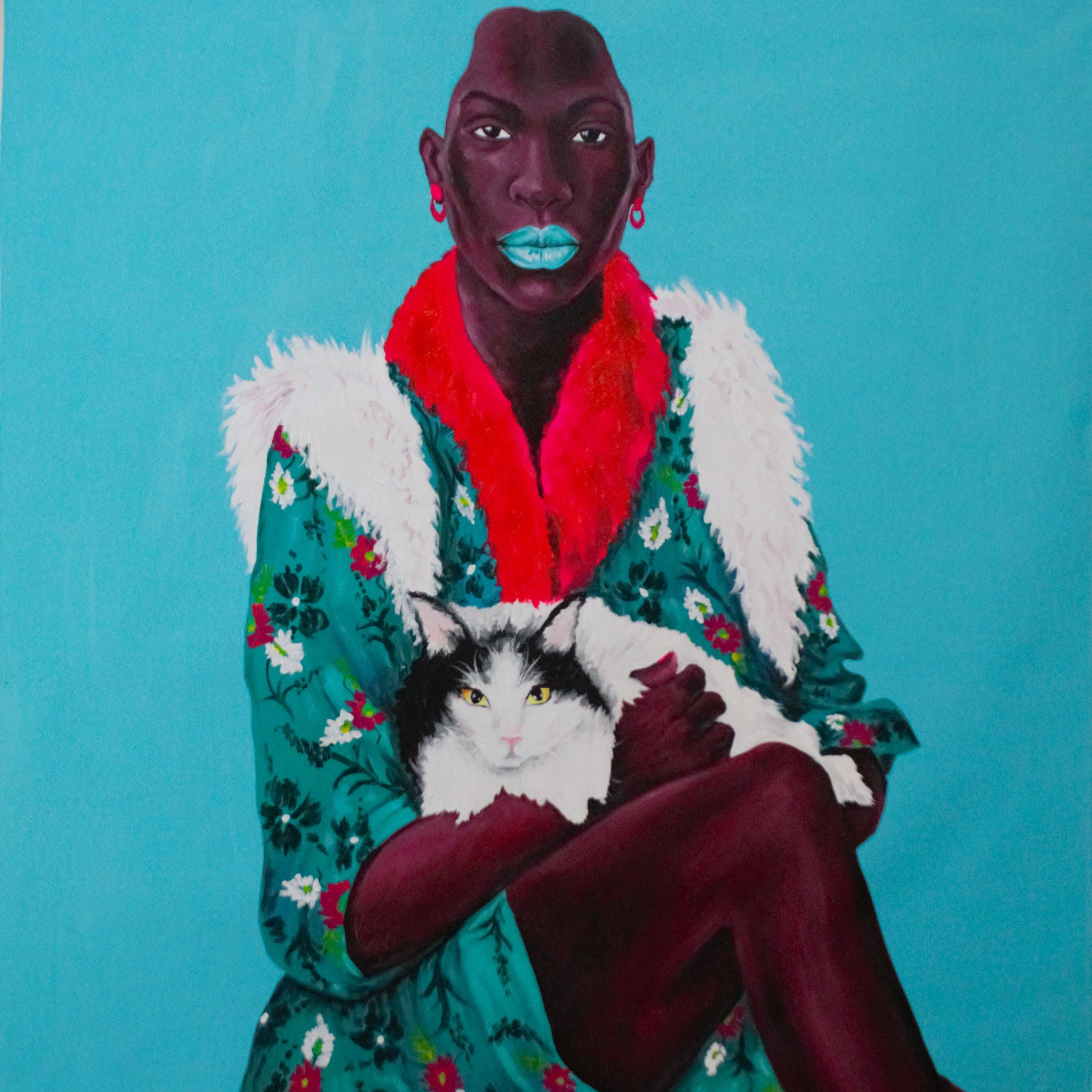
All Of It with Alison Stewart
Musah Swallah’s Pop-Up Exhibit Brings Ghanaian and Western Art to Chelsea
00:16:51
Loading summary
Transcript61 lines
- [00:00]
Progressive Insurance Announcer
All of it is supported by Progressive Insurance. Do you ever find yourself playing the budgeting game? Well, with the Name youe Price Tool from Progressive, you can find options that fit your budget and potentially lower your bills. Try it@progressive.com Progressive Casualty Insurance Company and affiliates Price and coverage match Limited by state law not available in all states.
- [00:30]
Alison Stewart
This is all of it on wnyc. I'm Alison Stewart. Artist Musa Swala's new show Between Worlds is filled with bold, colorful portraits on wood and canvas. His work was described as quote. In the broader dialogue of contemporary African art, Swalla stands among a new vanguard unafraid to confront the aesthetic expectations of the Western gaze. He does not merely represent Ghana, he redefines it layer by layer. Color code by searing color. Swall's work is on display through the end of the month at Ethan Cohen Gallery, and he joins us now to discuss. Musa, welcome.
- [01:07]
Musa Swala
Thank you so much for having me.
- [01:09]
Alison Stewart
The majority of your work is portraits, many of them really, really up close. What do you like about painting portraits?
- [01:20]
Musa Swala
Well, painting portraits was something that I really like so much. Growing up, I used to paint like abstract painting or drawings. And my dad used to ask me, how do you draw without putting eyes or nose, stuff like that. So he keep on like asking me questions anytime I do like abstract painting. So I got interested in doing portraits. One time I tried to paint picture of my mother and my father was like, wow, so you can also paint something real. So that's how I got the inspiration of like painting people's pictures and stuff like that.
- [02:00]
Alison Stewart
You primarily work across several mediums with canvas, with wood, with cork. First of all, how did you discover wood would be a good medium for you?
- [02:12]
Musa Swala
Well, the story of me working with wood started back home in Ghana. Like Ghana is blessed with a lot of like wood, timber and stuff like that. So I started painting with wood not long ago before moving to the United States. So I started painting with wood, trying something new from other artists because most artists in Ghana, like paint on canvas and on paper. So I decided to just move a little bit, get some kind of feel of a different medium and see how people are gonna react it. So my first time doing that, I had a solo show back in Accra that I exhibited Hollywood paintings. And it was, it was really, really nice. And the outcome of the show was something very big. And that's how I got the recognition of artists working with wood, like painting on wood. So at the point in time they used to call me the wood artist. The wood artist, yeah.
- [03:16]
WNYC Interviewer
And if you Go to our Instagram, Olivet, wnyc. I went to the show last night.
- [03:20]
Alison Stewart
And I got a picture that you painted on wood as well as some other. Some of the other portraits that we'll discuss.
- [03:27]
WNYC Interviewer
Yeah, it's interesting.
- [03:31]
Alison Stewart
As I was looking at the picture.
- [03:32]
WNYC Interviewer
On wood, there's something different about it. I don't know if it's that it's dimensional, that it's three dimensions.
- [03:39]
Alison Stewart
What do you think makes it different?
- [03:41]
Musa Swala
Yeah, because wood, you can have the feel of, like, touching the texture. Because I also do carve some part of the wood and I also, like, cut it, trim it for people to just have a feel. Like, art is not something which is like, in a square form or in a rectangular shape. It can be in a very, very different shape and sizes. So that was one of the things that I was using. And when I moved to New York, I got so amazed about the structure, the building, the scrap scrapers. So when you look at my wood, you can see how I arrange it in a form of, like, a building. And I do, like, paint on of it. Yeah.
- [04:21]
WNYC Interviewer
You also use cork. How did you get involved with using cork as a medium?
- [04:28]
Musa Swala
Wow. It's a long story, but I'll make it short. I got introduced by some of my friends back in D.C. well, I don't drink. Most people think I drink a lot when they see my quark painting. I don't drink at all. Yeah. So I got being introduced with corks, and one time I was like, okay, I just want to try something new to challenge myself. The cork painting you saw was a painting that I did during the lockdown, during the pandemic. I. I came to New York for a residency, and I got locked up here with a very few materials with me. So I decided to just use the whole that I have in creating that. That pieces. So that's how I got started creating painting with wine cork.
- [05:19]
WNYC Interviewer
My guest is artist Moussa Swalla. His new show, Between Worlds, is conceived at an intimate salon. It's on display at Ethan Cohen Gallery in Chelsea through the end of the month. You often work with really bold color. Yellow, red. When did you start experimenting with color and why did you side? I really like color.
- [05:41]
Musa Swala
Well, I started using brighter colors back home in Ghana. Like in. In school, we are being discouraged of using darker colors because most of our teachers think is going to, like, ruin our paintings. So I got used to brighter colors way, way back from school. So that's the reason why most of my painting you see, like, yellow, pink, like sky blue. These are some of the colors that I grew up with it. So that's. That's why you see them reflected in my paintings here and there.
- [06:15]
WNYC Interviewer
What does the intensity of the color do for your subjects when you're painting them?
- [06:22]
Musa Swala
So I use. Most of the time, I use, like, lighter colors for the background, and I use, like, deep and darker colors for the fugues so people can, like, easily view the painting. I don't like where the lighter colors have conflict with the darker colors. So I use different, separate colors in my paintings. Yeah.
- [06:49]
WNYC Interviewer
Let's talk about a couple of paintings in the show. My pet, there's a woman. She's sort of draped in a teal floral robe. She's got red socks and red earrings, and her legs are kind of crossed, and she's holding a cat. And there's a couple things that are really interesting about this. First of all, her hair sort of blends in the background. And this happens a lot in your painting. Tell me a little bit about this.
- [07:15]
Musa Swala
Yeah. So I started a series that I titled Invisible Hair. When I came to the United States. I've seen a lot of, like, how people, like, dye up their hair in different colors. So I got fascinated about it, and I was like, oh, cool. I can try something with the background and also with the hair. So that's how I got the idea of, like, having portraits and blending the hair into the background, using that as a negative space into my artwork just to communicate with other people. So I intentionally leave it blank for people to just interact with the paintings and stuff like that. So that's how I got the idea. And the picture in that painting was a friend of mine that posted on Instagram, and I copied it, and I was like, okay, I'm going to make a painting out of your picture. Will you allow me? And she said yes, because she has been, like, following me from. From. From way back. Yeah.
- [08:13]
WNYC Interviewer
It's interesting, though. How would you describe her pose?
- [08:18]
Musa Swala
So I used to, like, look at fashion magazines how, like, people pose and taking pictures. So that's how I got inspired by that pose. And I created some stuff around it, and I added the cat and stuff like that. Yeah.
- [08:34]
Alison Stewart
With.
- [08:34]
WNYC Interviewer
With the hair sort of fading into the background or being displaced in the background. I don't know how to say it. What does it challenge the viewer looking at the picture? Because where there should be hair, there isn't, but there is. Do you know what I mean?
- [08:51]
Musa Swala
Yeah. So I'm trying to make it as a signature as for my painting, so people can easily Recognize it when they see it anywhere, they can say, oh, this is a painting of Musa. This is his style. This is how he does his painting. So it's just something that I said is intentional that I left it for people to just like interact with the paintings. Try to guess how the shape of the hair, how the size of the hair and how the color of the hair is. So that's one of the things that I use in my artwork just to like, communicate with other people. Yeah.
- [09:24]
Alison Stewart
In the paintus, the painting called QC Studio is a picture of someone who is painting himself, who's painting.
- [09:35]
Musa Swala
So that's Kwesi Buche is one of. One of the biggest artists in Ghana. He's a friend of mine. So I started a series of painting artists in their studios. Yeah. So what I do is like, I'm like trying to celebrate most of these artists that people don't like, celebrate, especially where I'm coming from. Visual arts and artists are not that recognized and given much respect. So as an artist, I feel like I need to celebrate my. My colleagues who are doing very, very well. So I started that series called Artists India Studios. So I did a different, different paintings. I did Emmy Charol. I don't know if you saw that when you came. I did her in her studio and also the one you just asked me Question. So I just painted. The artist was doing their own style of painting.
- [10:32]
Alison Stewart
Yeah. It's interesting because they're working, you're working, and they're working at the same time. What have you noticed about artists now that you paint them when they're working, but you're like, oh, I didn't think about that before.
- [10:46]
Musa Swala
Yeah. Most people don't see the kind of process that artists go through for creating pieces. They only see the finish or the end product. But artists, like, go through a lot, spend a lot of time in studio painting, sketching, taking break, walking away from the paintings, like experimenting, different colors, sharing some ideas, stuff like that. So these are things that artists go through. Most people don't have the opportunity visiting artists in their studios and seeing how they do their work and stuff like that. So I was like, let me just try this and see how I'm going to celebrate my other colleagues by painting them into their studio. So that's how I got the idea of like painting artists doing their own work. You see brush on the floor, paint, water, all the things that artists use in their studios. Yeah.
- [11:43]
Alison Stewart
It was funny when you came in, you knew Gideon.
- [11:45]
Musa Swala
Yeah, I know Gideon way, way back. Like 15 or 16 years ago. So when I had you interview, I was like, oh, this my brother.
- [11:57]
Alison Stewart
I love that I'm talking to Musaswala. His new show is called Between Worlds. The hijab series is described as central to this presentation. Why is it so important to this presentation?
- [12:13]
Musa Swala
Yeah, so I also did a series on hijab ladies. Like the community that I'm from. My people from Nima are dominantly Muslim community. And most of these young girls growing up, most of them feel shy, like trying to cover themselves. And they feel like covering up covers up their beauty. So they are not that confident in like displaying themselves and showing themselves in the hijab form. And when you look at the picture, you can see that the face is dark. And most of them also have this mindset of like lighting up their skin, bleaching up their skin before they. They'll be seen as beauty or stuff like that. So I was like, no, I need to just use my. My painting in educating these younger girls on, you can still be black and be beautiful. You can still have your hijab and still be beautiful. You don't need to like expose yourself here and there before you think you are beautiful. People will see that you are beauty. So that's the series that I also working on.
- [13:23]
WNYC Interviewer
How is it received? How was it received by the women?
- [13:27]
Musa Swala
Yeah, most of them liked it because I'm trying to like paint their picture so I can also display for people to see. So when they see me posting this kind of pictures on my Instagram, they love it. They love it. Yeah.
- [13:44]
WNYC Interviewer
Where's your studio?
- [13:47]
Musa Swala
So I used to have a space that I call my studio in Brooklyn and Bushwick, but I'm currently moving from that place. So I don't have a studio at the moment. But I used to live in Bushwick.
- [14:02]
WNYC Interviewer
What was important to you or. And what will be important to you when you have a studio? Some artists have said I have to clean up as soon as I get in. Some people have to have music, some people have to have plants. What's important for you to create an environment where you can work?
- [14:18]
Musa Swala
Yeah. So we all take our workplace seriously. So my workplace or my studio is also kind of my office. So I need to take care of the place. I have to make sure everything is nice and clean. When I'm inviting visitors, I will make sure there's a space for them to like, also feel like they are welcome. Yeah, I don't need to like hide something from them or stuff like that. So my studio was just like, like an office to Me and I need to take it seriously. Yeah.
- [14:53]
WNYC Interviewer
Your work has been described as an homage to African artists and African American artists and other artists in the African diaspora. Who are the artists who have inspired you during your lifetime?
- [15:08]
Musa Swala
So I will say Amwako Bwafo inspired me a lot. We started way back in Ghana and he really supported me. I also have an artist currently, James Marshall. When I came to the United States, I had opportunity to go to the the Portrait gallery in Washington D.C. and I saw his painted life over there and I was like, wow. I was so amazed how he paints those dark skin and all stuff like. So I got really, really inspired by his painting. I did a painting of him also the artist in the studio. I have one of his painting that I did with me at the moment. So these are the artists that it really, really inspired me. And also Amy Shorell. Yes.
- [16:03]
WNYC Interviewer
Wait a minute. Hold on a second. This is an accident. Okay. Wait, what do I have on my shirt?
- [16:07]
Musa Swala
Oh wow.
- [16:08]
WNYC Interviewer
I'm wearing an Amy Cheryl T shirt of her doing Michelle Obama.
- [16:12]
Musa Swala
Yes, yes, yes, yes.
- [16:13]
WNYC Interviewer
I knew there was a reason I put this on this morning.
- [16:16]
Musa Swala
So I also painted her in the My Studio Artist series.
- [16:21]
Alison Stewart
Oh, really?
- [16:21]
Musa Swala
Yes, I do have that as well.
- [16:23]
WNYC Interviewer
Oh, that's amazing. I would love to see that.
- [16:26]
Musa Swala
Yeah.
- [16:27]
WNYC Interviewer
Before we go, what pieces are you excited for people to see in this show? What would you like them to spend a few more minutes?
- [16:36]
Musa Swala
Well, I just want people to see the kind of like art that I do. I'm not limiting myself with only one medium.
- [16:45]
Alison Stewart
Yeah.
- [16:45]
Musa Swala
So I work with acrylic, I work with oil, I work on wood, I work on paper and also on canvas. So it's just a way of telling people that I can work in different or various medium.
- [17:01]
Alison Stewart
I have been speaking with artist Moussaswala. His new show is Between Worlds at the Ethan Cohen Gallery in Chelsea. Thank you so much for spending time with us.
- [17:10]
Musa Swala
Thank you so much. Thank you for having me.
- [17:12]
Lifelock Announcer
The new year brings new health goals and wealth goals. Protecting your identity is an important step. Your info is in endless places that could expose you to identity identity theft leading to lost funds. Lifelock monitors millions of data points per second. If your identity is stolen, our restoration specialists will fix it, guaranteed or your money back. Resolve to make identity, health and wealth part of your New Year's goals. With Lifelock, save up to 40% your first year. Visit lifelock.com Specialoffer terms apply.
- [17:42]
Progressive Insurance Announcer
NYC now delivers the most up to date local news from WNYC and Gothamist every morning, midday and evening with three updates a day. Listeners get breaking news, top headlines and in depth coverage from across New York City by sponsoring programming like NYC Now. You'll reach our community of dedicated listeners with premium messaging in an uncluttered audio experience. Visit sponsorship.wnyc.org to get in touch and find out more.