Loading summary
Transcript67 lines
- [00:00]
Sponsor/Announcer
All of it is supported by Memorial Sloan Kettering Cancer Center. In a small groundbreaking clinical trial, 100% of participants with a specific type of rectal cancer saw their tumors disappear using immunotherapy alone. Researchers at MSK are now studying this approach in cancers of the stomach, liver and more. And a majority of tumors are disappearing. For MSK giving day, all gifts will be tripled. Learn more@msk.org all of it.
- [00:36]
Alison Stewart
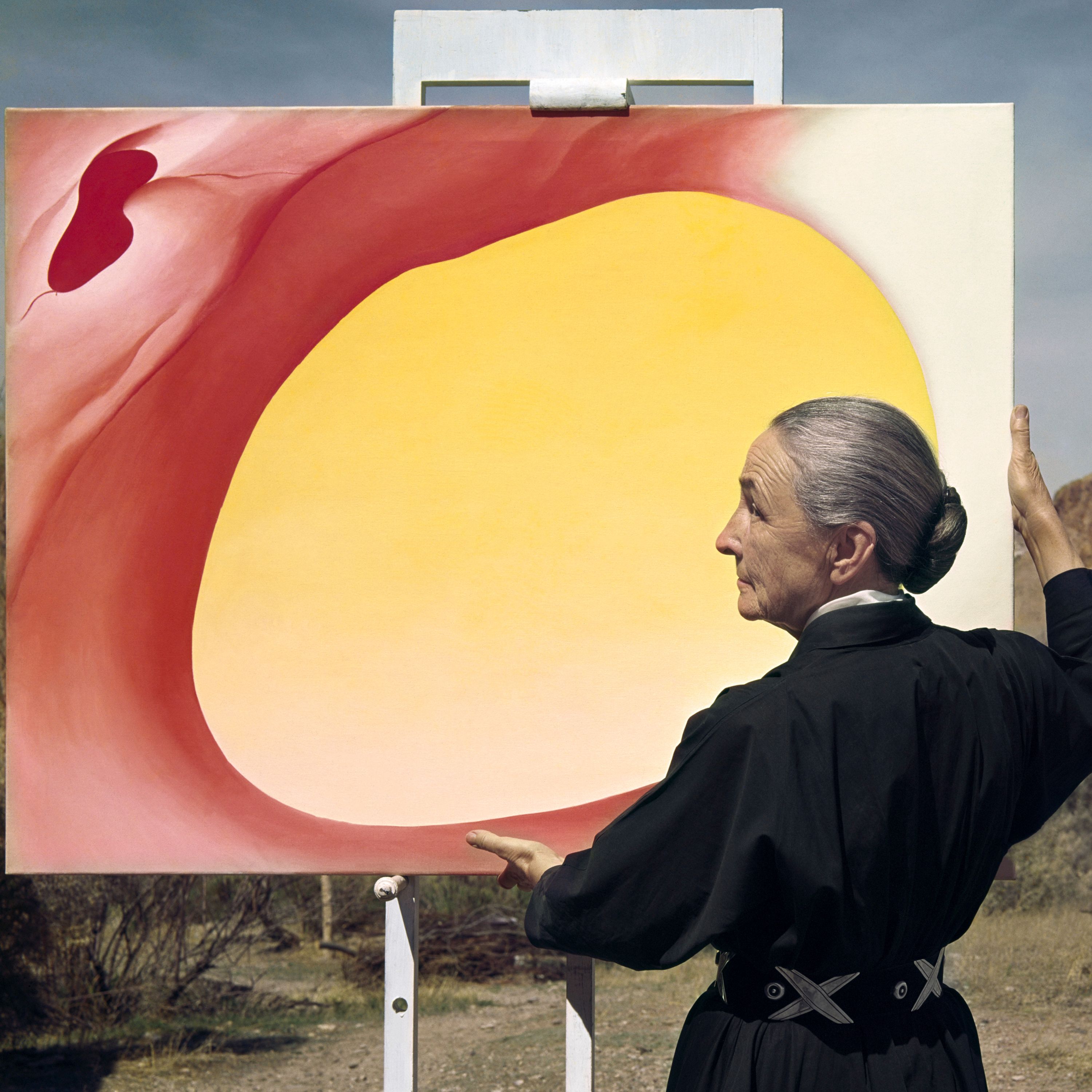
This is ALL OF IT on wnyc. I'm Alison Stewart. I wanted to preview some of the conversations coming up on the show this week. Tomorrow, we'll talk to a man behind a viral Instagram account called Trash Talk NYC who is inspiring people to go out in their neighborhoods and pick up garbage. We'll talk to him on Wednesday. We'll preview some music, some of our music releases, and hear a live performance from Jack jazz pianist Emmett Cohen. He's always great. And on Thursday, author Maggie o' Farrell joins us to talk about her new novel, Land that's in the Future. Now let's get this hour started with a great artist. We turn now to a new documentary about the American artist Georgia o', Keeffe, best known for her abstract close frame paintings of flowers or her landscapes from the Southwest. The film is called Georgia o' Keeffe the Brightness of Light. It leans on archive of letters between o' Keeffe and her artistic and romantic partner, the photographer and art promoter Alfred Stieglitz. The camera takes us into some of the real places where she lived and worked. A review in Hyperallergic says the documentary, quote, generously highlights the artist's lesser known bodies of work. It's available to stream on Den.
- [01:52]
Interruption/Listener
Excuse me.
- [01:52]
Alison Stewart
It's available to stream now on Demand on Apple tv. So let's get into it with documentary filmmaker Paul Wagner. Hi, Paul.
- [02:01]
Paul Wagner
Hey, Alison.
- [02:02]
Alison Stewart
So I wanted to get into this at the top, Claire Danes, she narrates your film and her husband, Hugh Dancy, also narrates the film. How did they get involved with the project?
- [02:14]
Paul Wagner
Yeah, well, kind of a package deal, right? Although we didn't quite present it to them that way. First of all, we are huge fans of Claire Danes. We think she's a terrific actress. And, you know, with Georgia o', Keeffe, we just felt like we really needed kind of the artistic credibility and authenticity and we felt Claire Danes could really deliver on that. Interestingly, when I went into it, I was thinking, oh, I'll work with her and kind of help her get a Midwestern Georgia o' Keeffe accent. I could tell she didn't want to do that, and luckily, I didn't pursue it. She had the right idea because in the film, very often the real o' Keeffe hear the voice of the real o' Keeffe along with right next to Claire Danes. And it would have been horrible if you started comparing the two. But she does a beautiful job. Just captures the emotional essence of these incredibly intimate letters that we're using in the film.
- [03:10]
Alison Stewart
It's interesting the way the film starts. Starts in Europe and asking people like, do you know about Georgia o'?
- [03:17]
Sponsor/Announcer
Keefe?
- [03:18]
Alison Stewart
Kind of, I know the name. Or, who is this woman? Why did you want to start there?
- [03:24]
Paul Wagner
I know some people think it's kind of weird that we start the film. I mean, the typical thing, right, is like, Georgia O', Keeffe, the greatest American artist of the 20th century, and to kind of trumpet her achievements. We thought it would be more interesting to start with people who were just discovering Georgia o'. Keeffe. And so all the opening little quickie interviews in this gallery in Basel, Switzerland, are with people who have never heard of Georgia o' Keeffe and are seeing her paintings in. In a gallery in Basel for the first time. And they sort of capture that excitement, maybe, that a lot of us, so many of us Americans are familiar with her. But there was that first moment when we discovered her art, and that's what we're trying to kind of elicit in that opening moment in the film, this amazing connection that you spontaneously make with her art. And then the film goes on to kind of lay out, in kind of a very straight biography, her life so that you understand where that art came from.
- [04:23]
Interviewer/Co-host
Well, what did the Europeans think about her work?
- [04:25]
Paul Wagner
Oh, there. Well, you'll see. You'll see in the opening of the film, they're blown away. There's one guy who I just love. He's not into art that much. He's never heard of Georgia o'. Keeffe. And he comes into the gallery, you know, kind of admitting he knows nothing about her. And by the time he walks through the show, he is totally smitten and just has this deep, electric connection with her. And I think that's the way a lot of us are. We have a very deep connection with her as an artist. And so it kind of poses the question at the beginning of the film, how could this come about? And that's what we try to do in the film.
- [05:00]
Interviewer/Co-host
Yeah, it's interesting because even people who don't know art know the name Georgia o'. Keeffe. And they know they enjoy her work.
- [05:07]
Paul Wagner
What do you think?
- [05:07]
Interviewer/Co-host
I mean, for people who aren't in the art world, why do you think there is this connection?
- [05:13]
Paul Wagner
Yeah, well, it's funny, I think, especially for women and especially for what we now describe as baby boomer women. So many of those people, starting with my wife Ellen, who's the producer of the film, you know, had Georgia o' Keeffe posters on their dorm room walls in college. And so in the film, we actually go back to the 1970s at a moment when Georgia O', Keeffe, her reputation as an artist had begun to wane a little bit. She was huge in the 1920s. It's been decades since she was big. And what happen in the 1970s is a whole new generation of Americans, especially American women, especially feminists, discover Georgia o'. Keeffe. And not just because her art is fabulous, but because her life is amazing and inspiring to them as women.
- [06:07]
Interviewer/Co-host
Yeah, it's interesting because several of the experts you spoke to allude to the fact that her legacy is about as much as the way she lived as her work. What do you miss out about Georgia o' Keeffe's story when you only look at her creative output?
- [06:22]
Paul Wagner
Yeah, I mean, so much the film builds. You see, as I say, in the 1920s, her artwork is huge. And one of the things we do regarding the artwork is we show so much more than the flowers and the bones and the landscapes. For example, she painted probably 20 paintings of the New York skyline, you know, which people don't even associate with Georgia o'. Keeffe. Some of my favorite artwork of o' Keeffe are charcoals that she did before she was even well known in 1915. And they're beautiful, they're totally abstract and amazing. So the first thing we do is kind of establish the breadth of her artwork. But then over the course of the film, the climax of the film really is in the Night comes in the 1970s, when she's discovered not just as an artist, but as this iconic American person inspiring to American women and also a woman who embodied what we come to understand as kind of modernism. The mid century architecture, the mid century furniture. Her clothing is kind of fashion forward in so many ways. Her lifestyle, she was into gardening and organic food, you know, in the 40s and 50s, kind of before it was a foodie thing. So so many of the things that we associate with of kind of cultural value that came out of the 20th century, most obviously feminism and, you know, the importance of women's lives. All so much of that is rooted in this life that Georgia o' Keeffe lived beyond her art.
- [08:03]
Alison Stewart
We're talking about the documentary Georgia o', Keeffe, the Brightness of Light. My guest is documentary filmmaker Paul Wagner. The Brightness of Light. Where does that tagline come from?
- [08:15]
Paul Wagner
I love that phrase. That's the beginning of her autobiography. I put that in quotes. It's not a real autobiography. It's a book that has a lot of her paintings and kind of her notes about it. But the opening line is, my earliest memory is of the brightness of light. And she describes this moment when she was a little girl, I mean, really just barely a toddler, and a memory that she had of the brightness of light. She was sitting outdoors on a blanket and describes this moment. And I just think that's so evocative. And the film is about that in many ways, about the brightness of light, the brightness of her vision as an artist, the brightness of landscape. As most people know, she had this intense connection with nature and with light in nature. So we felt like that was a kind of a title that wanted to be a title.
- [09:08]
Alison Stewart
Let's go back to her upbringing. She was one of seven children.
- [09:12]
Interviewer/Co-host
She was born in Wisconsin in 1887.
- [09:16]
Alison Stewart
But she really did show her individuality as a young woman. How did she show her individuality?
- [09:23]
Paul Wagner
Yeah, well, I mean, one of the earliest quotes in the film, she says, if my sisters wore their hair in braids, I wouldn't. You know, she just. She was sort of a contrarian in many respects. And that was rooted, I think, in her kind of artistic personality. She just had the character. And she said, when she was 10 years old, I am going to be an artist. She was sure of it. And, you know, one of the interesting things that we try to do in the film is show that actually for four years between 1908 and 1912, she stopped painting. So she early on had this youthful desire and passion for art, but she was being trained in realistic painting, you know, kind of European based, getting the light just perfect on a still life. And at some point in, when she was about 20 years old, she just lost her passion for that and stopped painting entirely until she became familiar with the work of a man named Arthur Wesley Dow, who was kind of a revolutionary art thinker and inspired her to take what eventually became a more abstract approach, that art could be about what you felt as an artist and just what you put on the canvas, whether it related to the real world or not. And that really set her loose as an artist.
- [10:47]
Interviewer/Co-host
Listen to a clip from your film Georgia o', Keeffe, the Brightness of Light. Here's Georgia o' Keeffe talking about the spirituality of her upbringing.
- [10:57]
Interruption/Listener
Well, I suppose I'm a religious person without a religion. I grew up in a household where there were three religions and there was very little talk about it. But a child knows anyway that there are differences of opinion. And it started me thinking about it when I was very young, so that I would have been. I could have been made a very good Catholic if they had worked on me a little, but I wasn't worked on.
- [11:22]
Interviewer/Co-host
I love hearing her voice, first of all.
- [11:24]
Paul Wagner
Yeah, her voice is so, so amazing. I love that story. I'm very proud. In the film, I mentioned my wife, Ellen Casey Wagner, as the producer. She found that clip, and it had not been seen or heard in over 60 years. That was from an interview in 1964 with Georgia in northern New Mexico, in Abiquiu, near her home. And I just love that because, you know, she talks about kind of possibly being a Catholic, and I can kind of see that that area of New Mexico is intensely Catholic, and she would have fit right in in that context. But she, you know, Georgia o' Keeffe, being Georgia o', Keeffe, she was going to find her own way.
- [12:11]
Interviewer/Co-host
Yeah, she had found her individuality, as you mentioned at this time, when she was a young artist. Who was her mentor, her main champion?
- [12:21]
Paul Wagner
Well, she had teachers that she studied with, including, actually, she went to. She attended a Catholic elementary school and studied with a sister there who loved her work and supported her. She studied at a boarding school here in Virginia and had a wonderful teacher. And she had excellent instructors in Chicago, Art Institute of Chicago and the New York Art League, Art Students League. But it was really a process for her of finding her inner voice, I have to say. And Dow, who she did, Arthur Wesley Dow, who she eventually did study with, was probably the single most important influence. And in terms of shaping her as an artist, what were some of the
- [13:13]
Alison Stewart
things she discovered about her own style? What worked for her and what didn't?
- [13:19]
Paul Wagner
Yeah. Oh, gosh. I think the key to her was to express her passion, her inner passion. And this was something that kind of, as I mentioned, under the old European approach to realism, was sort of stymied. She was an excellent technician. She had great skill with paint and light and so forth. But what really set her free as an artist and what drove the look of her art, which we now, you know, celebrate to this day, was this inner passion Sort of the psychology and the powerful thing I think, in the film is you're tapped into that through the letters. These are. It's. It's almost like pillow talk because a lot of it's sexual, a lot of it is romantic between her and Alfred Stieglitz, but a lot of is just passionate about her artistic inclination and her deepest feelings artistically. And this is something that the film is new in bringing, I think, to light. There was a tremendous film in the 1970s, actually, that had Georgia O' Keeffe on camera, but that was sort of Georgia O' Keeffe by Georgia O'. Keeffe. And in our film, we kind of strip away a lot of the sort of cliches and the legends about Georgia o' Keeffe and provide a much more intimate, deeper portrait of her.
- [14:46]
Alison Stewart
And we'll talk about those passions after a quick break. This is all of It. You're listening to all of it on wnyc. I'm Alison Stewart. We're talking about the new documentary Georgia o', Keeffe, the Brightness of Light. My guest is documentary filmmaker Paul Wagner. One thing I thought was interesting in the film is she moved around a lot from New York to Santa Fe at a time when you think about how hard it was to move around. Why did she move around so much? And where do we see that in her artwork?
- [15:30]
Paul Wagner
Yeah, well, one of the fun things was we tried to film everywhere that she lived and to get the camera kind of moving through the worlds that she inhabited. I'll just describe it by way of contrast. Her life versus her lover, Alfred Stieglitz and the other artists around him. These guys literally never went west of the Hudson River. I mean, it's the classic kind of, you know, insular New York art world. They were more oriented towards Europe. Georgia loved America. She loved all different parts of America, and she lived in many different parts. We talked earlier about how she grew up in Wisconsin, and that really informed her as a person. It made her very strong and self reliant, and it left her loving work very much. You know, she identified as like, you get up in the morning and you get right to work on what you do. She also lived several years in Texas. Everybody associates her with New Mexico, but she actually fell in love with the west and with that arid desert landscape in the panhandle of Texas where she lived for four years. And she was a schoolteacher. So she had another whole life. She didn't have this kind of privileged, I'm going to be an artist. She aspired to that. But she couldn't know that she was going to be an artist. And she took work that many women at that time who loved art and who were skilled at it took because the doors to being an artist were closed to them. So she took a job as an art teacher in Texas. She lived here in Charlottesville. She spent a lot of time at York beach in Maine. So there are many parts of America that she touched, and she was influenced by all those and had a broader vision of what the country was like and what the people of America were like. And I think that's one of the reasons that. That her art over the 20th century became so popular. It was drawn from the people and not from some elite notion of what, you know, great art was. It was drawn from the lives and the experiences of many Americans.
- [17:34]
Interviewer/Co-host
One of the things that is really dynamic about the film is this archive of letters between Georgia o' Keeffe and Alfred Stieglitz.
- [17:42]
Alison Stewart
For people who don't know who he is.
- [17:45]
Interviewer/Co-host
He's a photographer.
- [17:48]
Paul Wagner
And so much more.
- [17:49]
Alison Stewart
And so much more. Right.
- [17:50]
Interviewer/Co-host
Yeah.
- [17:50]
Alison Stewart
So who is he? We know who he is, but who is he?
- [17:54]
Paul Wagner
Yeah, yeah. Well, he was a great photographer, and he wasn't he. He was and isn't considered an important photographer in the history of photography. And he was very established. He was 24 years older than O'. Keeffe. They met initially because her. She had done these charcoals in 1915, and her girlfriend, who lived in New York, took them and showed them to Stieglitz. And he was a sharp guy, and he knew art, and he was a gallery owner. He owned a famous gallery called 291 in New York. And he immediately recognized. He had never heard of Georgia o', Keeffe, but he recognized them as brilliant art. And they met briefly, but basically they started an epistolary relationship, we'll say, for the next couple of years. So that was in early 1916, they started writing, and by 1918, she moved to New York at his encouragement so that she could kind of dive full time into artwork. But the letters are amazing. First of all, there are 25,000 pages of these letters that we had access to, and they have not been released until. Well, they weren't available at all until 20 years after O' Keeffe died. So it was well into this century. And they opened a door to her relationship with Stieglitz, but also her relationship to art that is really deeply powerful and deeply intimate. So the letters are sexy. There's a lot of kind of pillow talk in them. And we get into that relationship. The issue of sexuality is really crucial to understanding her work. You know, a lot of people famously think the images are of totally of a sexual nature. They are and they aren't. I will simply say you have to, you know, see the film to get a deeper view of that. But all of this is talked about in depth in the letters. And so they open a window to who she was and to her relationship with Stieglitz, which was wonderful and horrible at the same time. He had an affair with another woman, a long standing affair that, you know, tortured o'. Keefe. But she was true to him until his death in 1946. And it's an amazing part of her life story is this kind of deep relationship that she had with one of the most important artists of the time.
- [20:29]
Interviewer/Co-host
It's interesting because he takes nude photographs of her, and then she shows her art and it's a difficult time for her.
- [20:38]
Paul Wagner
Exactly. Yeah. He's a big promoter of her art, but he, in a self serving way, he undercuts her also. So what he does is she moves to New York in June of 1918. Within days, he is taking, you know, full frontal nude photos. Quite intimate. I mean, they would be shocking today. And believe me, they were shocking and really shocking in 1918.
- [21:05]
Alison Stewart
But they were beautiful, though.
- [21:06]
Paul Wagner
Yeah, but beautiful. And that was. You're. You've hit them. That's the key thing. She recognized she wasn't coerced. She wasn't some, you know, young, foolish girl who was gonna do this on a whim or because she thought he was. Oh, he's. It's Alfred Stieglitz, the big famous artist. She knew what she was doing. She recognized him as a legitimate artist. And she recognized this work of the photographs as important, valuable artistic work. And she's essentially a collaborator in those photographs. An artistic collaborator. What happens, however, is in 1921, he shows those photos in a show. So you can imagine right away there's kind of the titillation and scandal of her being, you know, his girlfriend, the model. Excuse me. By 1923, he exhibits her artwork. And everybody's not looking at the artwork. They're thinking about her as the naked, you know, girlfriend. So it undercuts his presentation or artwork, which he did respect. But he couldn't quite resist the promotional value of, you know, encouraging this sexual interpretation of her artwork. And it's still there. You know, here we are 100 years later, and that notion of, oh, the paintings, they're all about sex. That notion is still there. And you know, you hear it every time. And we. We get that question when we show the film.
- [22:39]
Alison Stewart
Yeah, it's really interesting. In the film, it's called Georgia o', Keeffe, the Brightness of Light. I'm speaking to its filmmaker, Paul Wagner, that, you know, that she allegedly painted flowers, but they're about female genitalia. And most of the art experts that you talk to really take issue with this.
- [23:01]
Paul Wagner
Exactly.
- [23:02]
Alison Stewart
What's overblown or misguided about thinking about Georgia o' Keeffe and. And that her work is sexual in nature.
- [23:11]
Interruption/Listener
Right.
- [23:11]
Paul Wagner
Well, I think a way of thinking about it that helps you understand what's going on and I think is a fairer, more honest and valid interpretation of the work is to say, yes, they are sensual, but they are not literally sexual. I mean, I think that's a way. Because when you look at them, it is. They are. They are full of passion and a passionate engagement with nature, not just about ideas, but a deep connection with the visual world. And they are lush and voluptuous, you might even say. So a lot of adjectives that come to mind that you would use to describe sexuality come to mind, but I think it's more valid and certainly fairer to her to say they are deeply sensual. And that's a way to sort of understand them and to explain why people see them in a certain way, even though it's not, you know, perhaps as correct and not truly valid from her point of view.
- [24:14]
Alison Stewart
Let's listen to a bit of an exchange between Georgia o' Keeffe and Alfred Stieglitz, explaining why she decided to remain in New Mexico for a while without him. This is from Georgia O'. Keeffe, the Brightness of Light.
- [24:29]
Alfred Stieglitz (voice actor)
July 6th. You said that I no longer cared for you. You had grown older and I cared for younger ones. Georgia. Georgia. Have you any idea how cruel these remarks? The fact is, you really do not need me anymore. Do you know this is the first time in 37 years that I have not a woman near me to care a bit for me?
- [24:55]
Georgia O'Keeffe (voice actor)
July 9, 1929. I chose coming away because here at least, I feel good. And it makes me feel I am growing very tall and straight inside and very still. Maybe you will not love me for it, but for me it seems to be the best thing I can do for you. I have not wanted to be anything but kind to you. But there is nothing to be kind to you if I cannot be me. And me is something that reaches very far out into the world and all around and kisses you a very Warm, cool, loving kiss.
- [25:34]
Alison Stewart
What changes about the way o' Keeffe navigates life after Stiglitz dies?
- [25:41]
Paul Wagner
I'm sorry, after she.
- [25:42]
Interviewer/Co-host
After he dies.
- [25:43]
Paul Wagner
Oh, after he dies. Yeah.
- [25:45]
Interruption/Listener
Yeah.
- [25:45]
Paul Wagner
I love that you pulled that clip. It's sort of my. One of my favorite moments in the film. And it gets at the complexity of their relationship. You know, here he is, he's like the ultimate whiny boy. He's got a girlfriend in New York and he's whining, oh, you don't care about me anymore. You know, you think I only care about you. It's like, oh, please. So you just like to kind of take him and slap him when you hear that voice. And what. But her response, and that's the actual response in the letters. That's. We're playing the letter exchange. She's so compassionate and kind of on one hand, lays down, look, this is something I need and I want to do, you know, but also respecting him, you know, and sends him a kiss, you know, that she still loves him, as obnoxious as he is at that point, but the moment in her life is crucial.
- [26:39]
Alison Stewart
Yeah. We've only got about a minute left though.
- [26:41]
Paul Wagner
Okay. This is 1929, and she has finally discovered New Mexico. And it will transform her art and her life. She, you know, commits to going to New Mexico for the rest of her life and living there. He passes away in 46, and, you know, it's. It's painful for her, but in many ways it sets her free to fulfill her mission and her life dream as an artist in this beautiful landscape in northern New Mexico.
- [27:14]
Alison Stewart
The name of the documentary is Georgia o' Keeffe, the Brightness of Light. My guest is documentary filmmaker Paul Wagner. Thank you so much for sharing the story with us.
- [27:24]
Paul Wagner
Thank you, Alison.
- [27:25]
Sponsor/Announcer
WNYC Studios is supported by Odoo. When you buy business software from lots of vendors, the costs add up and it gets complicated and confusing. Odoo solves this. It's a single company that sells a suite of enterprise apps that handles everything from accounting to inventory to sales. Odoo is all connected on a single platform in a simple and affordable way. You can save money without missing out on the features you need. Check out Odoo at O D O o dot com. That's O D O O dot com.
- [27:57]
Oh my gosh. Have you been to Marshalls lately? They have all the brand name and designer pieces you love, but without the jaw dropping price tags. Alright, so here's the. You should never have to compromise between quality and price and at Marshall's, you don't have to. Marshalls believes everyone deserves access to the good stuff, and that's why their buyers hustle around the clock. To make it happen for you, visit a Marshalls store near you or shop online@marshalls.com.