← All Of It with Alison Stewart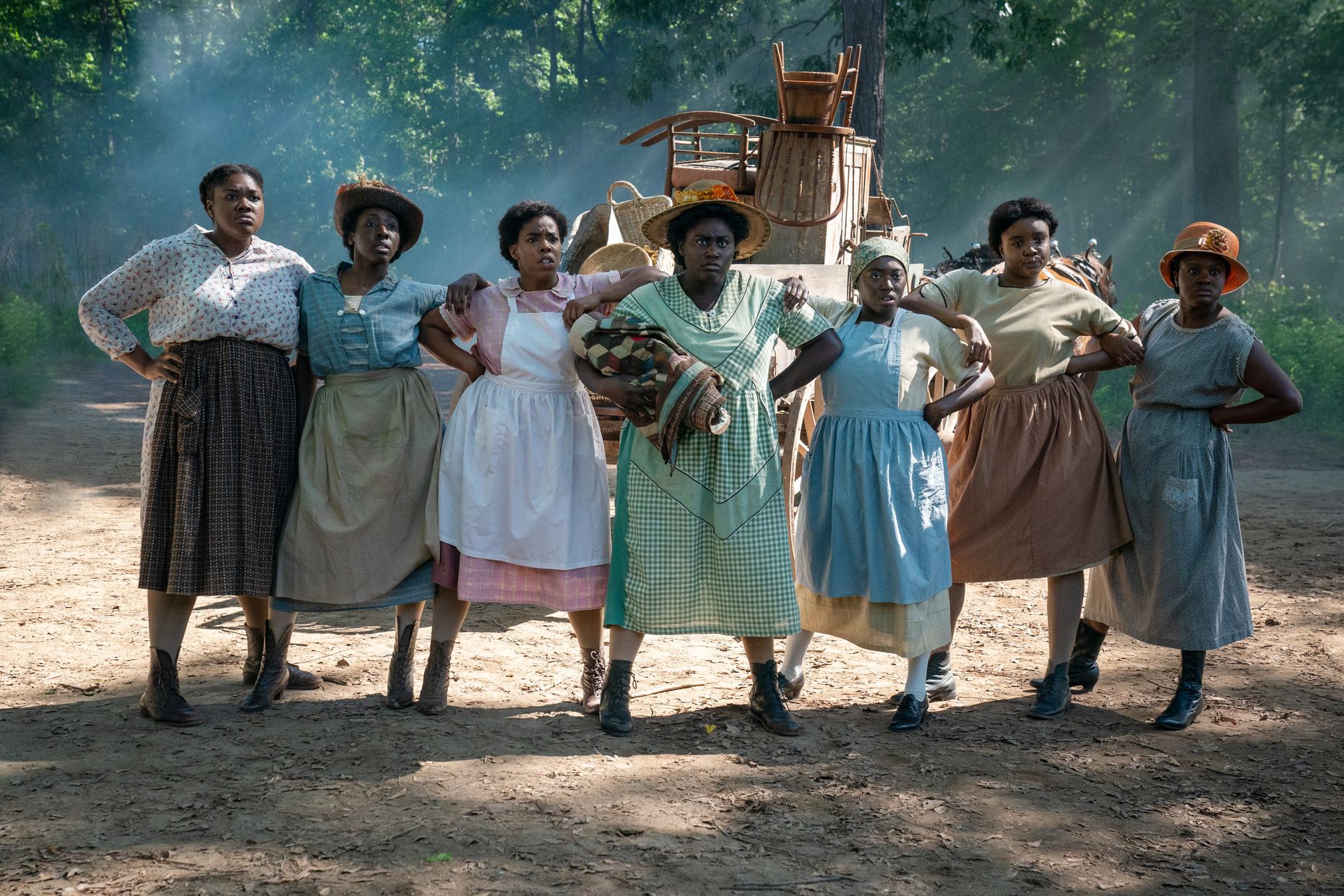
All Of It with Alison Stewart
Oscar Nominee Danielle Brooks on 'The Color Purple'
00:27:16
Director Blitz Bazawule and actor Danielle Brooks discuss turning the beloved novel, film and stage-musical "The Color Purple" into a movie musical.
Loading summary
Transcript56 lines
- [00:00]
Blitz Bazawule
I' ma put you on nephew. All right, unc.
- [00:02]
Interviewer (Alison Stewart or Kushan Avadar)
Welcome to McDonald's. Can I take your order miss?
- [00:04]
Blitz Bazawule
I've been hitting up McDonald's for years. Now it's back. We need snack wraps. What's a snack wrap? It's the return of something great. Snack wrap is back.
- [00:15]
Old Navy Advertiser
Some days call for sleek and straight, others for slouchy and relaxed. Whatever your vibe, Old Navy has the denim fits to match from extra high rise to barrel. It's not just a mood, it's a whole style range.
- [00:25]
Danielle Brooks
And with jeans Starting at just $22, you can collect them all. Snatched waist go extra high rise straight.
- [00:31]
Old Navy Advertiser
Lived in staple vintage slim, low slung.
- [00:34]
Danielle Brooks
And laid back slouchy wide. You've got range. Your denim drawer should too. Premium fabric deluxe details your perfect pair or weights.
- [00:42]
Old Navy Advertiser
Shop in store or online@oldnavy.com oh my gosh. Have you been to Marshall's lately? They have all the brand name and designer pieces you love, but without the jaw dropping price tags. Alright, so here's the truth. You should never have to compromise between quality and price. And at Marshalls, you don't have to. Marshalls believes everyone deserves access to the good stuff and that's why their buyers hustle around the clock to make it happen for you. Visit a Marshalls store near you or shop online@marshalls.com it's not rocket science.
- [01:16]
Blitz Bazawule
Grayscale has been educating investors on crypto for over a decade. Grayscale invest in your share of the future. Investing involves risk and possible loss of principle. Visit grayscale.com for more information. Listener Support WNYC Studios.
- [01:43]
Kushan Avadar
This is all of it. I'm Kushan Avadar in for Alison Stewart. For today's show we're bringing you conversations with folks behind some of the Oscar nominated films from the past year. The Oscars are this Sunday and now for our final encore presentation with a nominee, let's turn to the Color Purple. Here's Alison's conversation with director Blitz Bazawule and Danielle Brooks who's nominated for best supporting Actress for her role as Sofia in the new movie musical.
- [02:19]
Interviewer (Alison Stewart or Kushan Avadar)
Who better to direct a movie musical adaptation of the beloved Alice Walker novel the Color Purple then someone with music and literary chops and who is no stranger to working with strong women. Blitz Bazaoule is a true multi hyphenate. He's a visual artist, a rapper, music producer, novelist and filmmaker. He partnered with Beyonce to co direct the visual album Black Is King and made his feature film directorial debut with 2018's the Burial of Kojo. Blitz's new version of the Color Purple melds all of that experience and really goes for it. Combining big, lush musical numbers with moments of quiet intimacy, the film stars Fantasia Barrino as the downtrodden but resilient Celie. Fantasia performed the role on Broadway in the aughts, in the early aughts. Also reprising her Tony nominated role is our other guest, Danielle Brooks, who returns as the bold and joyful Sophia, a friend who teaches Celie that it's important to stand up for herself. Something Sophia has to remember as well after being beaten and jailed for clapping back at some racist white folks. Both Fantasia and Danielle have been nominated for for Golden Globes for their performances. Rounding out the central trio is Emmy and Oscar nominee Taraji P. Henson as Shug Avery, the blues singer who steals Celie's heart and protects her from her abusive husband. And joining us now to discuss the film is director Blitz Bazuili. Blitz, nice to meet you.
- [03:43]
Blitz Bazawule
Such a pleasure. Thank you for having me.
- [03:45]
Interviewer (Alison Stewart or Kushan Avadar)
And welcome back to the show, Danielle Brooks. Hey, Danielle.
- [03:48]
Danielle Brooks
Hey, good to be back.
- [03:50]
Interviewer (Alison Stewart or Kushan Avadar)
Blitz, when did you know you wanted to add filmmaking to your resume in addition to music, art, novel writing?
- [04:00]
Blitz Bazawule
Yeah, well, you know, filmmaking has always been, I'll say, my. My end goal, the beauty of the medium itself is it's an amalgam of all of these other mediums, right? A little bit of writing, a bit of literature, a little bit of photography and fine art, a little bit of music and cadencing and sound design. So even though it seemed I'd been creating in these siloed mediums, my goal was always to find a medium that truly united it all. And film has always been kind of the north star for me.
- [04:35]
Interviewer (Alison Stewart or Kushan Avadar)
Danielle, what did you learn about Sophia and your time playing her on the Broadway stage that you were able to bring to this performance on screen?
- [04:44]
Danielle Brooks
I mean, it's truly her strength. This is a woman who is a radical woman who, you know, moves how she wants to move and does life the way she wants to do life. And it's been such a joy to get to step in her shoes because as an artist, as you're growing, I think characters give you a gift. And that's what she's given me, is the strength and belief to stand firm in who I am on a daily basis, which has been a lot of fun. It's also been cool to step into her shoes again because you discover new things about the character, like there's actions and choices, objectives that I had in the past when I did it on Broadway that now are completely different. Stepping into the film because of the relationships or really just the depth and more. The more that I've grown as a person and had more of my own personal experiences. But also like what and how we've crafted Blitz in our lovely writer Marcus Garley have crafted this script. It's shifted a lot in a beautiful way that I think adds so much more layers of humanity to the characters. So that's been a lot of fun to kind of like get to live in both mediums with the same character, but find and discover new things about her.
- [06:19]
Interviewer (Alison Stewart or Kushan Avadar)
Blitz, you were born and raised in Ghana, and the Color Purple is a classic American novel. What was your first exposure to the story?
- [06:28]
Blitz Bazawule
Well, my first exposure to the story was Alice Walker's brilliant Pulitzer Prize winning book. I read it as a teenager and. And it really was one of the first times I'd experienced a story that traversed both the continent of Africa and the diaspora. Nettie's exile to the continent really was. And I was a recent immigrant at the time, and, you know, I hadn't read much African American literature that made an intentional connection. So it really struck me. And I think a lot of that was part of what attracted me to this opportunity was to really get to explore this yearning that is. Is this separation of, you know, continental Africans and diaspora Africans, specifically in the United States.
- [07:21]
Interviewer (Alison Stewart or Kushan Avadar)
All right, Blitz, this is a personal question. I'm going to Ghana in about three or four months. What's. What's one thing I should. I should do?
- [07:27]
Danielle Brooks
Well, nice.
- [07:28]
Blitz Bazawule
Oh, man. What's one thing? Oh, gosh, there's so many things.
- [07:33]
Interviewer (Alison Stewart or Kushan Avadar)
I have a week, but we only have 35 minutes for this interview, so I don't want to take it out with my travel itinerary, for sure.
- [07:38]
Blitz Bazawule
I mean, I would. You know, I really think one of the must dos in Ghana are, you know, is to experience, if you can, one of the festivals, one of them called Homo War. Homo War is a. It's an incredible festival that really, you know, if you're going to be in Accra, that is. It's for the Ga people and it's. It's. It's kind of precedes. There's a number of days of silence that, you know, you get to honor the ancestors. And then, you know, people come out wearing their whites and they really celebrate. The music is incredible. Traditional music, dance and food. That's a big one. And in a lot of ways, actually some of kind of what we pulled into the Color Purple in terms of even Our color theory was based on some of this, like watching the girls wear the white in the opening and how they come back with the white at the end. You know, it was a bit of an homage to homo war and that coming together. So, yeah, if you can do it, it'll be great.
- [08:45]
Interviewer (Alison Stewart or Kushan Avadar)
Thank you. So this is a true, true movie musical. It's got the big numbers, the dancing, the choreography, the great costuming. And, Danielle, you get to kick open a door in this musical, in your number. Share with us just so we can get a sense of the process of that moment, how it was filmed, your conversations with your director about that moment.
- [09:13]
Danielle Brooks
That was so much fun because, you know, it kind of felt like when you get to go back to theater and you get to do the work and have rehearsal, as we had with Blitz, and you get to build the moment together and be together versus just going in and people selling. You stand here and move there and do this and speak like this and hold the door like that. Really appreciate that. And I think that's like when you. Or when a project really does sing. And magical is when it is collaborative and creative. And Blitz has always given us a space to do that, to collaborate together. And so when Blitz asked me, he said, danielle, I need you to come through this door. I told Blitz, I was like, okay, but I really think Sophia would bust this door open with her foot. And he was like, great, let's find a way to rig this door so that you can continue to do this, you know, for every take. And that's what we discovered. And now it's kind of become a moment and such a cool moment, because, again, it was birthed out of artists coming together and being open to one another's ideas. And I think that's what a great leader does, is not always telling the things how I want them done. Which he did come in with such a great vision. But it's also about someone leading within a quiet tone and saying, like, I see you and I hear your ideas, and I'm going to allow you to bring those in the room, you know? And so I just really appreciated working with Blitz for. Because he really did allow all. All of us the opportunity to bring what we knew we could.
- [11:12]
Interviewer (Alison Stewart or Kushan Avadar)
But you take a big swing in that. So much of the story is grounded in a very textured reality. Some difficult sequences, some difficult issues around violence. But then there's also these fantasy moments, these tremendous fantasy moments where we sort of enter characters heads. How did you think about the balance between the two?
- [11:43]
Blitz Bazawule
You know? Yeah, I was just jumping to say, you know, I really looked at it as the oscillation between joy and pain, you know, And I think it's like the. That's a quintessential human experience, right, where we are always kind of turning our pain into power. And I think it's. It's something that can certainly be said for the African American experience, looking at how much beauty has been bequeathed to the world, a lot of it born out of pain. And so our job was really to kind of always give Celie that opportunity. And I really, very early on knew that we'll be exploring Seely's headspace. And a lot of it was also to debunk this, what I call a falsehood, you know, that people who have dealt with trauma and abuse are somehow docile or passive or waiting to be saved. I really believe that that's not true. And people who have dealt with trauma and abuse are constantly trying to work out in their heads how to escape this trauma, how to heal from this trauma, how to love, who to love, how to forgive. These are all tenets that Celie really displays.
- [12:57]
Interviewer (Alison Stewart or Kushan Avadar)
I want to play a clip from the Color Purple. This is a clip of Sophia where she is standing up to Mr. Who's your man's father? Harpo's father, Celie's nasty husband, played by Colman Domingo. And Sofia is coming to introduce herself now that she is very pregnant. So the first voice you'll hear is Corey Henry. And this is from the Color Purple.
- [13:20]
Blitz Bazawule
I want to introduce y' all to my girl.
- [13:23]
Kushan Avadar
This is Sophia.
- [13:25]
Blitz Bazawule
A lot of women. Who's killing you, gal? You seem like trouble.
- [13:32]
Danielle Brooks
Oh, no, sir. I'm one of August Butler's daughters. No trouble at all. Just big, who the daddy apples? I ain't gonna let you marry my son.
- [13:46]
Blitz Bazawule
Cause you in the family way. Petty guy like you can take his mind, but you can't have his money.
- [13:52]
Danielle Brooks
He ain't got no money. See, my sister and her husband say I can live with them as long as I please. Now, I come here out of respect, but if there ain't none to get, that sho ain't none to get. Don't keep me waiting.
- [14:11]
Interviewer (Alison Stewart or Kushan Avadar)
So, Danielle, last time you were here to talk about Shakespeare in the park, you hadn't announced it yet, but you were pregnant. When I saw that scene, I thought about that, and I kept. I was thinking, how has being a mother and the mother of a daughter impacted the way you see this story?
- [14:28]
Danielle Brooks
That's a beautiful question. I mean, just. Just getting to be that representation for her number one. But in this story, I feel like it's what it's given reminding me that I. All the power that I need is within me, you know, and I can be the hero of my own, you know, I don't have to. Anything that I want to do, I don't have to necessarily wait for somebody to give me permission to do that thing. You know, I feel like we find that with the character of Sophia, but also like growing up as a dark skinned, plus size, curly hair, southern woman, you know, feeling very much like Celie, where the world tells you that you're ugly and you're not worthy and you're not beautiful and you're not smart enough, you know, we get to cancel that noise out. And I just am excited for her to get to understand that the things that make her unique are really her superpower. That's what makes her really cool in this world and that's what we discovered with Celie. But it's also watching someone discovering that through sisterhood. And so I'm excited for her to get all of the lessons that are embedded in this story. To watch it quadruple million times and it still be a source of healing for her, especially now that we've added the music to it. I just love that aspect because even if you don't have time to watch this movie and the full totality of it, you still have the music to hold on to when you need your healing. Especially through songs like I'm Here in Hell. No.
- [16:29]
Interviewer (Alison Stewart or Kushan Avadar)
You posted a video of your daughter seeing the trailer of the Color Purple. You took her to see the Little Mermaid and it's just, it's so cute. She's like full tiara and sparkles and then it comes up and I just pulled a little bit of her reacting to you in the trailer. Let's roll that. I could listen to that like all day long.
- [17:07]
Danielle Brooks
Oh, me too. I could. Yeah. What?
- [17:10]
Interviewer (Alison Stewart or Kushan Avadar)
At that moment when you were, when you whipped out your iPhone to film your daughter, what was going through your mind?
- [17:18]
Danielle Brooks
I first didn't want to miss the moment. I was number one because I knew it was only going to play once. And this moment was only going to happen one time in this special way. And so getting to see her eyes look up at Halle Bailey and see someone that looked like her in watching the movie. But then also like watching the trailer, getting to watch her mother up there with her in a tiara, which I purposely did because she is a queen and naming her Freya because I want her to always be reminded that she is free in this world. It just was like, what is happening? My great grandmother would be over the moon right now to see this moment if she was able to witness how far we've come as black women. My God, you know, that was so exciting. And so it's just that testament of what the power of representation can do, because that's what it has been for me. But also, like, just for her to get to see the reflection of herself on that screen for the first time, the first time she watches a movie in a movie theater, it is the Color Purple. That is incredible. Well, she didn't watch the Color Purple, but the trailer purple.
- [18:44]
Interviewer (Alison Stewart or Kushan Avadar)
We're discussing the film the Color Purple. My guests are actor Danielle Brooks and director Blitz Bazungli. We'll have more after a real quick break. This is all of it.
- [18:57]
Kushan Avadar
This is all of it. I'm Kushan Avadar filling in for Alison Stewart. The Oscars are on Sunday, so let's get back into Alison's conversation with director Blitz Bazawuleh and Danielle Brooks, who stars as Sophie Sophia in the movie Musical. She's nominated for best supporting actress for that role. Here's what Basawule. Here's what Bazawule said when Allison asked him to explain how he picked the beautiful landscape locations where he wanted to shoot the film.
- [19:23]
Blitz Bazawule
When I got hired, you know, that was, like, the very first thing I started to do was drive the length and breadth of Georgia looking for spectacular locations. And I really believe that location is character. I always begin with location, because if I know the place that I know who needs to be in the place, I know what they're supposed to be doing. I know how they're supposed to be dressed. And so I always begin there. And I drove sometimes, you know, seven hours a day, just making sure that I was covering as much as I could. We ended up shooting a lot of our stage work in Atlanta and the surrounding areas, and when we shot a lot of our exteriors in Savannah, both of which, you know, are very specific to Alice Walker's intent. But I also wanted to ground the film in ancestral land, you know, black land, you know, and tribal land, land that, you know, bore so much, you know, pain and really show up with reverence for that land. And it was very important. I mean, there were some trees that really were haunting and really felt like, you know, you know, that things happened here, things that weren't savory, things that were painful. And so we all showed up with deep reverence for that space. And as much as we could, we prayed before we shot. I mean, we did a lot of things to honor that land. And I'm really, really glad that we were allowed to shoot in an environ that. The book, Alice Walker's brilliant, Pulitzer Prize winning book, was kind of set this.
- [21:16]
Interviewer (Alison Stewart or Kushan Avadar)
Story in and blitz a director's job. A big part of director's job is making decisions and making choices, sometimes difficult ones. What was a. Really, a tough choice that you had to make that ended up working out, but maybe you weren't so sure it was going to.
- [21:34]
Blitz Bazawule
Wow. You know, I think. I think one of the biggest gambles you take, especially when you're dealing with, you know, a story that is so known, so sacred, so important to many, is how would expanding it work? And again, knowing how familiar the canon is, from the book to Steven Spielberg's movie to, of course, the play, I was really, really uncertain about these imaginative moments, one of which is Celie on this giant gramophone. You know, you can hope that it will work out conceptually, but when you start shooting that scene, you're not quite sure what the entry point is and what the exit point. Well, I knew what the exit point was, but I didn't know how. How I was going to actually get into Celie's mind. I was hopeful. But when I watch the movie now and I see how seamless it is, I'm really reminded of the importance of courage as a director, because you have to make these choices that are often only you can see it, you know, and as much as I try to storyboard, I'm a fastidious storyboard. I try my best to. To draw as much as possible to show my team and my partners what my intent is for this film. I drew somewhere upwards of 1300 frames for the film, but even that's not enough because those are still just static images when you're on set. And I also really love physical production design. Right. So I like for us to shoot in situ in a way that the, the. The audience feels immersive, but also the actors believe it's happening. So we actually built a massive giant gramophone and built the needle. The only thing that we added digitally was the horn of the gramophone, but everything was real. So Taraji was really in a giant, you know, in a tub that was spinning. Fantasia was dancing around this giant gramophone. And again, you never know until you actually see it in frame and you see it cut in before you go, oh, my goodness, I'm so glad we were brave with the Camera.
- [23:56]
Interviewer (Alison Stewart or Kushan Avadar)
Yeah. It's such a surreal moment. Danielle, what's a piece of direction that you got from Blitz over the course of the filming that really helped you shape your approach to Sophia's story arc? Because she goes on. It's an overused word, but she does go on a journey, an emotional journey, for sure.
- [24:15]
Danielle Brooks
Mm. I feel like there were so many moments. First of all, he's just an incredible director. He's visionary. He's got it. Like, you know, anything. He told me I was down for the ride. Like, let's ride. Let's do it. Like, I'm down to play. And I think more than anything, I just was impressed with his vision. Like, the way in which he did the jail scene. Going from all, like, going to the different sins and shaping that, like, is masterful. It is masterful time in this beautiful way. So I just really love that about the way he worked. And I just keep going back to the dinner scene in my head, too, and really having to trust my director a lot of times. Well, let me say this. First, we shot the dinner scene over the course of five days. And during that time, a lot of people had unfortunately caught Covid, and I was one of the people who did not catch COVID And so we were trying to shoot around the people that could not actually be at the dinner scene. But what we discovered is that the power of that scene is in the unification of everybody being there, being present. Can you hear me okay?
- [25:42]
Interviewer (Alison Stewart or Kushan Avadar)
Yeah, you're good.
- [25:43]
Danielle Brooks
Can you hear me okay? Okay. And so what I enjoyed was. I'm sorry, somebody called me and threw me all the way off. But. But. So we were doing the dinner scene, and. Oh, what I was going to say was, I had to do that over the course of three days and sometimes by myself, and then finally the third time with the entire cast there. But what I appreciated, because at the time, I didn't want to do it the third time. And maybe Blitz can explain this better than myself, but I didn't want to do it the third time because in the past, with other directors, sometimes they can take advantage of your work and your creativity and not understand what it takes to do those very dark, deep scenes. And they will take advantage of that, and they'll say, just keep doing it, keep doing it, keep doing it. And they don't understand what it is doing for your mental space, your spiritual space, and in your physical body. And so knowing that I was working with somebody who truly was taking care of me as an artist, made sure that my spirit was okay, like he spoke about, we prayed together. He would come in our dressing rooms and talk to us, you know, on our down times to make sure we were okay. He made sure our set, our crew was respectful of the things that were taking place because what we were doing was very deep and dark work. And so I just grateful for his leadership in that way. And it actually kind of gives me a renewed faith and trust for hopefully the directors that I work with in the, in the future because I had cut off a part of myself being feeling like I had been taken advantage of when it comes to just do the scene over and over and over and over and over and over again, but them not understanding what it takes for me to do that over and over again. And so I'm grateful that like now my next projects, I can go in trusting that hopefully the director will take care of me the way that Blitz did when we shot Color Purple.
- [28:05]
Kushan Avadar
That was Alison's conversation with the Color Purple's director, Blitz Baziwuleh and Danielle Brooks, who's nominated for best supporting Actress for her role as Sophia in the new movie musical. And that's all of it for today. All of it is produced by Andrea Duncan Mao, Kate Hines, Jordan Loff, Simon Close, Zach Godrer Cohen, El Malik Anderson, Luke Green and Aki Camargo. Megan Ryan is the head of Live Radio. Our engineers are Juliana Fonda and Jason Isaac. Luscious Jackson does our music. If you missed any segments this week, catch up by listening to our podcast. It's available on your podcast platform of choice. And hey, if you like what you hear, please give us a great rating. I'm Kusha Navadar in for Allison. We so appreciate you listening. We appreciate you and we'll meet you back here next time.
- [28:54]
Blitz Bazawule
I'm gonna put you on nephew. All right, unk.
- [28:56]
Interviewer (Alison Stewart or Kushan Avadar)
Welcome to McDonald's. Can I take your order, miss?
- [28:58]
Blitz Bazawule
I've been hitting up McDonald's for years. Now it's back. We need snack rack. What's a snack wrap? It's the return of something great. Snackwrap is back.
- [29:10]
Old Navy Advertiser
Oh my gosh. Have you been to Marshall's lately? They have all the brand name and designer pieces you love, but without the jaw dropping price tags. Alright, so here's the should never have to compromise between quality and price. And at Marshall's you don't have to. Marshall's believes everyone deserves access to the good stuff and that's why their buyers hustle around the clock to make it happen for you. Visit a Marshalls store near you or shop online@marshalls.com.