Loading summary
Transcript41 lines
- [00:00]
Memorial Sloan Kettering Cancer Center Announcer
All of it is supported by Memorial Sloan Kettering Cancer Center. In a small groundbreaking clinical trial, 100% of participants with a specific type of rectal cancer saw their tumors disappear using immunotherapy alone. Researchers at MSK are now studying this approach in cancers of the stomach, liver and more, and a majority of tumors are disappearing. For MSK giving day, all gifts will be tripled. Learn more@msk.org all of it WNYC Studios is supported by Odoo. When you buy business software from lots of vendors, the costs add up and it gets complicated and confusing. Odoo solves this. It's a single company that sells a suite of enterprise apps that handles everything from accounting to inventory to sales. Odoo is all connected on a single platform in a simple and affordable way. You can save money without missing out on the features you need. Check out Odoo at o d o o.com that's o d o o dot com.
- [01:08]
Alison Stewart
This is all of it on wnyc. I'm Alison Stewart. Pop art in New York go way back. Think Warhol Lichtenstein. There's a new exhibit at the Guggenheim where the first New York museum show about pop art was organized in 1963. This 2026 show features work from the Guggenheim's Colle who are closely associated with the movement and also includes more contemporary artists that are in dialogue with the pop art of the 60s. The exhibit is called Guggenheim Pop 1960 to Now. My guest in studio is Guggenheim curator of collections Lauren Hinkson.
- [01:44]
Lauren Hinkson
Welcome, Lauren, thanks so much for having me.
- [01:46]
Alison Stewart
Allison, we've heard pop art you hear used all the time. You as a curator, how do you describe pop art to someone?
- [01:54]
Lauren Hinkson
So when we're talking about pop art, we are talking about a very specific historical movement. But I also like to think of it as an umbrella, right? So artists in the 1960s were thinking about bringing everyday life into their art. So advertisements, comics, celebrities, and they were really trying to reflect on the rapidly expanding world of mass media and consumer culture in the 1960s. As they progressed through creating their works, they were bringing these images into their paintings and sculptures. We think of, as you mentioned, Andy Warhol, right, the soup can. We're putting that on a painting and bringing it into a gallery. Or Claes Oldenburg takes an ice cream cone and makes it, you know, 15ft long and it looks like it's breathing, right? And so there's this sense of the looking at the moment of the 60s, the culture that we're living in in the United States at that time where we're bringing representational imagery back into art and that becomes really playful. But it's also a critique and a way to look at how visual culture surrounds us, what it means to us, how it defines who we are and our place in the world that we're inhabiting.
- [03:17]
Alison Stewart
Lawrence Art. Lawrence Alloway is credited with being the curator who brought Pop art to the Guggenheim. First of all, who was he?
- [03:25]
Lauren Hinkson
Lawrence Alloway was a British critic and art historian, and he came to the Guggenheim in 1962, was hired as a curator with the express purpose of bringing radical art to the program and, you know, a new, young perspective. He was a very young curator at the time.
- [03:43]
Alison Stewart
He organized the show called Six Painters and the Object. What was the idea behind that show?
- [03:50]
Lauren Hinkson
So the idea behind Six Painters and the Object was to bring together these artists that were being called Pop artists. And Alloway coined that term in the late 1950s, and it was his idea to put together this institutional show at the Guggenheim and tell the story of what these artists were doing. They're looking at advertising, as I mentioned, they're looking at the street. They're bringing what would be considered low culture into a higher context. And Alloway thought it was important to actually institutionalize, quote, unquote, to give them the legitimacy of a museum presentation, to say, this is a group of people that needs to be paid attention to it. It's radical art. It's getting pretty negative critical reception in the 1960s, I'm going to say.
- [04:49]
Alison Stewart
How was that received?
- [04:51]
Lauren Hinkson
Not well, because you have to remember at this time, or maybe for listeners who aren't as familiar with this period in American art, prior to the Pop Artists, we have Abstract Expressionism, these big abstract paintings that are about emotion. They're about processing the period after World War II. They're not reflecting the world anybody's living in. Externally, sure, internally, you know, your emotions, your feelings, and all of a sudden you have, you know, these flat images of consumer products and, you know, media images on the surfaces of paintings. And to a lot of critics, and, you know, among them, the big. The big named critics, you know, Clement Greenberg and Rosenberg said, this is not art. We need to, you know, ignore this, hop over it. But it was actually Greenberg himself who said, all profound new work is ugly at first, and we just needed the time to metabolize it. And so Alloway's role with putting together the show in 1963 was to actually tell the story of what pop art is. And so the Guggenheim had the opportunity to do that.
- [06:05]
Alison Stewart
We're discussing a new exhibit at the Guggenheim called Guggenheim Pop 1960 to now. It's on view through January 10, 2027. My guest is Lauren Hinkson, Guggenheim Curator of collections. Okay, we're gonna talk about the exhibit. If you'd like to see some pictures taken by me, they're not great, but it'll help you out with this conversation. Go to our Instagram stories. Llofit wnyc the artist Richard Hamilton was inspired by the Guggenheim. And you get to see that in the show. How do we see him?
- [06:37]
Lauren Hinkson
Yes. So Richard Hamilton was a British artist and he actually saw a postcard of the Guggenheim, decided to create these three dimensional replicas of the Guggenheim at a kind of larger scale and serially produce them. So we have three on view in the exhibition. And so you actually have the Guggenheim inside the Guggenheim. A little meta moment. And what's interesting is this idea of repetition really reflects the approach that a lot of poppers took at that time. You know, they're using the tools of master media, screen printing, accumulation of images to talk about the structures and systems that were around people at that moment. And so that's what Hamilton was doing. And Warhol was another artist who used those tools and that strategy in his art. And we have an incredible work in the show called Orange Disaster Number five. And it's this large, extraordinary orange painting with imagery of an electric chair from Sing Sing, the prison when we still capital punishment in New York. And it's a really powerful painting to see in person, if you know what that image is. Right. But what's fascinating about looking at Pop art historically in a contemporary context is not everyone knows what these images are and works are. Right. We have Oldenburg's soft pay telephone in the show too. Pay telephones are not common anymore.
- [08:14]
Alison Stewart
What's interesting about the Warhol piece, if I can interrupt for a moment, is the word silence is in the corner and it must be reproduced how many times?
- [08:22]
Lauren Hinkson
12.
- [08:23]
Alison Stewart
12 times. And as you look at the electric chair, but then you realize it says silence over and over again, which is really meaningful when you sit back and think about it.
- [08:32]
Lauren Hinkson
Yes, because then in the 60s, you're beginning to live in a saturated world of image culture right now. We're used to it. Were constantly bombarded with images. But Warhol recognized at the start of that media environment that that type of exposure would desensitize you to what the image actually meant. And so by putting it in this large scale painting, he's slowing you down. He's telling you to Read it like you just did. You took a moment, you saw the detail, and you metabolize that. And it was interesting. When the show was first opening, on opening day, actually, we had a children's group, a school group come, and the educators. We were still working on installing another work at the other end of the gallery, the educators sat the kids in front of Orange Disaster. And I thought, oh, this will be interesting to see how they frame this image. They didn't even talk about the image itself of the electric chair. They didn't identify it. They asked the children what they saw. Oh, that's interesting, because it wasn't legible to them as an electric chair. Because that image doesn't circulate in our culture in 2026 in the same way it did in the 1950s and 60s, especially around the subject that the painting is addressing. And there's a little boy who said. They asked, what do you feel when you look at this? And he said, I feel shy, and I think that chair is lonely.
- [10:01]
Alison Stewart
Wow.
- [10:01]
Lauren Hinkson
And it was so powerful because he got it. He understood the power of that image without even knowing what the subject was. And I think that's what pop culture and pop art does.
- [10:15]
Alison Stewart
We need to have kids in museums more. That's an amazing story. You have on your shirt a very lovely pin. Would you please explain people what you're wearing?
- [10:27]
Lauren Hinkson
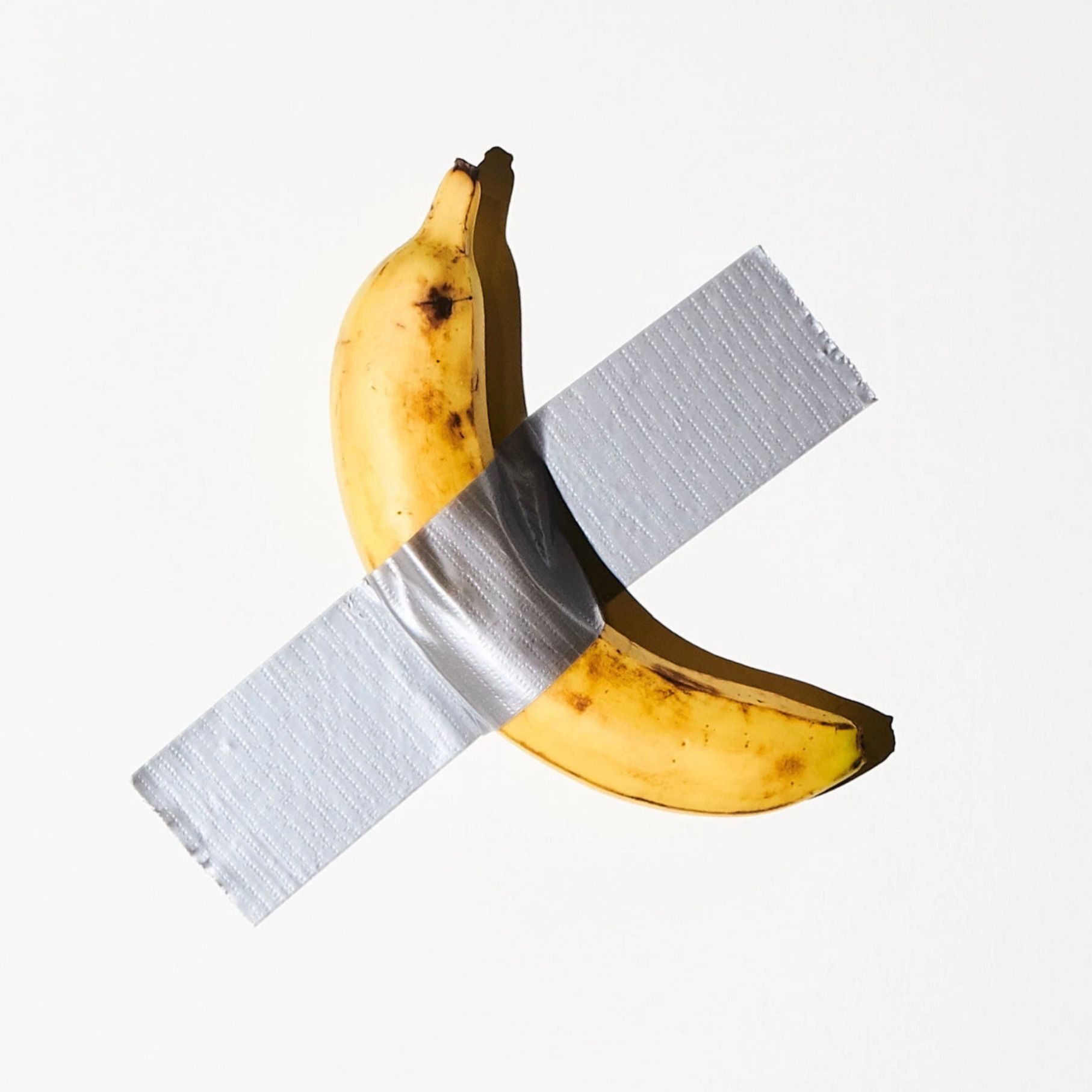
It's an unauthorized pin. I will do a preamble. But it is a enamel banana with a piece of actual duct tape taped over it that my wonderful colleague Eliza Stoner at the museum made for all of us who are working on the show.
- [10:42]
Alison Stewart
And that is because there is a piece called Comedian. People may have seen it. It's a banana taped to a wall.
- [10:50]
Lauren Hinkson
Yes.
- [10:52]
Alison Stewart
Why does that piece belong in the show?
- [10:55]
Lauren Hinkson
So Maurizio's piece belongs in the show because it's actually doing everything that we've been discussing about pop art, Right? It's the radical gesture. It's the relationship with image circulation, with commerce, with what does it mean to be art? What is art? Right? And he's taking a banana. He's putting it on the wall with. With a piece of duct tape. It's a conceptual gesture, but it has all these different histories and touch points. I learned recently that bananas became very common in the 1860s in New York, and people ate them, a lot of them, and threw the banana peel onto the ground, and people would slip and fall, and so newspapers would cover, oh, my gosh, people are falling because everyone' eating bananas. And then a few decades later, Charlie Chaplin puts the banana slip in a film, and it becomes this comedic gesture. And so over time, we have these moments of, you know, laughter, but also recognition that we have a visual culture that we're living in, and it has a power to influence us. And we need to understand how we see ourselves within that world around us and Maurizio's and, you know, engaging us and encouraging us and inviting us to have a little fun.
- [12:21]
Alison Stewart
Someone on this team. When is that for Halloween.
- [12:24]
Lauren Hinkson
Amazing.
- [12:25]
Alison Stewart
A white shirt, banana taped to him.
- [12:28]
Lauren Hinkson
Amazing. Amazing. And it's great with Duchamp on show, too, right now at MoMA, because it's the gesture. Right?
- [12:37]
Alison Stewart
We're discussing a new exhibit at the guggenheim called Guggenheim Pop 1960 to now. My guest is Lauren Hinkson, Guggenheim Curator of Collections. Let's talk about the Klaus Oldenburg piece, the giant piece, soft shuttercock. Now that originally when it was displayed, it was displayed over the rotunda. Now it's displayed very differently. Explain to folks how it is displayed. Excuse me.
- [13:06]
Lauren Hinkson
Sure. So when it was first shown in 1995, it was actually made for the Guggenheim's rotunda. So it's. It's a shuttlecock from the game badminton.
- [13:16]
Alison Stewart
It's giant too, by the way.
- [13:18]
Lauren Hinkson
It's huge. Each feather, there are nine feathers. Each feather is 20ft long. Okay, to start. Is that in your brain to start? It takes a rigging team a few weeks to install it. But what was exciting about showing this work again in the exhibition that we have on view is because it's a soft sculpture. And that's another kind of important thing to describe. These are not hard feathers. The 20 foot long feather is pliant. You know, it's filled with foam. It's made out of fabric. When you pick it up, it droops. Even though it weighs 400 pounds, when we rig it up, it droops, it twists. It's responding to the environment. And so when we moved it from its original intended place in the rotunda into the gallery, we wanted to create a sense of. Of the uncanniness of this object. Right. It's huge. It's strange. It shouldn't be that size. You have to walk around it and back away from it to even see the entire thing. And that relationship between you as a viewer and the object was an important part of Oldenburg's work. He was really engaged with happenings in the 1960s, performance art, bringing people together, talking about embodied viewing. But he's also interested in how these objects live, you know, how they have a sense of presence. And if they're living, then they have a history. And if they have a history, that means we can engage with them in different ways from our experience. So it's playful, it's uncanny, it's strange. It's very big, and it really does make you think. And the size of it, I think, also encourages you to slow down. Right. And in a culture where we're on our phones a lot, checking social media, the texts from family, and things like that, you kind of get a sense of awe because it's overhead, it's in front of you, and you have to stop to actually take it in.
- [15:29]
Alison Stewart
If you'd like to see some of the art that we're talking about, go to our Instagram page, llnyc. I want to talk about Kusama. You have a box that people stand in line for a long time, and they go inside the box. What happens inside the box?
- [15:48]
Lauren Hinkson
So inside the box is a mirrored room, and hanging from the ceiling are little orbs, and they light up and flicker and change color over time. It's a brief experience. It's only 60 seconds. So as much as I'm encouraging people to slow down, you do only have a minute in the infinity room. But what's fascinating is, you know, we're talking about this moment in New York in the media culture, and all of these artists reflecting the world around them, and they're talking about advertising and images of everyday objects. And Kusama, in her contribution, which she was an important figure in Pop art, she was an important figure in performance art. She influenced all of them. Andy Warhol, Oldenburg, she was the core kind of radiating out. But she was looking up and out to the cosmos, and also interior, too, into the soul, you know, and trying to get people to connect both with something very distant and something very close to us. And so you have this experience where you can see yourself located in this universe that she's created in the box. And it's really profound because it does, again, make you reflect on your place, the image of oneself in the way we're connected through art and through these big ideas that they're all addressing in our last moment.
- [17:18]
Alison Stewart
Is there any other piece that you'd like people to pay attention to when they go to the Guggenheim?
- [17:22]
Lauren Hinkson
Well, I would love to share that. Tomorrow, the second part of the exhibition is opening. That's all contemporary artists. There's 18 artists on view, all recently acquired to the Guggenheim School Collection. And we're looking at how contemporary practitioners are grappling with pop art as a strategy, so I encourage everyone to come and see that part of the show. In addition to the classic pop artworks,
- [17:49]
Alison Stewart
the name of the show is Guggenheim Pop 1960 to now. I've been speaking with curator Lauren Hinkson. Thank you so much for coming in.
- [17:57]
Lauren Hinkson
Thank you.
- [17:58]
Home Depot Advertiser
Heat up your Fourth of July at the Home Depot with our wide variety of grills under $300 and make every gathering one to remember. Give your outdoor a Glow up, whatever your budget is, with savings on seasonal plants starting at $5. With the grill fired up and your backyard set to perfection, you'll be able to invite friends and family over to kick off the party. Start celebrating with low prices guaranteed at the Home Depot, prices may vary by store exclusions apply. See home depot.com pricematch for details.
- [18:28]
Lauren Hinkson
Need a boost? Sometimes all it takes is tapping into your inner cool. Icebreaker's gum helps you unleash the confidence within. Each chew releases a rush of icy flavor powered by cooling flavor crystals, sending a wave of refreshment to reinvigorate all your senses. Icebreaker's convenient pack fits everywhere from car cup holders to backpack pockets, so you can find your cool wherever you go. Grab Icebreaker's gum online or at a store near you.