← All Of It with Alison Stewart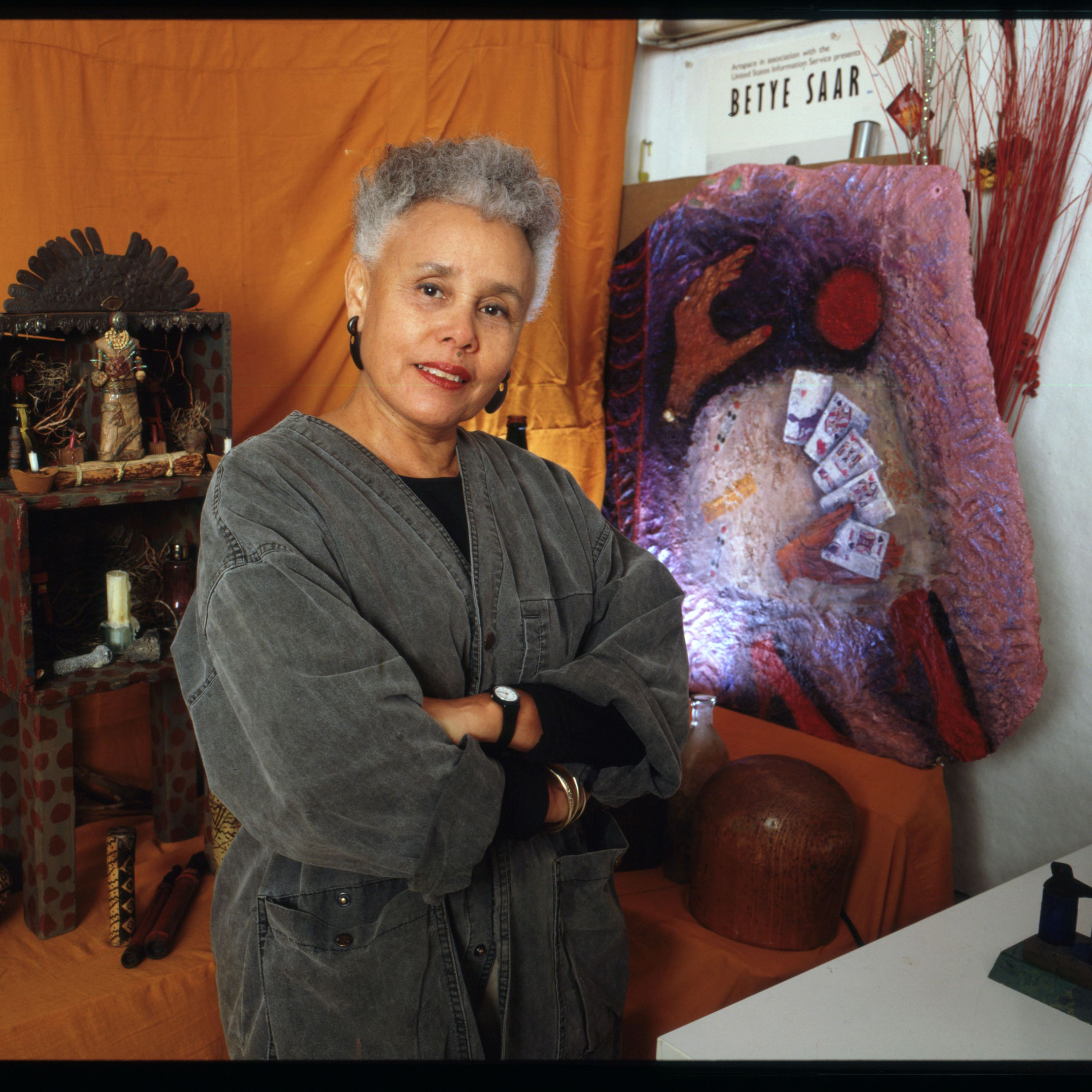
Loading summary
Transcript49 lines
- [00:10]
Alison Stewart
This is all of it on wnyc. I'm Alison Stewart. Just a few days away from her 100th birthday, the artist Betye Saar passed away in her sleep. She's known as one of the leading voices of the black arts movement. Saar lived her whole life in Southern California, and her work centered around found objects. You could often find her at a garage sale or a flea market. She was specifically interested in repurposing objects that portrayed harmful stereotypes or racist tropes of black people. For example, Saar's most famous piece, arguably is the Liberation of Aunt Jemima, depicting a mammy like character holding a broom, a grenade and a gun in front of a raised black fist. By the way, Quaker Oats quit using the Aunt Jemima brand in 2020, leading Saar to post on Instagram. She's liberated. Jane Carpenter Rock is the acting director of the Smithsonian American Art Museum. Her doctoral dissertation on Betye Saar's work, and she joins us now. Welcome to wnyc.
- [01:10]
Jane Carpenter Rock
Thank you. Thanks for having me.
- [01:11]
Alison Stewart
Given your long study of this great artist's work, what was your reaction to her passing?
- [01:18]
Jane Carpenter Rock
I was sad. I was sad, but I was also happy for her. I mean, Betty almost made it to 100, but she lived more than 99amazing years and her legacy is just unmatched. She did so much in her lifetime as an artist, as a mentor, as an inspiration for others. Her work is lauded around the world. She has pieces and exhibitions in major art museums. So I think she achieved many of her goals.
- [01:51]
Alison Stewart
How did you first become aware of Betye Saar's work?
- [01:54]
Jane Carpenter Rock
I first became aware of Betye Saar when I was doing a master's degree at Howard University. I was very interested in studying African American artists and. And their explorations of spirituality. And the first time I ever saw Betty's work, I saw an altar that she made called MT mti And it was amazing. For me, it was the first time I had seen contemporary African American art exploring themes of spirituality and drawing upon multiple spiritual systems, including African spirituality, Western spirituality, Asian spirituality. So that opened a whole world of Betye Saar to me.
- [02:36]
Alison Stewart
How would you describe the focus of your dissertation? This was a while ago, but when you were thinking about it and you were trying to figure out how you'll.
- [02:44]
Interviewer/Host (possibly Alison Stewart or another host)
How would you get into her work?
- [02:45]
Alison Stewart
What did you decide? How did you decide?
- [02:48]
Jane Carpenter Rock
Yes, the light bulb moment for me is when I realized that Betty was working in and between so many different, very powerful artistic traditions during her lifetime. She was very active in the Feminist art movement. She was active in the black arts movement. She's also associated with the California assemblage movement. And I loved the fact that she was moving in between these different movements and gathering pieces and then transforming them into her own visual forms and into her own artistic voice. She is what I called in my dissertation multipositional. She wasn't defined by any one of those movements or confined by them. She kind of transcended all of them and took little bits and pieces to create her own unique voice.
- [03:45]
Alison Stewart
Jane, were you able to speak to Betye Zar?
- [03:48]
Jane Carpenter Rock
Yes, multiple times during the course of writing my dissertation. She was very gracious, very generous. She invited me to her studio in Laurel Canyon, California, and she was so generous. And I think herself and her Persona and how she moved in the world was also one of her creations. She was so very spiritual, mystical. She loved going to flea markets. She was also very nurturing. She was a mother. So I think meeting her was also very informative to understanding her artwork and her artistic career. And I'm very grateful that I had that opportunity to interview her several times. And I actually saw her just a few years ago out in Pasadena. She had an exhibition at the Huntington Museum, and it was wonderful to reconnect with her.
- [04:38]
Alison Stewart
And I believe her daughter's an artist. Yes.
- [04:41]
Jane Carpenter Rock
Oh, yes. Allison Saar is quite an accomplished artist in her own right. And I'm very proud to say we have works by both Betty and Alison Saar in the collection at the Smithsonian American Art Museum. So we are very proud of our association with both artists.
- [04:56]
Alison Stewart
Artist Betye Saar died last week at the age of 99. Saar is credited as being one of the leading figures of the black arts movement. My guest is Jane Carpenter, rock actor, acting director of the Smithsonian American Art Museum, who wrote her dissertation on Betye Saar's work. She's joining us to look back at her impact and her legacy. You see this in every obituary, her being described as a leader or a defining movement of the black arts movement. Just for people, for. For context, how'd the black arts movement begin? When was its peak?
- [05:30]
Jane Carpenter Rock
Sure. You know, I think scholars generally track it as going from around the mid-60s into the mid to late-70s. There were groups of artists all around the country who wanted to break free from more traditional Western practices in art and wanted to infuse the art with African traditions, African cultural traditions and imagery, but also messages of solidarity, messages of liberation, and using the visual art to participate in the broader struggle for black visibility, black equality, and so Those were some of the hallmarks of the black arts movement. There were also important schools and movements within the black arts movement. Notably AfriCOBRA was quite recognized at the time. And they wanted to develop their own black arts aesthetic. And so it was quite a fruitful, dynamic period when lots of artists were gaining visibility and using art as a way to promote black visibility and black representation.
- [06:41]
Alison Stewart
Saar spent most of her life in Southern California. What kind of.
- [06:47]
Interviewer/Host (possibly Alison Stewart or another host)
How would you describe the art world that she came up in?
- [06:51]
Jane Carpenter Rock
Well, you know, she had her own unique trajectory. I would say her artistic career began probably very early in life. As a child, she talks about going to visit the Watts to Towers. And this is an iconic location in the Los Angeles area where a self taught artist built this huge monument of self expression. And she would go and even watch it being built at the time. An artist named Simon Rodilla. So that was her earliest artistic education, I would say. But then she also did receive formal artistic education. She received a degree from UCLA in 1989, 1949, and she then went on to do graduate level work. She was learned printmaking. She also did costume designing. And so she had quite a varied exposure to lots of different artistic creation and expression. I will say one of the pivotal moments for her was seeing an exhibition by the artist Joseph Cornell in 1967 at the Pasadena Art Museum. And he was an assemblage artist. He created worlds in boxes. And that was transformational for her. She went on to start doing the same thing and thus continued her exploration in assemblage.
- [08:13]
Interviewer/Host (possibly Alison Stewart or another host)
Yeah, the Cornell boxes are amazing when you think about what she worked with, the materials that she worked with, found objects, things like flea markets, maybe even a junk pile. Who knows? First of all, why was she drawn to these materials and how common a practice was it at the time?
- [08:34]
Jane Carpenter Rock
You know, Betty talked a lot about having a spirit of a scavenger or a magpie. She loved to go to flea markets, she loved to scavenge for things, even out in the natural world. If she saw a branch or driftwood or something that had a wonderful shape, she liked to collect it. So she was a collector, she collected lots of things. And one of the things that made her unique is that she was also collecting objects associated with femininity, with women, with domesticity. So these were not the materials that many California assemblage artists were using. So that was her unique contribution, I would say, to California assemblage. And like many other feminist artists, she was reclaiming these traditions, domestic traditions of knitting, of crafts to say, these are valid, these are viable, these are important artistic traditions that we should continue. And then notably, you mentioned Liberation of Aunt Jemima. She started seeing these black stereotypical figurines and figures in these flea markets. And in some ways it was hurtful, but in other ways, it was one of the most important expressions and contributions that she made. She reclaimed these objects and she transformed them into objects of power. And she often talked about she sensed a certain spirit in objects that she was drawn to, and she was able to harness the power within these objects to transform them into liberating figures.
- [10:16]
Alison Stewart
Actually, we have a piece of tape of Betye Saar talking about the liberation of Aunt Jemima. Again, it was a sort of a black mammy figure holding a broom. And then there's an image of a gun. It was sort of the front of an Aunt Jemima pancake mix label. And then there's a raised black fist in the beginning. And here's Saar speaking to NPR about it in 2006.
- [10:41]
Betye Saar (archival recording)
I'm the kind of person who recycles materials, but I also recycle emotions and feelings. And I had a great deal of anger about the segregation and the racism in this country. And so this series sort of evolved. And I feel like if I had to say what was my contribution to the art world and to the world in general as an African American woman would be this series.
- [11:09]
Alison Stewart
According to the LA Times, Angela Davis credited that piece with spurring the black women's movement. Why did it have that impact, do you think?
- [11:19]
Jane Carpenter Rock
Well, it was revelatory. The fact that a woman who was either a black woman who was either enslaved or a caregiver and seemingly subservient and denigrated could reclaim her power. Liberation of Aunt Jemima. Yes, she had a white baby on one hip that she was caring for, and she had a shotgun in the other hand. And so it was a moment where black women could say, hey, you know, this imagery was not necessarily just about oppression. This imagery was about black women who could reclaim their power, who sometimes were dissembling or showing one face of subservience, but in the background, behind the scenes, maybe plotting their own liberation or plotting the liberation of their families. So I think it was helpful to see black women is not just one way that black women are complex individuals and that they are capable of their own liberation.
- [12:25]
Alison Stewart
We're talking about artist Petty Saar, who died last week at age 99. My guest is Jane Carpenter, Rock, acting director of the Smithsonian American Art Museum, who wrote her dissertation on Betye Saar's work. We have on the phone someone from the New York Historical because there's an exhibit there right now called Betye Saar's Black Dolls. Rebecca Klassen, who is a co curator of the exhibit, which is on View through October 4th, joins us. Hey, Rebecca, thank you for calling in.
- [12:54]
Rebecca Klassen
Hey, Alison, thanks so much.
- [12:55]
Alison Stewart
So Betye Saar has entrusted the New York Historical with her doll collection. What's special about them?
- [13:02]
Rebecca Klassen
That's right. Well, there is a collection of over 100 black dolls. She and her gallery reached out to us last June to offer this, and we are so thrilled to be the stewards of these in the future. They are special because she saw them as special. She didn't have black dolls growing up. As a child, she had dolls, but they were white, and she hadn't even seen one until she reached College in the 1940s. So she began collecting them in the late 1960s, around the time when she was looking toward derogatory black Americana to reframe them in her assemblages. And for so long, these black dolls were very personal to her. You know, she kept them in a cabinet in her home and spoke about the energy sort of of almost bursting from this cabinet. And then during the pandemic, she began looking at them as subjects in watercolors and began transforming them and giving them a sense of agency and giving them their own liberation. I should say picking up on your earlier conversation. So we see what Betty saw in them, I guess, as a way of framing it.
- [14:27]
Alison Stewart
The exhibit also includes the only doll that Betty made herself. It's called Hoodoo Woman. Tell us a little bit about that.
- [14:35]
Rebecca Klassen
Yeah, Hoodoo Woman she made in 1974. And she used recycled and found materials, such as scraps of African fabrics and a nylon stocking for the head and the hands. And then the feet are made from the fingers of a leather glove. And she also included various bits of jewel. In a sense, it's like an assemblage. And in a way, we see it as a sort of self portrait because there was a photo taken a few years earlier in 1971. And she is posed in the same way as she has created Hoodoo Woman, so with upraised arms and one hand is pointing and the other is sort of in a raised kind of fist. And she says that Hoodoo Woman, the doll is like a practitioner of magic. You know, she's in the midst of casting spells. And so we see her as this sort of in her artistic self fashioning as a sort of hoodoo Woman and a mediator of ancestral knowledge and carrier of energy. Really.
- [15:43]
Alison Stewart
And my last question for you, I understand there are watercolors that accompany the dog.
- [15:49]
Rebecca Klassen
Yes. So we were able to match the dolls in the exhibition with watercolors that she began creating during the pandemic. The most recent one she created in 2025, so really not that long ago. And she sets these dolls, some of them are handmade and very unique, made by black women for the children in their care. And some unfortunately were born out of racist cultural practices and stereotypes and derogatory. And so these she sets in new and imaginative landscapes. She makes them mystical beings floating through the cosmos and gives them a sense of agency and self direction. So in the same sense that she transforms and recycles, she has recycled them into new visions.
- [16:48]
Alison Stewart
That's Betye Saar's Black Dolls, the New York Historical. Rebecca Klassen is co curator of the exhibit. It is on display through October 4th. Thank you, Rebecca.
- [16:58]
Rebecca Klassen
Thank you so much.
- [16:59]
Alison Stewart
Once again, our guest is Jane Carpenter Rock acting director of the Smithsonian American Art Museum. We're talking about the artist Betye Saar, who died last week at the age of 99. As you heard the conversation, what stuck out to you? You
- [17:14]
Jane Carpenter Rock
you know, I really enjoyed the conversation about Hoodoo Woman because I, I would agree. Betty was so focused on the power of women and the power women have to self liberate. And I think she did draw inspiration from either Hoodoo Woman or what I the title of my dissertation was actually Conjure Woman and this long of African and black women using rituals and knowledge of herbs, et cetera, to heal and to transform and to be leaders in their community. Drawing upon this legacy of spiritual power and spiritual knowledge, I think was a real, really strong theme in Betty's work and something that can be very inspirational for women.
- [18:11]
Alison Stewart
I wanted to ask you about the piece Black girl's window from 1969. You can see it at MOMA. This was considered a pivotal piece in her career.
- [18:21]
Rebecca Klassen
Why?
- [18:23]
Jane Carpenter Rock
Because, you know, she was very inspired, like I mentioned earlier, by the Joseph Cornell exhibition who made worlds within boxes. And she started working in boxes, but then she migrated to windows as another form of box, but a box that had panes of glass where it was mimicking this idea of looking into another world, so being able to have your vantage point, but peering through into another world where there were different rules and possibilities. And so Black Girl's Window I think was very transformative in her career because it helped her evolve beyond the boxes and became a fitting Metaphor for her exploration of spirituality and seeing into other worlds. She also embedded bits of photographs, photography and lithographs. So it was a way for her to bring in other examples of her work or other media and also draw on a sense of history and legacy and tradition.
- [19:35]
Alison Stewart
Betye Saar was active and working into her older age.
- [19:41]
Interviewer/Host (possibly Alison Stewart or another host)
What do you think that says about her creativity and about her spirit?
- [19:45]
Jane Carpenter Rock
Well, it says to me that art can be very life giving and very energizing. I like to think that it was this practice of creating and inventing and imagining that helped keep Betty young all those years. I would also say that she lived such a full and wonderful life where she was able to inspire so many other generations. I'm grateful to her for that. Not only her daughters, two of whom are artists, but countless students that she had. She was also a teacher, she was a mentor. She was an example to so many other artists, not just women artists, not just black artists, but artists all over the country and the world. So I'm grateful that she was able to live all those years so that she could continue her tradition of empowering others, because that's really what she did.
- [20:39]
Alison Stewart
Do you have a piece of work
- [20:40]
Interviewer/Host (possibly Alison Stewart or another host)
of hers that is a favorite of yours?
- [20:44]
Jane Carpenter Rock
Yeah, you know, we mentioned too, of course, Liberation of Aunt Jemima. I mean, it's just her kind of iconic piece. Also, Black Girl's Window, I think is so special. I'll mention a work, two other works, one that people might not be familiar with. It's called Record for Hattie from 1975. And it was a tribute to her grandmother. And I love that piece because I also have a grandmother who was named Hattie. And in my mind it was a way for her to honor this legacy of women that she came from. And so I find it very inspirational. It's almost a cultural memento that she's handing down to us. And then finally wishing for Winter. It's a wonderful window piece that's in the collection of the Smithsonian American Art Museum. We will have it on display next year. Next year. So that's another special piece. I encourage people to look that up.
- [21:38]
Interviewer/Host (possibly Alison Stewart or another host)
We have been remembering artist Betye Saar who died last week at 99. My guest has been Jane Carpenter, rock acting director of the Smithsonian American Art Museum. Thank you for your time today.
- [21:49]
Jane Carpenter Rock
Thank you so much.
- [21:52]
Commercial Announcer
The snack wrap plus Caesar sauce equals extra crispy chicken Caesary greatness. Sounds delicious. Caesar sauce at McDonald's for a limited time.