Loading summary
Transcript49 lines
- [00:01]
UPS Store Advertiser
Your package says delivered, but delivered where exactly? The hallway? The lobby? Your neighbor's apartment? Instead of playing detective with your deliveries, get a mailbox at the UPS store. We'll sign for your packages, text you when they arrive, and keep your deliveries low key under lock and key. Get three months free mailbox services with a new annual agreement at the UPS store. For full details and to get your Coupon, visit the upsstore.com offer
- [00:31]
Home Depot Advertiser
Working on Building a Dream space, but don't know where to start? At the Home Depot, we can help you bring your dream project to life. Whether you're building a backyard oasis, a podcast studio, or a wellness space, we've got everything you need in store and online. With project guides and free delivery options, it's easy to go from dreaming to doing the Home Depot. How doers get more done.
- [01:10]
Alison Stewart
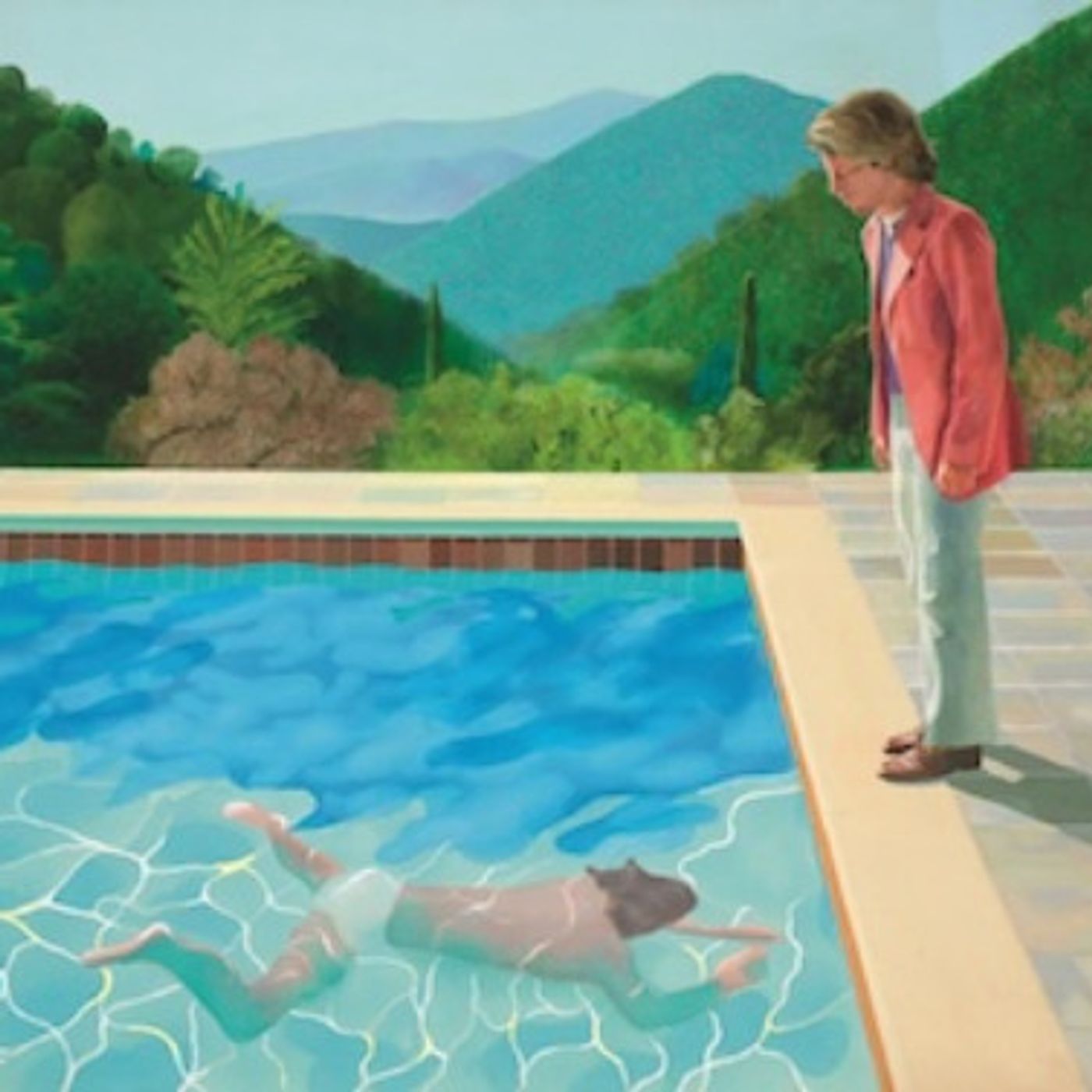
This is all of it on wnyc. I'm Alison Stewart. Earlier this month, the pioneering British painter David Hockney passed away at the age of 88. You might know him for his colorful painting of pools in la, where he spent a good deal of his life, or his double portrait series, or those pictures of his mom. Hockney had a long and prolific career that took many aesthetic turns. He never stopped coming up with new ways of seeing. He was also an openly gay man whose rapid rise to stardom happened at a time when being gay was actually illegal in Britain. Lawrence Weschler has been writing had been writing about Hockney for decades, including his 2008 biography, and they were also longtime friends. Earlier this month he wrote a piece for the New York Times called David Hockney and the Bliss of Not Standing Still. And he's got several more essays about Hockney on his substack Wonder Cabinet, where he's going to be publishing a batch of unreleased original iPhone drawings by Hockney tomorrow. If you want to follow along, you can go to our Instagram to check out some of the paintings we'll be talking about, plus a preview of those iPhone drawings that's oflovitwnyc on Instagram. And Lawrence, thank you so much for joining us.
- [02:21]
Ren Weschler
Thank you.
- [02:21]
Alison Stewart
And you go by Ren, correct?
- [02:23]
Ren Weschler
Yeah.
- [02:23]
Alison Stewart
All right, great.
- [02:24]
Ren Weschler
It solves the Larry problem.
- [02:27]
Alison Stewart
So you wrote a biography of David Hockney in 2008, but as I mentioned, you were fried. Can you tell me a little bit about your relationship?
- [02:34]
Ren Weschler
Well, it's funny because the first book I published was about a different LA artist named Robert Irwin, who then went on to be the first artist to get a MacArthur, actually. And after I had written that, and it was Ran in the New Yorker. It's what brought me into the New Yorker. And the book was called Scene Is Forgetting the Name of the Thing One sees. I get a call from David Hockney, who I'd never met before, Parenthetically, in terms of. Your Last interview was 43 years ago ago. 44 years ago was basically exactly the same time they got together. And he said, I've been reading this book and I disagree with everything in it, but I can't stop thinking about it. And he.
- [03:21]
Alison Stewart
That's sort of kind of a great compliment in some ways.
- [03:24]
Ren Weschler
Well, it wasn't that so much. He had very interesting ideas, but the point was, he said, why don't you come to my place the next time you're in town? And I had moved to New York in the meantime. It was back in la. And that was when he was doing those Polaroid photo collages. And that was when he started. And we talked for several hours. One of the things that was quite staggering, one of the things is that Irwin, who you may not know of, is primarily because he forbade the photography of his work. Erwin used to say that a photograph can capture nothing the work is about. It can capture everything. It's not about just its image and nothing. It is about its presence. And Hockney, amazingly, the first thing he said to me, he said, I used to think that was just a weird fetish, but I've come to agree with Erwin. I wish I had never let my work be photographed, because it is the case that no one can come upon a piece of mind in a museum and see it fresh. They see it as the poster that was in their dentist's office or the poster that was in college. All his work is so overexposed. Which is one of the things that makes those iPhone drawings fun to see because you haven't seen them before. But. But. So what happened is he asked me to write that text. And that text ran in a book called Cameraworks, which was a big coffee table book. And it was, apart from anything else, a refutation of Irwin. And then Erwin called me up and said, what a bunch of nonsense. Or words to that effect. Single word, starts with B. And I did his catalog next for a show. And then Irwin called me, said, what a bunch of. For 40 years, this went on back and forth, the two of them fighting for my soul. And it was not a personality conflict. It was really fundamental, what they were arguing about. Very interesting thing they were arguing about. And they never met. They would just. They had this battle. But so what happens when you get true to life, which is the name of the Erwin the Hockney book, if you kind of like shuffle them together, you can watch the conversation take place between them. It's really quite interesting. But anyway, so that's how I got to meet him. And then I just started hanging out with both of them and would write about both of them. While I was also writing about Poland or South Africa or torture in Latin America, I was doing all kinds of stuff, but that was an ongoing part of my life.
- [05:44]
Alison Stewart
How did David's public Persona differ from him as a private person?
- [05:48]
Ren Weschler
Well, first of all, he was a private person. And the public Persona was entirely a construct of the paparazzi. I mean, he. My thought about him before I met him was what I think everybody. That he was a party guy, that he was always out and he was going to all these lovely places, all these resorts and so forth. He was, in fact, just about the hardest working day to day, you know, nose to the grindstone artist I've ever met. He was constantly working. If he did go out in the early days, paparazzi would take off because he, by the way, is famous from the age of 22. He is famous in England still. But he would. And then they would recycle all the photographs of him over and over again. Anytime there was a story about him, there would be old pictures of him in parties. If you think about the paintings, for example, there's that famous painting of two guys sitting, looking at all these trees going down from Vichy. There's a third seat next to it. And you say, oh, there he is at the Vichy spa. No, he's painting. The reason the seat is empty is that's him painting there. And time and again, the things that make you think that he is always in the pool, he's not in the pool. He's painting people in the pool, you know, or he is, in fact, painting the pool itself. When he moved in that new place, he emptied the pool, painted the blue strokes on the. On the bottom of it. There was. He lived in this wonderfully colorful house in Mahond Ridge, Mahon Drive. And all the walls were these pure colors. It was incredibly wonderful. And the reason was because he had gone back to England at one point to visit his mother, and he had done paintings from memory of the house. And he had painted the house with all these wonderful, colorful walls. And when he came back, they didn't have those walls. So he painted them, paint them anyway. So in terms of the private public, there is that aspect. It bleeds into both, but it's hardly at all. And by the way, the last 30 years of his life, he's going deaf and so he didn't go out much at all.
- [08:01]
WNYC Host
I'm speaking at the life and legacy of legendary British painter David Hockney, who passed away earlier this month at 88 years old. My guest is his longtime friend and biographer Ren Weschler, who's released never before seen iPhone drawings of Hockney tomorrow in a substack wonder cabinet. Listeners call in. Do you have a favorite David Hockney painting that you want to shout out? What about his work spoke to you? What do you remember about him? Your calls and your texts at 2124-3396-9221-2433. WNYC. Hockney was born into a working class family in England in 1937, I believe. How did he talk about his childhood?
- [08:42]
Ren Weschler
Oh, with great affection. He had a good childhood. He was the fourth of five kids. His father was a conscientious objector. His mother was devout, quite devout. He was very fond of both of them, his mother. One of the things that's fascinating about him you mentioned is that he comes out with a completely relaxed attitude toward being gay. One thing that's interesting to think about is he's roughly a contemporary of John Lennon and Paul McCartney. He's about three or four years younger than them. And he arrives, by the way, later on in 1964, exactly the same year as the Beatles. But coming back to the earlier stuff, Bradford, the town he grew up in Yorkshire. He was very fond there. He used to go work in the fields of Yorkshire, bicycle out. And those are the paintings you later see in a later point in his life. And so he was especially fond of his mother. Her attitude was that his homosexuality, he was open to her about it, which was amazing, but that that was between God and him and that they'd work that out eventually. She was loyal to her son. When we say that it was illegal four years before he comes out. So he's coming out basically. He's born in 37, he's coming out in 55, 56, 57. And Alan Turing, the great computer guy, had been chemically castrated for being gay, like four years before this, that we're on the cusp of London, Swinging London and what will become Swinging London. And he is absolutely part of that surge. When people in England think about that surge, it's the Beatles, the Rolling Stones, but it's also David Hockney. It's all happening at once. And what was fascinating About David was he didn't make a thing out of his being gay. It was just part of his life. The relaxed attitude toward it was quite astonishing. And it is the same all the way through his life. So. And one of the things that was interesting about the time that I was getting to know him was that was the AIDS period. It was just when AIDS was happening and people would criticize him for not doing public statements and so forth and what was wrong. And he was a lightweight and he wasn't. He was, for God's sakes, he was painting dogs, dachshunds, right? Yeah. Do you remember those paintings? And what you don't realize is that work of that period is suffused with death and so forth, but also at a point where it's no longer possible to paint casual pictures of young men lolling about together because of aids, he does the dogs, the dachshunds, in exactly the same poses. Go look at those paintings. Those are all about aids.
- [11:36]
Alison Stewart
I want to ask a question, though, and it's a little bit of a basic question. How did he make the leap as a working class boy in Bradford to entering the art world?
- [11:47]
Ren Weschler
He. I'm not much of an authority on the actual things, but he went to art school and I mean, he was a drawer all the time and so forth, and that was encouraged and goes to art school. And what is definitely the case is that he is a star by the age of 22 in England. I don't think he had to think about money for the rest of his life. And he apparently didn't think about money. He never talked about it. There were other people taking care of that. So he was just not dumb. Never mentioned and talked about, But he does in 1964, so that's several years later. He's been doing earlier work, which we can talk about, but he comes to LA in 64 and as he says, the first thing he does is take driving lessons, get a driver's license and buy a car within his first week there. And as much as people talk about the boys, the pools, the palm trees, all the things he taught us, I grew up in LA and he taught us how to see the city. There were things we never looked at those street signs and suddenly they became Hockney street signs. The palm trees, they were just things or the sprinklers. He used to say to me, amazing city. I come from North England, where it's raining all the time here. When it rains, it rains from the ground up.
- [13:10]
WNYC Host
That's so amazing. As somebody sees something so differently that you've walked by a million times.
- [13:15]
Ren Weschler
And he did that. But I think the most important thing was driving itself, driving. Because the key thing in Hockney's life, and especially after 1982, 83, 84, when I was getting to know him, was moving focus. People will think that because he took tens of thousands of photographs, especially when he was doing the polar collages and those collages, that he would love photography. He actually hated photography. He said that photography is okay if you don't mind looking at the world from the point of view of a paralyzed cyclops for a split second,
- [13:56]
WNYC Host
but
- [13:56]
Ren Weschler
it's not what the work is. And he wanted to be true to life. And if you're going to be true to life, his great hero, his great thing is Cubism, which allows you multiple perspectives. And if you look at those photo collages, it's precisely that. It's not a single image, it's dozens of images. And you're seeing it from all different vantages. He gets fascinated by Chinese long scrolls, which is Chinese, and he gets fascinated by reverse perspective, all sorts of things to break down the tyranny of the photograph, which is one of the things that Irwin was doing too. Of the two of them just shut up and listened to each other. They realized they had a lot in common, but they never did.
- [14:35]
WNYC Host
Let's talk to Janice, who's calling from Montclair. Hi, Janice, thank you for taking the time to call, all of it. You're on the air.
- [14:42]
Caller
Oh, thank you so much for having this segment on David Hockney. And thanks to Mr. Weschler, I think I'm pronouncing it correctly. Hockney has been. I'm a 72 year old painter and he's been really my main inspiration for many, many years. I started using the iPad when he started using the iPad. Graduate school friend of mine introduced me to Brushes, which was his first app, right? And you know, now I use Procreate, which he did. But beyond the technical stuff, you know, Hockney, his. I think you mentioned his love of drawing and I think he couldn't help himself but just draw. Like you were saying, he wasn't in the pool, he was drawing the pool and he just drew. It was like his first language, like Picasso first language. And anyway, I just want to really thank you. He did so many things like, you can cut me off, I'm going on too long. But the way he used pattern, and I hate to say used, but because his paintings are living on, but the way he uses pattern the way he
- [15:52]
Ren Weschler
breathes, Pattern, breathe, pattern.
- [15:55]
Caller
And it's like, it's like a shorthand, right? And people see that shorthand and they know what he's talking about, even if he's not truly describing like a space or whatever it is. Anyway, just thank you so much for this segment.
- [16:10]
WNYC Host
Thank you, Janice, we appreciate that. Did you want to respond?
- [16:12]
Ren Weschler
I was just going to say that the funny thing about I was back in whenever that was 2008, I guess I was doing something on my iPhone and I said, david, do you know about this brushes thing? And he grabbed it from me and he kept my iPhone for like three days. And I was like, can I please have it back? You know? But then the thing that was amazing, that's what's on my Wonder cabinet tomorrow, is there were a group of about 15 or 20 of us who he was sending out almost daily, what he was discovering and what you get to watch with. I just. The reason I'm doing it is because when he died, I went back and looked, looked at. I have hundreds of these things on my phone. And the point is, one of the things that was amazing is these are all originals. There is not an original that is not this. It's exactly the same thing he has on his phone. But what was great is it was you couldn't monetize it, you know, except they did figure out a way to do it, which I don't really like are these blow up versions of them which are completely missing the point. They need to be looked at like stained glass windows almost. But the thing that was amazing to watch and I'm sure you will enjoy looking at this, is him figuring out how. How do you do cloth on glass, how do you do silver on glass, how do you do porcelain, how do you do glass on glass? How do you do transparency? The one that just blows me away is the last one I have in tomorrow's Wonder cabinet, which is he does typically a glass table with a glass ashtray with stubbed out cigarettes, but it's glass on glass on glass. And it is absolutely mesmerizing how exact he is. And he's just. And that is something he had to, for each of those textures, figure out how to do it. It was fascinating to watch.
- [18:02]
WNYC Host
And if you'd like to see a preview of that, you can go to our Instagram llofitwnyc. My guest is Ren Weschler. He is a biographer of David Hockney. He's a friend of David Hockney. We're taking your calls as well. Do you have a David Hockney painting that you would like to let people know about what it really means to you. Our number is 212-433-9621-2433. WNYZ. Roseanne from Long island is calling in. Hi, Roseanne, thanks for taking the time to call, all of it. You're on the air.
- [18:35]
Caller
Hello, how are you?
- [18:36]
Ren Weschler
Hi.
- [18:36]
Caller
I just wanted to share a story of what a sweet man he was. My brother, Richard Sasson is a dear friend of his, and he was painted by David. He's in a few paintings and he's lived in LA for 40 years. And in 1989, my husband and I were married in New York and we drove cross country to la. We stayed in LA for a few weeks and my brother took us over to David's house. And as a kind of a honeymoon gift, David took us for just my husband and I, because it was in a small convertible, took my husband and I for a ride. And this ride is documented in the painting of Mulholland Hills. He took us for a ride where he choreographed Wagner to the drive through Mulholland Hill. And with the top down at sunset,
- [19:31]
Ren Weschler
with eight or nine tape recorders in the back hood of his car. He started out by doing the Wagner, Tristana, Isolde. And he had a small stage on his table. And he would take you on drives through the stage set. And then he flipped it around and took you on drives through Mulhollen Drive and through other areas around Malibu and so forth with Sousa and Ravel and so forth. And then as you came around the corner, you went up the ridge, and he timed it perfectly so that the sun would just be setting and it would be fonder as you came down the hill. It was just amazing.
- [20:09]
Alison Stewart
I do have a clip of David Hockney speaking. This is his talking about his shift and his understanding of photography in particular as a reference point for his painting and how it started to change. This is from Smithsonian Channel's documentary called Seeing Beauty. We can talk about this on the other side.
- [20:27]
David Hockney (clip)
I'd become very, very aware of this frozen moment that was very unreal to me. The photographs didn't really have life in the way a drawing or painting did. And I realized it couldn't because of what it is. Compared to Rembrandt looking at himself for hours and hours, scrutinizing his face and putting all these hours into the picture that you're going to look at, naturally, there's many more hours there than even you can give it. A photograph is the other way Round. It's a fraction of a second, frozen. So the moment you've looked at it for even four seconds, you're looking at it for far more than the camera did. And it dawned on me that this was visible. Actually, it is visible. And the more you become aware of it, the more. This is a terrible weakness. Drawings and paintings do not have this.
- [21:28]
Alison Stewart
What's your take on that?
- [21:29]
Ren Weschler
I'm just reminded of the way he uses what he used to tell that kind of thing. He'd say, even a pornographic image, you can't look at it for more than 10 or 15 seconds. It just gets boring. As opposed to one of Picasso's Voyage Suite or something, you know, that you could look at for hours. Yeah, absolutely. And then, by the way, one of the things that becomes fascinating is at a certain point, he begins to realize that old masters starting. He notices it with Ingres, but then going back to Caravaggio and eventually all the way back to Van Eyck, that they are all using optical devices. And there's an incredible body of work which I actually worked with him fairly closely on, which results in a book called Secret Knowledge. But the key thing is he puts his. So typical. He takes his Xerox machine very high quality because they're all giving him the best Xerox machines so that he can test them, Xerox and so forth. Puts it in the middle of a studio. And then he basically puts. On the wall, it's two stories high. He puts all of Northern European painting and all of Southern European from his own library. And he does it from 1350 to 1850. And you notice that something happens in 1420. Between 1430 and 1420 and 1430, it's as if Europe suddenly puts on its glasses and you stop looking awkward. And it's Van Eyck. It becomes Brunelleschi and so forth.
- [23:06]
Caller
And.
- [23:06]
Ren Weschler
And then that look, the look of what look is the correct look, which is from one standing point. And so forth is all of art until 1840. And what happens in 1840 is the chemical photograph is invented. And they say you don't need to do painting anymore. And then suddenly you get Impressionism, Expressionism, and finally Cubism, which is the great critique of that way of looking and allowing lived time and so forth to be. But it was fascinating to watch him go through all that.
- [23:40]
WNYC Host
Let's try to get one more call in here.
- [23:42]
Alison Stewart
Hey, Luke, you have a few seconds. Tell us which David Hockney painting you like the most.
- [23:48]
Ren Weschler
Oh, my God.
- [23:49]
Caller
One of the most influential painters in the 20th century. But his portraiture, you haven't touched his portraiture, particularly Divine. This painting of Divine is perhaps the most intimate portrait yet painted.
- [24:03]
WNYC Host
Thank you so much for calling in. We have about a minute left. When you reflect on Hockney's legacy today, what do you think is his prevailing influence?
- [24:14]
Ren Weschler
Oh, he's hugely influential, just with the love of. I mean, one of the things, for a long time he was thought of as kind of a lightweight. But I think in the last 10, 15 years, people began to really grog that he was. Well, one of the things, I would say it was life against death. I mean, the world, especially after aids, is saturated with deaths and so forth for him. And his is one long assertion with what he used to sign his notes to you. Love life is what he said at the end. And so he's partly that. And it's a very, very important point through all this period right now. It's really important.
- [25:00]
WNYC Host
Thank you so much to Ren Weschler. And you should check out his substack tomorrow. Wonder Cabinet. You'll see David Hockney's iPhone drawings. Thank you so much for joining us.
- [25:09]
Ren Weschler
Thank you so much.
- [25:13]
UPS Store Advertiser
Your package says delivered, but delivered where exactly? The hallway, the lobby, your neighbor's apartment? Instead of playing detective with your deliveries, get a mailbox at the UPS store. We'll sign for your packages, text you when they arrive, and keep your deliveries low key under lock and key. Get 3 months free mailbox services with a new annual agreement at the UPS store. For full details and to get your Coupon, visit the upsstore.com offer
- [25:43]
Home Depot Advertiser
Working on Building a dream space, but don't know where to start? At the Home Depot, we can help you bring your dream project to life. Whether you're building a backyard oasis, a podcast studio or a wellness space, we've got everything you need in store and online. With project guides and free delivery options, it's easy to go from dreaming to doing the Home Depot. How doers get more done.