← All Of It with Alison Stewart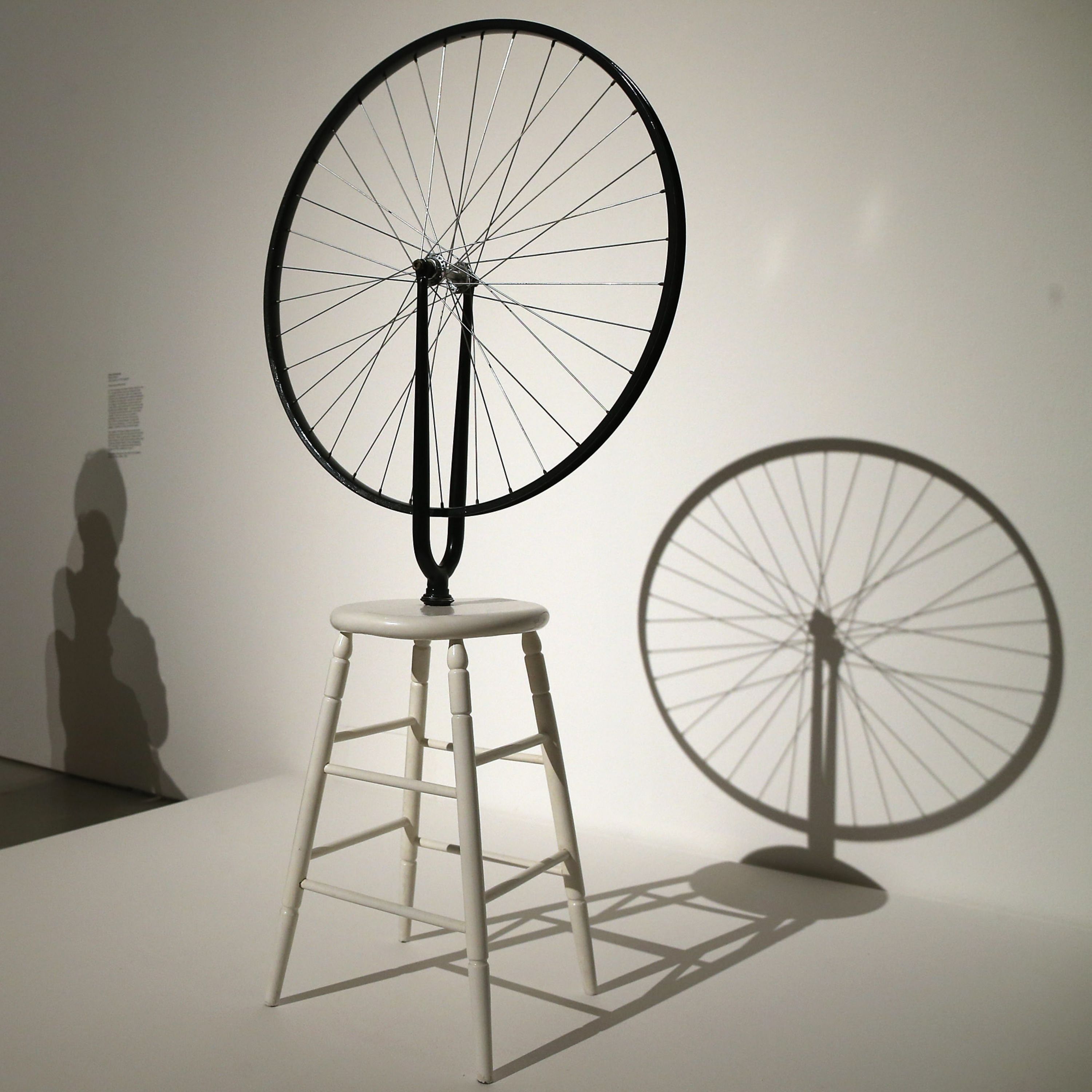
Loading summary
Transcript33 lines
- [00:09]
A
This is all of it on wnyc. I'm Alison Stewart. One of the things I love about art in New York City is that it isn't confined to just museum walls. It's in our parks and plazas built into the city's architecture. And sometimes it's being quietly created in someone's home for more than 20 years. Coming up, we'll meet Joe Macken, a truck driver who recreated New York City in miniature, block by block and building by building. After his children shared his work online. It attracted millions of views and inspired the exhibition He Built this City. Later, we'll also explore how Isamu Noguchi left his mark on New York through his sculptures, playgrounds, and public spaces, as well as the ambitious projects the city never allowed him to build. But first, a retrospective for French artist Marcel Duchamp, who once said, I don't believe in art. I believe in artists. Few artists did more to test the boundaries of what art could be. A retrospective at MoMA traces artist Marcel Duchamp's restless, eclectic career, from the colorful paintings of his youth and his Cubist period to the ready maids that changed the way we think about art. Urinal and all. The exhibition also reveals a more personal side of Duchamp. I found myself lingering in front of a portrait of his father. It's a quiet, affectionate painting that shows the serious talent Duchamp walked away from when he decided to stop painting and to pursue something entirely different. The show also explores his years in New York City, his devotion to chess, and the work he created as his female alter ego, Rose. C' est la vie. Marcel Duchamp is on View at MoMA through August 22, so you still have little over a week to go. See was curated by Anne Temkin and Michel Cuo. Michel explained how Duchamp first began to challenge our definition of art.
- [02:17]
B
He challenged it from the very beginning. And you can see as the galleries progress when you walk in the show. He starts out with a kind of academic styles of paint, learning how to make prints. But then very, very soon, he has his first real brush with notoriety. There's the painting that made him famous in 1912 called Nude Descending a Staircase Number Two. It was rejected twice, first by even his close friends and brothers as too strange. And then it created an outrage at the Armory show in New York in 1913. So I think at that point, as there are many turning points, but Duchamp really decides very early on that he's not gonna be part of any movement to subscribe to any kind of group or definition. And then it just explodes from there.
- [03:12]
A
And the show is exhibited in chronological order from the beginning of his career until the end. Why did you wanna structure it this way? Instead of going by themes?
- [03:22]
C
It may seem like an Unduchampian thing to do, in fact.
- [03:26]
B
Right.
- [03:26]
C
Because it's very logical. This is the beginning and this is the end. But we have two goals in having done that, and it's kind of contradictory goals. One is that you actually realize that all of his provocative, crazy, iconoclastic art that he's best known for, like the urinal titled Fountain, these objects that were so called readymades, making works of art that were made just by selecting a store bought item to call a work of art, all of that came from a background of serious, serious painting. And so as you live his life with him making painting that gallops through a whole bunch of styles in a matter of a few years, when he decides to give all that up, it's a real sacrifice, It's a forfeiture. And there's kind of been a truism out there for years that he did all of those crazy things because he had no talent. And we wanted to throw that out once and for all and make you see that, no, he was very seriously ambitious as an early 20th century painter and then very, very dramatically said, I'm done with that. So that sort of sequence is necessary to make that impact. But on the other hand, what also comes across through this chronological layout is that there are themes that are present at the very beginning in those very appealing oil on canvas paintings that stay with him through his whole life. And one of those, for example, is the Game of Chess. The first picture you see in the show is his older brothers sitting at a chess table playing chess. Well, you don't see paintings like that, like impressionist style paintings of chess for the rest of the show, but in every gallery of the show, you see chess in some way or another being a theme that he, as an excellent, outstanding chess player, really made it a kind of metaphor for art making throughout his whole life.
- [05:39]
A
We're talking about the massive retrospective of French artist Marcel Duchamp, open now at moma. My guests are Ann Temkin, chief curator of painting and sculpture at Michel Cuo, chief curator at large. Marcel Duchamp is open now through August 22nd. Duchamp was born in France in 1887, but he wasn't the only artist in the family. What do we know about the family? That it created these great artists? His siblings were artists as well.
- [06:06]
B
His grandfather was a printmaker and a painter. And then his brothers, who were older, became artists as well. And at a certain point, Duchamp moved to Paris very early on to study academically, but also to be with his brothers in the kind of bohemian world of avant garde art, art in, in Paris at the time. And his sister Suzanne also became an acclaimed artist. So Duchamp already was, as he said, in a kind of aesthetic bath in his childhood. There's an amazing piece called Errata Musical, which is a kind of chance based musical score very early from 1913. And he's thinking of it as an experiment for he and his sisters to, to sing. And it's a chance based musical composition. So that spirit of play, but also art making, you know, is just kind of in his bones.
- [06:57]
A
And one of the early paintings in this show I found, I just sat there and looked at it for a long time, was of his father.
- [07:02]
C
Oh, great.
- [07:03]
A
What is noticeable about this work, this piece he does about his father?
- [07:08]
C
It's an amazing combination of the sense of filial respect and filial love in two ways. One as the son of a biological father, but on the other, it's done in a very Cezannian style. And even the portraits of Madame Cezanne that Cezanne painted put her often in a striped upholstered armchair, and Mr. Duchamp is in that same kind of armchair. And the style is very much influenced by Cezanne. So you have this father, artist, father, father kind of doubled in that painting. And I think that accounts for some of the power that you felt.
- [07:51]
A
What was the art scene like when he was coming up?
- [07:54]
C
So he came up at this amazing moment in the history of art, really the history of all art, which were these first couple of decades in the 20th century when everything in not only art, visual art, but literature, science, everything was exploding. And so he rode with that wave of a transformation in culture, the likes of which I really rarely seen in history. So he absorbed all of what these avant garde people around him were doing. But then after about a decade, he, as we were saying earlier, wanted to jump into something just entirely his own.
- [08:39]
A
It's very interesting, Michelle. You know, the exhibit contains these beautiful, colorful works of art. You've mentioned him playing the picture of brothers playing chess. They look almost impressionistic when you see them. Were there any hints of sort of the artistic rebel he would become or was he following a path?
- [08:58]
B
I think you see it in another very famous, beautiful jewel toned painting of his friend named Du Mochel. And there's this kind of almost glow around the figure. And the story of Du Michel is that he was actually an X ray technician. And so there's this strange almost X ray like glow to the painting very early on. It's like Duchamp is already interested in the world that is beyond our visible reach. And that is going to, I think, affect and sort of bloom in all of the work that's about to come.
- [09:35]
A
And you mentioned this a couple of times that he said, okay, enough. He became a librarian at one point. What do we know about why Duchamp decided to give up painting?
- [09:46]
C
He felt if he continued painting in such a way that he needed to earn his living as a painter, he would be making work to please people, even his brothers, even the avant garde artists around them who worked in order to sell their art at an art gallery. He didn't have an art dealer his whole life. He just wanted to speak in the voice. He wanted to and not be worrying about appealing.
- [10:15]
A
Let's talk about the ready made Anne. What is a ready made?
- [10:19]
C
A ready made is what it sounds like. It's so easy and good. Instead of making a work of art, let's say a sculpture by chiseling wood or molding clay, he went to the store and just like you could buy a ready made shirt off the rack, you could buy a snow shovel and call it what you wish to, which in his case in 1915 was in advance of the broken arm and hang it up and enjoy it.
- [10:53]
A
What did the ready made symbolize?
- [10:56]
B
I think one thing is that there was this enormous pressure or sea change with the invention of photography for artists. Because if there's a machine that can depict realistically a scene better than any realistic painting could, what's left over for the artist to do? And I think in a way, the ready made is a response to that condition. And Duchamp saw that suddenly it's not necessarily skill or craft that is going to define the work of art. It's actually the act of choosing and it's an idea. And that's something that the ready made starts to propose. That Duchamp said it was almost like a rendezvous. And on one of his most famous readymades, which is in called comb, the exact date and hour of its choosing is inscribed on the side of the comb. So I love that idea. It's about a moment rather than about a kind of traditional skill.
- [11:53]
A
We need to ask about Rose. C' est la vie. How would you describe this alternate Persona? And there are pictures of him, her.
- [12:03]
C
So Rose, c' est la vie. First, his impulse was he was just done being just Marcel Duchamp. So he first had been done being Marcel Duchamp the painter. Then he said, I'm even done being Marcel Duchamp. I want to be a woman. And he picks the name Rose, C' est la vie for its wordplay. One of his great interests in life, it said properly in French, erose, like Heiress. C' est la vie, C' est la vie. That's life. Yes. And really through the show, from the beginning till the end, along with chess, one of the themes that is in every single gallery, like everywhere, is in fact, erotics and eroticism.
- [12:47]
A
Michel, what do we know about Duchamp's thoughts about gender and sexuality?
- [12:53]
B
Well, he's obviously playing with these roles and sees it as fluid in a way. And those photographs of him as Rose by Man Ray are just extraordinary. And then he even creates a kind of branding campaign with them when he invents a perfume, perfume line, of all things. And that's an incredible work. We also have the original in the show called Belle Beautiful Breath, and it's an emptied perfume bottle with a label on it that has a picture of Rose on it. And so this idea that this empty perfume bottle is not empty, it actually contains Rose's essence or breath, is something that shows how Duchamp was dealing with gender and, you know, role playing as something that was ineffable, fluid, ephemeral. I also love a really early drawing that we have from 1909 that's in the show. And the title of it begins, Ni' Homme n' Like Neither man nor Woman. And it's of a very dandyish, extraordinarily stylish figure. And so, again, really early on, I think he's playing with these different codes in a really brilliant way.
- [14:00]
A
He loved words. Words were a big part of his art, we'll say. And what was unique about the way he combined humor and art,
- [14:10]
C
it was fundamental to him. And I think one of the great things about the exhibition's visitors that we've been perceiving is that they're getting that, you know. And there's been a huge Duchamp industry of very, very serious art historical research and comment. And so much of him was about pleasure, and so much of that was located in wordplay. And don't forget, he was born French, but spent much of his life in America, but going back and forth between America and France. So he actually used the sort of disconnect between his speaking and writing French and his speaking and writing English, which was slow to come at first, as one of the ways that the word play really took off, like in that wonderful unfamiliarity with both at an equal basis. And the dissimilarity and the way that he could play on homonyms, for example, that sound like one thing in English and another thing in French. So just like he was neither man nor woman, neither French nor New Yorker, you know, he. He kept his avenues open.
- [15:27]
A
Okay, the hard question, Michelle, where would you like them to spend a little extra time?
- [15:32]
B
Oof. That is hard. I love, of course, all the galleries, but I do love the gallery we were just talking about of all of these replicas from the 1960s, including the replica of the large glass that we have. We walk into that gallery, and you're just surrounded by multiples of multiples. Suddenly you're in a hall of mirrors. There are these ready maids that you hadn't seen before because they're lost. Or there's readymades that you have seen before, and now these are replications of them. So another urinal. Multiple urinals, multiple bottle racks, iterations of Ella show Q. The Mona Lisa with a mustache. So what you're seeing is actually a sort of efflorescence in the 1960s of a new generation taking interest in Duchamp's readymades. And because they don't, many of them are around anymore, sometimes they were just thrown out as ordinary seeming objects. For example, the Italian dealer Arturo Schwarz has the idea to remake these, but to refabricate them from scratch with artisanal Italian work workshops. So you'll see something that was industrially produced originally, like a urinal that you bought off the shelf. But this one has been recrafted by these Italian workshops. So it's totally perverse. And I just love walking into that and being this kind of fun house, these replicas.
- [16:55]
A
What about you, Anne? Where would you like people to spend an extra moment or two?
- [17:00]
C
Well, there's a gallery right at the center of the show that from the start, we conceived of as a kind of show within a show. And that is the big display of his box in a valise. And the box in a valise is something that he began when he was 50, and he decided to make what he later called a portable museum of all the works, or almost all the works that he had made up until that time. He's still just known to a tiny circle of avant garde fellow artists, but he decides he needs a retrospective, and he spends five or six years making these beautiful, very, very beautiful, beautiful miniatures of all of his works and packs them up in a leather valise and, in fact, makes enough that there would be 320 of them to sell to people thinking that there will be 300 some people who want these, which wasn't the case right away for sure. And we for the first time present a display of great detail of a great many of these boxes so that you can kind of wander through his own retrospective of himself in miniature before and after you've been wandering through all of those objects in real life scale.
- [18:21]
A
Marcel Duchamp is on View at MOMA through next Saturday, August 22nd. That was my conversation with curators Ann Temkin and Michelle Kuo. Up next, Isamu Noguchi's art can be found across New York, from a bright red cube in lower Manhattan to the Queens Museum he created as a gift to the city. We'll talk about an exhibit called Noguchi's New York and his vision for a more creative, connected city. This is all of it.