Loading summary
Transcript48 lines
- [00:00]
Commercial Narrator
WNYC Studios is supported by Progressive Insurance. Did you ever think about switching insurance companies to see if you could save some cash? Progressive makes it easy to see if you could save when you bundle your home and auto policies. Try it@progressive.com Progressive Casualty Insurance Company and affiliates. Potential savings will vary. Not available in all states. All of it is supported by Memorial Sloan Kettering Cancer center in a small groundbreaking clinical trial where 100% of participants with a specific type of rectal cancer saw their tumors disappear using immunotherapy alone. Researchers at MSK are now studying this approach in cancers of the stomach, liver and more, and a majority of tumors are disappearing. For MSK Giving day, all gifts will be tripled. Learn more@msk.org all of it.
- [00:56]
Alison Stewart
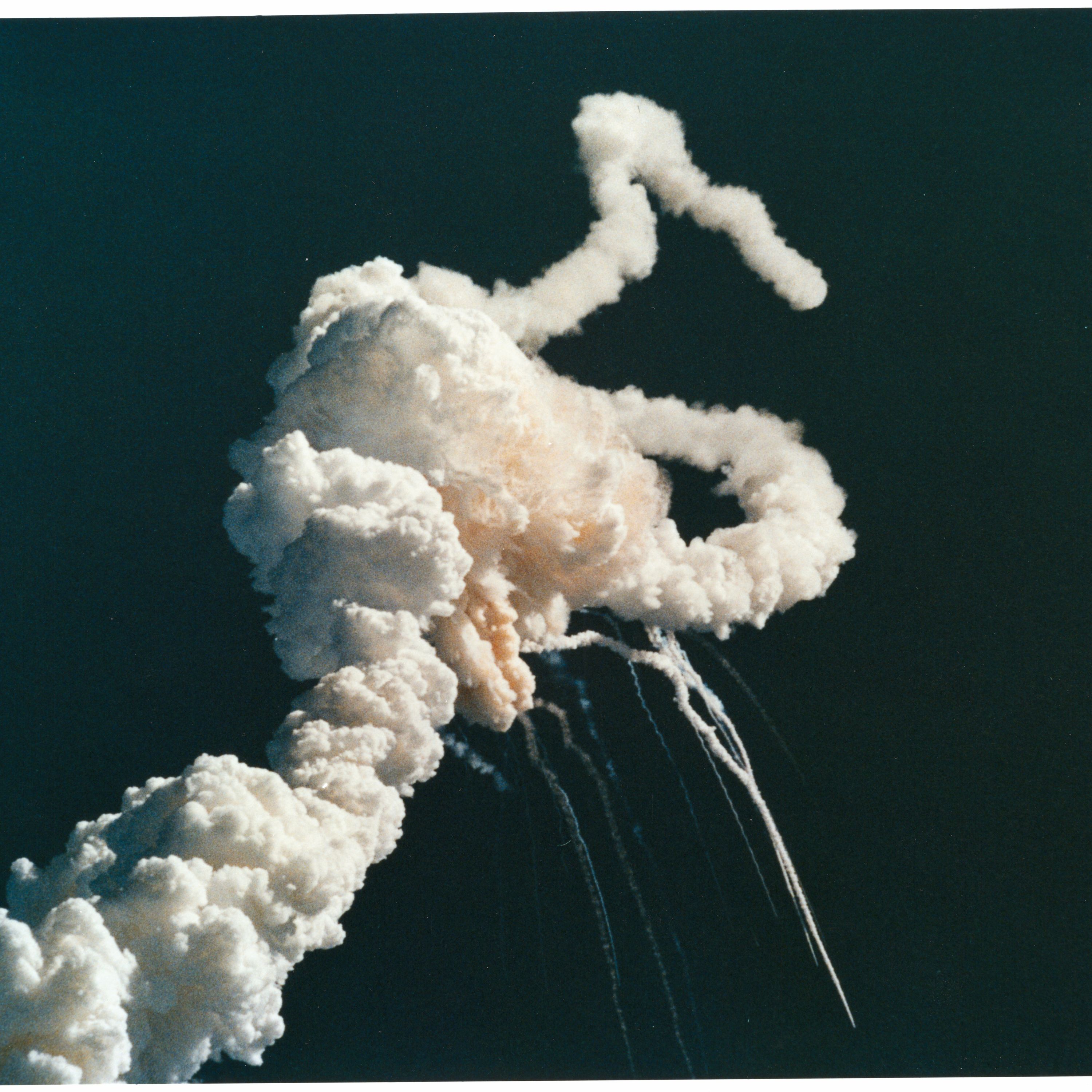
This is all of it on WNYC. I'm Alison Stewart. 40 years ago on January 28th, 1986, millions tuned in to watch the Challenger venture into space. But just 73 seconds after launch, the Challenger exploded. All seven astronauts on board were killed. They were Dick Scobie, Michael Smith, Ellison Onizuka, Judith Resnik, Ronald McNair, Gregory Jarvis, and Christa McAuliffe. Here's what you would have heard on CNN as the launch went wrong.
- [01:34]
Commercial Voice
Looks like a couple of the solid
- [01:36]
President Ronald Reagan
rocket boosters blew away from the side of the shuttle in an explosion.
- [01:50]
Adam Higginbotham
Flight controllers here looking very carefully at the sit obviously a major malfunction.
- [01:57]
Alison Stewart
A subsequent investigation revealed that there were serious questions about the safety of the launch that were overlooked. Journalist Adam Higginbotham is the author of a book that tells the story of the Challenger and what led up to and followed that fateful day. It's called Challenger A True Story of Heroism and Disaster on the Edge of Space. It's now out in paperback. Adam joined me to reflect on the anniversary. There has obviously been a lot of coverage of the explosion over the years, but I wanted to know if Adam felt there was more left to the story.
- [02:33]
Adam Higginbotham
When I started looking into the idea of doing it, I did wonder that myself, but quickly discovered that by the time I started working on the project, I mean, probably like 35 years had elapsed since the accident actually happened. And what I quickly realized was that nobody had really attempted to write a serious narrative nonfiction account of what happened that day. Since 1987, probably. And also in the years since the accident happened, a huge amount of information had come out, both in archival material and in personal memoirs. And also that the way the accident had been written about and featured in films and documentaries had increasingly come to focus Very tightly on the story of Christa McAuliffe, the teacher in space. And so I wanted to return to the story and tell it in a different way so that it brought to life the other six members of the crew who you mentioned who were on board the ship that day. But also the stories of the handful of rocket scientists who. Rocket engineers who attempted to stop the launch happening at the last moment, but obviously failed.
- [03:36]
Alison Stewart
You wrote that 1986 was expected to be a banner year for the space shuttle. What did they have planned?
- [03:43]
Adam Higginbotham
It was going to be the busiest year of manned spaceflight launches in NASA history. So the part of the point of the shuttle was that it was going to be this vehicle that made spaceflight routine. So space was just going to be a place where you went to work and traveling on the space shuttle, it was a shirt sleeve environment. It wasn't like traveling to the moon where everybody got into these bulky pressure suits with these kind of fishbowl helmets. You would just get into a sort of blue jumpsuit and then maybe put on a helmet and then. But you get into space and it'll be just a working environment. And the whole point of this began to kind of approach what they promised in 1985, where they had roughly one launch of the space shuttle every month. And that flight rate, you know, essentially almost kind of broke the agency. It was really sort of coming apart at the seams because it wasn't set up to run a trucking business into space.
- [04:40]
Alison Stewart
You had to wait till one shuttle came back to take a part of it, to put it onto the next shuttle for it to take off.
- [04:44]
Adam Higginbotham
Exactly, exactly. Because they just didn't have enough spare parts. And they were used to tailoring spaceships, you know, for one mission at a time. And suddenly they had a fleet of four spacecraft that were constantly rotating through Cape Canaveral on the way to space.
- [04:59]
Alison Stewart
Why were these the astronauts chosen for this specific mission?
- [05:04]
Adam Higginbotham
Well, I think that in part they were chosen because, you know, they represented a kind of idealized picture of melting pot America. And it's one of the reasons, I think, why the accident, when it happened, you know, made such an impact on the American psyche is because in addition to the teacher in space, candidate Christa McAuliffe, you know, the crew was. Was made up of this really kind of diverse cross section of the astronaut core that represented America. You know, so you had Ellison Ozuka, who was the first Asian American in space. You had Judy Resnick, who was the second American woman in space. You had Ron McNair, who was the second African American in space. You know, and on top of that, then you had had Christa McAuliffe who was picked because she was this sort of every woman, someone who was not only a great communicator, but extremely charming and was just kind of. And seemed totally normal. You know, she seemed to be a placeholder really for anybody who was an ordinary person who had ever dreamed of going into space as an astronaut.
- [06:16]
Alison Stewart
Yeah. What was the idea behind Teacher in Space?
- [06:19]
Adam Higginbotham
Well, I mean, that goes back to a similar problem that NASA was suffering from as they did with the Apollo program, which was that they began to realize that their effort to make space flight seem routine with the space shuttle had succeeded all too effectively to the point where the public got bored with it. Ho hum, you know, when they started launching one mission every month or so, Then it reached a point where public attention drifted away to the extent that the three national television networks stopped covering the launches live, just because it seemed to be, as you say, a pretty ho hum exploit to launch this vehicle into space regularly.
- [07:05]
Alison Stewart
And having a teacher in space wasn't just the beginning of it. They were going to have journalists go into space, all kinds of people in the future who lined up to be on that list.
- [07:19]
Adam Higginbotham
It was conceived as what was known as the spaceflight participant program. And so they did a lot of lengthy consideration about what kinds of people from ordinary walks of life they would choose to represent ordinary people. And initially the chief of NASA, the administrator of NASA, was very keen on the idea of sending a Boy Scout into space. And then they gave extremely serious consideration to sending Carol Spinney, who was the puppeteer who operated Big Bird on Sesame street, into space as the first citizen astronaut because they were interested in engaging children's interest in. In spaceflight. So, you know, Big Birds seemed like a logical choice. And this went so far that they actually corresponded with Spinny and he agreed to do it.
- [08:15]
Alison Stewart
Oh my gosh.
- [08:16]
Adam Higginbotham
And the main reason why they didn't is, is because they eventually figured out that the costume with the feathers and everything was going to behave awkwardly in orbit and that was going to cause problems. So at that point they moved on to other kinds of candidate.
- [08:33]
Alison Stewart
I am sensing that this was a PR ruse.
- [08:38]
Adam Higginbotham
Ruse is a strong word.
- [08:40]
Alison Stewart
Ruse is a strong word. A PR promotion.
- [08:43]
Adam Higginbotham
I would say that public relations was a leading element in the spaceflight participant program. And, you know, and so they chose a teacher first. And then they had. Actually, at the time the accident took place, I think that they had already selected a journalist candidate to be the Next person. And that was going to go ahead, but then they had plans for, you know, artists and sculptors and photographers.
- [09:09]
Alison Stewart
My guest is journalist Adam Higginbothen, author of the book A True Story of Heroism and Disaster on the Edge, Edge of Space. The paperback is out now. It's an excellent book, Adam. So where were you?
- [09:23]
Adam Higginbotham
I was at school. I was at high school in England. And because of the time difference, you know, I was in class when it happened or just coming out of it. And obviously because this was a pre cell phone, Pre Internet, pre 24 hour rolling news time, I didn't hear about it when it happened. And I just went out with my friends after school. And it wasn't until I got home quite late that night that my mother had been watching the news and knew all about it, told me what had happened. But I can still really remember how really, you know, totally inconceivable. I found it. It took me a while to kind of wrestle with it and realize that this really had happened because I, like so many other people, had had started to believe that, you know, NASA was an organization that could achieve the impossible on a regular basis.
- [10:13]
Alison Stewart
I was in college, I was at my college radio station and they said, you know, they had, in sort of introducing us to all the equipment, they said, when that bell goes off, that means something has happened. I remember that from the first day.
- [10:26]
Adam Higginbotham
Wow.
- [10:26]
Alison Stewart
And then I was in and the bell went off and everybody's head just turned to like, what's happened? Like we didn't know what was happening. It came over like a fax machine. It practically came over. And we broke, broke into AR on college radio. But it was a really, really my first experience with breaking news and what to do with that, what to do with that emotion, what to do with the job of telling people about it. It was an interesting point in my career. My career. Let's talk about the day itself, Adam. It was January 28, 1986, Kennedy Space center in Florida. But it was really cold.
- [11:06]
Adam Higginbotham
It was really cold. It was the coldest day in 100 years.
- [11:10]
Alison Stewart
So why is the temperature such an important detail?
- [11:14]
Adam Higginbotham
Because they, because what actually caused the accident was a failure of the seals in the solid rocket boosters that were the strap on rockets that provided the shuttle with most of its thrust on the way to orbit. And they'd had problems almost since the very beginning of the shuttle program with these rockets and with the seals specifically. But almost exactly a year before, in January 1985, when they recovered the rockets from the shuttle mission that had flown. Then they discovered that the kind of damage that they'd seen in these seals in the solid rockets was a lot worse than they'd ever seen before. And the engineers who examined the damage quickly made a connection between the historic cold that had fallen over the launch pad the night before that launch and the damage. And they thought their theory was that these. The seals are made of this sort of synthetic rubber called Viton. And their theory was that the extreme cold had made the seal so inflexible that they couldn't do their job properly. They couldn't flex into the gap in the joint in the rocket at the point of ignition, and therefore it made it possible for hot gas from inside the rocket to leak out. And so when the engineers heard the weather forecast in January 1986 of further historic cold sweeping over the launch pad, they immediately thought, well, we've got to stop the launch because it has to be postponed at least until the temperature improves, because otherwise, if the damage under similar circumstances last year was so bad, it could be a lot worse, and we run the risk of catastrophe. And so, late on the night of January 27, the engineers of the contractor that built the rockets over at Morton Thiocol in Utah called this late night teleconference meeting with their bosses at NASA to try and tell them that they recommended against a launch.
- [13:31]
Alison Stewart
And they wanted him to sign a piece of paper that says, I'm okay with the launch.
- [13:36]
Adam Higginbotham
Well, what happened is that they. Which was pretty wild, the engineers presented all their data and sent them a piece of paper that said, we do not recommend launch. But the NASA bosses, who at that point were under enormous pressure to get the launch to go ahead, made it very clear to them that they didn't want to hear this. They didn't explicitly say, we want you to change your minds, but they made it clear that they would be quite unhappy if they didn't. And then, as a result, they did indeed get them to send over this fax that changed their recommendation from no go for launch to go for launch.
- [14:15]
Alison Stewart
You know, so many people were watching, so many children were watching. They pulled the TVs into the rooms for kids to see. How did NASA and the government handle the immediate aftermath of the disaster?
- [14:31]
Adam Higginbotham
Not well. Yeah, because they didn't. They were kind of paralyzed. They did actually have. They had trained with, or they had developed procedures for how to deal with an accident like this, but they had never really had time to train on them. And as a result, their response was sort of paralyzed, and they didn't release very much information at all about what had happened. And it led to an assumption on the part of the media at the time that was kind of primed to, because of their suspicion of the lingering suspicion of government organizations and, and the White House, especially after Watergate, that was still lingering in the minds of a lot of journalists who were reporting on it at the time. And so it began to look like they were trying to cover up what had happened. And it wasn't until the Reagan administration appointed the Rogers Commission, an independent presidential inquiry into what happened that the real truth began to come out.
- [15:35]
Alison Stewart
Yes, we have a little bit of President Reagan's speech. Let's listen.
- [15:39]
President Ronald Reagan
We've grown used to wonders in this century. It's hard to dazzle us, but for 25 years, the United States space program has been doing just that. We've grown used to the idea of space. And perhaps we forget that we've only just begun. We're still pioneers. They, the members of the Challenger crew were pioneers. And I want to say something to the school children of America who were watching the live coverage of the shuttle's takeoff. I know it's hard to understand, but sometimes painful things like this happen. It's all part of the process of exploration and discovery. It's all part of taking a chance and expanding man's horizons. The future doesn't belong to the faint hearted. It belongs to the brave. The Challenger crew was pulling us into the future and we'll continue to follow them.
- [16:33]
Alison Stewart
Someone asked this question, they texted it in. Who put the pressure on the engineers to launch? I understand it was President Reagan. Is that true?
- [16:42]
Adam Higginbotham
That is not true. That was a sort of conspiracy theory that was widely aired at the time and continues to kind of re. Emerge even now. But it was also very thoroughly investigated by the Rogers Commission and they established that there was no evidence to that. The idea was that because the State of the Union address had been scheduled for that night, January 28, that Reagan had designed, and his people wanted to have Christa McAuliffe call in and participate in the State of the Union address. And so if they didn't get the shuttle off the ground that morning, that wouldn't have been possible. But there was no evidence to suggest that that was ever planned or that anyone in the White House put pressure on the engineers to launch.
- [17:34]
Alison Stewart
So, so what did they uncover? What did the commission uncover?
- [17:38]
Adam Higginbotham
They uncovered, you know, the, the report.
- [17:42]
Alison Stewart
You got a big book about it.
- [17:43]
Adam Higginbotham
Actually, the, the, the report that they eventually published, which, you know, stretches to five quite hefty Volumes, you know, called the accident an accident rooted in history. And it explains very clearly how there's this kind of long series of compromises and overconfidence and miscommunication and a whole series of red flags stretching back, you know, 10, 20 years before the accident actually took place. And that on the day of the accident there were clear warnings about the problems with the rockets and the cold weather, that had they been heeded, you know, the lives of the astronauts would have been saved.
- [18:29]
Alison Stewart
We covered a documentary about Sally Ride, the first American woman in space. And she participated in the commission that investigated the disaster. And she said she lost trust and NASA leadership during the course of that documentary. How long did it take NASA to recover its reputation?
- [18:50]
Adam Higginbotham
I'm not sure it ever recovered its reputation because, you know, there's clearly, you know, looking back on it, there's clearly a time before the Challenger accident and a time after the Challenger accident. And I think one of the reasons it remains kind of seared into the national consciousness is because it represented a kind of loss of innocence. You know, NASA was one of the last American institutions after Watergate, after the Vietnam War, in which people still had total confidence. You know, it still did exactly what it was supposed to do. It was a source of great pride. The shuttle itself, you know, in the years before 1986, was just, was a great symbol of American technical superiority and kind of cultural primacy in a way. And all of that was just shattered with a Challenger accident. And I think people lost a kind of open minded optimism that they felt about high technology that day. And I don't think that's ever really returned.
- [19:53]
Alison Stewart
That was part of my conversation with journalist Adam Higginbotham, the author of A True story of Heroism and Disaster on the Edge of Space. It's now available in paperback. And that is all of it for today. I'm Alison Stewart. I appreciate you listening and I appreciate you. I'll meet you back here next time.
- [20:13]
Commercial Voice
Maxing is so maxing right now, bro. Get ready for spicy chicken maxing because Carl's Jr. Is saving you big with a 5.99 maxed out double stack double stack double stack spicy chicken sandwich. Seriously, just 5.99 double stack spicy chicken. This is unreal value in the bromosphere. The new spicy chicken Max wallet friendly Max tasty only at Carl's Jr available for a limited time at participating restaurants. Tacked not included. Not valid for use within a combo or a combination with any other offered discount.
- [20:43]
Commercial Narrator
Need a boost? Sometimes all it takes is tapping into your inner cool. Icebreaker's gum helps you unleash the confidence within. Each chew releases a rush of icy flavor powered by cooling flavor crystals, sending a wave of refreshment to reinvigorate all your senses. Icebreaker's convenient pack fits everywhere, from car cup holders to backpack pockets, so you can find your cool wherever you go. Grab Icebreakers gum online or at a store near you.