Loading summary
Transcript129 lines
- [00:08]
A
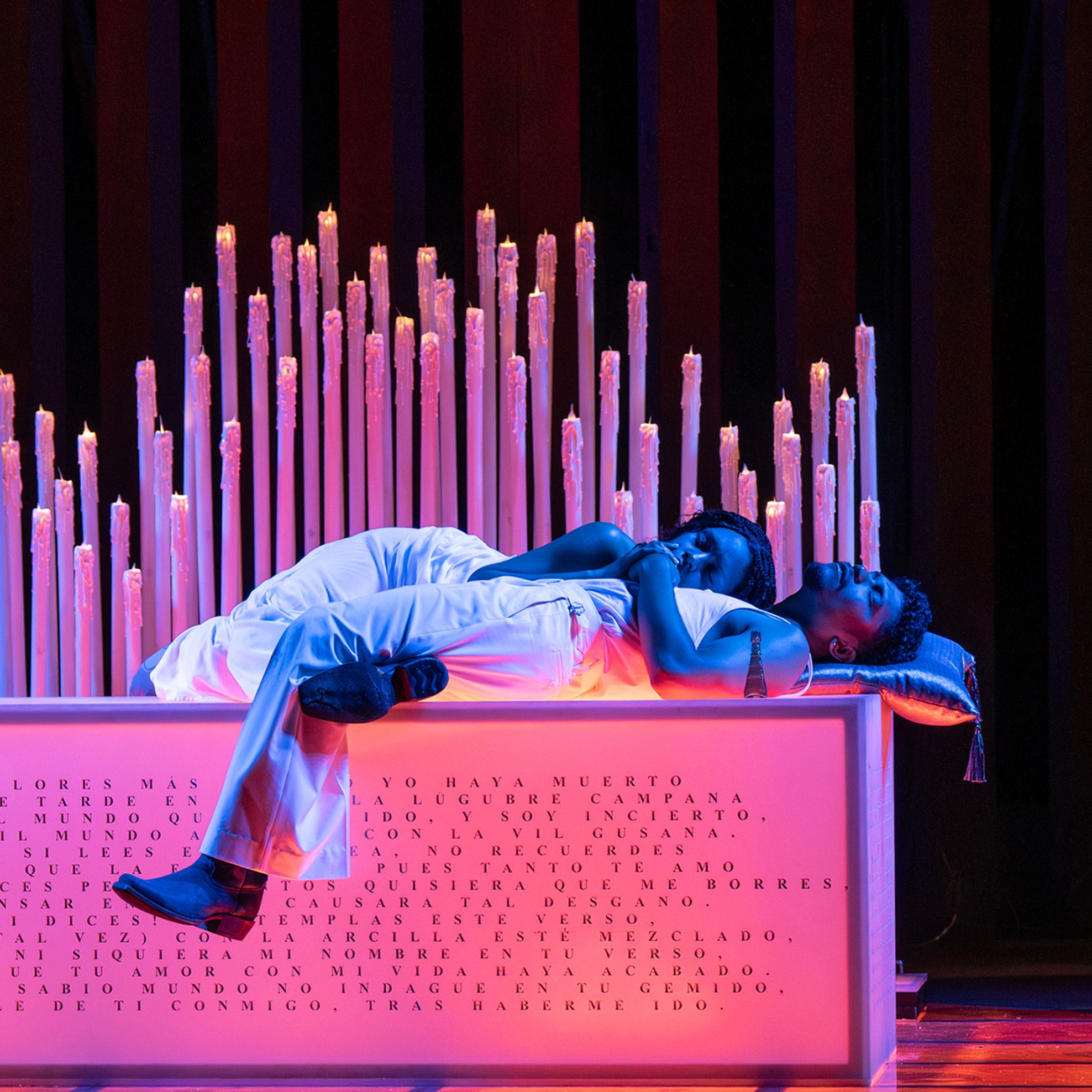
This is all of it. I'm Alison Stewart live from the WNYC studios in soho. Thank you for sharing part of your day with us. I'm really grateful that you're here. On today's show, author Ann Patchett will be here to talk about her new novel, Whistler. Chris Smalls joins us to talk about his new memoir, when the Revolution Comes, A fight for the future of the working class. And we'll hear from the playwright and one of the stars of the Tony nominated play, Play Giant. That's the plan. So let's get this started with Shakespeare in the Park. Right now in Central park, the Delacorte Theater has been transformed into a town on the US Mexico border. It is in this setting that gives new context to the Shakespeare in the park production of Romeo and Juliet or, or Romeo y Julieta. The star shows Ramaya Letia Aikens as Juliet and Daniel Bravo Hernandez as Romeo. Juliet's family are pro border enforcement. Romeo's friends are anti ICE activists like Mercutio, played by Caleb Joshua Eberhardt. At their fateful party meeting. It's full of singing and dancing, including wild costumes. Romeo and Juliet begin their courtship, often in Spanish. Romeo and Juliet is running now at the Delacorte and also starring Lachanze, Frances Zhu, Glenn Fleischer, Deidre o', Connell, and many more. Tickets are free. I'm joined now by Ramaya Latia Aikens, who plays Juliet. Hi.
- [01:40]
B
Hi.
- [01:41]
A
And Daniel Bravo Hernandez, who plays Romeo. It's nice to meet you as well.
- [01:44]
C
Hey.
- [01:45]
D
Likewise.
- [01:45]
A
And Caleb Joshua Eberhardt, who plays Merkecisha. Welcome back to the show.
- [01:49]
D
Thanks.
- [01:49]
A
We're happy to have you. Ramaya, you just graduated from the NYU MFA program last year.
- [01:55]
B
Yes, I did.
- [01:57]
A
How did you get this part? What was the audition process like?
- [01:59]
B
Oh, my gosh. Okay. So, yeah, I, earlier this year, I just got sent the audition and I saw that parts of it were in Spanish and had a call with the casting director, Heidi Griffith, just to ask about what that meant for the character. And she kind of explained to me that Juliet learns Spanish for, from Romeo, that she's not fluent, but she's trying to use that as a way to, like, connect with him. So I spent a lot of time, because I'm not a fluent Spanish speaker, I spent a lot of time working on that. So that was a big part of my preparation. And then I went in person at the Public. I had my initial audition and then felt really, really excited about it, but was kind of bummed because, you know, I, I Left feeling like, oh, that was all right. I don't know if I'll get. But then I got a call that I got a call back for it, and then came in the next week. And then after I did my audition, it was so dramatic. Like, I went to the door, I put my hand, like, on the doorknob to leave. And then Sahim was like, wait, there's nobody else that we want to be our Juliet? And so that was like a very. So a very cool moment. Like, I've never heard in the room, you know, about getting apart. So that was. It was really awesome.
- [03:18]
A
That must have been exciting to walk through the public theater just for an audition.
- [03:21]
B
Yeah, absolutely.
- [03:22]
A
In the first time ever went there.
- [03:24]
B
Yeah, yeah.
- [03:25]
A
Daniel, you were in Romeo and Juliet on Broadway. Yes, in a different role. What did you play?
- [03:30]
C
I played Abraham Montague.
- [03:34]
A
What did you learn from that experience that you were able to bring to this experience?
- [03:39]
C
Well, funny enough, I think watching Kit Connor do it every day, and I regard him as one of the best Romeos that I've seen. I think there's a lot of his performance that aided me in rehearsal. I mean, the only thing that hindered me was his accent. I kept saying a lot of the words in his accent, and I was like, oh, man, what about, I gotta get him out of my head? But so much of his, like, choices and so much that he brought out, I didn't necessarily copy, but I was inspired by it. So being Romeo, now I'm like, okay, how do I bring in some of Kit, and how do I bring in a whole lot of me as well?
- [04:15]
A
So, Caleb, you've been on Broadway before. The last time you were here was choir boy. You're recently. You're really good in that. At the cheerleading theater, you got older. That was great. Had you thought about Shakespeare in the park before?
- [04:28]
D
No, no, no.
- [04:30]
A
What made you go up for the role?
- [04:32]
D
I got the. You know, I got the email appointment, and I was like, well, of course I'm gonna, you know, shoot my shot. I. For some reason, I just, like, never. Actors want to do Shakespeare in the park, but I haven't. This is my first time doing Shakespeare professionally. I did it a lot in college. That was a long time ago, though, so I was, like, a little out of practice. But they gave me a lot of time to prepare the Queen Mab speech for my audition, and I just sort of did my best. I sort of felt like Ramaya afterwards. I was like, there's no way. I think he appreciated what I tried, but I Think they're probably gonna go with somebody else. And luckily, that wasn't the case. But I never thought of Mercutio. Like, I played Romeo in college and, like, scene work. Like, that was always like, my. You know, I just never. I. And it wasn't because I, like, had a aversion to it. I just, like, never, never, never considered it.
- [05:26]
A
You said you were out of practice.
- [05:28]
D
Yeah.
- [05:28]
A
When you were in college, how did you practice Shakespeare in college?
- [05:32]
D
I mean, they would assign. Junior year is, like, all. Where I went to. I went to Purchase, same as Daniel. And junior. Our junior year is all Shakespeare.
- [05:40]
B
Oh, cool.
- [05:41]
D
And then, you know, senior year, you bring it in if you. If you want to. And, you know, in voice and speech, we would, you know, dabble. Dabble at it. And I mean that. That's how we would do it. And it was. You sort of, like. You sort of obsess over it because it's like, you know, Shakespeare's sort of beaten into your brain a little bit. And that was. I did it. You did it out of, like, sort of obligatory. Like, you. Like, you had to. But once you graduate, it's like, if it doesn't come across your play unless you really love it. Like, I just. I don't know. I just never thought of it. But I love Shakespeare. I love doing Shakespeare.
- [06:13]
A
Do you remember that class taking Shakespeare?
- [06:15]
C
I do. Chris McCanthon taught it.
- [06:18]
A
What did he teach you?
- [06:20]
C
Well, Chris, funny enough, spends a lot of the beginning with, like, what's the subject? And the structure of the sentences, as opposed to iamic pentameter. Like, he just really wants you to understand what it is that you're talking about.
- [06:32]
D
Dirty Shakespeare.
- [06:33]
C
Yeah, yeah, yeah. And so he gives you an assignment where you're like. You break it down in your own words. It's really cool. And then towards the second half of the class, it's all about putting it on its feet and trying things out.
- [06:44]
A
Yeah, that's really interesting to, like, sort of break it down to its base level.
- [06:49]
D
I did that for Queen Mapp before my audition. I have it in my phone. Like a dirty Shakespeare version of Queen Map.
- [06:54]
C
Really?
- [06:54]
A
Oh, tell us about that.
- [06:55]
D
It's just what Daniel said. It's like you sort of, like, break down each line detail by detail in your own words so that essentially the speech doubles what it is. Because you're just trying to get every single nasty detail out of what Shakespeare is trying to say.
- [07:10]
C
It's like a stream of consciousness. Like, what does every word bring out in you? And so it just it makes it way longer, believe it or not.
- [07:16]
D
Yeah.
- [07:17]
A
This setting is set on the US Mexico border. The Capulets and the Montagues are on different sides of the immigration issue. Ramaya, what did you think when you heard that was going to be the setting for this?
- [07:30]
B
Yeah, I was really moved by. I think it's so beautiful to take Shakespeare that, you know, it's 400 years old, and make it really present and make it really current, and to do that in a way that really mirrors what's going on in the world right now. So I was. I was very excited and also intimidated. I think it's tough sometimes as an actor. You feel this responsibility to properly represent, you know, the time that you're in, especially if your production is gonna go in that direction. But it's like, it's a great responsibility, and it feels, like, really meaningful. So I was very excited by.
- [08:17]
A
We see Mercutio. He's kind of the leader of the resistance group. He sort of paints a balash ice on the wall. How do you see activism as part of your version of this character?
- [08:30]
D
I. I think Mercutio is a natural. He goes against the grain in general. Whether, you know, you set this show in a. In a place like it is now or not, it just goes against the grain. He's a contrarian. And so for me, knowing this was going to be set here, I tried to, like, embody that a bit more, just to, like, sort of help Sahim's vision come to life. The Abolish Ice moment was like something I was playing with in rehearsal and really fought for when we got on stage, just to be clear about what Mercutio finds important, what he fights for and how that connects to his love for Romeo, especially being what side he's on, being the kind, the person he is in this world. And I also think in today's climate, it's helpful, even within a fictional story, to be clear about what Caleb believes is the right thing. And so that was important for me, too, to sort of embody that.
- [09:37]
A
Daniel, what are some lines that maybe feel different or have a different context when set against this backdrop about immigration and the border wall?
- [09:46]
C
Well, there's the heavy lightness, serious vanity, which we've now changed to Spanish. But a lot of the notes that I was getting, it was, use the wall. Like, use the space that you're in, really take that in. So when I say, here's much to do with hate, but more with love, it's the difference of, like, here's much to do with Hate the separation, the borders, the man made borders that we're putting up and. But more with love, the love of like your own country, the love of the people that you share space with, language with the love of the people who believe we all should be together. So those kind of lines are very like, mean something different in this context. And it's very helpful because thanks to Sahim's vision, I get to just do that as opposed to come up with it on my own. Like, oh, what do I make this about? And it's like, oh, it's right there. It's right there on the stage.
- [10:40]
A
We're talking about Shakespeare in the park, the production of Romeo and Juliet. The version of this story takes place at the US Mexico border. My guests are Ramaya Latia Akins who plays Juliet as well as Daniel Bravo Hernandez who plays Romeo, and Caleb Joshua Eberhardt who plays Mercutio. Daniel, Romeo speaks Spanish when he gets very. When he gets excited about Juliet.
- [11:06]
C
Yes.
- [11:07]
A
When he gets near her. What conversation did you have with Sahimali, the director? We've been talking about when Romeo would switch to Spanish.
- [11:15]
C
Sahim wanted it to be a very special and conscious thing as a director. And so a lot of the conversation was what is my personal life like? Like when, when is it that I choose to speak Spanish as opposed to maneuver in English? And it's like when English words aren't enough anymore to describe an intense feeling, whether it's anger, love, excitement, it's. There's always a moment, I think as a bilingual human being where I'm trying to explain something in English and it's just not enough. And Ramaya has a moment like that in the play, which I think is awesome the way she does it every time. But it's like when the language that you're using isn't enough and you have another one, it just explodes out of you. And a lot of the conversations were that how natural can we make it? And what does it mean in my personal life and how do I put that into Romeo?
- [12:09]
A
It's interesting because the person who's sitting two seats over from me could said, I don't think she speaks Spanish. Like you were good, but like, but they understood that it was your second language.
- [12:19]
B
Yeah, yeah, yeah, yeah.
- [12:20]
A
Is that purposeful?
- [12:21]
B
Yes, yes. Because I think, I think it says something beautiful about trying to reach someone. Juliet speaks Spanish when there are two, two like points, I think in the play where she will decide to speak Spanish. One of them is when she really wants Romeo to understand something clearly in his own language that she thinks maybe he's not understanding fully. Like, there's this moment on the balcony where, you know, she wants Romeo to leave because, you know, she wants him to be safe. And even though she has these huge feelings for him, if. If he's seen, he will be murdered. And so she switches from English to Spanish to try to help him to understand that. And then another time that she does it is when she is alone and is trying to conjure Romeo in the space because we don't have much stage time together in the grand scheme of the entire play. So a lot of it is a longing for one another, and so she speaks it then when she's trying to, like, bring his essence to her when she is alone. But, yeah, it is. It is purposeful that she doesn't completely do it because it's. It's like she's trying her best to reach. And I. Yeah, I think that's like, kind of, like an endearing quality that you see in real life when people try to really reach one another. And specifically in this production, because they have two different upbringings and life experiences, they're still, like, fighting to be understood for one another.
- [13:57]
A
Caleb, what direction did Sahim Ali give the actors about Spanish in the play?
- [14:05]
D
Honestly, he didn't give me no direction about. Because I don't. I don't speak. No, I don't speak it. I think that was really, like, the language between them to really. And a little bit of Dee Dee, because Dee Dee, who plays Dee Dee o' Connell plays Nurse. I think she has a little moment to sort of, like, from how I enter, that, like, she sees Ramaya's or Juliet's passion to know this language and sort of, like, encourages her in a way, maybe against, you know, the family's wishes or whatever. But any direction that Sahim gave the cast about Spanish was really directed at these two and never really at me, although I have thought about sneaking it in, but I won't. You should do it just because it would, you know, add some chaos to the whole thing.
- [14:55]
A
There's some people who don't speak Spanish. They maybe don't know. Even know Shakespeare well enough to understand the. The balcony scene, because even if you don't speak Spanish, you kind of know what's going on. How do you use your bodies to. To get across what you're trying to communicate?
- [15:12]
B
Yeah, I think body language is, like, there's. There's some, like, some percentage that, like, most of the. To understand someone, it's mostly through body Language and not through, like, actual words. And so that's really fun to play with, especially because in the balcony, we're so far away from one another, and so we have to, like, use our bodies to try and reach. And so that's like figuring out gestures that kind of go along with the words that are being said in Spanish, because it goes back to that, like, fighting to be understood.
- [15:47]
A
How do you use your body in that speech, man?
- [15:50]
C
What don't I use in that speech? It's with every word, especially even in the Spanish parts. Just because Shakespeare and Spanish may be foreign to so many people. I'm a big physical actor, which is why I love theater, TV and film. I don't know about so much, but I love theater because I'm just.
- [16:12]
A
You can run.
- [16:13]
C
Yeah. And I'm running that whole scene.
- [16:15]
D
You run a lot.
- [16:15]
C
Yeah, yeah, yeah. That whole balcony scene. And before that, like, I'm running through the audience. I'm going up and down the stairs. I'm running. You could do a full sprint on that stage, and Sahim would be like, yeah, that works. And I'm jumping there's. Because she's so high up for the balcony scene, there's a lot that I use for Romeo and, like, the little skips and hops that I do to try and reach her. And I think wherever you're sitting, you can just tell that I yearn. Romeo yearns to just be near her or just have her gaze for a little second.
- [16:47]
A
We're talking about Shakespeare in the park, the production of Romeo and Juliet. We'll have more after a quick break. This is all of it. This is all of it on wnyc. I'm Alison Stewart. We're talking about the Shakespeare in the park production of Romeo and Juliet. This version of the story is set at the US Mexico border. My guests are Amaya Letia Aikens, who stars as Juliet. Daniel Bravo Hernandez, who stars as Romeo, and Caleb Joshua Eberhardt, who plays Mercutio. So when we see you at the beginning of the play, you come up from the bottom of the stage like these golden angels, sort of like a statue. What's going through your mind, Remy?
- [17:36]
B
What's going through my mind is not letting Daniel make me laugh. We, like. It's so. There's so many moments of stillness on stage because we have to play dead and we have to, like, be statues. And Daniel activates my, like, funny bones so much. And so, honestly, I'm just trying not
- [17:57]
C
to laugh for that whole.
- [17:58]
B
Ramaya. Julia is a statue So I don't. I don't know if much is going through her head at that point.
- [18:04]
D
You made me laugh during that moment the other day.
- [18:07]
C
Oh, I know. And you're under a mask.
- [18:09]
D
And I was under the mask, I was like this.
- [18:13]
A
I saw it Saturday night and it was cold Saturday night. You are in beautiful gowns and you were wearing, like, sleeveless shirts. How do you deal with the weather? How do you deal with outside. Outside people yelling. They were having. There was a park. There was a. People having a party in the park on Saturday night. How do you deal with the outside influences?
- [18:36]
D
Yeah, I mean, with the. With the weather. Once you get start. I mean, I think the audience has it worse than we do because they have to stay still. Once you start moving, the weather doesn't really feel like anything. You just. You're just so warm from running around the stage all the time. The partiers. I don't want to give it away, but I'm always like. I'm always like, there's a. In the scene, in the third scene that Mercutio appears in, there's a. There's a technical element that almost always shuts them up. But I don't want to give it away. I want you to come see it. But, like, I know that moment will always quiet them. But also, we're in the park, so you sort of have to do that.
- [19:10]
B
Yeah, yeah, absolutely.
- [19:11]
A
How'd you deal with the cold on Saturday night?
- [19:14]
B
On Saturday? Well, the. I think the adrenaline really helps. The worst moments are when. When I have to be still. And like we were just saying before the break, I come up from the bottom of the stage at the end where, you know, Romeo, spoiler, Romeo thinks that I'm dead, but I'm not. And Saturday I was, like, shivering so bad, and I knew that Daniel could see it. And in my head I'm like, well, this could. If only it was cold, like, she. He would know that she was alive. So, yeah, it's really just like fighting through it. But there. There, where it was kind of rainy and cold and they let us wear our personal jackets and stuff on stage. And that was really helpful.
- [19:57]
A
We've got a really interesting text from one of our listeners that says, this sounds like a great production, but I don't speak Spanish well. I have a hard time understanding the show. What do you think?
- [20:06]
C
I mean, my guttural response is like, I feel like people have a hard time with Shakespeare in itself. So, honestly, even if you don't speak Spanish, just because I'm assuming Maybe you've heard it before or around. It makes it easier to understand something about the Spanish word, the romance language itself. You're like, you. You get it. And. And we. We use Spanish on some of the most known scenes, the better known scenes. So I think. Come listen to it. I promise you, you won't be lost. I'll try my best to do it physically.
- [20:43]
D
It's also a testament to how good of actors these two are. Like, you don't need to know Spanish to know what they're communicating to each other because they're good actors. Aw.
- [20:53]
C
Thank you, Caleb.
- [20:54]
B
Thank you, Caleb.
- [20:56]
A
This show also is about violence. It's important to note, Caleb, when you think about this production set at the border, what does it investigate about violence and conflict? Because the show takes a turn.
- [21:14]
D
I think this is tricky. I think it perhaps makes you question tactics of certain enforcers and what motivates them to. I think we've created a mirror of somewhat what happened, unfortunately, in Minnesota, in a way. And for me, that made me question, like, how that kind of chaos happens so suddenly and how. I mean, I think what makes this version of the play kind of interesting is that Mercutio has. When Mercutio dies. Sorry, if you haven't. At this point, you should know Romeo and Juliet. You should know Romeo and Juliet. Mercutio dies and there's a. More. And in this version, there isn't as much. And I think that was. I think that was Sahim trying to create the shock of what that might be like at a protest when something. When an act of violence happens, and how you. You. You expect it to go one way and it. And it goes the complete opposite way. And you're sort of sitting and you're. And you're there sort of like, wait,
- [22:39]
C
what do you mean?
- [22:40]
D
He doesn't say, aye, a scratch, a scratch. Tomorrow you'll find. What do you mean? No, he's gone. You know what I mean? And I think what that is, is trying to recreate what that shock might have felt like when you're. When you're. You know, when you witness something like. Like that. And it's. It's a heavy. It's a heavy thing.
- [23:00]
A
Thank you for the thoughtful answer. That was a really good answer. Your character, Juliet, she's a pure teenager. She's funny, she's sassy with her nerves. She's impatient sometimes. She's impulsive. What characteristics of a teenage girl did you want to embody in your Juliet?
- [23:19]
B
There's this quote that I read somewhere about, like, no, Actress is ready to play, is really ready to play Juliet until she's read old enough to play the nurse. So I think I tried really hard not to create a caricature of, like, a young person and tried to really focus on, like, the stakes of really wanting something and wanting it now and just being, like, deeply in love. And I think that is, like, when you think of being young, that that's like, that impulsiveness and, like, impatientness is like, a quality that you think of. But I tried to come at it less from like, an. An outside in, like modeling myself after a teenager, and more like an inside out, like, starting with those feelings of just, like, desire and love and, like, excitement and then hope. Hopefully that would portray, you know, her age on the other end.
- [24:19]
A
In the beginning of the story, Romeo is in love with someone else, and he makes a quick switch to Juliet. What do you think that switch tells us about Romeo?
- [24:29]
C
You know, I love that question because I think so many renditions of Romeo, he can be seen as a player or as somebody who, like, he has light feelings. But I think it's quite the opposite. I think Romeo just has so much love to give and is trying to find someone to give it to. And Rosalind doesn't want it. And I think there was somebody before Rosalind who also didn't want it. And he doesn't really get the love from his parents. And so when he meets Juliet, who is seemingly returning it back, but also proposes marriage, like, she's the one who's like, if your purpose is marriage, I think all of a sudden his heart bursts. It's like the floodgates open. And now he doesn't know how far he can go with his love because nobody has ever opened the doors for him.
- [25:15]
A
Some people view this as an amazing story of love. It can be looked at a story of obsession. Some people say, what do you think that's so funny.
- [25:26]
B
Caleb and I and a couple of friends from the cast just watch the movie Obsession last night, and I found it so Shakespearean. Like, it's just so funny how these stories are told over. And I. I do think there is a quality of that. And I think what is cool about the way that we're choosing to do this production, that love comes from a place of survival in a world that both Romeo and Juliet feel dissatisfied with and are hoping that this love can somehow take them to a safer place. And in that way, the stakes are life and death, because they both are dissatisfied with the climate that they were born and raised in. And Want a better life and see that in one another.
- [26:17]
A
There are some amazing costumes in this show. You rock pink pants. Caleb, may I say shout out?
- [26:25]
D
Juana, our costume designer, how does the
- [26:29]
A
set and how do the costumes help you get into character? Caleb?
- [26:32]
D
I feel pretty swaggy in my costume, especially the pink bell bottoms. I really love the. My third look, which is like this all denim vest situation. I just feel real. I feel real like Texas Telfar Texas meets.
- [26:53]
C
Yeah.
- [26:55]
D
I got these cowboy boots on. I just feel it just especially with no sleeves. I'm not like the most muscular guy, but I feel like really just like I feel, I do feel powerful. Like with these, with these boots on and like these, these cool looks, I feel confident and like sort of just like fluid in my, in my personality.
- [27:14]
A
How do you feel about your costumes?
- [27:16]
B
Oh, I love them. They're so, like, magnificent. Something I've been playing with is, is how Juliet grows and changes in her comfort. Her comfort in her body. And so one thing that I love to like, play with the costume is like, there's a moment at the party where she's dressed in this, like, extravagant outfit. And the like, character work I've done with that is like her mom is trying to court her to be with this other character, Paris, and how the costume is beautiful, but Juliet feels awkward in the beauty of it. And that's something that I think is fun to play around with, like the dichotomy of the beauty, but like the discomfort that she feels. So that's helpful to play around with.
- [28:03]
A
What costume do you like to wear, Daniel?
- [28:06]
C
The wide, pant legged white pants. I love that, but honestly. Well, I. The whole play, I mean, I mean, there's only one scene in which they gave me like skinny jeans and Lord have mercy. But the white pants are definitely my favorite. Shout out to the wardrobe team who has to clean them out every time I get blood on them, which honestly, big shout out to them, but that's my favorite piece.
- [28:34]
A
Well, we got a text about your white pants.
- [28:36]
B
I've seen the show already.
- [28:38]
C
My, oh my.
- [28:39]
A
We were there both rainy days. The one where it got canceled. And the next day, watching the soaked gowns and the see through white pants, laughing face, they were amazing.
- [28:48]
D
See through white pants.
- [28:51]
C
Can I just add? Can I just add? The pants weren't see through until I sat in a thick puddle for vanishing.
- [28:56]
D
Yeah, yeah, yeah.
- [28:57]
C
And they became like. Yeah, it was, it was a choice.
- [29:00]
B
You wanted to show that Romeo was transparent.
- [29:04]
D
It was a metaphor.
- [29:04]
C
It just comes a moment where like, am I gonna sit in this puddle or not?
- [29:08]
D
And at least you didn't have to die in a puddle. I had to die in a puddle.
- [29:14]
B
So tragic. That's crazy.
- [29:16]
A
I want to ask you about the end of the show. You're having weddings and ceremonies at the end of each. Is each show?
- [29:23]
B
Yeah. Every show? Yeah.
- [29:25]
A
Why does it make sense to end this sort of tragedy on a joyful note? Who wants to take it? You take it. You take it.
- [29:33]
C
I'll take it. I'll take it. I'll take it. Well, when I was speaking to Sahim about it, because I had no idea that that was gonna happen at the end. And I was like, whoa, this is really cool. I think it's. You get to intermission, and our intermission happens after Romeo and Juliet get married, which is such a happy moment. And most people would like to end the play right there, but then there's the second half, and Romeo and Juliet don't get to live their happy ending. We all know how that ends. And I think having this ceremony at the end of the play is as if to say, hey, we're rewinding the clock back to intermission. Don't make, you know, try not let the world get to you. Don't make the same mistakes these kids made. You know, really enjoy your love and, you know, go forth, multiply the consciousness and. And. And love. And I think it's doing this at the end is a way of, like, showing the audience, let's rewind to that happy moment, and let's try and live there and make the world a better place so we can all be there at that intermission moment.
- [30:32]
A
Why do you like the weddings at the end of the play?
- [30:36]
B
It is just so. I don't know. It's. It's like. It just bursts my heart open. I think for the reason that you're saying that people would want to watch this story, and that has a very tragic ending. And then, in spite of it all, decide to love and to keep that going. And it's something that whenever I hear. Because they, you know, repeat the vows from. From Francis. Whenever I hear someone's. One of their voices crack like, I'm done. I just start. Like, we're all in tears, like. And it just. I think it's a. Instead of leaving the theater feeling heavy, I leave feeling really light at the end. So it's a good feeling to go home with.
- [31:23]
D
That's a good point.
- [31:24]
A
Caleb, what do you hope audience members leave feeling about this show, about Shakespeare? What do you want them to talk
- [31:30]
D
about over coffee about this particular production. Everyone's energy and hard work, really. I hope that they walk away. I really hope that, like there are some first time theatergoers, you know, kids mainly, it's the park, you know, that walk away with a bit of new reverence for this art form. I. Something really sweet happened the other day. I walked out and this little girl came up to me. She was like, you were my favorite. And she handed me a rose and she was like, this is like, it's really nice to meet you. And I was just like, I was just like, this, this, this is, this is why. You know what I mean? Like, if I had like a terrible show and was really down on myself and that happened, it would completely switch my. I have to like remind myself like, this is. I don't do it. I do part A. Part of it's for myself and like, you know, it's whatever. But mostly it's those type of things. I hope, like there are people that walk away sort of feeling affected and really appreciative of what a beautiful art form live theater is, especially in such a long standing institution as Shakespeare in the park, which is all our first time doing it. And it's just sort of like how many people are on this stage that we like revere. Every time I start the show, I like, I have a flash of James Earl Jones doing lear in my head and I'm like, how lucky am I to like stand in the same place that he did that? You know what I mean?
- [32:58]
A
So we've been talking about Shakespeare in the park, its production of Romeo and Juliet. My guests have been Ramya Latia Aikens, who plays Juliet, Daniel Bravo Hernandez who plays Romeo, and Caleb Joshua Everhart who plays Mercutio. Thanks for coming into the studio.
- [33:13]
B
Thanks for having me.
- [33:14]
C
So much for having us working on
- [33:18]
E
building a dream space, but don't know where to start. At the Home Depot, we can help you bring your dream project to life. Whether you're building a backyard oasis, a podcast studio, or a wellness space, we've got everything you need in store and online. With project guides and free delivery options, it's easy to go from dreaming to. To doing the Home Depot. How doers get more done. All new drinks are now at McDonald's, like the strawberry Watermelon refresher and the Sprite Berry Blast topped with cold foam. Who knew ice cold drinks could be so fire? Try them all now at McDonald's. Refreshers contain caffeine.