Loading summary
Transcript42 lines
- [00:00]
A
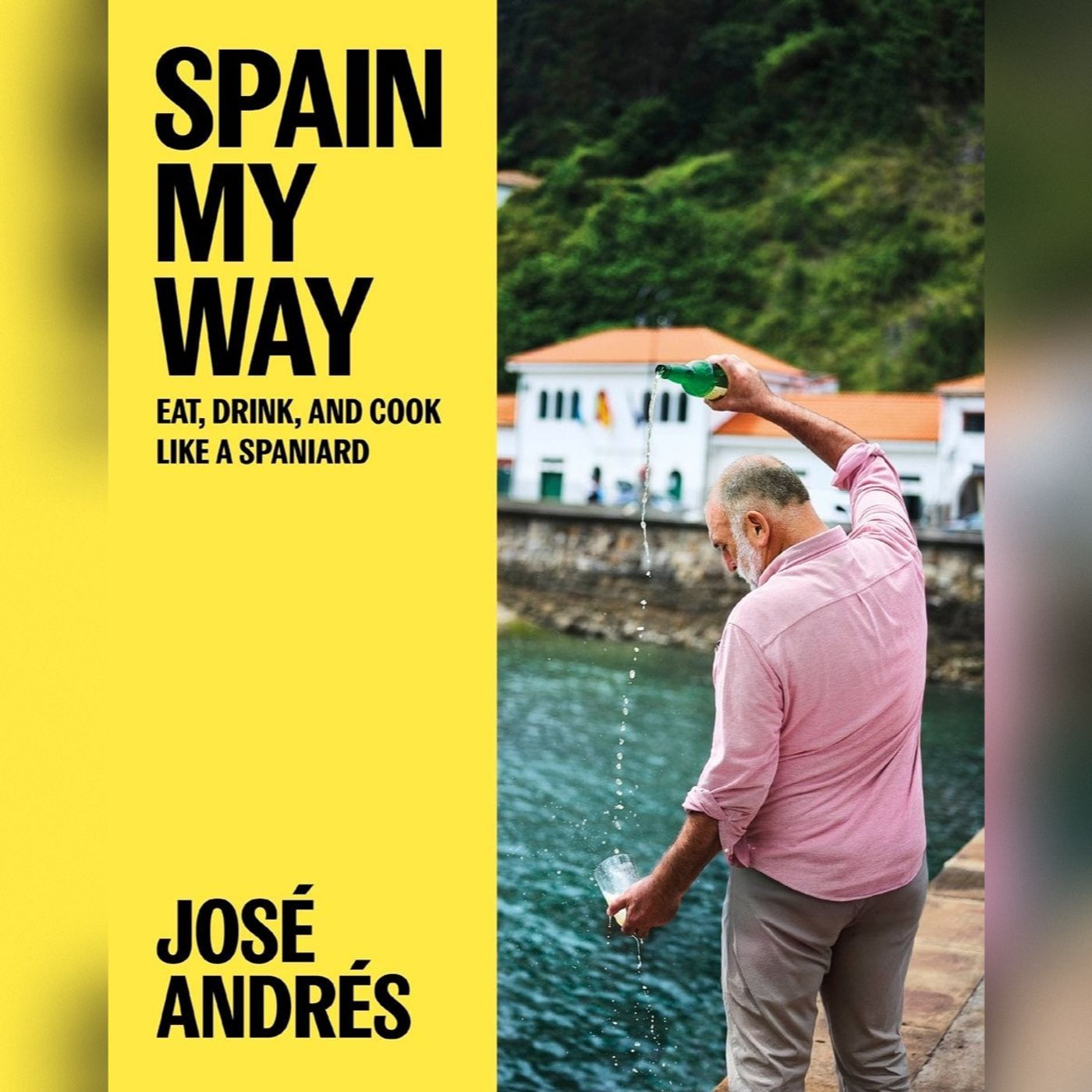
Foreign. This is all of it on wnyc. I'm Alison Stewart. Jose Andres returns to his roots, his Spanish roots, with his latest book, Spain My Way. Eat, Drink and cook like a Spaniard. He says this book tells the people, the stories of people who, quote, wake up and go to sleep thinking about food, whose thoughts revolve around what they're going to eat, when what they're going to drink and who they're going to be with. He has all areas covered in the book, including Mojo's flatbread paella, be some fish stew and cold soups like the classic gazpacho and gazpacho caliente, which is served hot. Spain My Way, Eat, Drink and Cook like a Spaniard is out today. Jose Andres, thank you for joining us.
- [00:48]
B
Thank you for having me.
- [00:50]
A
So the United States is your home base, but what is something you look forward to eating when you return to Spain?
- [00:57]
B
Oh, my God. Okay, when I travel back to Spain, before I leave the plane, I'm already thinking, okay, what time is it? 7:30. I'm going for churros, good fried churros with hot chocolate. And I'm just finding who of my friends, maybe near one of the places so I can not only have some of the things I love to eat, but at the same time, hey, breaking bread with friends. Maybe it's been many, many, many months or years.
- [01:28]
A
I didn't see what should Americans take from the way that Spaniards eat, the way they prepare their food even.
- [01:34]
B
Well, I think Spain and food is a way of life, especially when we think about tapas. Tapas, obviously they become very popular not only in Spain, but around the world even. It's not tapas like Spain. What is tapas in Spain? Especially if you are in the south, in places like Seville or k any, any little town in south of Andalucia, it's a lot of bars. You go bar to bar, a sherry here, a beer here. And in every place they specialize probably in a tapa can be simply saute mushrooms with garlic and parsley that they put on top of a piece of bread that has the meaning of tapa. Tapa comes from the name when centuries ago, in the taverns around the road, they will give you a piece of food on top of the glass of sherry or wine or whatever to make sure the insects, the flies will not go in. And because that was the COVID of the glass, that was one of the explanations of where the name tapa came from. So it's a way of life, place to place with friends, with Family, making new friends in the process, and celebrating life and celebrating your city, because it's the best way to be part of your city.
- [02:56]
A
I wish we weren't on radio at this moment right now because your description of tapas and your hand motions and your description of parsley on the flatbread was fantastic. And I will have that in my brain for the rest of the day.
- [03:09]
B
I was before I became a cook, I wanted to be an actor. When I was young, I was an actor. I even I was echoes of Peter Schaeffer. I love acting and yes, as you can see, I use my hands a lot.
- [03:26]
A
Jose, this book goes back to 1100 BC when the Phoenicians arrive. It describes Spanish cuisine. What do you think has been the modern evolution of Spanish cuisine, say, in the past 25 years?
- [03:41]
B
Well, the last 25 years, let me say the last 33, 34. Right in the moment I left Spain to come to the States. Spain is a melting pot like no other country in the world. But then, if you think about it, America is the melting pot like no other country in the world. And was a French philosopher, Brillat Savaran, in 1826, he published a book in the same year he died. He said, tell me what you eat and I will tell you who you are. Boom. This guy was Jules Byrne, a genius ahead of his time. Spain is such a small country. It's probably the size of Texas, but in the moment you drive one hour, buildings are different, languages may be different, accents for sure are going to be different. Dishes are going to be different. In the north is more butter, in the south is more oil. So Spain, through centuries, we've been very lucky that it's been a lot of different civilizations being part of Spain the same way in America, we are a very rich country. Not because we are money wise, in a way the richest country in the world, but it's rich because the diversity of the people, the diversity of what everybody has brought over centuries, this is what makes us richer. That's why when I came New York first time for me was like, oh, sure, I belong here. I'm a Spaniard in New York. Paraphrasing stinks. Photo If I'm an immigrant, and that's what Spain is, but that's also what I found in America, what I found in New York and what I found in Washington D.C. when I came into the States over 30 years ago.
- [05:32]
A
My guest is Jose Andres. His book is called Spain My Eat, Drink and Cook like a Spaniard. You call Jamon the king of cured Meats, Why?
- [05:44]
B
I mean, think about it, right? Civilization, humans, we've been smart, we've been trying to preserve the goodness of the earth. Salt was a gift of the sea. Even you can get also salt from mines in land. And somebody use first because preservation realized that, yeah, if you cover something in salt, the salt penetrates and nothing goes rotten anymore. Used to me to think like salt, a lack of pork, thyme, the beautiful air flowing from the mountains, bringing the aromas of the forest. That helps keep drying the ham. And two, three years later, you have something like with the right knife and the right magician. Because the guys that cut the ham in Spain, to me, they are magicians. And they slice, slice after slice. Something so delicate, when you put it in your mouth, your tongue starts like, acting funny, like, what's going on here? Sending message of I'm in love. That's what food is, is love. So those are pigs that are semi, semi wild. They live in the forest. Every September, the magic of nature happens. The acorns out of the oak trees fall down. The pigs keep going from the water to the acorns, from the acorns to the water, they double in weight over the next three, four months, they put all this fat. And then we're very lucky that we are able to get that slice that once in contact with our tongue. You say, what's going on here is so simple. When you think like the best dishes in the world, sometimes they are the most unique things. Who was going to say that pork and salt could be creating a bite so sublime. Iberico ham, ladies and gentlemen, what do
- [07:47]
A
you like to serve it with?
- [07:49]
B
Nothing.
- [07:50]
A
Nothing.
- [07:51]
B
Even in the book. And it's very traditional to serve a piece of bread toasted on the grill or on the toaster with a beautiful ripe tomato cut in half. And then you use that toasted bread, almost like if it's the grater. And then the flesh of the tomato keeps, like, gets in there between all the little holes of the toasted bread. Olive oil, salt and Iberico ham and tomato bread. I think they are perfect, even purest. They will say Iberico ham should only be eaten alone. But that's okay. It's controversies, even in the way you should be eating if you respect the other person's view. Controversies are always great.
- [08:42]
A
You include recipes from the area that you grew up in, Asturias, is that correct?
- [08:47]
B
Your Spanish is getting so much better over the years, Alison. I mean, really. I mean, the improvement I've seen on your Spanish, Alison Stewart Stewart. Over the years, it's astonishing. I mean, we are the Spanish speaking population of New York and the world. We are so proud of you, Alison Stewart.
- [09:08]
A
Gracias. Appreciate it. Asturias fried cutlets. Tell me about them.
- [09:15]
B
Oh, my God, the fried cutlets. What did we put there? Oh, yeah, yeah. We have a lot of versions. Okay. Is more stories to add than what is in the book. So it's in the book, by the book. I'm gonna tell you. The stories are not in the book. So this is cachopo. And cachopo is a big controversy because as many people of Asturias cooking, the writers that are there to protect the legacy of the cooking of Asturias will say that this is something for the tourists. That a good person from Asturias will never have a gachapo. Well, there's a lot of people disagree with this kind of approach, but my mother. So the caciopo is a very big piece of meat. Beef could be pork ternera, as we call it in Spanish. That will have or can have ham and cheese in the middle. And it's breaded egg wash. Flour, egg wash, bread crumbs. And then you fry it and it's perfectly crunchy the outside and creamy and soft in the inside. My mom used to make libritos. Libritos in Spanish is the diminutive of libro. Book, little book. Libritos. Why always with pork loin? She will ask the butcher to open the pork loin in little slices. But always making like a little book. And inside the two slices of the pork loin, she will put the ham and the cheese. The libritos is what I will bring to school in a sandwich. Juice hot. My father will put the libritos inside the bread. Some tomato. The bread will get soggy with the fat of the librito. Oh, my God. Cacioppo Librito. This is something every Spaniard grow up eating at home.
- [11:01]
A
How do you get the crust perfect? That's what I'm curious.
- [11:05]
B
Temperature.
- [11:06]
A
Temperature.
- [11:06]
B
Practice a good oil. In Spain, we are not afraid of frying because olive oil. Spain is a very big olive oil producer. We have a lot of olive oil olive trees. And frying is something I always saw in my home. It's more difficult to see true frying happening in households in America. A pot of hot oil can be a scary thing. But remember, you can bring your hand close almost to touch the surface of the oil and nothing will happen to you. If you treat the hot oil with respect, the oil will always respect you back. So I will say that in America and New York I think we have to if we're cooking home. Hey, I prefer you come to my restaurant to eat the fried foods you love. But I will say it's nothing like the fried potatoes my mom used to do at home. Those fried potatoes with the oil that was already older. That when the oil is slightly older. I'm sorry to say, but the potatoes are tastier than when the olive oil is new. Is the reality of the situation.
- [12:17]
A
My mother was Southern. Yes, I'm with you on that front.
- [12:20]
B
And the croquetas. The croquetas. I grew up with the leftovers of the fridge. That moment that the fridge is talking to you. Hey, baby, I have a lot of things. They've been sitting for weeks. Can you take care of them? You know when the fridge talks to you.
- [12:35]
A
It does.
- [12:35]
B
You listen to the fridge. My mom used to listen to the fridge. And thanks to that conversation, croquetas, those bechamel fritters always show up in the table. Was my favorite dish that my mom ever made for me. Especially at the end of the month when my father, mother were waiting for the last paycheck. And mothers and fathers will become like magicians, stretching whatever was left over in the fridge until the new paycheck came in.
- [13:03]
A
My last question for you. Hot gazpacho, Is it real?
- [13:06]
B
Oh, my God. It's more than real. It's mind changing. And I discovered. Everybody says that I'm an expert in Spanish cuisine. The more I know, the more I know I know nothing. And this book, like always when I go out, I find things I didn't even have a clue they existed. This hot gazpacho, gazpacho caliente for me is mind blowing. Everybody should travel to Spain. Used to this little place in the middle of nowhere. Where is the place I discover And I learned to make this amazing galpacho caliente.
- [13:42]
A
The name of the book is Spain. My eat, drink and cook like a Spaniard. There's a launch party tonight at La Barra at Mercado Little Spain, located at 10 Hudson Yards. Tonight at 6pm it was nice to speak with you.
- [13:56]
B
Jose, are you coming?
- [13:57]
A
I. I think I am.
- [13:58]
B
Good. Alison, I see you there.
- [14:05]
C
And Doug, there's nowhere I wouldn't go to help someone customize and save on car insurance with Liberty Mutual. Even if it means sitting front row at a comedy show.
- [14:14]
A
Hey, everyone. Check out this guy and his bird. What is this, your first date?
- [14:18]
B
Oh, no.
- [14:19]
C
We help people customize and save on car insurance with Liberty Mutual. Together we're married. Me to a human, him to a bird.
- [14:25]
A
Yeah, the bird looks out of your league.
- [14:26]
C
Anyways, Get a quote@libertymutual.com or with your local agent.
- [14:30]
A
Liberty. Liberty. Liberty. Liberty.
- [14:33]
D
Early birds Always rise to the occasion for summer vacation planning because early gets you closer to the action. So don't be late. Book your next vacation early on VRBO and save over $120. Rise and shine. Average savings $141. Select homes only.