Loading summary
Transcript54 lines
- [00:00]
A
All of it is supported by Memorial Sloan Kettering Cancer Center. In a small groundbreaking clinical trial, 100% of participants with a specific type of rectal cancer saw their tumors disappear using immunotherapy alone. Researchers at MSK are now studying this approach in cancers of the stomach, liver and more. And a majority of tumors are disappearing. For MSK Giving Day, all gifts will be tripled. Learn more@msk.org all of it.
- [00:38]
B
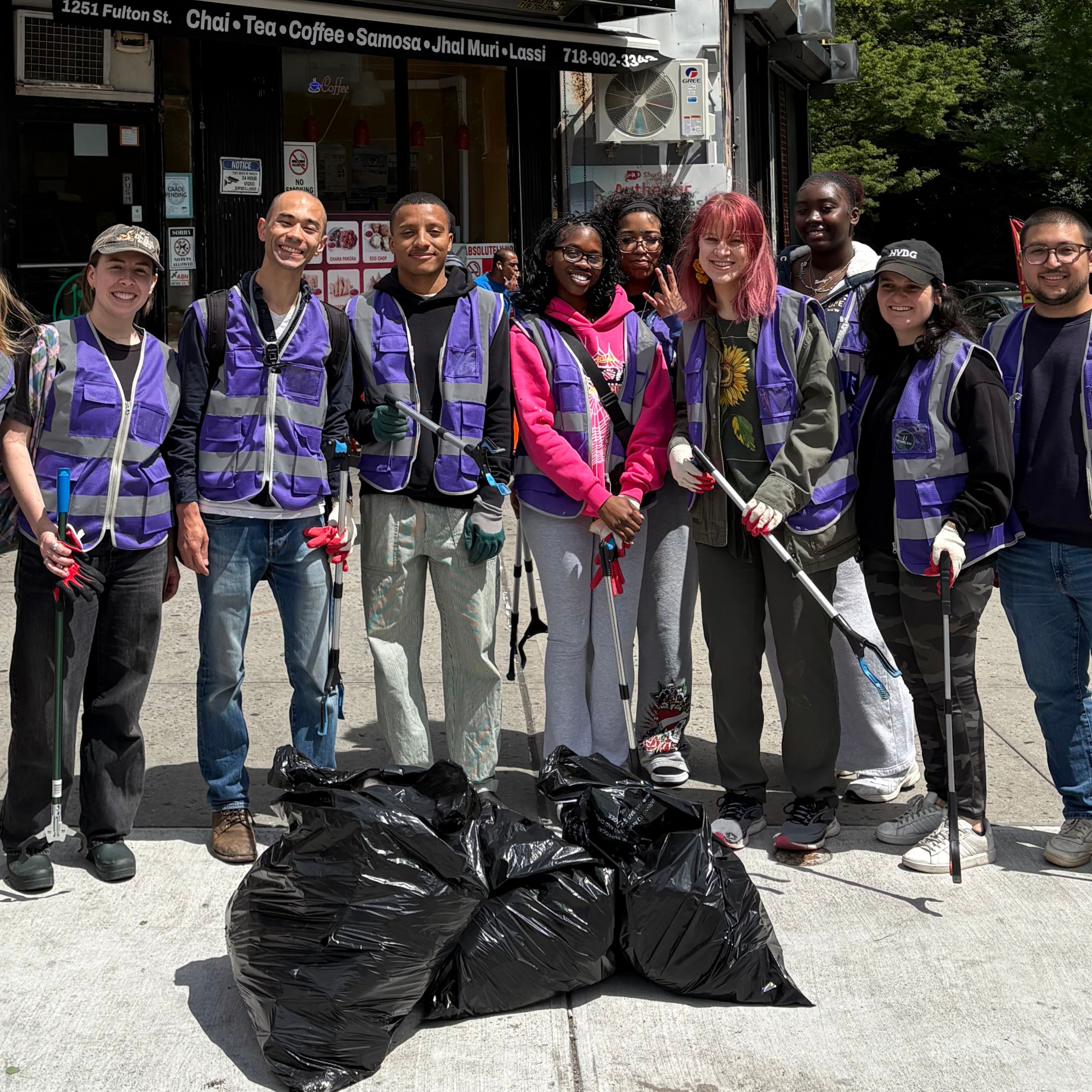
This is all of it on WNYC. I'm Alison Stewart. Last month on Instagram, Trash Talk NYC's first video was posted. It was created by David Clark, who decided to do something about his street in a small way. The post had a little bit of music, no talking, but it showed a fella picking up trash with a grabber and put putting it in a bag. Small pieces of paper, water bottle caps, receipts, one by one. It was sort of meditative. The caption read in part. This is a project to improve the quality of my life in my neighborhood. David has been tackling New York City's trash block by block for about 40 days now, all around the city and documenting it. When I first looked at his page that first week, he had, you know, a couple hundred followers. Trash Talk NYC is now up to 42.6 thousand followers on Instagram and an additional 11,000 followers on Tikt. And his work has evolved into a volunteering meetups too. To find out more, let's hear from David Clark, the founder of Trash Talk nyc. Hi David.
- [01:38]
C
Hello. It's a pleasure to be here.
- [01:39]
B
First of all, you went to Columbia before this all started. What did you study there?
- [01:43]
C
There I was a Middle Eastern studies major, but I also studied computer science and read a lot of philosophy and religion. I don't know which part of it was the most important, to be honest.
- [01:51]
B
Were you someone who always picked up trash on the street when you saw it?
- [01:55]
C
I definitely wasn't a person who littered and I would pick up trash. It's something that I started doing in high school with some just very casually, but in New York, it became something I really got into in this past winter.
- [02:06]
B
It's something that you said that your mom taught you. She's from Japan.
- [02:10]
C
Correct.
- [02:11]
B
And tell us about her influence.
- [02:12]
C
Well, Japanese culture is its own animal. And when I went to Japan last year and also in 2019, I was struck by how clean the streets were. And it's not because there are more trash cans there, there are actually less. But there's a different sense of personal responsibility which we've seen in World cup videos as Japanese fans have been leaving and cleaning up the city stadium. So she raised me within that culture.
- [02:35]
B
And so that had an influence on you how, when you came to New York City?
- [02:39]
C
Well, I would say that she is half New Yorker and half Japanese as well. She moved to New York from Japan in the 80s and so she was part of New York culture as well. But I think that my belief around how to keep a street clean came from that Japanese influence of It's a cultural problem, but one that can be solved.
- [02:59]
B
When did you get the idea of picking up trash into something that you would do every day?
- [03:05]
C
Literally the first day that I recorded. I think it's an incredible story because if you look back on that first video, it was a 20 minute video of me walking around my neighborhood just for myself and maybe for a couple neighbors. It didn't become a project that expanded beyond the neighborhood until a few days in, and it just evolved from there.
- [03:21]
B
So when you go out to pick up trash that first day, what did you bring with you?
- [03:25]
C
Just a grabber bag, camera, and all that I use is my phone strapped across my chest and a tripod. It's a very simple setup. I could have more expensive tools. I could really develop this project into something else. But I want it to be accessible so any person who sees the video can think, I could do this myself.
- [03:42]
B
At home, we're talking to David Clark, the founder of Trash Talk nyc. Hey listeners, if you want to call in and give David a good job, or if you have a question for him, our Phone number is 2124-3396-9221-2433 W. You can text to us or you can call in and chat with us as well. When you're picking up trash, what kind of questions do people have for you?
- [04:10]
C
First they ask if I'm getting paid, which I always say no to. And then I film it and I post it. They also ask how I choose the neighborhoods. And that's all based on followers and people I meet on the subway. Trash is something in New York we've learned not to notice, right? It's something to get by. We just don't look at it. So when I ask someone, what's, what's your block like? What's the litter situation? They're surprised because they've never been asked that question before. But I find that local knowledge is the only way to get those insights. So every time I'm on the subway, ask someone what's their neighborhood like? And I write it down and People send me messages all the time with pictures, they send me comments and I have a huge list and spreadsheet of all of those locations.
- [04:51]
B
You first started on your own block in upper Manhattan. What was the block like?
- [04:56]
C
Oh, that block. I've been living there for two years. It's 171st approximately. And it has always been a mess. It was especially bad in winter. I think any New Yorker remembers what the snow was like this past winter. That area, the snow didn't get cleared properly so the trash just built up and it couldn't be cleared out. So we had trash just in on the sidewalk for months it felt like. And so I started cleaning up then. But in general the neighborhood isn't that clean. So one thing that I did recently was I went through all the flower beds on my street and I mulched them. I got a great discount from the local hardware store. He was very happy with the project and I'm seeing if maybe beautifying the street will change the littering patterns. And so far I think that they have had an effect.
- [05:42]
B
We've got a call already. Let's talk to. I hope it's Nataya or Natia. Nitai, are you there?
- [05:49]
D
Yes, hi, how's it going?
- [05:50]
B
Going okay. What's your question?
- [05:53]
D
Yeah, I'm just curious like what trash is most prevalent and also like why you think that is.
- [05:59]
C
That's a great question. It really varies by location. You might be in the same neighborhood, but from one block to another, depending on what businesses are there, you'll see different trash patterns. Let's say it's a dump site near a residential area. You'll find food. If you're next to a lottery ticket store right next to where I live, you see a ton of torn up lottery tickets from people who lost. It really depends. Maybe in a commercial area you'll see car parts. So it is completely different depending on where you are. And that's something I've learned through this project, that every location is going to require a different local solution for that problem. Littering isn't the same thing all around the city.
- [06:40]
B
I'm talking to David Clark. He is the founder of Trash Talk nyc. You can find him on Instagram and TikTok. What changed about your block after you spent some time cleaning it up?
- [06:52]
C
A couple things that I'm very happy about. The first thing was it just looks better. There's less litter in general and the beds are nicely mulched. And I planted some flowers. It was great. The more important thing to me is I've started meeting my neighbors. I've been living in that neighborhood for about two years, and I haven't known my neighbors in the way that I would have liked to. Now I probably know dozens and dozens of people on my block and around it who've seen me working, who've struck up conversations. I know all the supers on my block and have told them, thank you for the work that you do in cleaning the streets. I think that appreciation helps, too. So I'd say the main thing that's changed is community building, and I want to keep doing that on my street as well.
- [07:35]
B
Let's talk to Deirdre, calling in from the Lower east side. Hey, Deirdre. Thanks for calling all of it.
- [07:41]
D
Hi, how are you? Thank you for having me.
- [07:44]
B
Great. What do you want to say?
- [07:46]
D
I just want to say thank you, David, because this is such a huge service, and I wish. I hope it inspires other people. This is something I will do on the street. I will pick up trash because several people in front of me will walk over things. And the one thing we are blessed with here in New York City is a trash can on every corner. But you see. You see people unwrapping something and just dropping it. And, you know, I don't want to engage with people like that because you never know what's going to happen. But I then turn this into. Especially during COVID I felt like there was a lot of trash around, and I would go out on walks and pick things up and do squats. So I call them my trash squats.
- [08:28]
C
I love that. I love that.
- [08:29]
B
That's so funny. It was very interesting, David, because you did a video in Tribeca and you kind of wanted to dispel a myth about certain neighborhoods being more cleanly than other neighborhoods. Tell us a little bit more about that.
- [08:46]
C
So neighborhoods are clean to various extents. If I go to the Bronx, pretty much anywhere I go in the Bronx is going to be more messy than most of Manhattan. So there are differences for sure. But the myth I was trying to dispel was one that I've seen in the comments. And just as a comm belief in New York that certain neighborhoods are clean, they are clean, but our standard here is different from maybe in some other countries. I was in Tribeca, and we all know this, at least if you've looked carefully, the streets are paved out of trash. I think as the streets are being paved, trash is blowing around. It's not possible to keep the street clean. And so I was literally seeing trash embedded and with parked cars, they hadn't moved for alternate side parking. So there's a huge dust buildup and dirt buildup, which can be a hazard as well. So every neighborhood I go to, there's some work to be done.
- [09:36]
B
And it's interesting because I sort of got from one of your videos that it's not necessarily only people dropping stuff. It can be the surrounding areas. Like the trash cans aren't the best in bad weather. Can you explain that?
- [09:49]
C
Yeah. So we're familiar with those New York City litter bins that are green wire and have an open top. Those are all of the bins in my neighborhood. They're very easy to tip over. And they also are open to the wind. So on a particularly windy or stormy day, and we have those a lot in summer, you'll see it. The trash will just have a life of its own. Will come up and out of the bin and blow all around the street. Also with these lighter bins, one problem is that they will be intentionally dumped in searching for food. And I understand that, but it is a problem with litter. Big belly bins, those have dropped recently. Those have a compactor inside. They're the bins where you step on a pedal and that opens the door. Much more high tech, higher volumetric capacity. But they have problems on their own. They get jammed or clogged and then they're not usable anymore. So different bins, different problems.
- [10:42]
B
I'm talking to David Clark. His Instagram is trashtalknyc. As I said, I've started following you from like day one and you have blown. It's blown up. It has gotten huge.
- [10:53]
C
It's been a crazy journey.
- [10:54]
B
When did you realize that it had taken on its own life?
- [10:57]
C
So day one, that was a 20 minute video. Wasn't expecting out anything out of that. Day three was the first day, I believe, that I edited to below a minute, which is a requirement on Instagram that I didn't know about. And I believe that day five and day six went viral. Then day 12, then 20 and so on. About one video a week. When I started seeing those take off, I realized that it was a larger cultural moment that I didn't know that I was a part of. I think it's all tied together. Mamdani, the Knicks, just a general New York cultural moment here in the summer. And I believe that's why this project has taken off so much. And it's a powerful message for people that they can take a stand in their own neighborhoods and improve the conditions in their community. Just on Their own.
- [11:45]
B
This said, I just donated to him for his good work.
- [11:47]
D
Love it.
- [11:49]
B
Invariably on one of your posts, someone posts, this is not your job. This is the government's job to pick up trash. What do you think?
- [11:57]
C
Yeah, thank you for bringing that up. That's a really great point. The government's job, I would say, is to pick up the sanitation bins, the litter bins on the corner. Their job is not necessarily to clean the sidewalk. Technically, that's a responsibility to the businesses and landowners there. However, the city is supposed to enforce the cleanliness of streets through fines. Now, I've spoken with business owners all around New York about whether they're seeing those fines. And it varies. Some neighborhoods, they see them all the time, which is how it should be. It should be consistently enforced. In Washington Heights, most business owners have told me that they were fined before COVID but since then it's been almost nothing. And that street is always a mess and something that would be fined in other neighborhoods. So it is the city's responsibility, but is also business owners. However, I do think that the best stewards for a neighborhood are going to be the people who live there. So I have the belief that it should be neighbors taking care of their own streets in these smaller residential areas.
- [12:57]
B
And let's talk to Elisa real quick. Hey, Elisa, you've got a couple about 30 seconds.
- [13:03]
D
Thank you for taking my call. And thank you, David, for picking up trash. I am a trash picker. Not as often as you are, but I just wanted to make a comment because I will go out of my way wherever I am to thank those people who are picking up after us, the bids who have people out working, ready, willing and able folks. Because really, without the folks who pick up after us, everything would fall apart. Very important people do that work.
- [13:28]
C
Definitely. Yeah. Wherever I am, I try to thank the sanitation workers I meet. And it's funny now because in the sanitation department, word of the account has spread. So nearly every trash truck driver is like, oh, you're trash talk. Which is a lot of fun. But just earlier in the studio, I was thanking Cindy, who is a cleaner here at the studio, for her work because it's all one thing.
- [13:48]
B
Anyone who cleans and people can volunteer.
- [13:51]
C
By going to trashdocnyc.org we have been
- [13:55]
B
talking to David Clark, the founder of Trash Talk nyc. Thanks for what you do, David.
- [14:00]
C
Absolutely, my pleasure.
- [14:02]
B
And that is all of it for today. I'm Alison Stewart. I appreciate you listening and I appreciate you. I'll meet you back here tomorrow.
- [14:13]
A
This one's for all my TV lovers. My entertainment from DirecTV gets you 60 channels and Disney, Hulu and HBO Max all in one pack. But here's the thing. With so much great TV and my entertainment, you're gonna want to talk about everything you've been watching. Just remember that your friends might not be as well watched as you. Don't be a spoiler and encourage them to get my entertainment for just 34 99amonth. Go to directv.com genrepacks and sign up today. New customers only. Service renews monthly unless canceled. Credit card required Conditions apply to apps. HBO Max Basic with apps begins after DirecTV five day trial. Learn more@directtv.com restrictions apply.