Loading summary
Transcript31 lines
- [00:00]
Progressive Insurance Announcer
All of it is supported by Progressive Insurance. You chose to hit play on this podcast today. Smart Choice. Make another smart choice with Auto Quote Explorer to compare rates for multiple car insurance companies all at once. Try it@progressive.com Progressive Casualty Insurance Company and affiliates not available in all states or situations. Prices vary based on how you buy.
- [00:31]
Alison Stewart
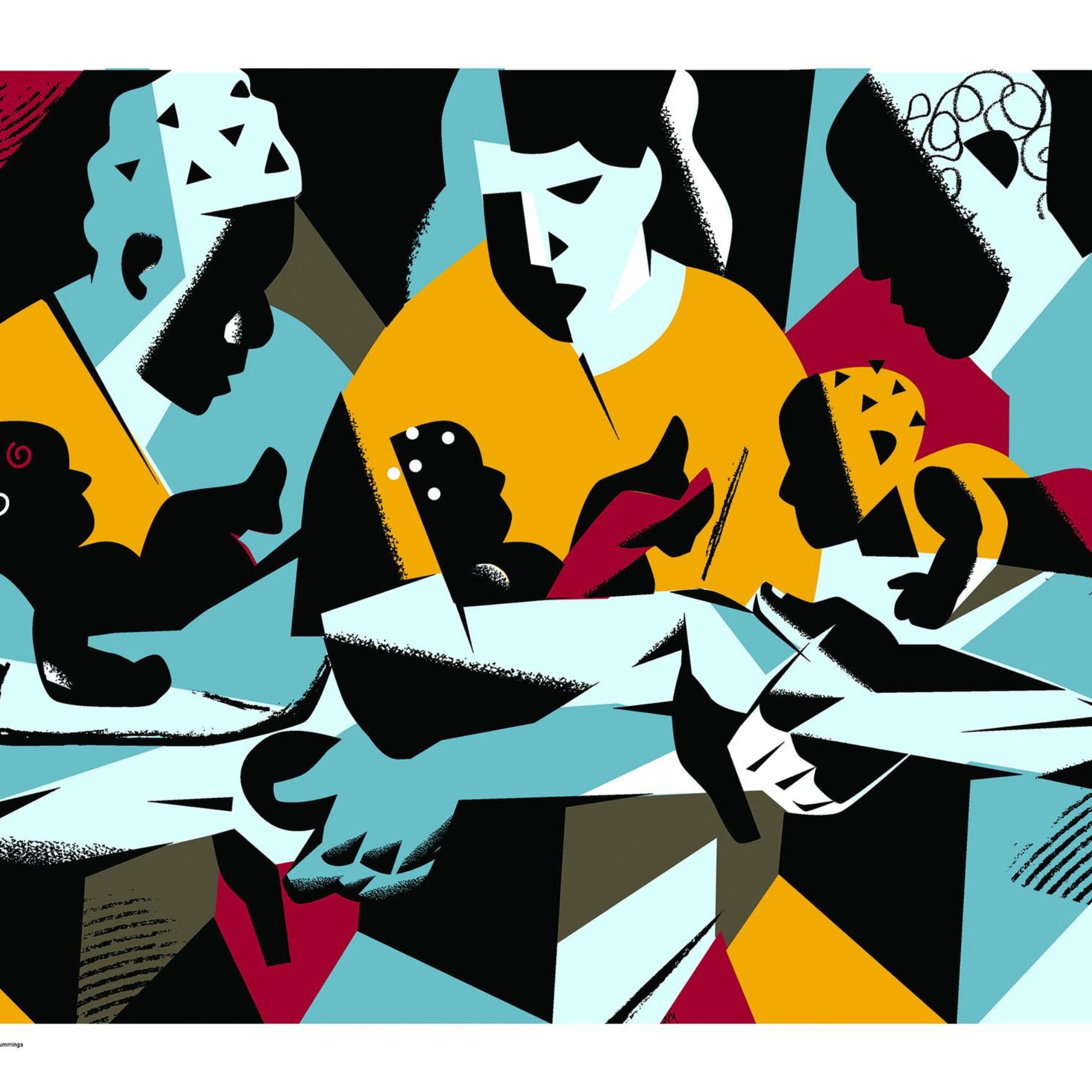
This is all of it on wnyc. I'm Alison Stewart. We're finishing our hour spotlighting gallery shows by welcoming back Terence Cummings. Cummings is a New Jersey based artist originally from Birmingham, Alabama. You can see a new solo exhibit of his work on view at the Arts Council of Princeton at 102 Witherspoon Street. The show is called Art for Change. It features 15 new print works that focus on current social issues like ice arrest, civil rights and mass incarceration. The show is on view through February 7th and Terrence Cummings is my guest. Terrence, it's nice to see you again.
- [01:10]
Terence Cummings
Yes, nice to be here again.
- [01:12]
Alison Stewart
Alison, the show is called Art for Change. How specifically do you think about social change when you're in your studio?
- [01:22]
Terence Cummings
Well, you know, I approach this as a moment in time where I want to bear witness. So it's kind of twofold. I want to exist in the moment of change and report and have it reflect in my work. So that's how I approach this.
- [01:43]
Alison Stewart
When you think about it, I know.
- [01:44]
Interviewer
This is a little bit of an.
- [01:45]
Alison Stewart
Essay question, but why can art be a tool to create change?
- [01:57]
Terence Cummings
Well, I think art is a vehicle where we as artists have to be not only a vessel to incite change, but also just to mirror what we are experiencing and put it on canvas in a way that groups of people can understand. I find that art is not as when we're dealing with complex topics, art can be less divisive and open ourself up to, you know, cordial kind of discussions.
- [02:36]
Alison Stewart
That's interesting. The sentiment of the show can be seen in your piece Stronger Together. It and I'll ask you to help me describe it, but it's men and women, they're sort of arm in, arm crossed, almost like forming a. A human chain.
- [02:52]
Terence Cummings
Yes.
- [02:53]
Alison Stewart
How did you get the idea for this piece?
- [02:57]
Terence Cummings
Well, back in the 60s, during the Civil rights movement, this was a vehicle for unifying one another during the struggle. So I had to just, I wanted to come up with a way of encapsulating how people from all demographics, ages came together at that time to fight for civil rights not for just for one group, but for this entire nation.
- [03:32]
Alison Stewart
And when you looked at the painting, when you Finished it. What did it mean to you?
- [03:38]
Terence Cummings
Well, you know, as I had, I think during our last discussion, I went through several rounds of concepts and sketches before I even approached going to the final. You know, as I mentioned before, I kind of start off with a black line charcoal drawing, and each color is layered on another layer, either mylar or tracing paper. And I spec the colors, laying one color on top of the other, forming new colors and bringing in textures and patterns. So in my process, I knew I had something good once I knew that I had finished the initial concept, the sketch, and then from there, what winds up happening is it winds up being licensed by other entities. And it's important for me to. And other artists to understand that. Well, I help with some of the students that I work with, I help them understand that art should exist beyond that creation. You should be able to make money from the piece that you've created.
- [04:54]
Interviewer
There's another piece in this show called Clarence. It depicts Supreme Court Justice Clarence Thomas and he's walking with a ladder. Why did you feel moved to make this piece?
- [05:10]
Terence Cummings
Well, I wanted to. I wanted to highlight the hypocrisy, if that's the right word or term of it, that he. For me, Clarence used all the mechanisms of affirmative action to get where he was and the opportunities utilized to become a Supreme Court justice. And the fact that he is still only one African American male that's on that, on the justice in the justice seat, and yet he is. Was a motivating factor in rolling back affirmative faction.
- [06:05]
Interviewer
My guest is New Jersey based artist Terence Cummings. We're discussing his exhibit Art for Change, on view at the Art Council of Princeton through February 7th. There's a trip taken, the show of an enslaved person, an incarcerated person, and a deported person, all placed within the American flag. They actually, they make up the American flag. What do you hope viewers feel or see more feel about American history by looking at the images presented side by side?
- [06:38]
Terence Cummings
Yeah, this piece for me is a. Is a reminder of the experiences that marginalized groups have gone through. And it's just kind of put. Put things in perspective, even though that these are challenging times that we're going through now. I just wanted to remind my viewer that these experiences are experiences that we have already been through and can continue to go through and, and, and succeed.
- [07:13]
Interviewer
There's another one called Born American. Would you describe it for us?
- [07:19]
Terence Cummings
Yeah, I described this piece as a series of children of different shades wrapped in the American flag. And surprisingly enough, with this piece, I was surprised that I got some pushback from this.
- [07:37]
Interviewer
Really?
- [07:38]
Terence Cummings
Yeah. That kind of surprised me. The fact that that I wrapped a brown child in the flag was a kind of a hot topic in certain circles that I kind of welcomed. And my position is that. We should embrace the fact that we different groups and marginalized groups contributed greatly to this country and embrace the fact that we are all Americans.
- [08:21]
Interviewer
It's interesting. That leads me to a part of your description on your website where you write that the essence of your art is always revolves around our shared humanity. Why do you focus or why do you keep in your mind shared humanity when you're working?
- [08:48]
Terence Cummings
Well, mainly because that there are just so many forces that are trying to keep us separated. And it's important that we kind of remind ourselves that, you know, just like the piece that I had done stronger together is that we are more effective. And what makes this country great is the diversity of all of us working together for a common goal. That's always been the case in America.
- [09:21]
Interviewer
You mentioned earlier that you teach students. What do students want to know these days?
- [09:31]
Terence Cummings
Well, that's a good question. I get life's life's question. Life. Life questions the. But more importantly that how to. How to effectively convey their concepts in visual terms. I find that it is, I think, more challenging for young artists to execute conceptual work and put it on paper or canvas rather than coming up with images that they would draw, let's say, from a photograph. I mean, I think that drawing beautiful pictures is one. One phase of it, one phase of creating great work. But if you can combine the fact that you can draw a beautiful picture and execute a stunning concept, then you have the full package.
- [10:50]
Interviewer
The name of the show is Art for Change. It's on view at Art Council of Princeton through February 7th. My guest has been Terrence Cummings. Terrence, thank you so much for sharing some time with us.
- [11:01]
Terence Cummings
Thank you very much, Alice, for having me. It's been a pleasure.
- [11:05]
Progressive Insurance Announcer
WNYC Studios is supported by Odoo. When you buy business software from lots of vendors, the costs add up and it gets complicated and confusing. Odooh solves this. It's a single company that sells a suite of enterprise apps that handles everything from accounting to inventory to sales. Odoo is all connected on a single platform in a simple and affordable way. You can save money without missing out on the features you need. Check out Odoo at O D O O dot com. That's O D O o dot com.
- [11:35]
Sustain Pro Advertiser
Suffering from dry, tired, irritated eyes. Don't let dry eyes win. Use Sustain Pro. It hydrates restores and protects dry eyes for up to 12 hours. Sustain Pro Triple Action Dry Eye Relief.