← All Of It with Alison Stewart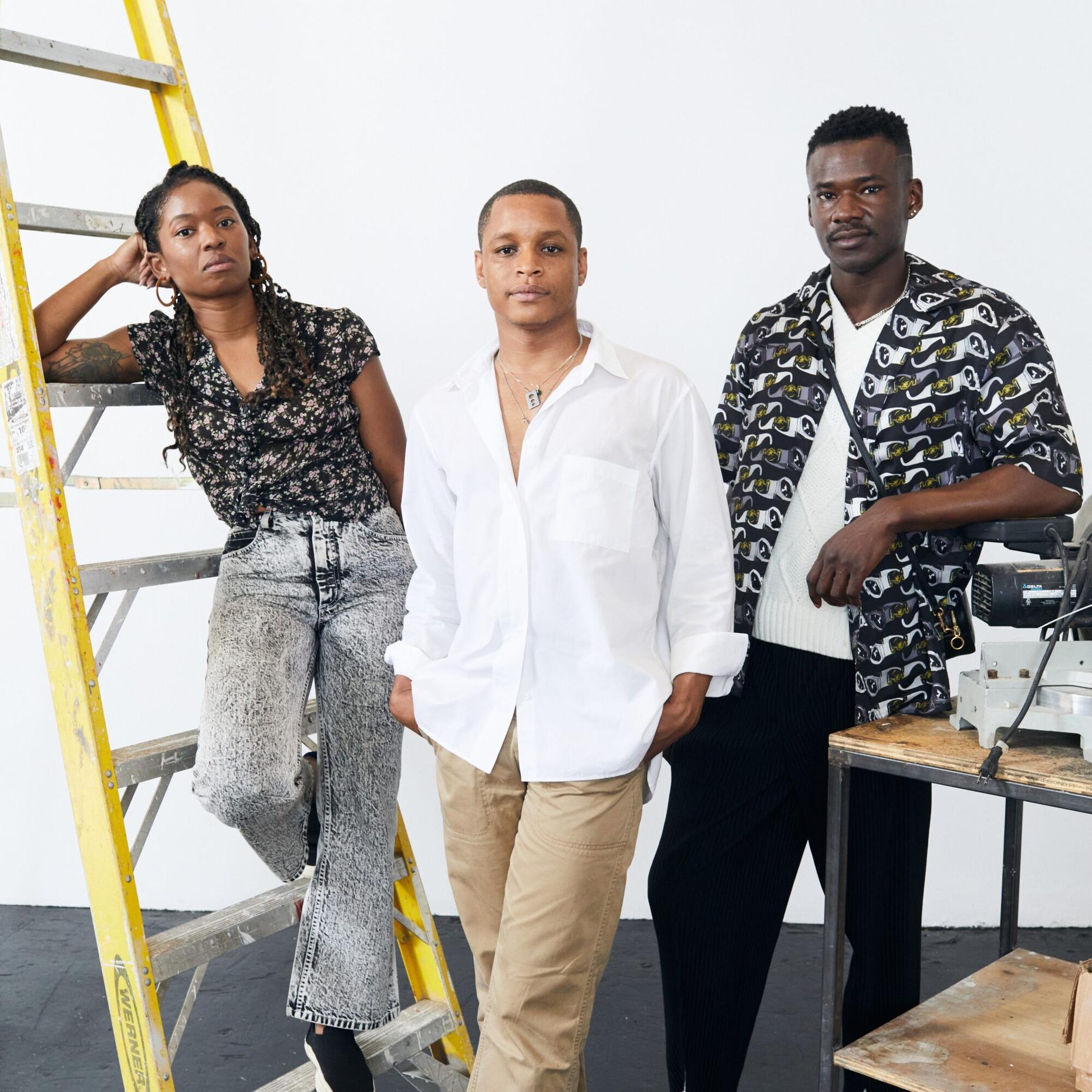
All Of It with Alison Stewart
The 2022-23 Studio Museum Artists in Residence
00:21:43
The annual Studio Museum residency has long been one of the most prestigious artist residencies in the city, and a fertile ground for emerging Black artists.
Loading summary
Transcript43 lines
- [00:04]
Alison Stewart
Listener support WNYC Studios.
- [00:18]
This is all of it on wnyc. I'm Alison Stewart. This year's selected artists for the prestigious Harlem Studio Museum residency are presenting their work in a new show at MoMA PS1. This residency has nurtured the careers of artists now among some of the greats in both historical and contemporary art, like David Hammons, Candy Wiley, and Karen Oliver. At the end of each year, the artists present the work they've made during the program. The three artists in residency this year are diverse in their backgrounds and artistic exploration. There's Charisse Perlina Weston, born in Houston, who works with glass sculptures and is inspired by her research into anti black violence and surveillance. There's Jeffrey Maris, born in Haiti and raised in the Bahamas, who in this show works in sculpture and performance art that explore ideas of body, our place in the universe, and black fiction like Octavia Butler's Parable collection. And there's Devin N. Morris, born in Baltimore, who likes to wander the streets of Harlem for found objects to incorporate into his work, which include abstract sculptures and layered paintings on wood panels. And Everin Edge Studio Museum artist in residence 2022-23 is on view now at MoMA PS1. With me now are two of the artists, Jeffrey Maris and Devon Morris. Welcome to both of you.
- [01:34]
Jeffrey Maris
Thank you.
- [01:35]
Alison Stewart
And Studio Museum assistant curator Yelena Keller. Yelena, thanks for being here as well.
- [01:40]
Yelena Keller
Thank you.
- [01:41]
Alison Stewart
So, Jeffrey, why were you initially interested in applying for the program?
- [01:44]
Jeffrey Maris
I first encountered Studio Museum when I was about 18 years old. I came to New York and I did a residency, and I just so happened to wander into Harlem with a few friends, and it was the first time that I saw art that focused on people from the African Diaspora, art that reflected issues I was interested in, and I felt deeply connected to the program. To my surprise, I found out that Studio Museum had this amazing artist in residence program. And here we are some 14 years later where I'm honored to say that I'm a part of that legacy. And I spent a year learning, growing, and playing with this amazing cohort, Yelena and everyone at the institution.
- [02:27]
Alison Stewart
Devin, how about for you? Why were you initially interested in applying for this program?
- [02:33]
My introduction to Studio Museum was when I started making zines back in, like, 2014, and I was invited to the. Yeah, I was invited to the building to do, like, a talk or something. And I wasn't even aware at that time I wasn't thinking of myself as an artist. But I. When I got off stage, I met the current residents at that year. And they were like, yeah, you're an artist. And I was like, what is this? Like, whatever. I just paid to no mind. But I to this day maintain relationships with those people. But as well, over the years, I applied once and I remember thinking, don't apply to anything else until you feel like your work is ready. So I think about maybe five or six years later I applied, which would be the last year in 2022. And I got it when I felt like I was telling. Having a complete sentence.
- [03:26]
Yelena, what is the application process like?
- [03:30]
Yelena Keller
Yeah, so artists apply through a digital portal. I love kind of talking about this because the residency itself sort of traces the full arc of the history of the institution. And so in the early days, artists were mailing applications. We sift through digital applicants in a sort of grueling all day kind of process. But I think it's also important to note as well that, you know, we are kind of gathered today around the culminating exhibition. But the sort of selection process is really kind of focuses on the artists themselves. Really sort of seeing the residency as an opportunity for kind of deepened research and engagement and really sort of considering where an artist is in their career, practice in life, and the many ways that the residency might be able to support them at that kind of inflection point. So, you know, I think in this way, it really colors kind of what the exhibition is, that we are kind of, after many months together, thinking about sort of what this moment has been.
- [04:37]
Alison Stewart
Y' all are up in Harlem. Jeffrey, when you think about the energy and the culture of Harlem, how has it seeped into your practice?
- [04:46]
Jeffrey Maris
So I lived in New Haven, Connecticut from 2020 to 2021. I did this other residency program called Nexhaven and I moved to Harlem. And when I moved to Harlem, I moved, brought an entire forest of plants with me. And I didn't really think about it when I was looking for an apartment in New York, but light translates to more money. And so I essentially have. I continue to live in the same apartment. I have this apartment that doesn't have a lot of access to light. And so my plants weren't doing very well. And when I started the residency at the Studio Museum, I decided to bring the plants into the studio. And as the sun shifted in the sky over the year, I stopped having access to the little bit of light that I did have. And one day I was walking towards the studio and I saw the stroller on the street, and I had this aha moment where I was, wasn't really thinking about it. In the context of art, it was more a survival strategy. And so I decided to bring this stroller and take my plants on these walks. And so that became a ritual, if you will, where I walked my plants throughout Harlem. And it sort of grounded me in terms of finding my identity in the space. A lot of the local restaurants and coffee shop and people started to pinpoint me, and eventually that led to these spontaneous conversations about, what am I doing? Where am I coming from? Who am I? And the minute I said studio museum, that sort of became the verification mark, because a lot of times we think that the surrounding world have no idea what we're doing or where we're coming from. But that really was the thing that validated my experience. And it's interesting not being at the residency anymore, because I'm still thinking about how. How this practice continues and how it applies to both my art practice and my life.
- [06:43]
Alison Stewart
Devin, as part of your work, you incorporate found objects, pieces of things you find. How do you go about identifying and collecting objects around the city?
- [06:54]
I mean, I collect them everywhere around, anywhere I travel to. It's really, like, for me, a way of finding a way to, like, reflect why I'm in a space and how I can, like, be a part of it. Because I was initially. Initially in my art making, I would struggle with, like, meaning and to struggle with, like, the meaning for why I'm in a space. Like, is it because I'm black? Is it because all these things that are projected toward me as opposed to the being? And then I just started to, like, develop this deeper connection to objects where there was a shared. A general shared thing that everyone could take part in or already has, historically, through just these objects existing, whether it be, like, you know, somatically, like, our bodies knowing the thing that I find or me existing, I mean, or, like, everybody's, you know, existing within a wall that had, like, tiles. And I pick up these tiles after someone's renovating. But, yeah, the sensitivity toward looking, picking, I think, came from taking walks with my mom when I was a kid, anytime we had to go somewhere. I remember one time we went to my high school, and when we were coming out, she found a cherry tree because she was always picking with her hands, and she was like, oh. She's like, it's cherries. And I was like, what? So we picked them down. We ate it. And so whenever we would walk, she would grab a leaf and break it. And then I started to grab leaves and break it and smell. And that gave me a real sensitivity to Space. So every time I'm walking, I'm just looking around. I'm looking for something to experience in that way. And then that became finding comfort and legacy through picking up objects that were once used by someone.
- [08:34]
Right. Because that was somebody's house, but the fort somebody's house was on some truck that some guy drove from someplace else after. I mean, there's a whole. Legacy, I think, is the word you use.
- [08:42]
Yeah. And that's. And that's really the main cause for me is like, this, trying to stay within legacy because I find it so hard of a means to traverse as I grow as, like, this human that I am.
- [08:55]
Yelena, I'm going to ask you to speak to Charisse's work because she's not here today. Her glass, it's bent, it's melded into shapes. What's impressive about the way she works with this material?
- [09:08]
Yelena Keller
Oh, everything. I think Charisse really has a sort of masterful engagement with this material. As you noted, she's working primarily in glass, but really explores the full capacities of the medium in many ways. I think engaging with her work really requires yourself to engage with your own physical body. She is often balancing glass panels against sort of these lead forms, and there is a sort of embodied precarity to the medium. Right. I think she's thinking deeply about sort of the fragility of the medium as well as the malleability of the medium as she's kind of working with it, again, kind of through this process of fire and heat, but also collapse and break, all of which is part of the process of the making of the work and embracing the sort of various forms with which it takes, in many ways, sort of seen as an extension of or poetic of a black experience. And so I think, as both Jeffrey and Devin have just noted, there is this sort of deep consideration around the physical body, but also what it means to move through space, to move around her work, but also to move around all of their work. Right. As you engage in the space of the gallery, I think there is a sensitivity to space and place, one that is, I think, kind of deeply resonates with black and brown bodies, in particular, queer bodies, and what it means to sort of navigate through space and time. I think Harlem is a kind of deep, resonant space as well as related to a lot of this work. And I think spending time in Harlem over several months together collectively, and spending also time inside of studio spaces and engaging in conversations, all really impacts the ways in which these artists are thinking. And I think that's deeply felt inside the space of the gallery.
- [11:00]
Alison Stewart
We're talking about and ever and Edge Duty Museum Artists in residence. It is at MoMA PS1, on view through April 8th. I'm speaking with Yelena Keller. She's the museum assistant curator, as well as two of the artists featured in the show, Jeffrey Maris and Devon Morris. So, Jeffrey, when you work to the Rising sun from far away, it looks like it could just be like this big representation of the sun. But when you get closer, you realize it's crutches. It's a bunch of how many? Like a hundred?
- [11:26]
Jeffrey Maris
180.
- [11:27]
Alison Stewart
180 crutches. And as you get closer, it looks less like a sun and maybe more like a. Like a virus of some sort. And you mentioned it's inspired by. From something from your personal experience. Would you feel comfortable sharing?
- [11:39]
Jeffrey Maris
Sure. Yeah. So 2022, I feel like since 2020, it's been, wow, this year is so hard. But 2022 completely shifted my body, my biology, and I had to come to terms with that. The pre2022 Jeffrey doesn't exist anymore. And I need to walk into this new dimension of myself. Had a really big health hurdle that I had to and that I continue to overcome. And so I think I've approached so much. It's interesting to even think about this moment now, because even before 2022, I really thought about my practice in relationship to care. I would often talk about how care is this radical gesture. What does it mean to be a black man in the world? That. And what does it mean to be a black man in this world and to really be conscious about the ways in which I care for myself and my community. But that care became. That care became something that I have to live with for the rest of my life. And so the sculpture is really coming from that positionality. The title of the work is to the Rising Sun. I was born in Haiti and I grew up in the Bahamas. And the second stanza of the national anthem of the Bahamas says, the first answer goes, lift up your head, and the second one is to the rising sun. And so the work also deals with this idea of place, place making nationality. What does it mean to be inside a space, but not really feel like you belong to that space? To me, it's about the complications of feeling big and small at the same time. Thinking about universal ideas, thinking about the universe, but also thinking about the chemical and biological, the things inside our bodies, and the way that reflects facts into this sort of wider cosmic conversation.
- [13:38]
Alison Stewart
It's a line in the black national anthem as well. And lift every voice.
- [13:41]
Yeah. Remembering. There you go.
- [13:45]
I'm glad you sang it. That was Devin, by the way, speaking about space in your room's arrangement. The walls are painted dark blue, and the sculptures are placed in the center of the room, surrounded by. By different collage style pieces. What was the process like for deciding how you wanted your pieces placed, where you wanted your pieces placed, what color you wanted the room to be?
- [14:08]
I think it started with the color, because that was a big experience of, like, just centering myself in Harlem. So I would take these walks for about six months before I ever created anything. And the blue was from a night where I was at Randall's Island. And, yeah, it was just such a wonderful blue sky. So I took a video of it, and I was. And I didn't know that subconsciously that would become, like, a conscious reasoning for the color for the wall, which I wanted to be a specific feeling of dusk, of light, but darkness. And as far as the way that the sculptures are placed, I think that it just kind of all started building toward a landscape, which, at first, we weren't. I wasn't thinking about that. I was just. I just knew I wanted to make sculptures that would title High Grasses. I knew that the tiny object pour that I compiled was. I knew that in my head, I was calling it stream, but I wasn't relating that I was interested in the sky, but I knew that I was interested in this juxtaposition of outside, interior, and exterior. And that was showing up in the work a lot. And that's always something that I'm conscious of when I work, is kind of creating these impossible spaces. And I think that is well translated through how the sculpture and collage is arranged in a room.
- [15:31]
You know, Yelena, both these artists have talked about walking around and how walking around was important to them in their practice. When you think about the environment around the Studio Museum, when artists experience that, what is its role? What is the neighborhood's role? What is the location's role?
- [15:50]
Yelena Keller
Yeah, you know, Harlem is such a vibrant and kind of beautiful place in so many ways and has such a rich history. It's also a complicated place. I think so many artists come into the residency, you know, with a real sort of sense of self and practice and work, and it's really incredible to watch the ways in which Harlem finds its way into the work that they're making while in residence. The kind of presence of Harlem for all of us. I think, you know, some of the artists end up moving to Harlem. Some artists don't, but I think the kind of through line of Harlem as a site and space is always there. Harlem is a historically black neighborhood. Harlem is a place where I think so much of the kind of beauty of black culture is alive and well and present in the streets, as well as kind of the challenges of what it means to be black in America. All of that seems to kind of play and really unfold in real time. And I think spending time in Harlem, it's impossible to sort of ignore the many ways in which these sort of disparate paths kind of cross and fold. And so there's so much, I think, rich texture that is present there. I also think in this moment, when the culminating exhibition is happening at MoMA PS1, it's a really kind of special opportunity in some ways, to bring a piece of Harlem to a Long island city, to think about sort of different audiences, what it means to be of a diaspora. There's so many sort of communities that are resonant in Long Island City as well to this work. And so, yeah, I think, you know, Harlem is at the heart, in many ways of this museum and in many ways at the heart of this work.
- [17:44]
Alison Stewart
Jeffrey, we love books on the show, so I love books too. You're inspired by Octavia Butler. How so?
- [17:52]
Jeffrey Maris
So I have to call in my dear friend into the space, Tamashi Jackson, who's an artist who I deeply admire as well. In the summer of 2020, Tamashi started a reading club. I met Tamashi at another residency that I did, and every Sunday was like going to church. We had homework throughout the week where we had to read a specific amount of texts from the Parable series, Parable of the Sow and Parable of the Talent. And every Sunday, there would be a group leader who would lead the discussion. I've since gone on to read both of those books three times since that summer. And I was very inspired by Octavia Butler's the Parable series and thinking through this Afro futurist lens. Right. And so for me, the work is. For me, the work is deeply political. It's about a lived experience. It's about anti black violence. But it also, for me, proposes a future where we can escape from this violence, where we can live our wireless dreams, where we don't have to live under the violence of the hegemonic gaze.
- [19:03]
Alison Stewart
And.
- [19:06]
Jeffrey Maris
Sorry, I'm getting a little bit choked up. And so for me, I typically always ground my. My art with research that often comes from black authors.
- [19:20]
Alison Stewart
Devin when people go see the show. What is one thing you'd love for them to notice some piece that you worked really hard on or a moment in the show or a part of one of your works that you just want them to spend extra 10 seconds with?
- [19:34]
I don't think it's one thing. I think if anything, there's I'm always trying to get to an emotion that might be a little impossible to realize. So I think, if anything, I hope that there's a culmination of feelings that are based in traces and like refractions that then become something that they can feel, because I know that's how I make it, you know.
- [19:56]
The name of the show is and Ever and Studio Museum Artists in Residence 2022-23. It's on view through April 8 at MoMA PS1. I've been speaking with artists Jeffrey Maris and Devin Morris, as well as Yelena Keller, student museum assistant curator. Thank you for coming to Studio and and congratulations on your year of work.
- [20:16]
Thank you, thank you, thank you.
- [20:18]
And that's all of it for today. I'm Alison Stewart. I appreciate you listening and I appreciate you. I will meet you back here tomorrow.
- [20:45]
WNYC supporters include the New York Phil presenting holiday traditions throughout December like Handel's Messiah and Holiday Brass, plus Marvel Studios Black Panther in Concert, an event combining film and orchestra tickets@nyfield.org Holidays on the.
- [21:02]
Brian Lehrer
Next Brian Lehrer show, our climate story of the week, why a leading climate scientist is mixing in some climate optimism. Along with the latest mornings to do a more Also our monthly call your senator segment, my questions and yours for Senator Kirsten Gillibrand and another shop listener. Call in this time for those of you from Queens, the Bronx and Staten island who are now selling holiday gifts. The Brian Lehrer show, weekdays at 10am on WNYC.
- [21:30]
Alison Stewart
Fresh air is coming up with journalist and author Garrett Graf. His new book is titled the Inside Story of the US Government's Search for Alien Life here and out there. That's next on 93.9 FM and AM820 or live stream it@WNYC.org.
- [21:49]
Jeffrey Maris
This is WNYC FM.
- [21:52]
Alison Stewart
H t.