Loading summary
Transcript117 lines
- [00:08]
A
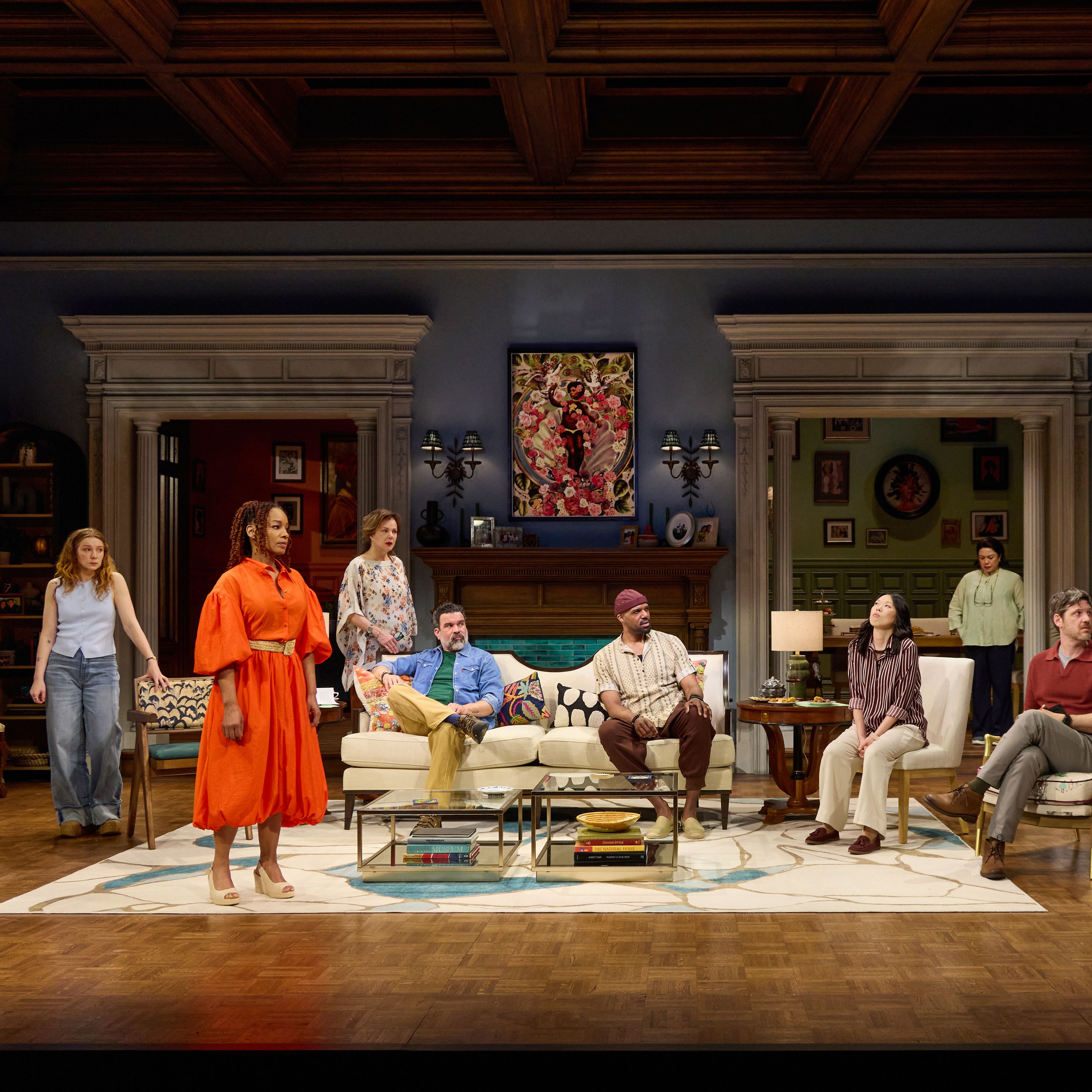
This is all of it. I'm Alison Stewart live from the WNYC studios in soho. Thank you for sharing part of your day with us. I'm really grateful that you're here. On today's show, we'll speak with the directors of the new documentary Mario, about New York's former governor. And we'll speak with reporter Frank Gianchimo about his article which follows former Gawker staffers 10 years after the website shut down. That's the plan. So let's get this started with the Ballisters. The Tony nominated play. The Ballisters tells the story of a neighborhood dispute that spirals out of control. The story is set in Vernon Point, a historic neighborhood with wide boulevards and lovely homes. Kira and her family have recently moved there from Baltimore and she's decided to join the neighborhood association, which is full of longtime residents. The president is Elliot, an affable man who grew up in Vernon Point. He is determined to preserve what is special about the neighborhood, even if that mainly means policing teeny, tiny details about the homes, like the family that wants to use plain railings rather than the authentic balusters that are required. A point of contention is an intersection by Kira's house that she is convinced is dangerous. She spearheads a group that wants to put something there, stop signs or a light. And Eliot thinks this would ruin the Esplanade. As each side fights to sway the association to their side, the battle starts to get nasty and really, really funny. The Ballisters is nominated for five Tony Awards, including best play for playwright David Lindsay Abair, who joins me now alongside actors Anika Nunny Rose, who plays Kira, and Richard Thomas, who has earned a Tony nomination for his role as Elliot. The Ballisters is running now at the Friedman Theatre. Thank you so much for coming to the studio, by the way. Thanks for having us, David. I kind of want to ask the essay question first. So going to go for it. The small details, like the balusters, picking the right balusters, paint colors for houses in this town. They're small details that mean something else. What do they mean?
- [02:18]
B
For sure, the play was inspired. I happen to live in a landmarked neighborhood in New York City. This is not my neighborhood. These are not my neighbors. But the play came up.
- [02:27]
A
You have to say that, don't you?
- [02:28]
B
I. I do. Even though they don't believe it. I have to say it over and over again. No, the play was inspired by our very heated Google group where they would discuss these very tiny details like drainage ditches and rainwater, and they would get operatically passionate about these small things that I did not care about. And of course, as a writer, I thought, well, what is this really about? It's not really about rainwater and balusters. It's about people wanting control or their legacy or in some cases even weirdly, mortality. And I felt like, I think there's a play there.
- [03:02]
A
RICHARD how would you describe Vernon Point to someone who first came there?
- [03:06]
C
Vernon Point. It's a place where everybody would want to live. It really is. It just, it's a model, model of old timey beauty, coziness and insularity.
- [03:21]
A
How would you describe it?
- [03:23]
D
ANIKA I think it's a beautiful neighborhood. It is a neighborhood that people would strive to live in. It is a model of past Americana, which we are holding onto in some places and destroying in other places. And it is like all of America, whether we want it to or not, changing.
- [03:48]
A
Would you describe it as a place that people are nostalgic for?
- [03:51]
B
DAVID oh, for sure, yeah. I mean, one of the missions of the board is to preserve the past, which is a dangerous thing nowadays when the past doesn't include everyone.
- [04:04]
A
We don't actually learn where Vernon Point is. Why did you want to why did you want it to, for people to understand how this is larger than just one place?
- [04:14]
B
Well, a couple reasons. One, I wanted plausible deniability, but I also wanted artistic freedom. I wanted it to be I wanted to apply that to lots of people and not just specific to my neighborhood. And that's, you know, what I'm hearing from folks. People love to guess where the play is based, and it's generally their neighborhood. And I say, sure, if that's what you think, so be it.
- [04:38]
A
RICHARD ELLIOTT Seems like Mr. Rogers with an edge.
- [04:41]
C
Yes, that's a very good way to put it.
- [04:43]
A
You know, what do you think?
- [04:45]
C
Sometimes I feel like Mr. Rogers with an edge.
- [04:49]
A
What do you think Elliot thinks about his own power and how he chooses to wield it?
- [04:55]
C
Well, he's very complex in a beautiful way, because he's ill. So underlying all of his, excuse me, all of his concern and control efforts over the neighborhood, underlying that there's this terror of his mortality and the inevitability of it. That changes. But I think he loves the neighborhood because it represents his child. He was raised there, born and raised there. So it's home. And it's home for him in a way that may be different from the other people. But I think the only way he can exercise any control over his life at this Point is by controlling as much as he can of what happens in the neighborhood. And then he's become a sort of immovable object, and an irresistible force shows up and you have drama and comedy.
- [05:49]
A
Kira wants to be a different person than she was in Baltimore. She was on a board in Baltimore, and it ended not so great. Why does Kira think she can change when she moves to this new neighborhood?
- [06:00]
D
I don't think she wants to be a different person. I think that she wants to be completely herself in a space where she thinks she's going to be allowed to be herself. I think she's a more careful person in this space because she learned that who she is is not always going to be accepted. Is something as a black woman that we know forever growing up from when you are a child. But at some point, you think your position, your money, your space is going to insulate you in some way from that, your intelligence, and it doesn't. So what she does come into this neighborhood with is great hope because it is a diverse neighborhood. The board is diverse. These are intelligent people from all different walks of life. And she thinks, okay, I'm finally in a space where these people care about the neighborhood, but they also seem to care about each other. And we will be able to speak and change things. We are meeting in order to make things better. And yes, everyone there does want to make things better, but they want to make it better in the way that serves them. So that does not always align with the person next to you or two people over. So that is where trouble begins.
- [07:18]
A
David, when you were writing this piece, what piece of information or stage direction tells us the most about Kira and Elliot?
- [07:25]
B
Let's start with Kira tells us the most about them. Gosh, it's a good question. I think there are several points early on in the play where Kira says she wants to fit in. And so everything that's that was just said about the character is absolutely true. She also wants to be on her best behavior. And what I love best when I watch the show is seeing Anika do her best to be on her best behavior. And she's just incapable of letting. Of not letting her true self come out. And that's the journey of the character that I love watching. And for Elliot, it's sort of this similar in that he thinks everything that he's doing is in the best interest of the neighborhood, but really it's spoiler in the best interest of himself. And so to see Richard go on a similar journey of I'm going to be on my Best behavior. And he's an incredibly amiable person that is putting his best foot forward. By the end of the play, Anika's character has pushed him so hard that his true self comes forward as well. And he's not necessarily that amiable Mr. Rogers character that you mentioned early on.
- [08:37]
A
With an edge, the edge comes out. We're talking about the Tony nominated play, the Ballisters. My guests are playwright David Lindsay Abair and actors Annika Noni Rose and Richard Thomas. The show is about a fight between neighborhoods, and it's over a traffic light. There are many points, Anika, where Kira could just give up, just give over to Elliot and say, that's fine, we'll move on, we'll move on. Why doesn't she give up over this intersection?
- [09:06]
D
A she cannot, baby. It is actually dangerous. And what she is trying to do is make sure that no one is hurt or killed, be it a person, a grown up, a child, a pet. It has become very clear to her that this intersection is problematic. And the fix could be so simple. Like, it doesn't have to be a big deal. And she has thought it over. She has jengaed this problem, like, gotten to the point where everything is balanced and she gives him what could work. And even then, it is not accepted. So now, now I have a problem with you. Now we have to deal with each other because it's clear that you're trying to block this progress that I have for safety. Now I need to get to the root of what this is, because this isn't about the corner. This isn't about safety. This has now become personal in some way, and I need to know why.
- [10:10]
A
What is it about Elliot that triggers her?
- [10:13]
D
Just that.
- [10:13]
A
Just that. Or any personality or any sort of trait that triggers her.
- [10:17]
D
It is clear to me that the person that he's putting forward is not the person that he is. So for me, it is important to get to the root of who this person is, because I think Kira is inherently offended by falsity, by the mask. And we all have one, right? We're all, in some ways code switching when we walk into rooms, but when that mask is apparent, you're not doing a great job, then it can be offensive. Because I'm coming to you with what I think is a true and honest desire for safety and for goodness. And you're giving me a gloss, a sheen, and not even being truthful about what it is. That is deeply offensive to Kira and frankly to me. Like, that would really burn me and I would need to Know what this is, Elliot?
- [11:19]
A
What is Elliot's approach to conflict?
- [11:22]
C
Well, Elliot's approach to conflict is to smile, I think, and to double down on earnestness and. And, you know, the performance of his good intentions until it isn't. Until, you know, the rage that he's underneath. All of this about his, his. His control over the neighborhood being probably fatally challenged, as well as the rage over his own illness and his own, you know, imminent death. So the. One of the beauties of the play is that is that Kira uncorks this rage finally so that in a way he's able to express fully and completely what it is. The beauty of the role for me is that it would be so easy for it to be written as the guy that it's easy to hate. But David's given him this beautiful humanity because he is manipulative. Absolutely. But he's also blind about a lot of things that he's doing that he thinks is, as David says, he thinks he's doing the right thing, the right thing for the neighborhood. And there's a waking up that happens for him when he wakes up to a lot of things that he has sort of willfully been and ignorantly been blind to for a long time. So that he comes, he leaves the stage aware of himself more clearly than he was before, especially because he's been given this beautiful unraveling at the end because he's always human, you know, and all the things that Anika says about him are true, but he's still a person. And we're given the person finally. So that someone you've been, you know, betting against all night, you have to have a certain feeling for by the end.
- [13:12]
A
We're talking about the Tony nominated play, the Ballisters. We'll have more after a quick break. This is all of it. This is all of it on wnyc. I'm Alison Stewart. We're talking about the Tony nominated play, the Ballisters. My guests are playwright David Lindsay Abair, actor Anika Noni Rose, and Richard Thomas. The show is about a fight between wealthy neighbors over a traffic light. And it's about so much more. Anika. Kira is not the only person of color in the neighborhood, but it's majority white. It was. How does Kira feel about her identity as a black woman in this room?
- [14:00]
D
I think Kira's very comfortable with who she is. I think that she's also very aware of who she is and what that means potentially to other people. So in the fact that I mentioned that she's coming in with hope. She also, I think, gives people a lot more chances and leeway than she necessarily would in a different space, because we know that most times we have to. I think that Kira is a very strong force, and she dampens that down for the room. She makes what she thinks is the perfect room. So there is nothing to criticize in this home. When you come to her HOA meeting, she is doing everything the way it should be done. She's not differing from the way it has been done, except for not getting people drunk, you know, And I think that what is interesting about what Richard was saying about Elliot is that he has this rage. Kira also has a very deep rage. And the beautiful thing, I think both of them are like, they both uncork each other in some way. And the beauty of what David has created here is that. And it could be played a different way.
- [15:32]
C
Very much so.
- [15:33]
D
But she is not an angry black woman. And I refuse to give an angry black woman. That's tiresome. It's trite, and it's played. But she has the right to have anger, and she has the right to express it. The about her is that she does everything in her power to make it a space where she wouldn't even have to feel that. That no one would have to judge her in a way that that would be present. And yet, even then, there it comes.
- [16:09]
A
Richard, I'm gonna ask you to set this up for us. There's a moment when Elliot comes to the house, sort of with a box of photos.
- [16:16]
C
Yes.
- [16:16]
A
What's his purpose with the box of photos?
- [16:19]
C
Well, excuse me. I think he wants. I think he wants the conflict that seems to be building to subside. And I think he feels that the best way to do that is to show Kira why he cares the way he does and what the neighborhood really means personally to him. And also to put it on a personal level, not on a theoretical level, so that she might be seduced into feeling a certain way about it. Of course, she doesn't need to be shown that because she is already a sensitive person who is living in a neighborhood that she admires and thinks is beautiful. But. But I think he feels that he is bringing her a peace offering, and also he's trying to get her to go along with him because he wants. You know, he wants things to stay the way they are. He wants an ally rather than an antagonist on the board. So in his own sweet way, you know, there's a lot of.
- [17:22]
A
We're gonna hear the clip in a second, but go ahead.
- [17:25]
C
That's a great jazz number too, by the way. In his own sweet way, I think there's some seduction involved and of course she doesn't fall for it. But there's also. We get an opportunity in that scene to see how he feels about where he lives so that later on when, when he does fall apart at the end of the play, you've already seen that, what it means to him. It's a, it's a beautiful way to set up the underlying profound attachment he has to his, to his childhood and to his neighborhood. It's. It's just humanized. I mean, it's the most beautifully. It's. The scene is so beautiful and I look forward to playing it every single night. You know, I just want to say that when you play an antagonist and you're going to be locking horns with another actor in a play, it really only works if there's a deep trust and feeling of admiration and affection. The trust. And the more you care about the person you're fighting, the better your fight can be. The more love there is and the more trust and admiration there is. The. You can really go at it hammer and tongs. Kind of like marriage, actually. You know, you can have a really good fight only if you really. If that bond is strong. And I feel that it is. And so it's very exciting to let yourself fall into the arms metaphorically of your partner in, in scenes of conflict. And we have that and it's beautiful.
- [19:04]
D
And you said sweet and we laughed, but it is sweet, to be perfectly honest. And I think Kira recognizes that sweetness because there is something about those pictures in that neighborhood that she really loves. I love old timey photos. I love houses that are from this era that are being protected. I love finding the dumbwaiter and seeing the painted wood and finding all the. I've lived in one of these houses, you know. So when she looks at these pictures, she's enjoying the pictures for what they are. When she sees him as a little boy, you see someone else when you see the child, right? And that is manipulative, but it's also, oh, look who this person was. Look at the kernel of what has grown from this person. And I can see the care and love that he has. So there is a sweetness in it. It is, it is ill used, but there is a sweetness in it and there is an honesty in it in that this is the thing I love the most. And he's handing it to me in hopes that I too will find love for it. The problem is I already have love for it. But I also recognize how the strict control of it is problematic.
- [20:28]
C
I think one of the most beautiful things about that scene is that there is a moment when you can. That they share over these pictures where you can see what a near miss it is that they might. If he had just not been so. You know, they say, you know, if you hold on too tight, you're gonna get rope burn. Right. So if you weren't holding on so tight, I think there's a commonality and affection almost. They just miss a certain connection in. And they come so close to it that I think it's quite touching.
- [21:04]
A
Let's hear a little bit. This is Kira and Elliott talking about a box of photos. Elliot has shown Kira about what Vernon Point used to be. This is from the Ballisters.
- [21:12]
C
If we keep giving in, then eventually the neighborhood won't look the way it should.
- [21:16]
D
Like your pictures, you mean?
- [21:18]
C
Someone has to hold the line, and that's you.
- [21:22]
D
Oh, I get it. You have all these wonderful memories of baseball and Bachmanuel.
- [21:30]
C
I know you think I'm.
- [21:32]
D
Yeah, but you can't go back in time, Elliot. Things change. You said nobody had air conditioners, but guess what? They do now.
- [21:40]
C
Yes. And now there's no reason to go outside and gather with the neighbors, which in my opinion, is a loss. I was hoping the photos would maybe show you that.
- [21:47]
D
Yeah, the photos are nice, but also kind of weird for me.
- [21:51]
C
Weird? Why?
- [21:53]
D
Honestly? Because everyone's white.
- [21:57]
C
No, that's.
- [21:58]
D
Look at the pictures, Elliot. Everyone is white.
- [22:00]
C
No, There's. No. Here's Mr. Tesoriero.
- [22:05]
D
Italians aren't white.
- [22:07]
C
Well, they are now.
- [22:10]
A
That gets such a funny. That's such a funny moment in the play.
- [22:14]
D
It's a brilliant line because it's so American.
- [22:16]
A
It is so American.
- [22:18]
D
And it tells you a lot about the construct of whiteness and what it is.
- [22:22]
A
Yeah. We're doing a documentary about Mario Cuomo and about him growing up and becoming governor and all that he went through as an Italian American. Interesting. That's for later on in the show. David, you also touch on class in this show. Kira has a housekeeper, used to be Elliot's housekeeper, and she doesn't want her to dress in a mage outfit. And Kira's eye, she's like, I don't care. I'll dress any way I want. Liz does tell me a little bit about that decision, to put that in that detail specifically.
- [22:55]
B
Well, I think it tells us a lot. It tells us that. Well, I don't want to speak on your Behalf. But for me, the character wants a lot of the trappings of this house and this neighborhood and a certain lifestyle. But a part of her, and I speak as someone who grew up very working class, is also a little bit uncomfortable with that. And so she pretends that she's doing this on behalf of her maid, but really it's to make herself feel a little bit more comfortable because it feels a little weird.
- [23:25]
A
How does it feel for Kira to have a housekeeper?
- [23:28]
D
Well, first of all, I think she's very grateful to have a housekeeper because it's a huge house. It's a huge house and she has two children, and that's a lot to take care of. But also, you know, she knows what it is to come from a group of people who were subjugated, who were made to wear specific outfits so that they could be recognized as less than in a certain environment. So she doesn't want. Want to have this person feel like they are being looked at as less than, even though there are moments where she. And this is embarrassing to say as if I did it, but there are moments when she basically dismisses this woman and gets her out of the room. Like, get out of this room. I'm having this meeting. I'm running this. I'm at this space in my life. Please go away. But she doesn't say, please go away. She just gives her something to do because it's her job, and that's the clean way of being able to do that. And I think that we all, as humans, have those foibles and those twists and turns where I'm very aware of what this could mean. My mother cleaned hotels in the play, you know, so I know what it is for someone to be a maid and to feel made, to be less than. So everything that I say to this woman, I'm trying not to make her feel that way. Even in situations where absolutely the request says, this is your place. You're not here to have a conversation in my home with this woman who's not actually your friend. Can we please just have this meeting? And that's super shitty. Oop.
- [25:11]
A
This is all of it on wnyc. I'm Alison Stewart. We are talking about the Tony nominated play, the Ballisters. Richard, do you think there's a generational difference in the room?
- [25:24]
C
Oh, certainly. And there's a generational difference in the audience. It's one of the most wonderful things is that the factions on the stage are mirrored by factions within the audience, different demographics in the audience. And you can tell from Performance to performance, from the matinees to the evenings, what part of the week, what the preponderance is in terms of the point of social points of view. You know, there are people. There are people who want to hang me in the town square five minutes into the play. And there are people who keep trying to see my point of view. So I think that there's. And. And partly it is generational. You know, the young Jacobins in the audience really, really want to burn me at the. Burn me at the stake. I can feel it while I'm out there trying as hard as I can to be as nice as I can, but they're just not having it. But I think there is generational. I mean, he's the oldest person, and consequently he feels. I think also he knows best because of that. And there's a. There's a. He has a. He has a patronizing quality that is. That, I think also is part of the generational. The thing.
- [26:37]
A
It's sort of funny. You can hear it in the room. Sort of the waves go based on what's said in the play.
- [26:43]
B
It's my favorite part of the play.
- [26:44]
A
Oh, yeah.
- [26:45]
B
I was so nervous about some. Some of the things in the play made me feel prickly. I was like, oh, you can't put that in there, David. People are gonna think that's what you think, or you're gonna think that. So it's funny to watch certain sections of the audience laugh at things and get stares from the other side of the audience. Like, how can you laugh at that? And then swapping roles. Three lines later, I was like, oh, what's happening in the audience is the same as what's happening on stage.
- [27:05]
A
I do wanna get to this clip. In the play a lot, people are quick to form judgments, and there are accusations of racism and homophobia throughout the show. Let's listen to where Willow, a woman who works for PETA, she says all the politically correct things and corrects people. She's being taken to by Isaac and she starts crying, which leads to a surprising moment. This is from the Ballisters.
- [27:26]
D
I acknowledge my privilege and I welcome having it checked. At the same time, I try to use my privilege to lift up others
- [27:34]
A
by working at PETA. I'm sure cats everywhere appreciate all you've done for me.
- [27:41]
D
PETA isn't just cats.
- [27:43]
C
I think it's awesome that you protect animals.
- [27:45]
B
They don't have a voice after all. But the. The rest of rest of us, we do.
- [27:48]
C
And we're not a shy bunch.
- [27:50]
D
If Anybody wants an apology from Alan,
- [27:52]
B
they can ask for it themselves. We don't need you to be our savior in here.
- [27:58]
A
Oh, my God.
- [28:02]
B
Of course not.
- [28:05]
D
Is that what you think?
- [28:07]
A
Because that is, like, the last thing
- [28:09]
C
I'd ever want to.
- [28:11]
D
That is not at all how I see myself.
- [28:13]
B
Are.
- [28:14]
C
Are you crying?
- [28:17]
D
I'm sorry. I didn't mean to make.
- [28:19]
C
Isabel.
- [28:19]
D
Oh, Willow, don't do that.
- [28:21]
A
What?
- [28:21]
D
I said, it was only a matter of time, right? Who had the June meeting?
- [28:26]
C
I did.
- [28:26]
B
Pay up, suckers.
- [28:27]
A
I don't have cash.
- [28:28]
D
You good with Venmo?
- [28:29]
C
Yeah.
- [28:29]
B
Venmo.
- [28:30]
C
Zell, out of the way. What is happening here?
- [28:39]
D
We.
- [28:43]
C
We had a WGT pool.
- [28:45]
D
Wgt White girl tears. Sorry.
- [28:49]
A
You can just hear the audience slowly, slowly react to what's happening. What did you want to examine about the way we judge people?
- [28:58]
B
Well, it's interesting, you know, I was writing not from my experience with several of the roles, so I kept putting the play in front of some writers of color who are close friends to mine, saying, hey, where do you go? Okay, white guy? And they said, no, you're good in here, here, and here. But you kind of pull your punches. You're really mean to the white people. And I think the people of color can be just as complicated. And by the way, people are different when there aren't any white people in the room. And white people are different when there aren't any people of color in the room. So I wanted to bring. I knew I didn't have any scenes that did that, but by having this moment of where, oh, there was an offstage scene that you didn't see where the people of color were alone and this white girl. Tears came up. And so I was trying to dramat what happens when the white people aren't around. And, you know, we won't go into it, but there's a scene later in the play where we find out what happens when the people of color aren't around. So that's what I was trying to do with those scenes.
- [29:52]
A
It is a hilarious play. It is a. It's a heartbreaking play in many ways. It is Tony nominated, by the way. It's called the Ballisters. My guests have been playwright David Lindsay Abair and actors Annika Noni Rose and Richard Thomas. Thank you so much for coming to the studio.
- [30:08]
B
Thank you so much.
- [30:09]
C
Thank you so much for having us.
- [30:11]
D
You won the bid.
- [30:13]
B
You're on the job now. You just need the materials. Get supplies that work as hard as
- [30:19]
C
you do from the Home Depot.
- [30:22]
B
Maximize your savings with pricing benefits for pros.
- [30:26]
D
Get savings on the products you purchase the most and earn perks at checkout.
- [30:32]
B
Sign up today to save time and money.
- [30:36]
C
The Home Depot Pro it's about time
- [30:41]
D
Having the right people in your corner for life's biggest milestones makes all the difference. Like a friend who's there when you're house hunting or checking out a new ride, State Farm is there, too, helping you choose the coverage you need. With a State Farm agent, you know someone is there to help you along the way. And with so many coverage options, it's nice knowing you have help choosing a plan that fits your needs so you can continue celebrating all of life's milestones. Head to statefarm.com to get a quote. Like a good neighbor, State Farm is there.