Loading summary
Transcript40 lines
- [00:00]
Progressive Insurance Announcer
WNYC Studios is brought to you by Progressive Insurance. Insurance isn't One size fits all. That's why drivers have enjoyed Progressive's Name your Price Tool for years now. With the Name youe Price Tool, you tell them what you want to pay and they'll show you options that fit your budget. So whether you're picking out your first policy or just looking for something that works better for you and your family, they make it easy to see your options. Visit progressive.com, find a rate that works for you with the Name youe Price Tool. Progressive Casualty Insurance Company and affiliates Price and Coverage Match limited by state law. All of it is supported by Memorial Sloan Kettering Cancer Center. In a small, groundbreaking clinical trial, 100% of participants with a specific type of rectal cancer saw their tumors disappear using immunotherapy alone. Researchers at MSK are now studying this approach in cancers of the stomach, liver and more, and a majority of tumors are disappearing. For MSK Giving day, all gifts will be tripled. Learn more@msk.org all of it now is
- [01:01]
Dr. Horton Sales Announcer
your time to get into a new Dr. Horton home by taking advantage of its national Red Tag Sales event this Friday, July 10th through Sunday, August 2nd. Stop by any of its participating communities and find select red tag homes at Incredible Pricing. So whether you're buying your first home or looking for an upgrade, you don't want to miss the Red Tag Sales event. Starting this Friday. Discover the Dr. Horton Difference. Visit Dr. Horton.com Dr. Horton America's Builder and Equal Housing Opportunity Builder.
- [01:40]
Alison Stewart
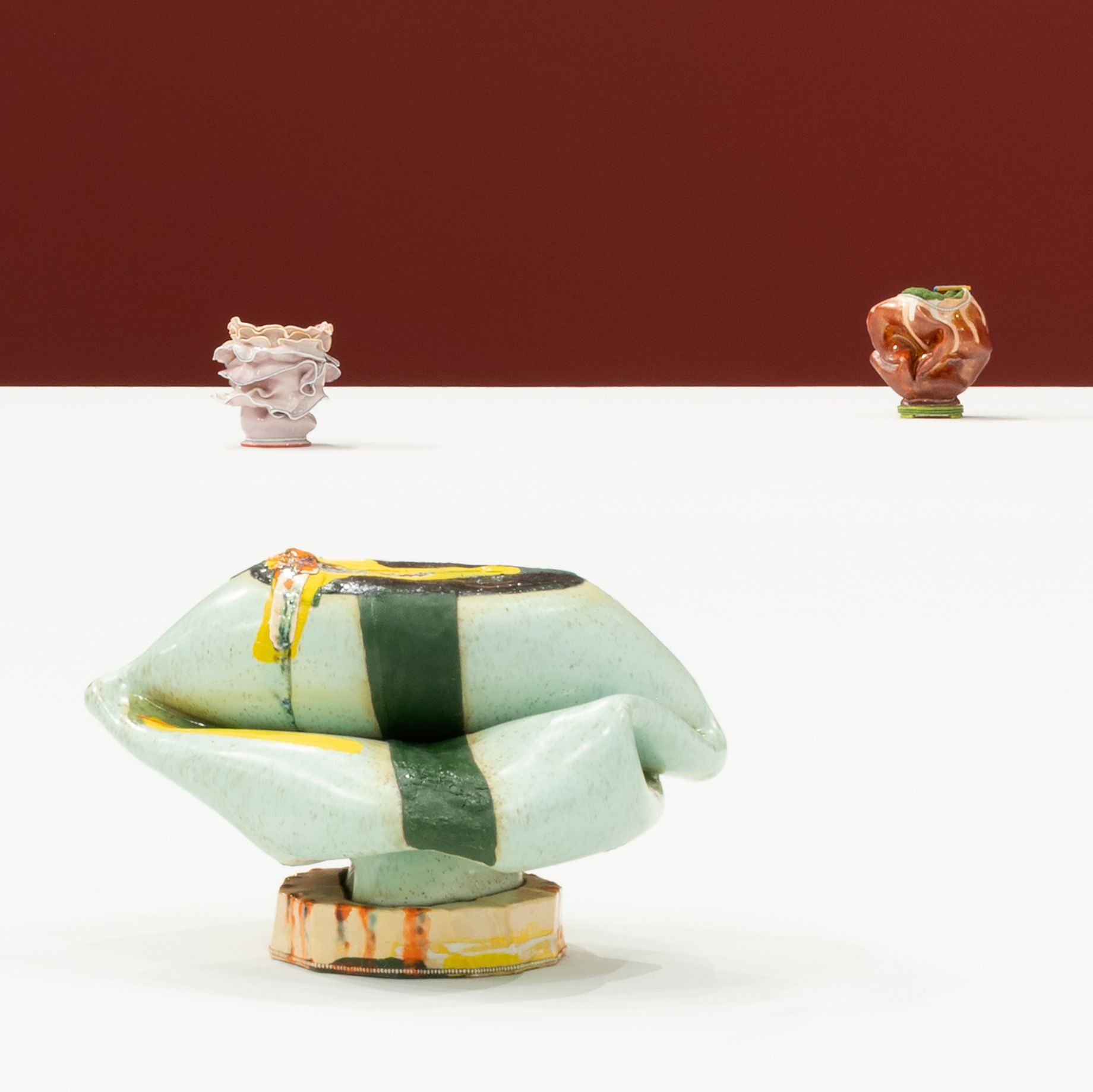
This is all of it on wnyc. I'm Alison Stewart. We continue this hour of art outside the city with a new retrospective at the Tang Museum at Skidmore College in Saratoga Springs. Kathlee Butterly is a New York based artist who has spent decades creating unique ceramic sculptures. Small in stature, each piece plays with color, texture and form in surprising ways. Some look like mushrooms sprouting in the forest. Some call to mind a crumpled can or a deflating balloon. And they have cheeky names like loud silence and middle classiness. The retrospective at the Tang Museum brings together pieces from all different moments in Kathy's career. It's titled Kathy A Assume. Yes, it's running through July 26th. Accompanying the exhibit is also a stunning new monograph of Kathy's work. Joining me now to discuss the exhibit is Kathy Butterly. Hey Kathy.
- [02:38]
Kathy Butterly
Hello.
- [02:39]
Alison Stewart
Along with the curator of the exhibit and the director of the Tang Museum, Ian Berry. Hi Ian.
- [02:44]
Ian Berry
Hey, how are you?
- [02:45]
Alison Stewart
I'm doing okay. So this exhibit is part of the Tang Museum's 25th birthday. Why did you want Kathy Art to be part of the show?
- [02:55]
Ian Berry
Well, Kathy is a Tang favorite, and We've worked together 20 years ago on a smaller show at the museum, which is one of the most memorable in our history. And when we were thinking about ways to celebrate all the good things we've made at the museum, focusing in and doing a deep dive into a single artist that we think is really where it's at in terms of experimentation and pushing media forward is something we wanted to do. And Kathy. The conversation with Kathy is just a joy, and it has been a joy for not only the students and the faculty and the people around Skidmore, but so many people have now come to see, and it's just worked so beautifully for our anniversary.
- [03:45]
Interviewer
Kathy, what is it like for you to see pieces from different moments of your career on display together?
- [03:53]
Kathy Butterly
You know, it's profound, really, and it's such a gift to me because basically, there's pieces that were made 30 years ago and pieces that were made in 2025, and they've never met each other. They're like family, and they've all come together, and they're having an ongoing conversation. It's really like looking at my life in chapters. And it's a special treat for me because I haven't seen some of these in so long. So, you know, it's just. It's really moving for me, and I'm really grateful.
- [04:28]
Alison Stewart
Kathy, what's changed in your practice in those decades and what's remained the same,
- [04:34]
Kathy Butterly
you know, what's remained. This is what having this experience of doing the book and the exhibition has shown to me because. Is that there have been distinct changes within my work, even though I've decided very clearly to work in a very restrictive way of only using a vessel form and only using clay and glazed materials and working small scale. I think what I find by working with the scale and with these restrictions is I find freedom. So what I have to do is. But I'm finding expansion through constriction or contraction, in a way. And the more I limit myself, I find the possibilities are endless. And so as I'm looking at the show and I'm looking at the book, I see that there's been a constant flow of discovery, and I'm not done. I'm finding now that I really have taken a pause. This show has given me time to pause and look and reflect, and that's really extraordinary. And I'm feeling very confident to move forward and the confidence is about basically not knowing exactly where I'm going, but I really trust the process because clearly I've been doing something.
- [06:02]
Alison Stewart
Ian, when you look at the pieces in chronological order, what patterns or. Or changes emerge in Catholic.
- [06:11]
Ian Berry
Oh, yeah. I mean, when you come into the gallery, we decided at the somewhat. Somewhat later in the planning to take all the walls out of the gallery. And so everything is in one huge room together. And it's organized on these three huge plinths or tables. And the first table is early works from the 90s, where you can see a more overt reference to bodily forms and adornments. And you can really, I think, recognize, and I think people have a fun time kind of seeing themselves in the works, trying to find the artist in the. In the works. They're all abstract, but they have references that one can. One can play with and build off. And then the second platform in the 2000s, sort of break the mold, breaks the mold even further and reflects on events like 9 11, which happened not too far from Kathy's studio, and, you know, super experimental pushing of glaze on top of glaze and pushing the form into ways that had never been seen. And then the last one, the hugest of these platforms is the last decade, which is a refining of the work even more to the core shapes of a circle and a square, which, you know, I love how Kathy just said that the kind of constraints are the thing that makes freeze her in the studio. And I think that is really evident in that last platform where the constraint of these shapes of a circle and a square and even the sort of monochrome almost glazes actually achieve some amazing painterly experiments and inventions.
- [08:03]
Interviewer
And if you'd like to see some of Kathy's work, head to our Instagram of nyc. We have a couple of images posted on Instastories. My guest is artist Kathy Butterley and Tang Museum director and curator Ian Barry. We're discussing the new retrospective of Kathy's work, Kathy Butterly. Assume yes. It's open at the Tang Museum in Saratoga Springs through July 26th. Assume yes.
- [08:27]
Alison Stewart
It's in your book, page 257. Why is it titled Assume Yes, Kathy?
- [08:37]
Kathy Butterly
I kind of collect titles. So as I'm in my studio listening to wnyc, quite often, I take notes, I hear things, and I mishear things. Mishearing creates some very good titles. But I'm walking around New York City, I'm walking around Maine with my phone and just taking notes all the time and collecting ideas for titles. So the title Assume Yes. You know, it probably came from my title book and I don't know what a piece is going to be about. You know, I'm really a process oriented artist, so I, you know, I fire my works, you know, up to and even over 20 times each. So I build up meaning as I'm, you know, making them. So I don't really know what they're going to be about until halfway through or even when they're done. So I was looking at the piece and I came up with the title. Assume yes, but assume yes. I think this is an end to all of my work is that we think of assume yes as being very optimistic. And it is because we think of the word yes as always being positive and the word no being negative. But sometimes no is positive and yes can be negative. So assume yes. I would like to follow it with assume yes. What. So that complicates my work a little bit. And I think my work is complex.
- [10:04]
Alison Stewart
It was interesting, Ian, hearing Kathy talk about the process of her work. When you first met Kathy, what were her the biggest questions you had for her?
- [10:14]
Ian Berry
Oh, that's a great question. I think, you know, as a curator working with artists who are making the work new in their studios, I get the great, great, great privilege of being in the studio and being able to ask questions about how is that made? What tools are you using, what's the. What's happening here? And then getting the. Having the hard, the harder conversation then with myself about how much to share with the public after that, because some mystery is actually quite good. So I think I was mesmerized by the work and I'm sure Shirley had a lot of questions about how they were made because they do really feel like magic sometimes.
- [11:03]
Alison Stewart
Ian, what's a piece in the exhibit that invites you to spend some extra time with it?
- [11:08]
Ian Berry
Oh, man, there's so many. We have 45 works in the show that span 30 years. And, you know, we, I come, I come to many. I mean, there's a few old favorites that we've shown before, like Red Shimmy and Mask, which are sort of, which I call classics, and it's so wonderful to revisit those. But then there's the experimental ones like Mushroom Nirvana and seeing the glaze, you know, just doing things that, you know, Kathy's putting this glaze through the process where it's never, never acted like it's been before. But I think Heavy Red is the one we probably, you know, that's a newer piece and we've decided to display it Kind of on its own towards the end of the show. And it is a truly epic, gorgeous combination of colors that and textures. It has a very shiny surface and a very matte inside. And Kathy's carved and cut into the sides of the shape so you can actually see inside and outside this sculpture. It's a real fantastic work that I definitely revisit every day in the gallery.
- [12:30]
Interviewer
Kathy, how do you know you're done with a piece?
- [12:34]
Kathy Butterly
That's such a good question. Early on, when they were very detail oriented, I just kept adding more and more until they got to a point where I was like, is there anything else I can add to make this piece work? And now I'm at a point because I'm really interested in minimalism and monochromatic works. And so now when I make a work, I say, is it enough? And I'm finding that in the works that I'm making now, less is more. And I'm really letting the color define the form. And the colors that I'm using are just. I'm so, like, I'm so into them and it's. I'm finding that the colors are absorbent and they also reflect colors at the same time. So I'm working with shadows and reflections in ways I've never had. So I don't know. It's really exciting.
- [13:35]
Interviewer
You mentioned this earlier. Your work tends to be on the smaller size. I think there's one piece, like, about 9 inches tall, but they can be as small as, like 3 inches tall. What do you like about keeping your pieces relatively small?
- [13:51]
Kathy Butterly
You know, I find small so important. That's my strength and that's my power. And, you know, I kind of base it on the idea that, like, you know, you know, on this earth, the things that are the most important are some of the smallest things, like under my feet, like the things that keep the earth alive. But basically there's a difference between size and scale. So I work in small size, but with all the detailing and all the carving and love that I put into the works, I'm making them so that when you do look at them, the scale feels enormous. So I'm working on these small sized pieces for months, even up to a year or two years. For certain pieces, I love taking a long time. I'm not in a rush. They're not about production. They're about me finding the works and going on a quest and a journey. And so what I'm interested in is going into the works and getting lost and finding universes within them. So that's what? Small scale, you know, large. Small size, but large scale. You know, that's how I would describe my work.
- [15:01]
Alison Stewart
Did you want to add something, Ian?
- [15:03]
Ian Berry
Well, I was going to say to get back to color a little bit. When Kathy was talking about the newish works and the color, one of the other things you can see when you come into the Tang is a monumental sculpture by Robert Arneson that we installed near the entrance to the show. And. And I love Cathy's connection to the history of her medium. And Arneson in particular was a key figure. And some of Arneson's own and actual glazes are in the show. And I think that is such a special honoring of a legend in the field and honoring your teacher, Kathy.
- [15:45]
Kathy Butterly
Yeah, Kathy.
- [15:46]
Interviewer
The pieces are often sitting on these
- [15:49]
Alison Stewart
little square blocks that kind of like pedestals. They're different colors, they're different textures. How do you pair the right sculpture with the way you present it, the block you present it?
- [16:01]
Kathy Butterly
Oh, this is a good question. Thank you. It's really interesting to me. So when I first started using this idea of the square, the cube, to put the top form on top of, I was just thinking of them as a podium for them to speak. And now my thinking has changed. They're two dimensional diptychs, really. And so the cubes are constructed. So they're actually made by rolling them out and creating these cubes, which are very difficult to make. And as I'm working, I have the top forms all on one shelf in the studio. And then I start making the cubes, and I think I'll make a cube to fit a form, and then it doesn't work. So then I have a cube and it's like musical chairs. In my studio, some of the cubes are fired 15, 20 times until they find its mate. Really?
- [17:03]
Alison Stewart
That's so funny. So you sort of have to mix and match and see which goes together. Which looks like a marriage.
- [17:09]
Kathy Butterly
Totally. It's musical chairs. And, you know, it's really interesting. It's counterintuitive because sometimes the largest form will want the tiniest space. And that creates a certain sort of tension within the works.
- [17:20]
Alison Stewart
That's very interesting. So, Ian, the sculptures are. Can be a 360 experience, can be examined from very different angles. How does a piece change depending on where you look at it and when you look at it?
- [17:37]
Ian Berry
Oh, absolutely. It's tremendous. And Kathy's work is a perfect example of that. And it's partly why we took the walls out of the gallery and installed it the way we did so that you can really be free as a visitor to walk all around the space, see multiple pieces in Conn with each other, look across the room to see the one side of another behind the side of a different one, and then come around and see it from a different angle. Some of Kathy's works are dramatically different, depending on which side you see them. And in the book, we had her actually a really. We had a fun debate with each other, editing which images would make it into the book, because depending on which image you put in the book, you might see a totally different piece. There's a moment in Kathy's work when the middles are kind of, you know, squeezed in so that they become extremely flat in the middles. And if you take. If you look at it from one side, the piece may be, you know, less than a half an inch thick, but if you look at it from another side, it's, you know, six or seven or eight inches wide, and it has a completely different presence in the space. So we definitely wanted to give visitors the opportunity to move around and discover the works from all their sides. It's one of the greatest pleasures of the exhibition.
- [19:06]
Interviewer
Kathy, I have to ask you, you've lived in the East Village among artists for many years now. How has the artistic community in New York been important in your.
- [19:17]
Alison Stewart
In your life and in your career?
- [19:19]
Kathy Butterly
Oh, it's so important. I mean, my friends are artists, and we. I mean, most of our conversations are about art. And what shows did you see? And, you know, who's inspiring you at the moment? What's great about growing up in the East Village also and having two children is our kids went to a school where most of the parents were artists. So not only, like, we would, you know, go hang out at the park, our kids would play. We would talk about art all the time. So it was. Being in New York is so important for me and for my work.
- [19:54]
Interviewer
I believe the piece is. The exhibit is called Kathy Butterly Assume. Yes. It's open at the Tang Museum in Saratoga Springs through July 26. I've been speaking with Kathy Butterly and the Tang Museum director and curator, Ian Barry. Thank you for being with us.
- [20:11]
Ian Berry
Oh, it's a joy. Thank you.