← All Of It with Alison Stewart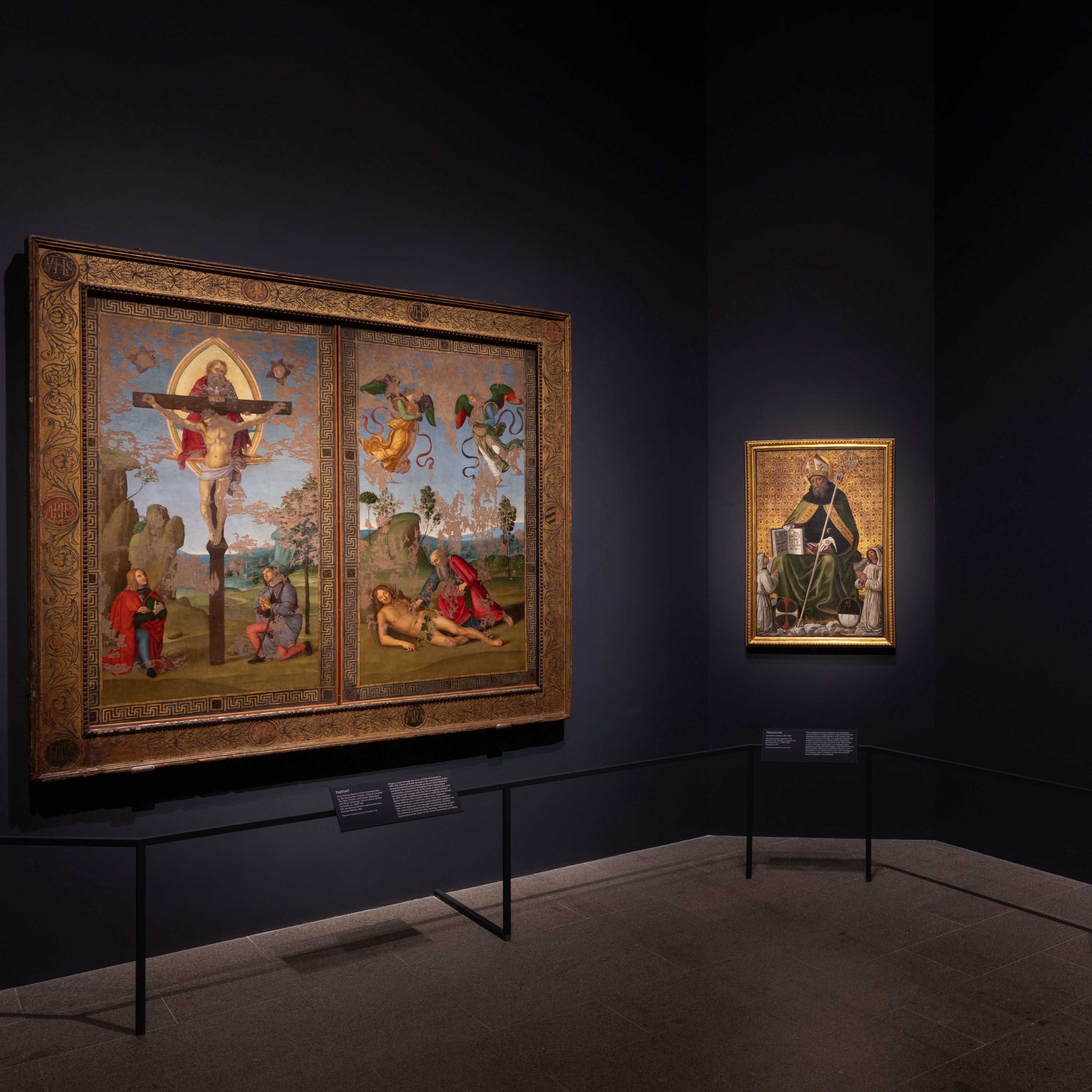
All Of It with Alison Stewart
The First Major Survey of Renaissance Master Raphael Opens at the Met
00:23:03
Loading summary
Transcript46 lines
- [00:00]
LinkedIn Hiring Pro Announcer
The new LinkedIn hiring pro can't undo your last hire, the lone wolf who you thought was a good collaborator because you didn't have the right candidate insights. But once you hired them, it was all hoarding info, declining meetings and howling at the full moon. But LinkedIn hiring pro can go deeper than just the resume to find you a perfect fit by using insights from the LinkedIn network to give you a short list of best fit candidates. Hire right the first time with LinkedIn Hiring Pro. Post a free job today at LinkedIn.com
- [00:29]
Pandora TV Show Narrator
Pandora from premieres April 19th on MGM in a small, inescapable town, understanding the monsters may be the only way out. Desperate hope may lead residents toward even darker truths. I think they're doing it to make us afraid.
- [00:48]
Carmen Bambach
Well, then, it worked.
- [00:49]
Pandora TV Show Narrator
Something ancient is feeding off of their suffering, and it won't stop. Survival will demand impossible choices from season four premieres April 19th on MGM there's
- [01:01]
Chevrolet Commercial Announcer
a reason Chevy trucks are known for their dependability. It's because they show up no matter the weather, push forward no matter the terrain and deliver. That's why Chevrolet has earned more dependability awards for trucks than any other brand in 2025, according to J.D.
- [01:12]
Carmen Bambach
power.
- [01:12]
Chevrolet Commercial Announcer
Because in every Chevy truck, like every Chevy driver, dependability comes standard. Visit Chevy.com to learn more. Chevrolet received the highest total number of awards among all trucks in the J.D. power 2025 U.S. vehicle Dependability Study Awards based on 2022 models. Newer models may be shown. Visit J.D. power.com awards for more details. Chevrol let's drive.
- [01:38]
Alison Stewart
This is all of it. I'm Alison Stewart live from the WNYC studios in soho. Thank you for spending part of your day with us. I'm grateful that you're here on today's show. Actor Chase Infinity will be here in studio to talk about her role as Agnes in the new Hulu series the Testaments. It's a follow up to that Handmaiden's Tale. We'll also talk about the Criterion Channel's new collection of classic corporate films, thrillers, with friend of the show Clyde Foley. And we'll continue our celebration of National Poetry Month by learning about some Arab American poets. And we'll speak with the author Carol Clare Burke about her hot new novel, Yesteryear. That's our plan. So let's get this started with the Renaissance artist Raphael. Today, 543 years ago, the Renaissance master Raphael was born in Urbano, Italy. And also today, April 6, 1520, Raphael died in Rome at the age of 37. He was revered in his lifetime by popes and the people alike. And now you can see hundreds of his works at the Met. In the first major American survey of Raphael, it took eight years to make happen. Raphael's sublime poetry takes visitors from the beginning of his life to its untimely end. It's full of religious paintings, portraiture, sketches, tapestries. The exhibit also explores Raphael's influences, from his father, who was also a painter, to contemporaries like Leonardo da Vinci and Michelangelo, who both served as inspiration and competition. The New York Times calls it, quote, an exhibition of such sublimity and grace, it's hard to square with the cold world outside. It's open now at the Metropolitan Museum of Art through June 28, and I'm joined now by its curator, Carmen Bambach. Carmen, welcome to the show and congratulations on the work that you've done.
- [03:37]
Carmen Bambach
Thank you for having me. And happy birthday, Raphael. Happy birthday also to my late mother. She was also born April 6th. It's such a joy to be here. Thank you.
- [03:49]
Alison Stewart
It's amazing to see how the work has resonated with people. It's only been open for a little bit, but people are just. They just stare at the paintings. What have you observed from people who've gone to the exhibit?
- [04:01]
Carmen Bambach
I'm amazed by the sense of reverie, and it's generally quite silent. And I love that because it's akin to a bit of a spiritual experience. And I think in the end, that's probably the reaction I would want to most have. A sense that they've gone on this journey looking at the artist's work, but also getting a bit of the identity of the artists as well.
- [04:31]
Alison Stewart
It's interesting. I was amazed to find out that this was the first major US exhibition of Rafael. Why do you think it took so long?
- [04:40]
Carmen Bambach
Well, it's a complicated process. It is why it took so long to do just curatorially, to learn the research and then negotiating the loans. Often it kind of feels that you are negotiating for the firstborn of a royal family or something like akin to that. And yes, to put all the pieces together. It's a big process. We have 62 lenders, 137 works total, 33 paintings by Raphael, 140 or so of his drawings, the tapestries and all to the end of constructing this journey through his life and to show how influential he was. This is an artist practically from 1510, all the way to the late 19th century. He remained to be the role model for young artists and in the training of young artists and also kind of a model for gracefulness, elegance, and a kind of perfection.
- [05:46]
Alison Stewart
You did so much research, so much travel in those eight years preparing for this moment. What did you learn about those travels, learn that was valuable to you in putting together this exhibit?
- [05:59]
Carmen Bambach
I think it's always interesting to go to the places that are not so well known and then go through their collections. I do a lot of what I would call shopping in museums. That means I do have an idea of what I would like to get from certain collections and really explore those. But also in those wanderings in the same collections, you go, ah, this is such an amazing drawing, as happened to me in Montpellier in the south of France. And I kind of go, but this Madonna and Child is just arresting for the humanity and the beauty and tenderness of this image. And I said, well, it's hardly known, probably hardly people have seen it in the original. So, yes, let's have it integrated into the selection of all those beautiful Madonnas.
- [06:52]
Alison Stewart
And I want to be clear, for people, this is your only chance to see this exhibit, correct?
- [06:57]
Carmen Bambach
Yes. The works are very fragile. And so, for example, the paintings that are on wood really are very, very difficult to secure alone. And in fact, most of the larger paintings on panel, on wood, do not travel. There are also canvas paintings that really very difficult to borrow. But most importantly, the drawings cannot be exhibited for more than, say, four months at the most, five months at the most. So really, the Met could only be the single venue of this exhibition. It's the fragility. Drawings become very brown. The paper really, and the colors also. The materials also fade easily.
- [07:41]
Alison Stewart
We are discussing the new exhibit at the Met, Raphael Sublime Poetry. My guest is curator Carmen Baumbach. The exhibit is open now through June 28, only at the Met. Let's go back to when he was born, today, April 6, in 1483, in Urbino, Italy. What did his hometown mean to him?
- [08:02]
Carmen Bambach
I think it meant a great deal more than what we may possibly have imagined. For me, as an art historian, it was also really crucial to understand what a family and what a hometown would have meant to an artist like this. Urbino, when Raphael is born, had just had the death of Federico da Montefeltro, the great duke who had brought the humanities, humanism, and the extraordinary Renaissance to Urbino. But Raphael was born, let's say, at the twilight of a court. And it's interesting, Raphael signed himself until the end of his life as Raphael of Urbino, Raffaello Urbinas. And so, in that sense, yes. And he also, of course, kept letters, property, all sorts of stuff in Urbino and belonged to the institutions in Urbino. And I do think that the political network tied to the dukes of Urbino who followed after Federico da Montefeltro had a lot to do with his arrival in papal Rome. So one of his patrons was Giovanna Feltria della Rovere. Giovanna was basically the sister in law of Julius ii, the pope in Rome. So while Tallinn spoke a great deal, while Raphael was also very supported by Bramante, his great friend, also from Urbino, really the political network there of the della Rovere is probably the most important conduit to his arrival and presence. And then, of course, success, thanks to his brilliant genius.
- [09:45]
Alison Stewart
He was well connected, yes, and knew
- [09:48]
Carmen Bambach
how to move very elegantly. It's kind of interesting because, again, Urbino was a court, and his father had already been a court painter and a poet. So in a way, Raphael had imbibed all that went along with the elegance of a court and being able to speak with powerful people. And in many ways, this was very different from the situation that would have happened in Florence or with Florentine artists, Tuscan artists, Florence being a republic. So Raphael's sort of past in Urbino and being brought up there also was, in a way, a smooth transition to papal Rome and to the papal court. He was, as we know from biographers, he was just amenable to speak to all the powerful and also to fellow other artists. So he was a very social, sociable, very incredibly adept, elegant person. In addition to the genius, of course,
- [10:55]
Alison Stewart
you mention in the exhibit, there are also paintings by his father. You mentioned he was a poet and a painter as well. Do you see his influence on his son, on Raphael?
- [11:07]
Carmen Bambach
I see it in a more abstract sense, I would say. And it's great that we're celebrating the month of Poetry because the exhibition is subtitled Sublime Poetry. And one of the things I wanted to emphasize is Raphael grew up while his father, Giovanni Santi, was composing his epic poem about the life of Duke Federico da Montefeltro. In fact, if one reads it from beginning to end, one notices that from the point of view of technical virtuosity, it's really quite a poem. It's longer than the Divine Comedy. Obviously not at the height. At the same height, artistic height. So here we have an artist who basically grows up hearing the of poetry. Raphael himself tried to compose sonnets. He was not such an accomplished poet himself, but he lived in a culture that considered poetry and painting sister arts, and in many ways, his friends, his entire culture in papal Rome. Was all about the idea of the dialogue between poetry and painting. Painting being the blind poetry and poetry being the blind painting, that is, is the dictum that seems to occur and recur. And then Raphael's paintings, I think, do speak to a kind of sublime poetry.
- [12:32]
Alison Stewart
It's sort of wild in the exhibition because there is a room which has projections on the wall like the Vatican. It's his work. And when I was in there, I was wondering to myself, gosh, what did they think about using the technology to put this on the walls when you're dealing with something that's so analog, so real as Raphael's paintings?
- [12:58]
Carmen Bambach
Well, at the Metropolitan Museum of Art, we have a brilliant team, digital team, and I think that they could use their entire artistry in their field to bring this together. I would also like to say that the Met is probably the only museum that could be able to pull off an exhibition such as Raphael of Blind Poetry. The dedication, the artistry of our colleagues, our research associate, the exhibition project manager, Extraordinary, extraordinary team of people. And I would say, probably if we had to count everybody who partook in bringing all their best art, 160 people at the Met were involved in this. And I think it is in this way we have pulled it off.
- [13:56]
Alison Stewart
What did you want people to experience, being in that room, surrounded by his work?
- [14:02]
Carmen Bambach
I think the sense of his artistic identity was really what has moved me most. And to sense this painter who. Artist. Painter who. An architect and who did theatrical designs, who. Who created a kind of alternative universe for us, a universe of beauty, of elegance, of poetry, at a time when it was a complete opposite to the historical reality. The peninsula is wracked by wars. Urbino itself was being sacked. And it is interesting that all this pastoral elegance, that even a friend of Raphael's, like Baldassarre Castiglione, who's celebrating this in the Book of the Courtier, it's being composed at a time when Urbino was essentially just ransacked. It's also interesting to have his Madonna and Child images, these beautiful mothers and children who are health, the picture of health at a time when women of childbearing age are decimated, and infants, really, there's such an enormous infant mortality. So in a way, he's creating this alternative, an aspirational ideal of what motherhood should be. These paintings that belonged in the houses of the Florentine nobility, they're aspirational models, what the young mother to be should hope to be able to present to her family. So there's in many, many different ways that Raphael creates this extraordinary universe. And in many ways, I wanted that to be the feeling for the exhibition itself. Working with exhibition designer, architect, we wanted to create that sense of even architecturally, to celebrate the portraits with a kind of temple like structure. And the Madonnas and Child, same thing. So there is a sense of like doing a journey in almost 3D through this artist's work.
- [16:16]
Alison Stewart
We're discussing the new exhibit at the Met, Raphael, Sublime Poetry. My guest is curator Carmen Baumbach. The exhibit is open now through June 28th. As well as painting religious subjects, Raphael also painted portraits of his wealthy patrons. What made him special as a portress?
- [16:37]
Carmen Bambach
I think probably the number one quality is that he made all his sitters look really better than they were. He could really flatter. And it's kind of interesting because we do have portraits of some of the people that he painted by other artists, and so we have records of their physiognomy. One of the great works in the exhibition is the portrait of Baldassarre Castiglione, the author of the Book of the Courtier, who was a very intimate friend of Raphael. And to take that portrait, he is presented in this almost regal pose, seated and his hands interwoven and wearing this enormous black velvet hat. We know that Baldassarre Castiglione was absolutely bald at that time because we do have another portrait by one of Raphael's assistants, Giulio Romano, that shows him without the hat at pretty much the same time. When we look at that portrait, for example, we notice that he's wearing dark clothing. So it's the elegance that's being celebrated. Also in the Book of the Courtier, people wear dark colors. You know, like a New Yorker who wears black is the most elegant. And then if we think about Pope Leo X, who was really his major patron in later years, Pope Leo X was ugly as sin, essentially. We do have a portrait of him done by Giulio Romano in the exhibition. A drawing that is really a beautiful drawing, but really it can corroborate what I'm saying. When Raphael took up painting the portrait of Leo X, it is. You really would say, this is such a dignified, handsome looking man. And you focus immediately on the beautiful hands, which we know that he was praised for. So Raphael, in short, was really the cool portraitist to have.
- [18:39]
Alison Stewart
I love his depiction of hair, the way he does hair, the way he does flyaways in the hair. It's so beautiful.
- [18:47]
Carmen Bambach
Every single portrait of woman or man mostly has those flyaway hairs that are highlighted and they Kind of bring that elegant animation to the portraits. My favorite in this group of portraits would be the Bindo Alto Vitti, the Florentine banker who's painted in his youth, when his whiskers must be just like the most extraordinary piece of artistic virtuosity. Go look at those highlights and the hair and the gaze over his shoulder. There's something very sensuous also about that portrait. And we know that Binto Altovitti in Leno became very ungainly and heavy. And so he lost that flower of youth.
- [19:37]
Alison Stewart
There are also sketches, I do want to let people know, there are these beautiful sketches of Raphael's. What can we learn about his artistic process from looking at these sketches?
- [19:47]
Carmen Bambach
It's really great that you brought this up because I feel that so much there is to understand about Raphael really does come from understanding and seeing his drawings. And the paintings are pretty much the end result and the beauty and the idealized figures that we may adore or as was also, there was a generation that was not so keen to admire that perfection. When we engage with the drawings, we see that his drawing process, his design process was extremely disciplined. We learn how he, he tests, how he experiments. Many of the drawings actually look almost expressionistic in their presentation. And we kind of see him testing ideas through step and step and step of drawings. And he can produce 30 drawings and then say, oops, this just doesn't work. He throws them out and starts again. It's an incredible journey. And so what I would say about Raphael's perfection, that whether people admired it or were less receptive, is that it was a very hard won victory. It's thanks to the drawings that we get his perfection.
- [21:06]
Alison Stewart
Raphael's a bit younger than da Vinci and Michelangelo, but they all exist at the same time. How would you describe their relationships to one another?
- [21:16]
Carmen Bambach
Well, probably the easiest to characterize is Michelangelo. So in many ways, and Michelangelo is almost 20 years older than Raphael, in many ways. Raphael was the tragedy that happened to Michelangelo as an artist, in that he was. Raphael was praised so much for his creative invention, inventive power, his imagination. And things seemed to flawlessly and easily and seamlessly just flow out of his brain into perfectly composed compositions, paintings, whatever. And Michelangelo basically is the artist of the difficulta, the difficulty, the expressive, anatomical contortions of the figure and all this. And there is of course, spiritual beauty and all this. But what is extraordinary about Raphael is that harmony and that sense of elegance that so many of his patrons absolutely adored about Raphael. Raphael sneaks into the Sistine chapel to learn what Michelangelo was doing. And instantly he absorbs it and then incorporates and then sort of takes off. He goes many steps further. So 20 years after Raphael's death, Michelangelo was still complaining and saying anything that Raphael has done well in his art, he got it from me. So we sense that he was haunted by Raphael. Now, in the case of Leonardo, I think Leonardo was a much more open personality. None of the secretiveness of Michelangelo. And because he was a great deal older than Raphael and also this more genial kind of character, he actually was very open and very likely also opened his studio and much of his work to Raphael. So they coincided in Florence for four years and then for another three years in papal Rome. And it is interesting because in Leonardo, I would say that Raphael found a kind of interlocutor. It was a kind of artistic conversation. And Raphael learned and absorbed a great deal from Leonardo. And what we would say in contrast is where Leonardo, and again, Leonardo is an artist that I absolutely adore. He was a bit of a flake. I mean, he was inventive, he was scientific, he was curious. He had trouble finishing on deadline. He basically just did not turn out finished paintings for his patrons, whereas Raphael got it done on deadline pretty much when he was super busy. He had a really well organized studio and he was able to marshal this very well organized studio and the assistance to complete work, piles of work. I mean, this man was multitasking in a way that's hard to believe.
- [24:21]
Alison Stewart
The name of the exhibit is Raphael Sublime Poetry. My guest has been curator Carmen Baumbach. Congratulations on the exhibit again.
- [24:29]
Carmen Bambach
Thank you so much for having me come visit the show.
- [24:32]
LinkedIn Hiring Pro Announcer
Thank you. The new LinkedIn Hiring Pro can't undo your last hire, the lone wolf who you thought was a good collaborator because you didn't have the right candidate insights. But once you hired them, it was all hoarding info, declining meetings and howling at the full moon. But LinkedIn hiring pro can go deeper than just the resume to find you a perfect fit by using insights from the LinkedIn network to give you a short list of best fit candidates. Hire right the first time with LinkedIn Hiring Pro. Post a free job today@LinkedIn.com Benson, Pandora
- [25:07]
Pandora TV Show Narrator
and Doug, there's nowhere I wouldn't go to help someone customize and save on car insurance with Liberty Mutual, even if it means sitting front row at a comedy show.
- [25:16]
Carmen Bambach
Hey, everyone, check out this guy and his bird. What is this, your first date?
- [25:20]
Pandora TV Show Narrator
Oh, no. We help people customize and save on car insurance with Liberty Mutual. Together we're married. Me to a human, him to a bird.
- [25:27]
Carmen Bambach
Yeah, the bird looks out of your league anyways.
- [25:29]
Pandora TV Show Narrator
Only pay for what you need@libertymutual.com Liberty.
- [25:32]
Alison Stewart
Liberty.
- [25:33]
Carmen Bambach
Liberty.
- [25:34]
Alison Stewart
Liberty.