← All Of It with Alison Stewart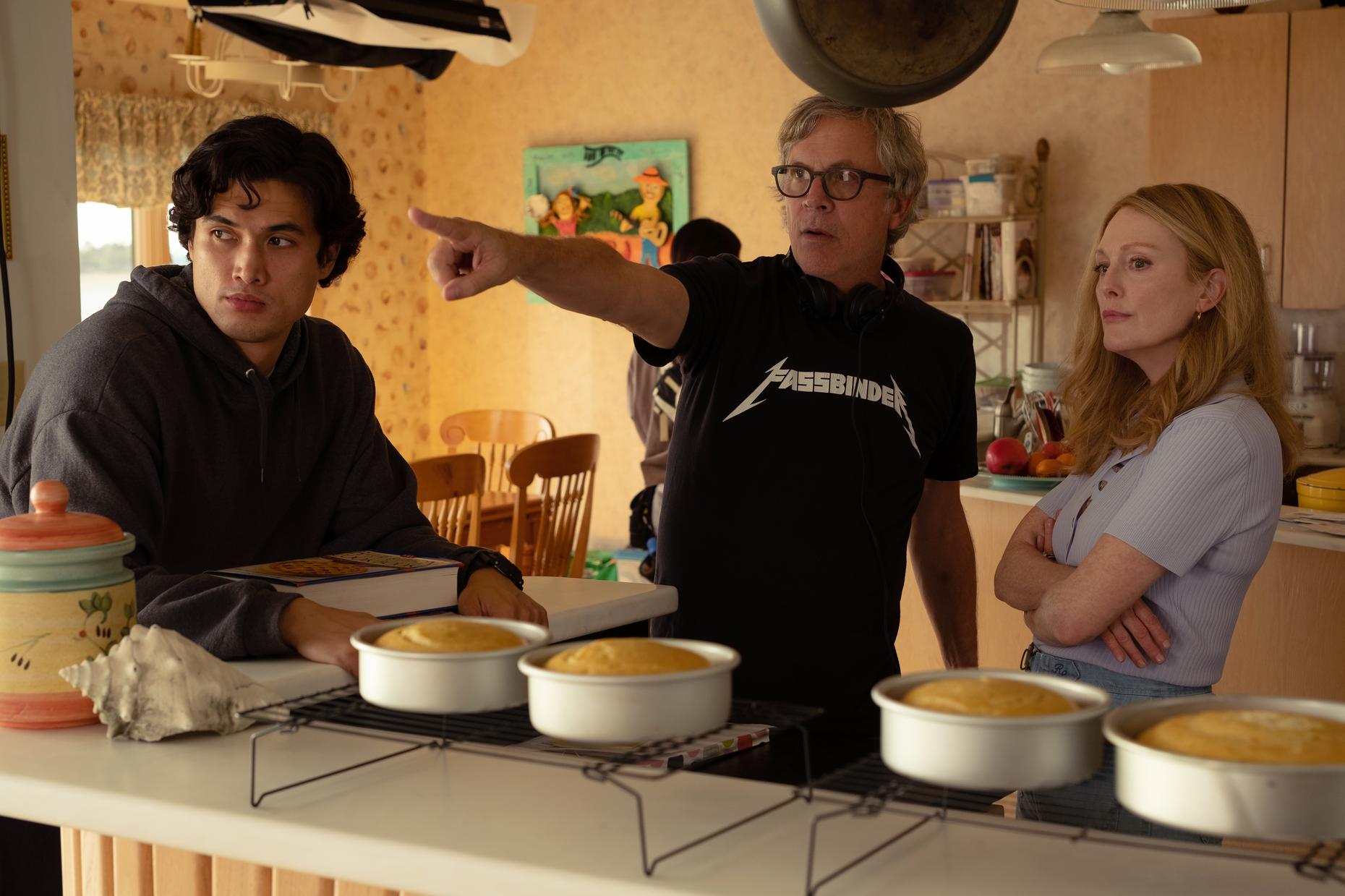
All Of It with Alison Stewart
The Independent Spirit Award-nominated Film 'May December'
00:28:48
Director Todd Haynes joined us to discuss his Independent Spirit Award-nominated film, 'May December.'
Loading summary
Transcript37 lines
- [00:04]
Todd Haynes
Listener supported WNYC Studios.
- [00:17]
Tiffany Hansen
This is all of it. I'm Tiffany Hansen in for Alison Stewart. So glad you're with us. The movie May December explores what happens when we forget that the lies we tell ourselves are lies. The film stars Natalie Portman as Elizabeth, an actress preparing for the role of a woman whose story is ripped from the headlines. Gracie Atherton Yu, played by Julianne Moore, believes that her relationship is like a Romeo and Juliet story. Two true loves separated by society. The thing that separated them is the law. She was jailed for the child rape of a 13 year old boy she met while in her 30s working in a pet store. We meet them 20 years later. That woman and now man Joe, played by Charles Melton, are married with children and living a normal ish existence outside of Savannah, Georgia until the actress Elizabeth shows up to study as part of her preparation. Her presence stirs up a lot and unspoken traumas become. Become bubbling up, come bubbling up and Elizabeth's motivations become murkier. Here's a clip from the trailer.
- [01:29]
Alison Stewart
Do you remember when you first met? You came to the pet store looking for a job. It was summer after sixth grade, seventh. Why do you want to play me? When they sent me the script, I thought here is a woman with a.
- [01:44]
Todd Haynes
Lot more to her than I remember from the tabloids. What would make a 36 year old woman have an affair with a 7th grader? People they like see me as a victim. I wanted it.
- [02:02]
Tiffany Hansen
May December was inspired by the real story of the late Mary Kay Letourneau, a teacher who had sex with her student in the late 1990s and later had a family with him. Letourneau died in 2020 at the age of 57. The film is nominated in five categories in this weekend's Independent Spirit Awards, including Best Feature, Best Screenplay, Best Lead and Best Supporting Performance for Natalie Portman and Charles Melton, respectively. Filmmaker Todd Haynes his is up for best director for the film. His previous films include the Velvet Underground documentary and Carol, starring Cate Blanchett. Haynes joined us back in November to talk about May December. When it first came out, Allison started by asking him what hooked him about the script after producer Natalie Portman had sent it to him.
- [02:53]
Todd Haynes
She sent me the script right at the height of COVID There was a lot of script circulating, a lot of stuff being read, a lot of speculation about when we were going to all get back to work and what we were gonna do next. So I was reading more stuff than usual. And this script by Sammy Birch, an emerging writer with an incredibly distinctive and Confident voice really impressed me in so many ways. I mean, I think it was this sense of discomfort that she conducts with such confidence in the course of the storytelling. And I think the initial stress of genius, I think in the way she structured it, is that it's all set 20 years after the fact, 20 plus years after the fact, after the tabloid event, after the arrest, after the incarceration. And so what you're really seeing is the way people survive these kinds of crises or try to. And in that way, to me, it was like, of course, it's this exotic, disturbing, extreme example of a story of a marriage, of a love relationship that crosses all these boundaries. But the way we all survive, our lives, our marriages, our commitments, is a universal thing that I felt, you know, sort of simmered through this script with such an interesting understatement throughout and tension. And so you're really observing this. What happens when this actor, as you described in your setup with the actress coming to town, played by Natalie Portman, begins to crack away at the very strong fortification that has surrounded this family all these years and kept them going?
- [04:40]
Alison Stewart
Yeah, they've all put things. And we've all done this, put things in little boxes and pushed them to the side so you can go forward. And here comes Elizabeth opening, Tipping. Open the boxes and saying, what's in there? What's in there, exactly. What's in there exactly?
- [04:52]
Todd Haynes
And you. And you initially think, oh, okay, she's gonna be our way in. She'll be the reliable narrator. She'll be the person that we can identify with as the outsider. And as the story starts to unfold, and it almost begins as a sort of investigative journalism process where she's interviewing people and she's interviewing Gracie and Joe and the kids and people in Gracie's life. And we set the film ultimately in Savannah, Georgia, in the Tybee island community beach community. It's about 20 minutes outside downtown Savannah. You begin to question, really, her motivations, how far she's gonna go, how many boundaries she herself will cross in the process of seeking the quote, unquote, truth of this story and serving her needs as an actor and representing this character, depicting this character that Julianne plays. And so you're left with this sort of shifting sense of fidelity between the two characters and trust that never really ever resolves. And what the film ultimately becomes, I think, is in the third act, is Joe's story. The man in the middle of all this who has sort of been locked up in decisions made for him when he was way too young. But that he has also been a dutiful father in his life. And he's raised these kids. And the family life has taken the focus of their energies and their time. And another thing that is looming over the story. Which only spans about three weeks in Savannah. Is the imminent graduation of the last two kids. The twins, who are about to leave the house. And all of a sudden, even before Elizabeth enters the scene. You feel that this couple is about to have to confront each other in ways they haven't all these years.
- [06:54]
Alison Stewart
This was originally set in New England. And so for practical reasons. It's too hard to shoot for three weeks in New England. But I'm wondering if relocating it to outside of Savannah. Which has got sort of its own energy around it. How could you use this new location. And the Southern island community. And island community ethos to tell the story?
- [07:19]
Todd Haynes
Yes. I mean, there were really interesting things about Camden, Maine, in the original concept. Camden, Maine, is almost the phantom city for Peyton Place. I don't think Sammy herself. And I think I may have visited Camden years and years ago. I don't think she had. But she used it for all those sort of evocative, mythical reasons. But it was practical purposes. When we finally realized when we might be able to make this movie. It was the only schedule that opened up for me. Julianne and Natalie was the fall of last year. And there was no way to shoot May. It had to be May. Graduation, graduation month in the Northeast. And anywhere in May in Maine. And Sam Lysenko is the production designer of this film. And he and I had just been working on another project that got waylaid. And I had just been to Savannah for the Savannah Film Festival. Not too long before. I'd been there a few times before for the festival. And we thought, wow, what about this place? This really could play for the spring. In the fall. It's laden with such disturbing layers of American history. It's also preserved in ways that is unusual for American cities architecturally. It's why people visit Savannah. And we thought didn't make sense that the Gracie character would be in historic downtown Savannah. Too exposed, too claustrophobic, too visible. But that would be a place you could imagine this actress coming and staying in. A little fancy inn, right? But we looked on the map and saw this little island, this island community. It's only 20 minutes away from downtown Savannah, of Tybee. And so we went and visited. It was just last August, at the height of the, you know, summer in Georgia. And found our instincts confirmed by what we saw and what we encountered, and we even, like, went off the beaten path of the Savannah Film Commission that was giving us suggestions of houses to look at for locations, and found that house that becomes a real centerpiece for the film. Found that street with the Spanish moss dripping off the oak trees on your drive toward these houses built in the late 70s, 80s. Put a note in the door of our favorite one and heard back from that guy while in town. You know, it doesn't always happen, but a series of sort of circuitous things and unexpected things and, you know, the surprises of filmmaking and the pressure of having very little time and very little money to get this thing made actually ended up producing all of these interesting outcomes. When we saw that house and we were in that humid, socked in, you know, marshland, thick with the precipitation lodge between the sliding glass doors in the living room and in the window, and it. The way it smudged your visibility out onto the. Onto the marsh land that it sits on, right in the dock in the backyard, it was like, yeah, this is even more. This seems even more fitting of a place that's secluded, that's isolated, that's enjoyed, it's sort of distanced from the rest of the world, but you're also trapped in it, and you can't venture freely within it. And it's beautiful, but it's also contained and sort of stifled.
- [11:14]
Alison Stewart
My guest is Todd Haynes. We're discussing his film May December. So Elizabeth shows up, this actress, and she is there to watch, to learn Gracie's mannerisms, she says, to understand Gracie's point of view. And when they first meet, they are sizing each other up, and they're eye to eye. And Gracie notes that they were the same size. What did you want to capture when these two women are eye to eye for the first time?
- [11:42]
Todd Haynes
I think initially you want to look at their differences. You know, they do remark on their similar heights. But I think the sort of suspense of the film is in the ways that slowly we watch the transformation of Elizabeth and her process of trying to pick up on the cadences and the styling and the makeup that Gracie wears and the colors that she wears and that you watch this slow transformation of one actor becoming this character, trying very hard to embody who this woman is physically. But you realize along the way that it's more than physically, that there are things about each of these women that remind you of each other in ways that one suspects they're not entirely prepared to see in themselves. And those ways of seeing and not seeing, those ways of being able to look at things around you, but not at yourself. I think, create this whole dynamic, the subtext that's going on through the film. And it's played out in these sequences that I, at an early stage of the preparation process, I thought would be best served in shots that hold and frames that feel discomfortingly long and static and unyielding. And, you know, look, I could not read this script and not think of films like Persona, Bergman's Persona. Right off, Right. The process of these two women who kind of are merging with each other and starting to blur, one of whom, in fact, in that film is an actress and the other is a caretaker who comes to serve her when she has a event with stage fright and has stopped speaking. And there are those frames that are ever, you know, emblazoned in my memory as a filmgoer of Liv Wolman and Bibby Anderson sort of circling each other, comparing hands in the backyard, wearing those matching white straw hats in the beautiful. Sven Nyqvist cinematography, you know, and then ultimately looking toward the lens of the camera together as if it's a mirror. And in our film, we have all these scenes in mirrors.
- [14:17]
Alison Stewart
Yeah, there's a lot of mirrors. I mean, some of them, I imagine, were quite difficult. There's a scene in a dressing room.
- [14:24]
Todd Haynes
Yeah.
- [14:24]
Alison Stewart
Where we see. We see all different sides of these two women. And we get an inkling. Not only do we see the way they're reacting to the young daughter trying on clothes, we get an inkling of Gracie's meanness towards her daughter and the sense that she is not this sweet, demure, possibly victimized person. She's got a mean streak.
- [14:48]
Todd Haynes
She's got a mean streak. And that you also realize this is an inheritance.
- [14:53]
Alison Stewart
Yeah.
- [14:53]
Todd Haynes
That you feel like this is something that is not just originated in Gracie, that it's most likely something that she learned from her mother. I think that scene that starts to talk about her daughter's body as she's trying on different dresses for her graduation. I think there are very few women in the world who don't watch that scene and recognize that conversation and the lack of consciousness about what's being said. It's just that it's being said with a stranger with incredible power and influence who's witnessing it. And it puts it into another frame, a heightened frame that makes us, the viewer, even more uncomfortable watching it. But it's not necessarily something that we haven't seen played out between mothers and daughters for generations.
- [15:44]
Alison Stewart
The two women, as you said, we're looking to see how much alike they are and how different they are, and there's lots of little, really great details. And I'm sure you, you know, obviously you worked with your costume designers. I'm thinking about Natalie Portman's character. Elizabeth shows up, and she's trying to dress down, so she's got the hat and the sunglasses on, but she's wearing a Cartier bracelet and watch. So she's got about $6,000 on her wrist. And that wouldn't even come to her mind to take that off.
- [16:10]
Todd Haynes
No, no. And yet the rest is, like, the black or the maroon, shifty, the dress, the little straw hat that's trying to sort of, you know, deal with the climate and so forth. No, there's an unconsciousness about her, obviously, that you mark at the very beginning, and yet you accept and you sort of go, oh, yeah, of course, she's from Hollywood and she, you know, she's an actress, and how nice is she gonna be to these local folks in the south? And how mean is she? You know, whatever. These are the kind of questions you begin asking until you really start to see major shutter vision on the part of this character and how the lengths to which she really is going to go to serve her own needs and how disposable the people around her really are.
- [17:02]
Alison Stewart
We're discussing the film May December with its director, Todd Haynes. We'll talk a little bit more about the character, Jo, as well as the use of music in the film after a quick break. This is all of.
- [17:22]
Tiffany Hansen
Welcome back to all of it here on wnyc. I'm Tiffany Hansen in for Alison Stewart. So let's get back to Allison's conversation with Todd Haynes, who is nominated in the Best Director category of this weekend's Independent Spirit Awards for his film May December, which is additionally nominated for Best Feature and Best Screenplay. Two of its stars, Natalie Portman and Charles Melton, are also nominated for Best Leading and Best Supporting Performance, respectively, for a grand total of five categories that May December is nominated in. So let's get back to Alison's conversation with director Todd Haynes. She asked him how he and his team picked Charles Melton to play alongside the powerhouse talents of Natalie Portman and Julianne Moore.
- [18:07]
Todd Haynes
It was a process that I, you know, went through with my longtime casting director, Laura Rosenthal. New York Bass. We have a wonderful, long and rich relationship, and there are certain films that require the discovery of certain actors who may. Who may not be very well known, but who have a disproportionate impact on how the film really works. And this was Certainly the case with Jo. Jo is a half, half Korean kid raised in this community who we learn from the stories of the past as it's on, as it sort of filled in. Got a job at a pet shop, working part time when he was a teenage, young, young teen. And that's how he met Gracie and where this, this, the sexual and romantic relationship began. So we did our job. You know, we put out a breakdown for the, for the character and got tapes of actors reading for the role and some really fine and interesting Korean actors and half Korean actors and. But Charles, and Charles is an actor who some people know from the show Riverdale. He began, I think, in the second season of Riverdale, which is very well loved for followers of that show. I had watched it when it first started. I saw a couple episodes at the very beginning when it premiered. But I did not see Charles on that show. So I didn't know his work. And what Charles did on that audition tape was absolutely distinct from what other actors were doing. And I think it was the other actors interpretation of Joe that felt a little closer to what I had imagined him to be. And this is again, in hindsight, what you realize is the incredible part of the creative process is that the serendipitous ways that you find and meet people and the way you're introduced to this actor or that location or this setting or this creative partner deepens what you're doing and makes it more specific and teaches me, the director, more about what the story is. Charles was more pent up and more tentative and more almost like preverbal. Like you really saw somebody who had been so completely physically shut down and was dutiful and was supportive of Gracie and her private panics in the bedroom that we witness. And he was a loving father to these kids, you know. But I all of a sudden saw not only the present of story of Joe, but I saw the past as well in ways that I think I was almost holding off from being able to fully confront.
- [21:19]
Alison Stewart
You know, I want to say it's the. This is funny. There are some very funny moments. And it's about pacing. It's about you use music and use visuals to bring some humor into it. Was that in the script or was that something that you and your screenwriter discussed?
- [21:40]
Todd Haynes
No, it was, it was in the script. I don't think we ever. They're situate. The humor is situational and character based. And so it's not like gags or jokes or things they don't sit on top of the content of the Film of the storytelling and the writing. And you don't know how you feel about them as you read them. That's the thing is you're sort of interrogating yourself as you. That's how I felt when I first read the script. And that was what I so loved about it. And wanted to find a way in the film that that would be available to the audience. That they were almost compelled to be interpreting what they're watching. But that it should be a pleasurable. Even with the discomfort that it stirs up. And the way it keeps asking you to shift your sort of expectations and stuff that you bring to a story like this. I think it was in the editing room where my editor, Fonzo Gonsalves, and I would be watching these scenes unfold and go. Because we weren't laughing out loud while shooting it. We also were just racing through. We shot this movie in 23 days in Savannah under a very tight schedule. We were having a fantastic time. It was a real synergy among the creative partners and the actors on this film. So it was a very positive experience despite those challenges. And I made some strong choices about how to frame it and shoot it. That didn't really have alternative options.
- [23:16]
Alison Stewart
You get what you get. You don't get upset.
- [23:18]
Todd Haynes
There was one way to do it. And if it didn't work, I don't know what we would have done. It's a very restrained, austere kind of visual language. But so you. And this is true for any movie. However you shoot it and however much time you have. You're getting to know what it is as you're cutting it. You don't have time to really assess what it is while you're shooting it. You're just trying to get all the pieces. And then you start to live through it. And breathe through it. And watch it play out and it's. And find its whole, whole body. And it's all shape in the editing room. And it's a mysterious part of the process. And you also have to leave all your expectations behind. All the projections that you had and the. You know, the visuals and the planning. It's all finished. Whatever stage you're in in the present is all you have. And you have to make it work.
- [24:10]
Alison Stewart
Let's talk about the music. It's really important in the film and its placement in the film. So I want to talk about two composers. The first is it Michel legrand score from 1971. The go between. This involves a young boy who has a crush on an older woman. How did that music become a part of the film?
- [24:29]
Todd Haynes
I suspected that part of the way you could have that kind of fun sense of interpretation while watching this movie is through various kinds of framing elements. And I thought music could be one of those. And so while I was putting together my image book and looking at movies and getting ideas and inspiration and trying to put it all on the page to share with my creative partners, which is the way I like to work, I watched the go between on Turner Classic Movies one day. Now, this is a film. It's a Joseph Lozi film from 1971, very well regarded. Julie Christie, Alan Bates, beautiful film. Right. But it's a film that's sort of fallen out of circulation in the United States. It's very. Doesn't show up much. And I think I saw it when I was a teenager, when it came out, a young teen and haven't seen it since. And I watched this film and I was astonished by this Michelle Legrand score that plays so boldly and ominously right up front and is basically ahead of the story that starts to unfold as you watch the film. And I was like, wow, that is so interesting. The subject matter of the film has maybe some vague parallels, but they're, they're quite different from. It's a very different kind of movie than it's set in the turn of the century in England and it's a coming of age story of a 12 year old boy. And it's. But the, and the music arguably sits at as far outside, if not more so of that film and your experience watching it as it. As it does at times in May, December, or at least as up front and in your face. And so I started to just add the score when I finished my image book and sent it around to my partners, I was like, play this score while you turn the pages of the image book.
- [26:26]
Alison Stewart
Let me play a little bit.
- [26:27]
Todd Haynes
Yeah.
- [26:45]
Alison Stewart
So we get the drama. We understand it's a little bit like, to your point, it's a little bit ahead of the story.
- [26:51]
Todd Haynes
It is.
- [26:51]
Alison Stewart
And then how does the second composer come in?
- [26:53]
Todd Haynes
Well, Marcelo was always going to be my composer for the film. And I just. This was just Marcelo Sarvros, Marcelo Zarvos. And I've worked with Marcelo on one other project prior to this, Dark Waters. And it was a wonderful experience and he's a brilliant composer. And when I found this music, I sort of, just for the sake of putting us all in the same place in sort of method while making the movie, I literally dropped cues into the script. And we would play those cues while we shot the movie for all the actors and the crew. And I sent. And I initially did that for Marcelo. And I said, marcelo, the score is crazy. It's gorgeous, wild. It breaks every rule of what. Of what film scores do. And he. He was like, oh, my God, this is amazing. And I kind of hoped he. I was thinking, he's a very busy in demand composer. And I thought if he had time, he could send us little sketches of ideas while we were shooting and we would throw those in. But what it did is it just became more and more affixed to what the film was becoming. And we cut the film to the score. And this is usually where temp scores come into play when you're cutting, not when you're shooting a movie. And finally I came to Marcelo with my tail between my legs, and I was like, marcelo, I think we need to incorporate this remarkable Michelle Legrand score and have you make it your own and rerecord it and rearrange it and bring in these tonal and other elements that we'd thrown into the temp. And he did just that. And the result is something really pretty extraordinary.
- [28:44]
Tiffany Hansen
That was director Todd Haynes in conversation with Alison Stewart. The film they were talking about is called May December. Nominated for five Independent Spirit Awards, that award ceremony is being held this weekend.
- [28:57]
Ira Flatow
This is Ira Flato, host of Science Friday. For over 30 years, the science Friday team has been reporting high quality science and technology news, making science fun for curious people by covering everything from the outer reaches of space to the rapidly changing world of AI to the tiniest microbes in our bodies. Audiences trust our show because they know we're driven by a mission to inform and serve listeners first and foremost with important news they won't get anywhere else. And our sponsors benefit from that halo effect. For more information on becoming a sponsor, visit sponsorship.wnyc.org.