← All Of It with Alison Stewart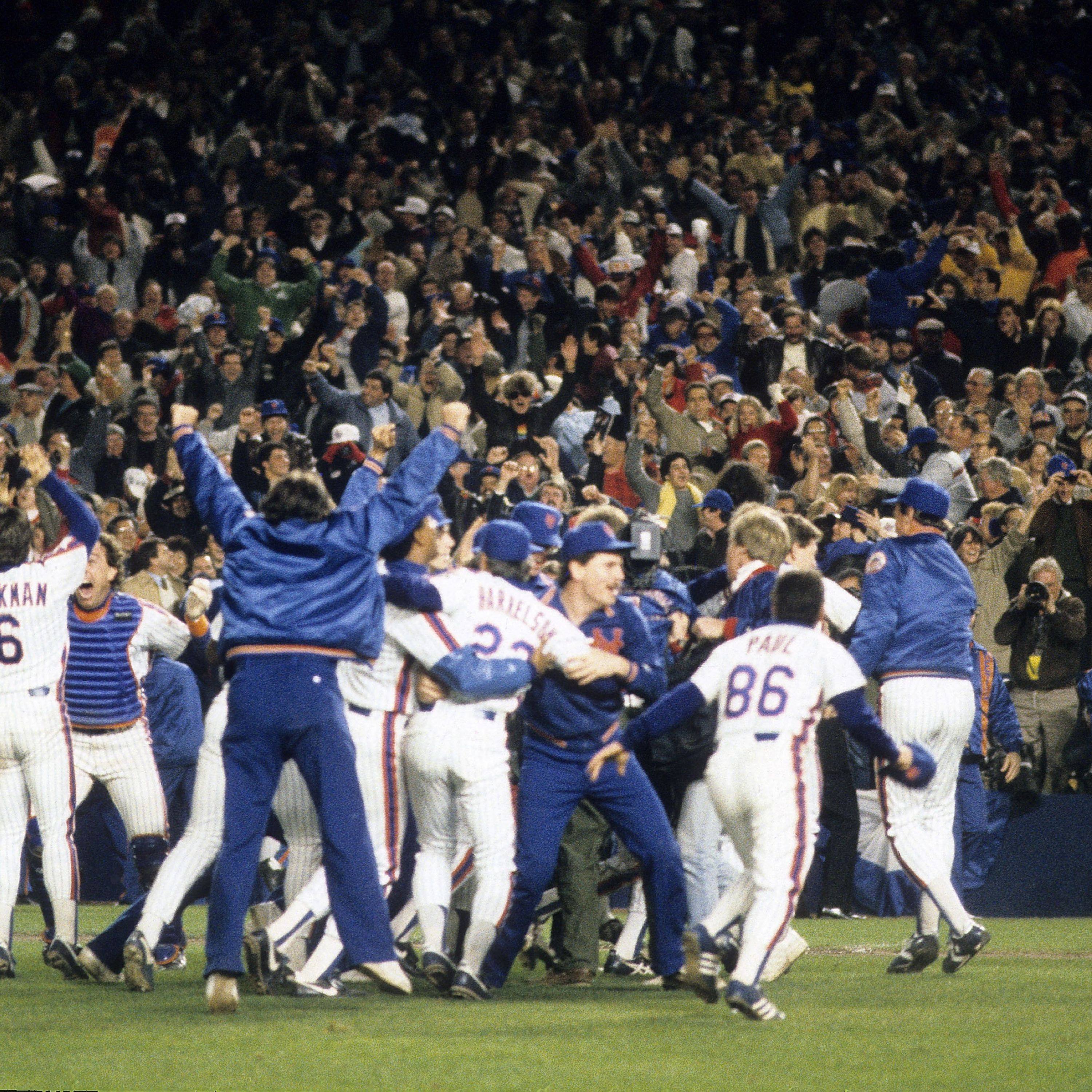
Loading summary
Transcript72 lines
- [00:00]
Progressive Insurance Announcer
WNYC Studios is supported by Progressive Insurance. Did you ever think about switching insurance companies to see if you could save some cash? Progressive makes it easy to see if you could save when you bundle your home and auto policies. Try it@progressive.com Progressive Casualty Insurance Company and affiliates. Potential savings will vary. Not available in all states.
- [00:29]
Alison Stewart
This is all of it on WNYC. I'm Alison Stewart. This year is the 40th anniversary of the 86 Mets who won the World Series. It was the last time the team won the World Series. The Mets beat the Red Sox in seven games. But of course, the most famous moment of the Series is in Game 6 when the Mets came from behind with a hit through Bill Buckner's legs. Let's listen to that moment as called by Vince Gulley.
- [00:56]
Andy Gitlitz
Can you believe this ball game of Shay?
- [00:58]
Alison Stewart
Oh, brother.
- [01:01]
Andy Gitlitz
So the winning run is at second base with two out, three and two to Mookie Wilson. Little roller up along first, behind the bag. It gets through Buckner, here comes Knight
- [01:17]
Jason Isaac
and the Mets win it.
- [01:19]
Alison Stewart
This Saturday, August 1st, the Mets are inviting the World Series winning team back for a reunion as the 2026 Mets play against the Miami Marlins at Citi Field. And it certainly will be a welcome wave of nostalgia given how the season is going. This for the team. AM Gitlitz is the author of the book Metropolitan's New York Baseball Class Struggle and the People's Team. He's here with me now to reflect on 40 years since the 86 Mets and to hear your memories. Andy, welcome back to wnyc.
- [01:48]
Caller
Thanks.
- [01:48]
Andy Gitlitz
I was very relieved. We're not talking about the 2026 teams.
- [01:51]
Alison Stewart
No, we're not. We're talking about the 86 Mets. Your book says you're right on the COVID The Mets are the people's team. How did the 86 mechs factor into the focus of the book?
- [02:03]
Andy Gitlitz
Yeah, so it's a political history of New York baseball in which the Mets are the main character. And so I try to look at the team history and connect it with these moments, these social and political moments in New York history. And the 80s is one of the clearest examples of that, especially 86, because this is, you know, 86 is 10 years since the start of the fiscal crisis, which is one of the darkest times for New York and the Mets. This is the Grant's Tomb era that, you know, really only started to end, started to look better at in 1980 when the team is bought by a new ownership group, including Fred Wilpon, who's also central to New York's financial recovery. He was a real estate tycoon who helped build the suburbs during the White Flight era. And then in 1986 he completes the Lipstick Building in Midtown east, which was the headquarters of a lot of the companies that were central to this economic optimism, this financialized sugar rush, amongst other kinds of substance induced rushes in the 80s. You know, Telecom, Telecom plus was there Citigroup, Bernie Madoff Enterprises, which is a story for another chapter. So the recovery of the Mets under Wilpan and the recovery of New York are similar stories and they kind of both reach a peak in 86, of course, before the crash of Black Monday in 87 and the crash of the Mets also in 87. 88.
- [03:34]
Alison Stewart
Listeners, those of you who are Mets fans, what are your Memories of the 86 World Series winning team? You can call or text us now at 2124-3396-9221-2433 wnyc. You can tell us who your favorite player on the team was. Is there a moment that stands out from that? The atmosphere in New York, like when the Mets won the World Series? 2124-339692-22433. WNYC. Andy, what do you think about the 86 team? What did it represent about fan culture around the Mets?
- [04:12]
Andy Gitlitz
Well, I think this was a moment when the fans and the team really were kind of on the same page. They really looked like one another. The Mets were a diverse team, a lot of black and white stars. They had working class origins and the team was really fighting for New York in a way. Throughout the 86 season, there were a lot of on field brawls and also off field brawls. Three of the players were arrested in Houston outside this Wild west themed bar for accidentally fighting with some off duty cops who were working as bouncers and the fans themselves were fighting. For example, in Philadelphia in September there was like a mini riot when the Mets narrowly missed their pennant clinching game. So it felt like New York was really trying to say, hey, we're back, we're on top again. We're the greatest city in the world again. And the Mets seemed to be part of that. And the media actually really decried the Mets for this. They connected the raucousness of the team, the reputed hard partying and fighting of the players with the hedonism of the yuppies downtown and the violence of the inner city. But the fans didn't really seem to care. I think they loved the team. They saw them as much like them and this is really shown in game six, like you mentioned, when there's this army of police trying to keep alcohol and props and signs out of the stadium. But the game begins with a soap opera actor, Mike Sergio, parachuting into the game, showing that the Mets were gonna. Were gonna party one way or another.
- [05:48]
Alison Stewart
Yeah, let's talk to Mike in Flatbush. He has a memory of the parachuting into the game. Hey, Mike, thanks for calling all of it.
- [05:56]
Caller
Thanks for having me. Yeah, I remember I had a family friend, was his neighbor, and he ended up parachuting into an Evander Holyfield fight a few years later. But what I remember about the. The 86 series was it was just part of the whole scene. Like, as people were saying with the Knicks, like, the vibes were immaculate. And back then, before 9 11, things were a lot, you know, chiller in the skies. So he could do that. He probably was slapped with a couple of things, but, like, his life wasn't ruined. He was just a folk hero about it. And I appreciate giving us the chance to reminisce rather than deal with this wreckage that is the season this year. Thank you.
- [06:42]
Alison Stewart
Let's talk to Robert in Queens. Hi, Robert. Thanks for calling all of it.
- [06:46]
Caller
Oh, hi. And thanks to your screen reporting, putting me on the air, because what I really going to share is just a very personal, sweet little addendum to this series that I remember vividly, which is, and I told him I went to two games in person with seats behind home plate for a total of $10. And which, you know, today you have to add a lot of zeros, but
- [07:16]
Andy Gitlitz
this season, tickets aren't too expensive, actually.
- [07:21]
Caller
Thanks. Well, I didn't have tickets and I couldn't get anybody to show up with me on the ludicrous chance that I would get good tickets. So I'm in Queens anyway, and I just went over somewhat early, but not, you know, many hours early. And I'm milling around. I had learned how to work the lines at Shea pretty well, but in this case, I just went to whatever seemed the best one, and this guy was holding up a ticket and he said to me, do you need a ticket? I said, yeah. And he gave it to me. It was a seat behind home plate, free.
- [07:58]
Progressive Insurance Announcer
That's pretty good.
- [07:58]
Caller
I went the next.
- [08:00]
Alison Stewart
What say go, go ahead, finish. Finish up.
- [08:02]
Caller
Yeah, it was.
- [08:03]
It was great. I went the next night. I didn't know if I could repeat this ludicrous incident, and I didn't. I.
- [08:13]
Alison Stewart
But thank you so much for calling, Robert. We really appreciate you Taking the time on August 1st, the Mets are celebrating the 40th anniversary of the World Series 86 Mets by inviting the team back for a reunion at Citi field. Reflecting on 40 years since the 86 Mets with Andy Gitlitz, author of the book Metropolitan's New York Baseball Class Struggle and the People's Team. We have a guest, Andy in studio, Jason Isaac, who you may have heard of one of our engineers, is a huge Mets fan. Jason, what does the 86 Mets team mean to you?
- [08:48]
Jason Isaac
Hi, Alison. The 86 Mets were the team that made me a Mets fan for life in 1986. I was 10 years old, so this, this is going to sound familiar, probably to knicks fans in 2026 who were 10 years old. I had never been interested in sports before that. I was a nerdy little kid, not athletic at all. I was into science and comic books and. But my grandfather had been a Mets fan and started telling me about the. All I knew about the Mets when I was very young was they were bad and the Yankees had Reggie Jackson. So everybody was a Yankees fan. But my grandfather started telling me about the Mets. They had a player named Darryl Strawberry who was going to be real good. And I thought that was the funniest thing ever. Strawberry. And then in 84 and 85, my friends in school started becoming Mets fans too, because all of a sudden they were kind of good. So anyway, April 1986. One night I finished my homework, I'm just flipping through the channels looking for something to watch, and I land on Channel 9. The Mets were playing and hey, it's that guy Dwight Gooden everybody's been talking about. He's pitching. And nine innings later, Dwight Gooden struck out 10 Philadelphia Phillies in a complete game. The Mets had a win and I had a new obsession. And I watched every game probably for the rest of that summer and several years to follow.
- [10:19]
Progressive Insurance Announcer
Andy, he mentioned Doc Gooden, right? What made Dot such a great pitcher?
- [10:26]
Andy Gitlitz
Well, he was a real phenomenon and like the fact that he came up with this team as they were recovering from such a dark era to competitiveness in 85. And he was just immediately celebrated as a savior, a kind of people's hero. There was the K corner in the left field where people would hang ks. This is the start of a tradition in baseball that still exists. They still have the K corner at Citi Field today. And he was, interestingly, not really a part of that swaggering, sort of Animal House style scum bunch of the team. He really kept to himself. He was maybe Kind of like you or me when we were kids, kind of shy and nerdy and doing our own thing. And I think pitching is a particularly intellectual pursuit. And he was one of those guys who really made it into an art.
- [11:18]
Alison Stewart
Did you have a favorite player, Jason?
- [11:20]
Jason Isaac
Well, Gooden was definitely one of them. I didn't have a single favorite player, but I liked a bunch of those guys. I really thought Keith Hernandez was super cool and I loved his style of play, especially as a fielder. He was this brilliant Gold glove first baseman. But I also like some of the role players. I liked Roger McDowell who was the one of two, you know, firemen, relief pitchers they had because he was a practical joker and he was like lighting shoes, lighting his teammates shoes on fire in the middle of the game, stuff like that. You know, they called it the hot foot. I liked Kevin Mitchell, who was a rookie and he played six different positions that year. And he was a real like stocky guy who looked like he should be a power hitter. But Davey Johnson had no hesitation to put him in at shortstop if he needed him there. And he was great. And they had a backup catcher named Ed Hearn who I liked because he had these big goofy looking glasses, kind of like I was wearing at the time, you know, so 10 year old me could. Could kind of relate to different aspects of, of the. The team.
- [12:21]
Alison Stewart
Jason, thank you for your time.
- [12:23]
Jason Isaac
Thank you, Alison.
- [12:24]
Alison Stewart
This brings me to a question for you, Andy. Can Andy speak to the team's ownership, Davy Johnson, seasoned teammates and absence of supervision and guidance for the very young Doc Gooden and Daryl Strawberry, corresponding to the impact on their personal lives?
- [12:40]
Andy Gitlitz
Yeah. So one kind of theory that I go through in this chapter is that Davy Johnson was a really brilliant pioneering manager, especially in the field of sabermetrics. He really was one of the first to bring computer generated lineups into making. And this was, you know, kind of confusing and annoying to players at times. But as long as the results on the field were there, as long as everybody was playing up to their statistical potential, he could kind of just ignore their personal lives. You know, he. Any if the. If half the team was going to the strip club after the game and showing up hungover the next day and taking amphetamines to get through the game, that was none of his business. His business was what happened on the field. And so I liken this to the dawn of the cybernetic era in general, where your work life and your personal life could be totally separated. And so the social ramifications of this economic recovery could kind of be ignored for the time being.
- [13:43]
Alison Stewart
Even for the World Series against the Red Sox, the Mets had to get through the Astros. What was a memorable moment from that series?
- [13:52]
Andy Gitlitz
Well, something that Mookie Wilson called the Dred Scott decision, which is Houston had this incredible pitcher who. People have to see it to believe it. Check out his pitches on YouTube. The break on these balls were like nothing I've ever seen. And it was pretty widely known or alleged, pretty widely alleged that he was putting sticky substances on the ball or throwing spitballs or something, and the team was begging the MLB to reign this in, and they sided with him. And so this was another. This was another obstacle that the team had to overcome. And they. They could barely hit him at all. So the fact that they won that series is a small miracle.
- [14:36]
Alison Stewart
We're talking to Andy Gitlitz. He's the author of the book Metropolitan's New York Baseball Class Struggle and the People's Team. We are celebrating the 40th anniversary of the World Series winning 86 Mets. We want your Mets memory when they won the World Series. Our number is 2124-3396-9221-2433. WNYC. Let's talk to Barbara in Brooklyn. Hey, Barbara, thanks for calling all of it. You're on the air.
- [15:04]
Caller
Hi.
- [15:05]
Thanks.
- [15:05]
Oh, the 86 Mets were so great. And me and my friends went. They were long. We were both longtime Mets fans, and I did redial to get the tickets and stuff. I was at work, you know, redial, redial, redial. And they got the tickets and they could go. And we went anyways, when they won that game, and we felt the stadium shake. Old Shea Stadium is shaking because everybody was so excited.
- [15:34]
Alison Stewart
Thank you so much for calling in.
- [15:35]
Progressive Insurance Announcer
Yeah. How would you describe the atmosphere that night at Shea?
- [15:39]
Andy Gitlitz
I mean, that's another thing that every Mets fan needs to watch is the entire game six is on YouTube and throughout it, Vin Scully is constantly making these comments about how crazy the volume of the crowd is and how excited people are. And it. You know, it's a game that the Mets were losing for most of it while Roger Clemens was pitching. They tie it 3, 3. Late in the game in the 10th, the Sox go up two runs. And then it. The Mets are down to their last out, and another magical thing happens. There's a jinx on the scoreboard. They prematurely say, congratulation, Red Sox. And this maybe brings the stadium back to life. And then it brings the team back to life. They tie the game. Mookie Wilson. So they get one run. Mookie Wilson comes up, has this incredible at bat. A wild pitch ties the game and then he hits that ball through Buckner's legs. And the Sox can't believe it. The champagne was already in their dressing room. And the Mets go on to win the next night. And it all seemed to come back to this slogan that the new Mets ownership had when they took over in 1980. The magic is back.
- [16:50]
Progressive Insurance Announcer
Let's talk to Don, who is calling from.
- [16:54]
Alison Stewart
I'm not sure where you're calling from.
- [16:55]
Progressive Insurance Announcer
Don is in the Lower east side. Hey, Don, thanks for calling all of it.
- [16:59]
Caller
Hi, thanks for having me on. Yeah, I have great memories of that series because I was at the second and the seventh game that year. I had with some friends a Saturday ticket, which I don't think they. That doesn't exist anymore. But one of the benefits of getting that every Saturday ticket was you were going to get two tickets to World Series games if it went to seven games. So everybody remembers the sixth game because it was so crazy. But the Nets weren't guaranteed to win the seventh and it didn't start well. They were down three to nothing and Ron Darling wasn't doing the job. So my, my nominee for the savior of the 1986 series is Sid Fernandez, who came in and shut the. Shut Boston down seven straight huts. We walked the first guy, but then seven straight outs.
- [17:43]
Progressive Insurance Announcer
Thanks for calling in. This says I was a 15 year old in 86, was at the game with my 18 year old brother and it was as incredible as you can imagine. The parachute, the Buckner moment. Everyone went nuts. We were hugging sweaty strangers. I remember a lot of people left the game early thinking it was hopeless. I wonder if any of your listeners left early and would admit it. When did it seem hopeless?
- [18:04]
Andy Gitlitz
I mean, it looks pretty full from the video and it would be a really sad thing to leave a World Series game early. You know, I went to the NLCS, a game against the Dodgers in 2024 and the Mets were down 10 runs. But I was not leaving.
- [18:21]
Alison Stewart
This is interesting. It says I was at game six and a friend and I were planning to go meet two girls after the game club in Huntington, New York. We decided to leave early before the end of the game to beat the rush out into the parking lot only to hear screams when the ball went through Buckner's leg. Back inside to enjoy the celebration. To this day I regret walking out and miss seeing the play unfold. Why is that such a moment? When the ball went through Buckner's legs. Why is it such a memory that people can't forget?
- [18:53]
Andy Gitlitz
I mean, I think part of it is it's such a Mets moment. Of course, we think of it that way now because it's in the past. But this is the story of the mets in the 60s. They were the worst team in baseball until 69, when they won this miracle, almost millenarian championship that seemed to correspond with the emerging youth movement and the positivity that people felt at the end of the 60s. And so for them to have this swagger and this certainty that they would win all through 86 and then to almost blow the World Series, it's almost like they needed to be underdogs again. And something weird and magical like the black cat incident of 69, when a black cat curses the Cubs during the pennant race. Something like that needed to happen for it to be a true Mets win. And I think as Mets fans who know that history, that's what we're all waiting for.
- [19:47]
Alison Stewart
Let's talk to Jill, who's calling from Manhattan. Hey, Jill, thanks for calling all of it.
- [19:53]
Caller
Hi, thanks for having me on. I was a freshman at SUNY Albany that year, and my parents were visiting for Parents Weekend. We went to the Joe Piscopo show because he was performing for the parents and the kids, and someone screamed out from the audience, what's the score of the game? And he said, you want to know the score of the game? Literally walked off the stage and everybody was stunned, thinking he was coming back. Never came back. Went back to the hotel to watch the rest of the game. And that stuck out for me and a lot of people that weekend.
- [20:27]
Alison Stewart
Thanks for calling. Let's talk to Charles and Chelsea. Hey, Charles, what's your memory?
- [20:32]
Caller
Oh, I have several memories. I went to all four games. I'll never forget leaving game two at Shea Stadium, and it was deathly silent as we walked down the ramps because they had lost and went up to Boston, down to zip. So then everything changed in Boston, and Game 6 was nuts. It was crazy to be there. And it's something I'll never forget.
- [20:53]
Alison Stewart
Let's talk to Kate in Jackson Height. Hi, Kate.
- [20:57]
Caller
Hi.
- [20:57]
How's it going?
- [20:58]
Alison Stewart
Doing okay.
- [21:00]
Caller
I was also at game six. I was nine at the time. And in fourth grade we all played Little League every day. We would arrive at school and hang out outside before school started and talk about the game the night before. And when we left that day, everyone was like, oh, gonna watch the game. Can't wait. And I got home and somehow my dad had come up with tickets. And we went and it was the coolest. Not only did we see the Buckner play, obviously, but I remember specifically that someone parachuted onto the field in the middle of the game, which was really crazy. And I got interviewed by the local news after, and it was really exciting. Now I live in Queens. I have a three year old. We went earlier this summer and we saw Soto hit a grand slam. So he kind of has a good luck charm about the Mets.
- [21:49]
Progressive Insurance Announcer
Very nice.
- [21:49]
Alison Stewart
Thanks for calling in. It's been 40 years since the 86 Mets. What should the team mean to the fan base today?
- [21:59]
Andy Gitlitz
Well, you know, I'm so jealous to hear these stories from the callers because
- [22:03]
Alison Stewart
they're great, aren't they?
- [22:03]
Andy Gitlitz
I was born about nine months after the 86 World Series, maybe not coincidentally, so I never got to experience a Mets championship. And, you know, I've been in the city when the Giants won the super bowl and when the Yankees won the World Series. But I had never seen anything like when I was writing the book, reading about what the city was like for 86 and 69. I had never seen anything like that until this year. And so with the Knicks winning in June and everybody watching it on the street, every radio listening to it, everyone talking about it, everyone wearing Knicks stuff, fireworks going off when they won, weeks of partying afterwards, and the ticker tape parade, that's the first time I ever experienced anything like. I think it's probably, you know, that moment's probably different in terms of volume and demographics and stuff, but the way sports writers and fans remember 86 and 69, it's identical to what I experienced this June with the Knicks.
- [22:58]
Alison Stewart
The name of the books is Metropolitan's New York Baseball Class Struggle and the People's Team. It is written by AM Gitlitz, Andy Gitlitz. Andy, thank you so much for joining us on all of it.
- [23:11]
Caller
Thank you.
- [23:12]
Andy Gitlitz
Thanks so much. Let's go, Metz.
- [23:13]
Alison Stewart
Let's go, Metz.
- [23:14]
Andy Gitlitz
Suffering from dry, tired, irritated eyes. Don't let dry eyes win. Use Sustain Pro.
- [23:20]
Jason Isaac
It hydrates, restores and protects dry eyes for up to 12 hours.
- [23:24]
Andy Gitlitz
Sustain Pro, Triple action Dry eye relief.