Loading summary
Transcript26 lines
- [00:10]
A
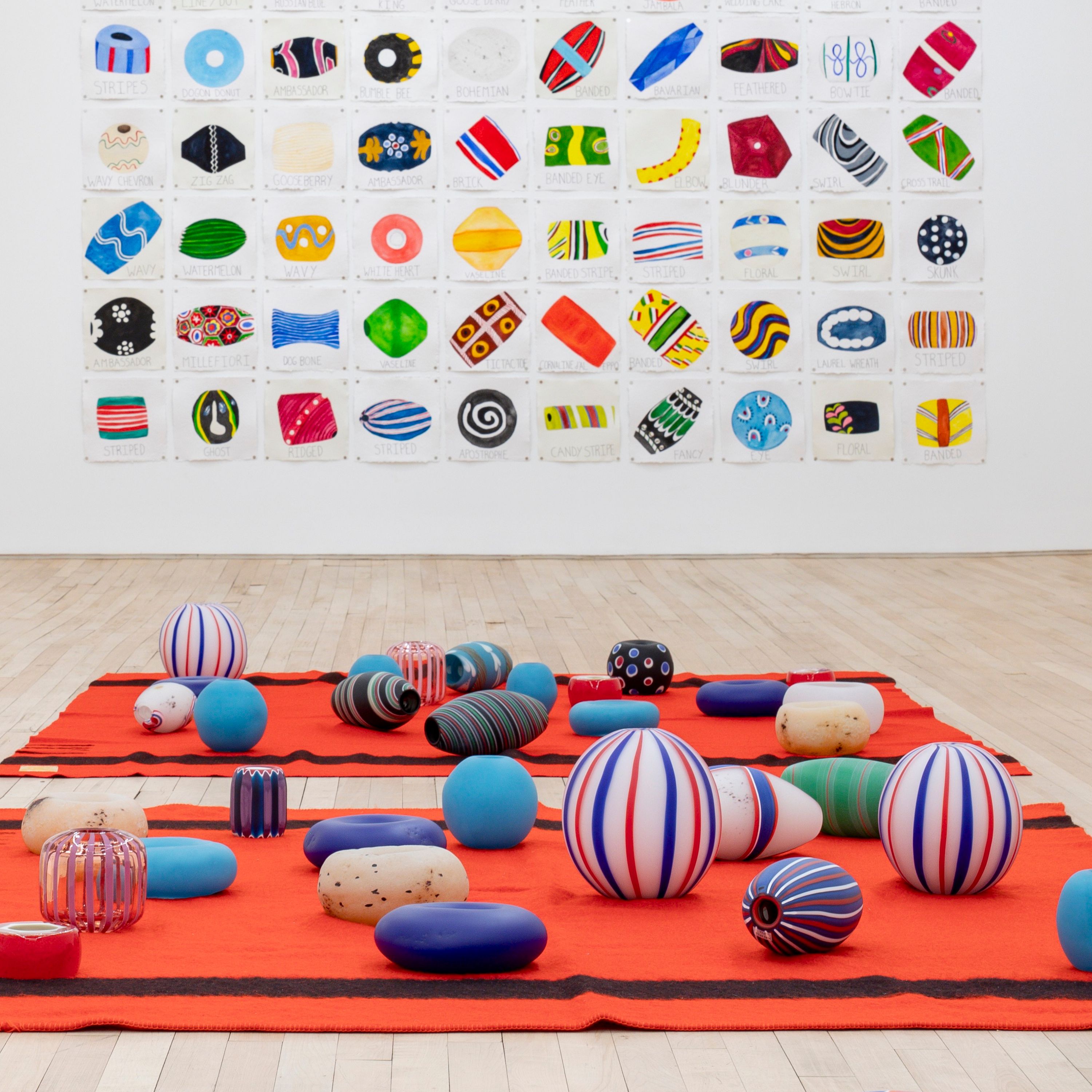
You're listening to all of it on wnyc. I'm David Fuerst, in for Alison Stewart. The indigenous artist Wendy Red Star has a new exhibit at the gallery Sargent's Daughters in downtown Manhattan called One Blue Bead. You may have heard a familiar legend that was part of the inspiration behind this collection. The story goes back to back in 1626. The Dutch purchased the island of Manhattan from the Munsee tribe in exchange for just a handful of beets. There are lots of questions surrounding the story, and there are few historical records documenting the deal. What does exist is entirely from the Dutch perspective. The exhibit is located just a few blocks away from where that exchange supposedly took place. And in this show, the beads take center stage. The Collection features over 200 watercolor paintings and Dutch dozens of glass sculptures of these European trade beads that were supposedly used to purchase Manhattan. Wendy is from the Apsaplega Nation in Montana, and the exhibit is based on her archival research into the history of European glass beads as a form of global currency dating back to the 1500s. And she uses the beads to ask questions about how an object acquires value, who gets to make that decision, and how that value changes over time. One Blue Bead. It's on display at Sargent's daughters through April 18. And Wendy Red Star joins us now to discuss the new show. Welcome back to wnyc.
- [01:43]
B
Thank you, David.
- [01:44]
A
So how did this show take shape? How did these trade beads capture your eye and your attention?
- [01:52]
B
Well, it started with an invitation to Pilchuck School of Glass, where I got to work with gaffers and then was invited to the Tacoma Museum of Glass. And I developed the idea of. I just tried to make it simple for myself. What. What in my life is glass? And I was like, beads. Trade beads. Okay, let's do that. So it was very simple.
- [02:19]
A
It started with the glass.
- [02:21]
B
Yes, it did. But then I discovered when looking into specific types of trade beads, a rich history.
- [02:31]
A
I mean, tell us about the name of the show. One Blue Bead. There are lots of beads featured in the show, right? Not all of them are blue. So why that title?
- [02:42]
B
Well, there's two reasons. The first reason is because blue beads were the most popular for Native people on the west coast for trading. A lot of times Lewis and Clark would say deals would not be made with Native people unless they had blue beads. They didn't care about the fancy striped beads. Blue beads were super popular. And the other reason is I do a lot of digging into the census records from the Crow tribe, and there Is a person named one blue Bead. So I was like, obviously, blue beads are very important. Important enough that it's somebody's name as well.
- [03:27]
A
Interesting. Well, tell us what we can see at the show. There are these glass sculptures that we're talking about of these European trade beads. And these are done on a large scale, right? These are blown up versions of those original beads, correct?
- [03:44]
B
Yeah. So you walk in and you're confronted with a bench with newspapers. And the newspaper basically is kind of like the Wall Street Journal and tells you the history of the beads, all the beads that are displayed on the floor, the glass beads. And then when you walk around the corner, you're confronted with these massive grids of watercolor paintings and then three Hudson Bay red blankets that have glass beads, trade beads on them.
- [04:24]
A
Speaking purely on an aesthetic level, they look so alluring. They're laid out on these blankets. And there's something about this larger scale. You want to pick them up and handle them. Not that I'm encouraging that.
- [04:39]
B
Yeah, no, they are. And that's glass. Glass is so seductive in that way. So I think that's a huge part of the appeal of glass beads. But, yeah, I think that's what I wanted is to really take a more intense look at beads. And by making them much larger, we have to kind of. We can confront them easier than the smaller beads. So that was really important to me,
- [05:12]
A
seeing that grid on the wall right. Of the beads. The show almost feels like a glossary or an archive showcasing the many different kinds of colorful glass tokens that were exchanged between colonizers and indigenous peoples as this early form of currency. But it also takes the beads seriously as artistic and cultural objects in their own right. And the way that you present them, displaying the beads on the floor, sitting on these red wool blankets in the gallery, is this a simulated bead exchange?
- [05:51]
B
Yeah. I really wanted to transform the gallery and make the gallery be kind of like a trade center trading post where they are literally selling these glass beads. So that is definitely part of the concept. And then there's so many layers to this exhibition. But the Hudson Bay blankets, they're called point blankets, and they have these stripes on one side, these black stripes, which are the points. And during the French fur trapping era, you could get one of those blankets according to how many stripes were on, it would be how many beaver pellets you would need to trade. So if there was four, you could get that blanket for four beaver pelts. So I wanted to have that as a reference between trade between Native People and Europeans. And then also it relates to Canal street and what's happening just currently just around the corner from the gallery, having their, like, faux purses and things like that laid out on tarps so that they can take them away. I thought all of that is so interesting to me and just really provides a lot of nuances and things to think over.
- [07:29]
A
Well, you call this exhibit site specific because. Well, it sounds like multiple reasons, but because the gallery Sargent's Daughters is in this particular neighborhood of Lower Manhattan, that's really close to where the sale of Manhattan to the Dutch supposedly took place. Was it important to you that this show happened where it's happening?
- [07:51]
B
Absolutely. I really love having a site specific work, really being sort of tied and grounded to help articulate the story and the history. So I think being so close to that area really is powerful. For the concept of this exhibition, I
- [08:13]
A
wanted to ask you a little bit about just how you do your work. Was this your first time working with glass? A lot of your previous work featured photography and textiles.
- [08:25]
B
So I worked with glass previously, but it was a different type of working with glass, which was kiln based. And I did a piece called the soil you see, which was a replica of my thumbprint, but at 7ft tall. And that showed for a little bit on the National Mall and then went to this great sculpture park in Montana called Tippet Rise. But this would be my first time working with blowing glass. And so it's completely different. And that is also fascinating to me, the glass world and the different techniques and the different mastery that is required to do those techniques. So this is my first blown glass piece.
- [09:18]
A
They're incredible. Like I said, they're so alluring. You just want to reach out and hold them. I won't. I promise I won't do that. But all of the beads, all of these pieces, correct me if I'm wrong, they're all based on European pieces, mostly made in Italy. So how do you think about the process of reinterpreting these objects as meaningful pieces of Native American culture and history, even though they may have been originally introduced by European colonizers?
- [09:53]
B
I think that's what's fascinating about these beads is that they, when they came into different communities, different communities used them in different ways. For instance, my community, we really absorbed those beads into our regalia and beadwork. It replaced quill work for us. So the beads, really, for me, I find that kind of connection between Italy and the Crow Reservation super interesting. But, yeah, there were two places that were sort of the Main places that made trade beads. And that was Murano island in Venice and then also a place called Bohemia, the Czech.
- [10:47]
A
Oh, fascinating. Let me mention again the name of this exhibition. It's called One Blue Bead. We're speaking with the artist Wendy Red Star. This is happening at the gallery Sargent's Daughters in downtown Manhattan. It also features over 200 watercolor paintings on the wall along with these large scale glass sculptures of the beads that we're talking laid out on the ground. Why have both 2D and 3D renditions?
- [11:17]
B
Well, for me, I really learn a lot from the art that I make. So part of it was just trying to in the study of learning about these beads. So the watercolor paintings are studies of individual trade bead types. And then to have the actual glass blown beads is another like way of learning about trade beads. And I found it really interesting because the way that trade beads were made was they're called wound beads. And that's completely another completely different glass technique than blowing glass. So there had to be a lot of problem solving in figuring out how to turn this wound glass technique into a large scale blown glass technique.
- [12:14]
A
You have said that the intention of this exhibit isn't exactly to correct or explain the historical record. What are you hoping that people walk away with instead?
- [12:28]
B
Like I said, I feel like grounding. I think it's really interesting, like how these trade beads connect to all over. And I think that's what I want. I want people to feel more grounded, to recognize like where they're at when they're in the gallery, how close they are to this important part of history.
- [12:54]
A
Well, thank you so much for sharing all of that today. It's really cool. One Blue bead on display at Sergeant's Daughters in downtown Manhattan. That's on display through April 18th. Wendy Redstar, thank you so much for joining us today.
- [13:08]
B
Thank you. Every day WNYC Studios is working to get closer to New York and to New Yorkers. The underwriting we get from businesses helps power our independence. Learn how your organization can join in at sponsorship.wnyc.org.