← All Of It with Alison Stewart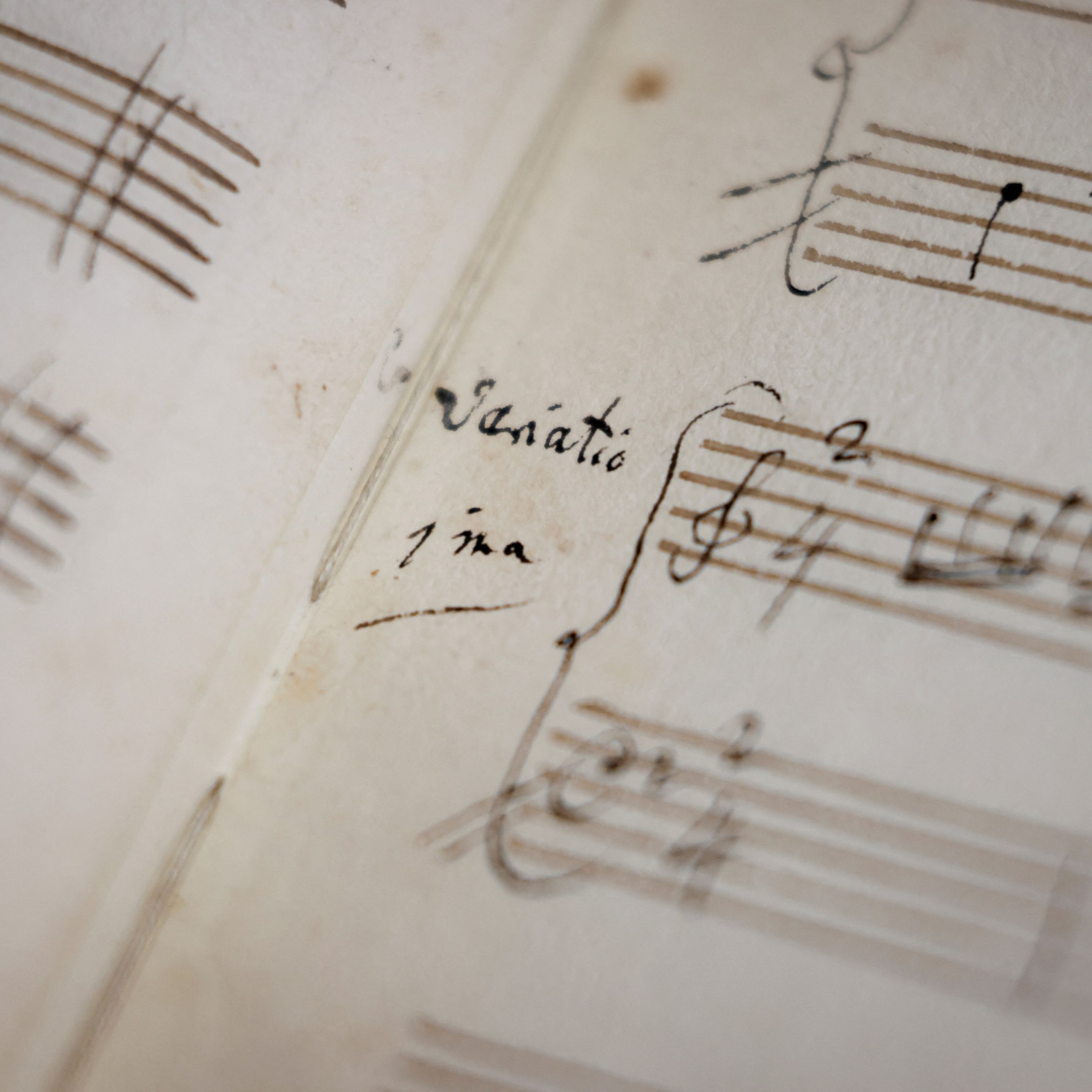
All Of It with Alison Stewart
Why This New Manuscript is 'The Most Important Mozart Discovery in Decades'
00:10:54
Loading summary
Transcript37 lines
- [00:00]
Commercial Announcer
WNYC Studios is supported by Progressive Insurance. Did you ever think about switching insurance companies to see if you could save some cash? Progressive makes it easy to see if you could save when you bundle your home and auto policies. Try it@progressive.com Progressive Casualty Insurance Company and affiliates. Potential savings will vary. Not available in all states. All of it is supported by Memorial Sloan Kettering Cancer center in a small, groundbreaking clinical trial where 100% of participants with a specific type of rectal cancer saw their tumors disappear using immunotherapy alone. Researchers at MSK are now studying this approach in cancers of the stomach, liver and more, and a majority of tumors are disappearing. For MSK Giving day, all gifts will be tripled. Learn more@msk.org all of it when it
- [00:49]
Home Depot Advertiser
comes to your yard reliability matters, shop with confidence at the Home depot and get 4th of July savings on Ryobi, the number one cordless outdoor power brand. It's time to choose your power. Both The Ryobi Ryobi 18 volt and 40 volt self propelled mower kits are on special buy for an even lower price of $429. Each was $479. Ryobi's battery platform delivers the power, runtime and dependability you need to tackle yard work with ease. Shop 4th of July Savings on Ryobi Outdoor Power only at the Home Depot while supply is Last pricing valid June 25 through July 8. Use only. See store online for details.
- [01:28]
David Fuerst
It's all of it on wnyc. I'm David Fuerst in for Alison Stewart. It's not every day that a long dead composer drops a new single. But that's sort of what happened on Friday, June 19 when the National Library of France announced the discovery of seven new Mozart compositions. The music was found in a 248-year-old anonymous untitled notebook that belonged to one of Mozart's pupils, a French noblewoman. She played the harp and her father, the Duke of Guisn, was an accomplished flute player. So the pieces were an especially rare find as very little of Mozart's work was written for flute and harp musicians around the world excited to get the chance to hear and play these new pieces. And joining us now to discuss this discovery is flutist, composer and WNYC host Emmy Ferguson. Emmy, welcome to all of it.
- [02:23]
Commercial Announcer
Hi.
- [02:23]
Emmy Ferguson
Thank you so much for having me today.
- [02:25]
David Fuerst
So when this news came out, what was the immediate reaction like in your circles and within the classical music world as a whole?
- [02:34]
Emmy Ferguson
Oh, well, in my circles it was revelatory. This is super exciting for us. We flute players and harp players were thrilled to hear that there are seven new short works by Mozart for us. And anytime that the world is celebrating classical music and this kind of brilliant discovery is always really exciting for the community.
- [02:56]
David Fuerst
And he did not write much for the flute and it's sort of because. Is it true that he didn't like the flute very much?
- [03:04]
Emmy Ferguson
Ooh, I don't know.
- [03:05]
David Fuerst
That was a deep gasp.
- [03:07]
Emmy Ferguson
It is a deep gasp. It's funny. I don't think anyone who wrote an opera called the Magic Flute can hate the flute or dislike it that much. But you know, we have this one letter from Mozart to his father complaining about the gentleman who commissioned his flute concertos, the first and second flute concertos and his flute quartets, saying that, oh, you know, I just cannot stand to write music for an instrument that I don't like. And we don't know the context of this letter whether he was complaining about someone that he didn't particularly like working for or who wasn't a particularly great performer. I like to think that maybe it was a moment of frustration that he was just venting. And if we were to look at all of our text messages today and take them as gospel, you know, one fleeting, you know, frustration from one day would then make all flute players in
- [04:06]
David Fuerst
the future to think about that, we'll overlook this letter. We'll focus on the Magic Flute instead. I like that. By the way, is there any speculation that these were not actually long lost Mozart pieces but the work of another composer or maybe an AI prompt and then snuck into this notebook to try to disguise is some new Mozart discovery?
- [04:30]
Emmy Ferguson
I don't think there's any speculation. This notebook has been in the holdings of the French National Library for centuries now. I think it arrived there during the French Revolution. The commissioner and the father of the co collaborator in this notebook. The notebook is a collaboration between Mozart and a student of his was aligned with Marie Antoinette. And so when the French Revolution happened, his manuscripts were confiscated and put into the library where they've been waiting for years and years to be discovered.
- [05:08]
David Fuerst
And this has been authenticated?
- [05:10]
Emmy Ferguson
This has been authenticated. It was a pretty fast turnaround. I think February was when it was found. And since then scholars and researchers have done everything they can to get it authenticated.
- [05:23]
David Fuerst
Well, let's hear some of the actual music. This is a radio performance of one of these new pieces. Here it is it. You have mentioned that this piece sounds similar to another Mozart work, the Concerto for Flute and Harp, is that right?
- [06:06]
Emmy Ferguson
Yeah. The Concerto for Flute and Harp is one of the most iconic works in our repertoire and one that is familiar to a lot of classical listeners, specifically for its gorgeous second movement. But the selection that you just heard, which is from one of the compositions in this newly discovered notebook, has some similarities to the first movement of the Mozart Flute and Harp Concerto, which was written for this father daughter duo. Around the same time, you can hear those scales going up and down. That is the really familiar reminder and a great way to also say, like, hey, I think this could actually be Mozart.
- [06:43]
David Fuerst
And just in case I called you by accident, a WNYC host. You're a WQXR host. You can do both. You know, you're hosting right now. This counts. So is there something that, you know, you mentioned, there's some similarities there. So you can hear some. Something in this performance that indicates for you that this is Mozart's writing?
- [07:06]
Emmy Ferguson
Absolutely. You hear that? And I think any flute player or harp player sort of immediately recognizes those patterns that are a hallmark of Mozart's writing. And when you listen to all seven of these different short vignettes that Mozart and his student wrote together, you start to hear other similarities. Maybe they're not quite so fleshed out. Maybe they're taken in a slightly different direction because Marie Louise was the one who was doing that particular section. We don't yet have the manuscripts available to look at. So once we finally get to be able to see these documents, the public can be able to see these documents, then we'll be able to get a better sense of where Mozart's writing started and where Marie Louise's writing continued and vice versa. And we get a much clearer picture of the tapestry of this collaborative composition.
- [08:02]
David Fuerst
These pieces, all written for flute and harp, mean for you as a flutist, what is special about. About getting new pieces for this lineup, this combination of instruments?
- [08:15]
Emmy Ferguson
Yeah, well, for me, what's really special is that these are two of the oldest melodic instruments in the world. We find examples of flutes and harps in almost every civilization throughout history. And so this is another wonderful touch point in that legacy that we can point to that I think really unites only flute and harp players who perform the music of Mozart, but flute and harp players from all around the world of all different genres and all different backgrounds. And so it's just really, really exciting.
- [08:50]
David Fuerst
I know you said you're waiting for the manuscript, but are people already starting to perform this, this work and start learning it?
- [08:57]
Emmy Ferguson
Well, I think you could listen and transcribe it, but I think Having access to the music will be very huge because one people will be able to get to perform it, but have even more of a sense of Mozart's personality, his teaching style, which historically we have another set of teaching notebooks with an English composer, Thomas Atwood, that have given us a really robust understanding of Mozart seven years after in Vienna and sort of what his teaching style was. But how we have a 22 year old Mozart. You know, think about someone fresh out of undergrad going into sort of one of their first teaching jobs and having to figure out what is it that I'm going to work on with this student and how do I impart the things that are important. You see that, you see his frustrations. We also see his frustrations in his letters to his father where he also complains about the quality of composition of Marie Louise and how she's just, she has no good ideas.
- [10:01]
David Fuerst
Wow.
- [10:02]
Emmy Ferguson
So we'll, we'll get a lot.
- [10:04]
David Fuerst
Is there something we can learn from these manuscripts about Mozart the teacher as opposed to Mozart the composer?
- [10:13]
Emmy Ferguson
Absolutely. And I think that's what's so important for us all to remember, is that we are all students of Mozart today. We all learn Mozart from when we were quite young. And as a general public we hear Mozart's music in so many different ways. But now we all get to sort of cosplay as a Mozart student by going into these manuscripts and seeing what it might have been like. And you know, I'm sure he was a very hard teacher because his standards were so high.
- [10:48]
David Fuerst
I'm just trying to picture where you were when you heard about this news and where you were when you were listening to it. Just what that moment was like for you.
- [10:56]
Emmy Ferguson
Yeah, I think I was scrolling through Instagram and it came up with the video when they announced all of this and the recording you heard a few minutes ago, they had a beautiful performance in France of these seven excerpts. And the musicians had been cloistered and rehearsing this in secret leading up to the performance because they didn't want it to leak. You know, this is, this was a big drop in the classical world, you know, akin to, you know, a new Beyonce album dropping. That's what this was for us. So I was scrolling through Instagram and saw the video and sort of stopped in my track. This is really incredible.
- [11:37]
David Fuerst
Well, let's finish with some more of that new Beyonce. I mean, new Mozart ludus. Composer and WQXR host Emmy Ferguson. Thanks so much for joining us.
- [11:49]
Emmy Ferguson
Thank you.
- [12:13]
Commercial Announcer
You're never just one thing.
- [12:15]
Emmy Ferguson
You're the boss.
- [12:15]
Commercial Announcer
Hey Google, when's my next meeting? The athlete that class wrecks me and their mom. Everyone in the all new Mazda CX5
- [12:23]
Emmy Ferguson
more to move every side of you.
- [12:24]
Commercial Announcer
Learn more@mazdausa.com Google is a trademark of Google LLC. Sequences shortened and simulated.
- [12:29]
Emmy Ferguson
We know you'll always find ways to look out for the people you love. And with Amica Life Insurance, we'll help build a plan to make sure you always can. Visit amica.com and get a quote today.