← All TWiT.tv Shows (Audio)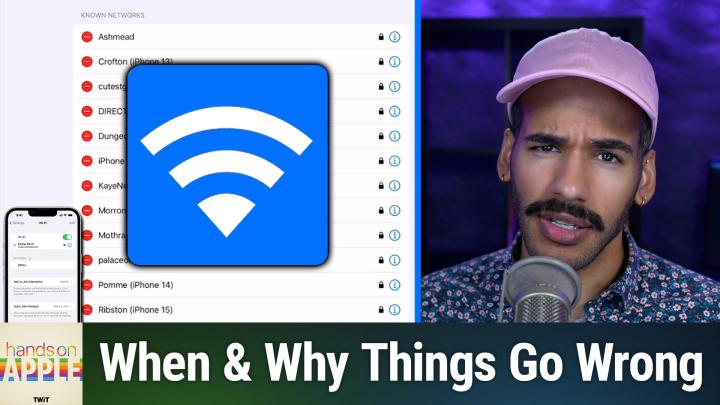
All TWiT.tv Shows (Audio)
Hands-On Apple 188: Wi-Fi Troubleshooting
00:15:08
Privacy, Speed, & Connection Management!
Loading summary
Transcript11 lines
- [00:00]
Micah Sargent
Coming up on Hands on Apple, let's take a look at Wi Fi troubleshooting on your iPhone and iPad. Stay tuned.
- [00:08]
Unknown Speaker
25 years ago, a small group of business and government leaders met in Washington, D.C. they envisioned the creation of an independent non profit organization with a mission to help people, businesses and government mitigate the growing threat of cyber attacks. Today, the center for Internet Security embodies that vision. For 25 years, it's worked with a global community of IT and cybersecurity experts to develop the CIS benchmarks and CIS critical security controls. These proven security best practices defend against common cyber threats and streamline compliance with industry frameworks, regulations and standards. Today, CIS provides cybersecurity services, threat intelligence and critical resources to help public and private sector organizations alike state strengthen their Cyber defenses. Visit cisecurity.org today. That's the letters cisecurity.org to find out how CIS can help your organization as we create confidence in the connected world.
- [01:08]
Ryan Reynolds
Ready to level up? Jumbo Casino is your playbook to fun. It's free to play with no purchase necessary. Enjoy hundreds of casino style games like bingo, slots and Solitaire anytime anywhere with fresh releases every week. Whether you're at home or on the go. Let Shumba Casino bring the excitement to you. Plus get free daily login bonuses and a free welcome bonus. Join now for your chance to redeem some serious prizes. Play Chumba Casino today. No purchase necessary. VGW Group void were prohibited by law 18/ DNC supply hey, it's Ryan Reynolds here from Mint Mobile. Now I was looking for fun ways to tell you that Mint's offer of unlimited Premium Wireless for $15 a month is back. So I thought it would be fun if we made $15 bills, but it turns out that's very illegal. So there goes my big idea for the commercial. Give it a try@mintmobile.com Switch upfront payment of $45 for three month plan equivalent to $15 per month required new customer offer for first three months only. Speed slow after 35 gigabytes of networks busy taxes and fees extra. See mintmobile.com.
- [02:11]
Micah Sargent
Podcasts you love from people you trust.
- [02:15]
Unknown Speaker
This is.
- [02:26]
Micah Sargent
Hello and welcome to Hands On Apple. I am Micah Sargent and today we are going to take some time to talk about some of the wifi settings on your iPhone, your iPad, and talk about when and why things might be going wrong. This is a common question that I get from people, especially in regard to their social media browsing, where they are visiting sites and the sites aren't loading properly. Something is wrong Very common thing for that has been troubling me is scrolling through Instagram and having video stop loading midway through what I am looking at. So I want to talk about some of the features that are there and also just talk about general WiFi settings. So let's head over to IPADOS and take a look. Now importantly, this is IPADOS 18.5 which is a current released version version of IPADOS. It is not the beta. The stuff that we talk about here applies to anyone running the latest available version of iPad OS. So we've launched the Settings app and we're in the Wi Fi settings and first and foremost on this page you have the ability to toggle off and toggle on wifi. Sometimes that's all it takes. By toggling it off here as opposed to in Control center, it will disconnect from Wi Fi and essentially turn off the iPad's ability to connect to nearby. Toggling it back on will then force that connection to take place again. On this page you will also see networks that are saved that you can connect to again. These are networks that you commonly connect to that are considered yours for various reasons. So Mica 16 is an iPhone and Winterstein happens to be the guest network at my home. Other networks will show up below in the networks section. So the iPad is currently sort of looking around for other possible network and if it were to find one that would show up in that section, if it is a network that is not broadcasting its ssid, then you would tap other. You would type in the name of the network the security type and type in the password to get it to actually let you connect. Now you'll notice that I have two features below. Ask to join networks and that one is turned off. There are three options. Off, notify and ask. So what happens is if you are trying to connect to a network and there are no known networks, so my phone and the guest network and then my main network are not around, then what will happen is the WI fi or the system will say hey, I can't find any networks that you normally connect to. Do you want to find something? Ask is going to give you the ability to try to connect to a network, but will ask you before you actually do it. So notify is just a little notification. Ask is going to say yes or no and give you that ability to connect. In this case I choose off because I don't want it to pop up and show me networks and say hey, do you want to connect to one of these? No, I want to go in and make that choice myself. The last section is Auto Join hotspot. And essentially in this case it will look for nearby personal hotspots. So actual hotspots that you have some connection to and join those you can choose never ask to join, or automatic where it will automatically connect. It will say, hey, I found a person. This is what ask to join does. I found a personal network for you. Here's what it is. Do you want to join it or never? I have asked to join turned on, because in that case I do want it to give me that ability. Now, before we go a little bit deeper into the WI Fi page, there's one more thing I want to point out to you, and that is the edit button in the top right corner. Pressing on this edit button will do a face ID to look at your to to determine that you are you. And then it will. It will show you all of the various networks that you have ever connected to, all of the known networks. And the reason that it does face ID is because this is actually on your keychain, which is Apple's sort of name for all of the credentials that you have that are synced between devices by icloud. So in this case, these are the known networks. You can choose to remove them or keep them however you want to. And these, you know, I've got networks from friends here, I've got networks from enemies, I've got networks from different iPhones that I've had in the past, so on and so forth and so all. And then even down at the bottom, networks from TWiT. So all of these are here and I can keep them saved, but I can also get rid of them. So if you ever have your device connecting to a network that you no longer want it to connect to, coming into this page by choosing Edit, hitting the red circle next to the network and choosing Delete will remove that network, that WI FI network, from your listing. And then it asks you, are you sure you want to do this? It's going to remove it from icloud. And I say, yes, I do want you to do so. And so it does. Now let's talk about the final set of WI FI settings. And this in particular applies to what I was talking about before. When it comes to having issues with apps not loading properly, I'll tap the eye icon next to the network. And first and foremost we have the Forget this network option. This will remove it just like it did in that edit option. But this is specific to a network that you have in front of you. Auto Join says if this network is available and I find this network, have this device connect to it. Now of note and common issue that I see that I experience myself is sometimes my device will automatically find my guest network before it finds my main network and then will connect to that and then I have trouble accessing some of my home devices and that is because it auto joined the guest network. So I'll go into the WI fi settings and see that it's set to Winterstein instead of Ashmead which is obviously a problem. So I always make sure now to go into Winterstein or Winterstein excuse me and turn off auto join password here currently not displayed but if you tap and hold on that you can actually share that password with someone else. The next option is load data mode. This is particularly handy if you have like a hotspot that is not just a personal hotspot from a phone, but an actual sort of third party hotspot. Puck low data mode is going to turn off things like background tasks like photo syncing and automatic updates to make sure that you're not super using that cellular network or maybe you're at a family member's house and their wifi is is limited by a certain amount of data each month. Turning this off or turning this on will limit how much data you're using to just kind of the active things that you're doing on the device. The next section is something that can cause issues on some networks. This is the private WI FI address option. And what this does is every device that connects to a WI FI network or a network has a Mac address and this address is sort of the name of this device, the id, the Social Security number, so to speak, even though it's not supposed to be used for id, the Social Security number of that device. And what's happened over time is different networks have used network tools, have used that Social Security number of your device to track it across the network. So you can say when this device connects the network it always has this set of rules, right? Well, that can be a privacy concern, particularly if you're connecting to public networks where if your Social Security number for your device, again the Mac address shows up here near these stores and then later on it shows up here near these stores and those two companies talk to each other. There's the possibility that your location data and your activities and perhaps your shopping interests are all collected. So over time Google, Apple and others have added this functionality that makes it so you don't have the same and the true Social Security number of your device your Mac address displayed. So there are some different options for private WI FI address there's off that's going to use the one that is built into the iPad and keep it that way. Fixed is going to make it so that for every network there is a Mac address that is generated for that specific network. So it's still not your original wife or it's not your original Mac address, but it is static per network and then rotating is actually going to change your Mac address regularly so that even if you connect to one network regularly, it's likely that your Mac address changes over time. Now the reason that I say this could cause some issues is there are some networks that require a sort of identity fingerprint by way of Mac address and there's a thing called Mac address filtering. So if you are ever having issues connecting to a network and you don't have access to sort of make adjustments to the Mac address filtering or other similar tools, this could be what's causing your issue.
- [13:21]
Unknown Speaker
This episode brought to you by Red Canary when cybersecurity threats hit fast, you need an MDR partner that moves faster. Red Canary delivers 24.7expert MDR support, total visibility and actionable insights. Plus it helps you detect four times more threats so you can stay ahead without burning out. Red Canary clears the noise and has your back every hour, every incident. Get the backup you deserve. Visit redcanary.com difference to learn more.
- [13:51]
Trading shouldn't have barriers When Robinhood started, it was built to make trading more accessible. Now Robinhood offers more sophisticated trading tools. Experience the future of trading on Robinhood Legend, the all new desktop platform that harnesses intuitive design to deliver a seamless experience for traders. Free to use with a Robinhood account, Robinhood Legend is designed for how you trade with powerful charts including custom intervals down to the tickets and over 80 indicators and drawing tools. Trade all your favorite assets, including popular stocks and ETFs, all in one place. Take your trading to the next level by customizing your layout in seconds and even enter and exit positions in one tap right from the chart. With up to 8 charts per layout, the future of trading is fast, powerful and precise. Experience it now on Robinhood Legend Sign up today. Investing is risky. Robinhood Financial LLC Member SIPC is a registered broker dealer. Other fees may apply.
- [14:50]
I'm no tech genius, but I knew if I wanted my business to crush it, I needed a website. Now, thankfully, Bluehost made it easy. I customized, optimized and monetized everything exactly how I wanted with AI in minutes. My Site was up. I couldn't believe it. The search engine tools even helped me get more site visitors. Whatever your passion project is, you can set it up with Bluehost with their 30 day money back guarantee. What do you got to lose? Head to bluehost.com that's B L U E H O S T.com to start now.
- [15:21]
Micah Sargent
The next option here is easily the one that causes the most trouble. This is a feature that is not necessarily going to be something that you have access to because it's actually a premium feature that Apple provides and it is limit IP address tracking. And what this does is it hides your IP address using some clever behind the scenes mechanisms involving sending your it's sort of like a vpn, but not exactly like a vpn, but sort of reroutes your connection through a couple locations to make you appear like you and others are all coming from the same place. Which sounds a lot like a vpn, right? But it's a private relay feature. By turning this on, yes, you are helping to cut back on different online services abilities to track you. But if the relay servers are overloaded or for some reason you're not able to get a good connection to those relay servers, then it slows down your connection immensely and in some cases prevents you from being able to view content on social media or other places. So that is why I have limit IP address tracking turned off. Now this is a feature that you could have both on cellular and on WI fi, so be sure to check both places for this feature to be turned on. And sometimes for some people, in some places it works fantastically. For me that has not been the case so I typically have it turned off. The rest of the stuff is very in depth, very nerdy for many people and and just has to do with how your router is assigning IPs to you. DNS and proxy is a whole nother level and so we won't talk about those because typically those are not having an impact on things like being able to connect to your social media. But those other options are options you might want to take and of course just a better understanding of how these different pages and settings work and what they mean and what they do. Thanks so much for tuning in to this week's episode of Hands on Apple. It's always a pleasure to bring this show to you. I'll be back next week with another episode. Until then, reach out to me. Micahit tv. Thanks so much. Bye bye.
- [18:13]
Unknown Speaker
Get your tech news exactly how you want it with TWiT TV Tech News Weekly with Micah Sargent delivers quick hit coverage and exclusive journalist interviews, giving you the inside stage scoop on breaking tech stories in under an hour. Now for deeper dives, I hope you'll join me, Leo Laporte, and a great panel of tech industry experts. That's every Sunday with this Week in Tech. We'll break down everything from AI breakthroughs to privacy concerns to cybersecurity alerts in the tech world's longest running and most trusted tech news roundtable. So efficient or in depth, the choices you are yours. Subscribe to both shows wherever you get your podcasts and head on over to our website, Twit TV for even more independent tech journalism.