← All TWiT.tv Shows (Audio)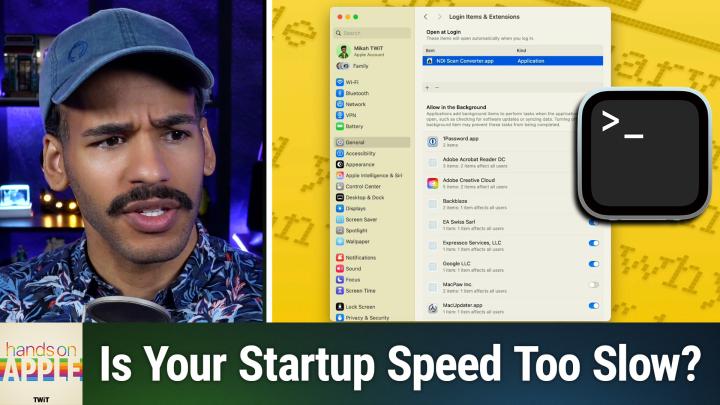
All TWiT.tv Shows (Audio)
Hands-On Apple 195: Slow Mac Startup Speeds
00:20:00
Fixing macOS login sluggishness
Loading summary
Transcript18 lines
- [00:00]
Micah Sargent
Coming up on Hands on Apple, let's take a look at troubleshooting some startup errors and speeds with your Mac. Stay tuned.
- [00:10]
Unknown
25 years ago, a small group of business and government leaders met in Washington, D.C. they envisioned the creation of an independent nonprofit organization with a mission to help people, businesses and government mitigate the growing threat of cyber attacks. Today, the center for Internet Security embodies that vision. For 25 years, it's worked with a global community of IT and cybersecurity experts to develop the CIS benchmarks and CIS critical security controls. These proven security best practices defend against common cyber threats and streamline compliance with industry frameworks, regulations and standards. Today, CIS provides cybersecurity services, threat intelligence and critical resources to help public and private sector organizations alike security strengthen their Cyber defenses. Visit cisecurity.org today. That's the letters cisecurity.org to find out how CIS can help your organization as we create confidence in the connected world.
- [01:11]
Micah Sargent
Let's map out this week's amazing destinations and travel tips.
- [01:15]
Will
Honestly Will, I didn't plan any trips, but I did switch to T Mobile with their new Family Freedom offer.
- [01:23]
Unknown
That's not the itinerary we're following.
- [01:25]
Will
Well, I'm departing from AT&T and embarking on a new journey with T Mobile. They paid off my family's four phones up to $3200 and gave us four new phones on the house.
- [01:39]
Micah Sargent
Bon voyage.
- [01:40]
Unknown
Introducing Family Freedom. Our lowest cost will switch our biggest family savings all on America's largest 5G network. Visit your local T Mobile location or learn more@t mobile.com familyfreedom up to $800 per line via virtual prepaid card typically takes 15 days. Free phones via 24 monthly bill credits with finance agreement eg Apple iPhone16128 gigabyte 802999 eligible trade in eg iPhone 11 Pro for well qualified credits end and balance due if you pay off early or cancel contact T Mobile.
- [02:09]
Podcasts you.
- [02:10]
Will
Love from people you trust.
- [02:13]
Micah Sargent
This is tw. Hello and welcome to Hands on Apple. I'm Micah Sargent and today we are taking a look at something that I have seen people complaining about slow startup speeds, they restart their Mac or maybe you're a person who shuts down your Mac and when you go to kick it back on it takes a little longer than maybe you've had in previous versions of macOS. So let's take a look at some of the things that you can do to deal with this problem by heading over to macOS and taking a look here we are on Mac OS and as you can see, I am running macOS Sequoia. Now, the first thing that we want to look at is something that is common for everyone. There are probably apps and other things that you have installed that have, you know, decided that they need to be part of your startup. That when you first log into your machine, these things are going to run in the background. Now, I've done an episode before of Hands on Mac that talked about login items, but this is a more sort of general look at things. And so I want to remind you how you go about checking if you have stuff that is trying to log in in the background. So first and foremost, we launch the System Settings app and we go the General tab and we choose login items and extensions. Now, there's one application that currently opens at login. So when I log into this machine or when you log into your machine, all of these items up here are going to automatically open. Now, the only thing that I have here is an app, and this app is the app that I use to display my Mac for all of you. So it's called an NDI Scan converter. You may have many apps in here. These are the apps that are going to launch at startup. And depending on how many apps you have here, that could be the reason why your startup is taking a while. You may go through and decide, oh, I don't need that app, I don't need that app. Go through and simply hit the minus icon to remove the app that you don't want. Now, there could be an app that you regularly do use at startup. You did the plus icon, choose that app. You can also click and drag the app into this area to get it to automatically open that app at login. Now, beneath that is an option that says Allow in the background. And this Allow in the background option is a little bit imprecise because when it comes to apps that are allowed in the background, these are apps that are, or I should say services, processes that are allowed to run in the background, but often kind of get kicked off at startup at login. So check this as well and make sure that these are apps that you're okay having run in the background. And if there's anything that you aren't wanting to have automatically going when you start your Mac. And as you're using it, this is where you would go about disabling it. You can simply toggle off that Allow in the background option. Now, if you have the Adobe Suite or you have Google Chrome or some other Google product installed in your Mac. I would recommend leaving those options alone because almost always these have to do with some of these services that run in the background for those apps and disabling them, coming from someone with the experience of having done so messes things up. So it's best to leave that alone. So if you see a Google option or an Adobe option, best to just let that go in the background. But again, you can remove any of these items that you don't want going in the background. Now, this is the way to go about making these changes using system settings. But it's not the only way. And in some cases you can get more information if you use Terminal. Terminal, of course, is the command line on the Mac. And we're going to access that by holding down the command key, hitting spacebar and then starting to type in Terminal. Up pops Terminal. We hit Enter and then it will allow us to use Terminal. So with this I can view all of the login items by typing in la u n c h that's launch ctl. That's the command. We'll hit space and we will tell it what we want it to do. We want it to list all of the stuff that is going to start up at login. Now, most of this you'll notice, has com Apple. Those are processes that are Apple processes that are part of what's built into the system. So you aren't going to want to make adjustments to those. But for example, here we see us Zoom Updater. So that's Zoom's updater. That's part of the process. Let's keep scrolling and see if we can't find something else that kicks off at login. Still Com Apple. There's com Adobe. So we've got an Adobe process we can keep scrolling through until. And I'm not seeing a whole Lot else here. Com 1Password. So there's my 1Password browser. Now at any point with those non apple options, you can type in once again, launch ctl. So that's telling it. This is the command that I want to use. We're going to go with the word command for this in this case. And then we type in the word remove and then we would type in the specific identifier for the process. So if it was calm.slow loading app.app, then that would be the thing that we would do and type in and it would allow us then after hitting enter to actually remove that item from our login items. So if you're having trouble getting it to remove using the Login items option, you can head into the terminal and do a remove from there. Now there's another thing that you may come across and that is launch items that aren't showing up in the places that you would expect them. And the way to access those is via Finder. And so from our desktop we can either click on Finder or just clicking on the desktop will also bring Finder up here to the top menu. And we want to go to the word go and then we want to choose Go to folder. Now the other way to do this is with the keyboard shortcut. So I can also hit Shift command and tap the G icon and that will automatically launch the Go option. And we are able to use Finder to go to a specific place. And funny enough, the last place we went to is where we want to go Library Launch agents, which are the the services that are going to turn on and activate when we actually launch the machine. So we can see all of the. These are all the non Apple versions. The Adobe options are here, Google options are here. Malwarebytes is here, and then Zoom is here. If we didn't want these and we couldn't get them to go away some other way, this would be a way to remove them. Now Command Shift G again and we want to go to Launch Demons. Here we can see all of the launch daemons as well. And again, previous episode about the difference between Launch agents and launch daemons. You can check that out to learn more about that. But perhaps for some reason we're no longer using the EA application, but it keeps trying to start at startup and it's slowing things down. This is where we'd be able to remove that and say no, I don't want you doing this anymore, get rid of it. Goodbye. And then the last one we want to do is check our user specific launch daemons and or excuse me, launch agents. And so the way that we do that is by putting the tilde icon before library. So it was Library launchagents librarylaunchdaemons. Now we're doing Tilde librarylaunchagents. What that does is it's a shortcut. The tilde icon is equivalence to saying users slash the name of the user, which in this case is Micah twit/library/agent. So it's just kind of a shortening of that. And then we will go to that area and you can see that we have Clean My Mac and Backblaze and an Adobe tool again Adobe's. We saw Adobe in every single one of those places. But if there was something in here that was sticking out to you, you said, oh, I don't use that anymore. I've uninstalled the app, but that launch agent is still there. This is how you would get rid of it. Let's map out this week's amazing destinations and travel tips.
- [11:57]
Will
Honestly, Will, I didn't plan any trips, but I did switch to T Mobile with their new Family Freedom offer.
- [12:05]
Unknown
That's not the itinerary we're following.
- [12:07]
Will
Well, I'm departing from ATT and embarking on a new journey with T Mobile. They paid off my family's four phones up to $3200 and gave us four new phones on the house.
- [12:21]
Micah Sargent
Bon voyage.
- [12:23]
Unknown
Introducing Family Freedom. Our lowest cost will switch our biggest family savings all on America's largest 5G network. Visit your local T Mobile location or learn more@t mobile.com FamilyFreedom up to $800 per line via virtual prepaid card typically takes 15 days. Free phones via 24 monthly bill credits with finance agreement eg Apple iPhone 16128 gigabyte $829.99 Eligible trade in eg iPhone 11 Pro for well qualified credits End and balance due off earlier Cancel contact.
- [12:48]
Micah Sargent
T Mobile there's another way to help speed up startup and in particular kind of right after startup. Remember that we did command Space to launch terminal. Sometimes macOS, Sequoia in particular can get hung on trying to re index Spotlight. So let me explain this a little bit. Spotlight is your tool, that command space tool to search across your Mac and look at the different files, applications, everything that you have installed on your machine, right? Well, in order to get the system to actually find what you're looking for, it requires you to it requires Spotlight to have an index of the different stuff that's on your Mac. So it's sort of like a list, an always updated list. It tells it where to look and what's there and kind of speeds things up by having a little bit of a cheat sheet to look at when it's trying to help you find things. A reindex basically throws out the old list and gives you a new one. When you update macOS, sometimes that list can become corrupted and it will keep trying to spin on that list, which can cause hangups. So in order to kind of force a reindex of Spotlight once again, we can go to terminal and we want to use what's called mdutil. Now this stands for metadata utility and its sole purpose is to serve as the spotlight indexing And Spotlight Command Tool. There are many different options available to you using mdutil, but what we want to do specifically is erase the Spotlight index and restart. But let me show you first and foremost what happens when we type in mdutil and hit enter. We can see what the different commands are. So I can see that in order to erase and rebuild the index, I need to use a command that is a dash and then the capital letter e. So what I would want to do here is type in mdutil and type in dash or hyphen and capital E and hit enter. But it didn't work. And that is because you are required to run this as the administrator of the machine or the root of the machine. So in order to do this, you actually have to type in sudo first and then it will ask you for your password. You'll type that in. And now it just erased my Spotlight index. If I type in sudo mdutil and we look back at our list, look at the option that says print indexing status. So in this case it's going to tell us if there's anything we need to know about the Spotlight index and we can check here to see if it re indexed it. And because this is a simple system, there's not a lot running for or installed with this Micah Twit account very quickly able to index Spotlight in this case, but being able to have that information and again, more importantly, re indexing Spotlight can sometimes solve those hangups when it comes to the speed of the system. Now there's another place that we want to look. So we're going to go back to Finder and we're going to choose go to folder. Remember shift command G for go and this time we want to look in the caches. So there are a few places where cached files are stored. We can go to Tilde, which remember, is a shortcut for the user library caches. And all of these are cached files that can, if we would like to, that we can if we would like to delete. And by removing these, then we are able to cut back on what is stored for later. Now, sometimes this can be helpful to have and we would want to keep it. But in other cases you may not need this stuff and so removing it is not an issue. The other place that you look is just library caches, which is the system version. And removing these requires the use of an administrator password. But again these cached files can be removed. I'm kind of doing these in steps. So if you're still Getting a slow machine after you've done the options up to now, then going in and removing your caches can sometimes help. One final suggestion for you, if you're running rather and using an older Mac, then it is possible that some of the cool new animations that are in Sequoia are causing a bit of a slowdown for your startup on your machine. Heading into system settings, going into Accessibility and choosing Display, will give you the option to reduce motion, which will cut back on animations and also reduce transparency, which will remove some of that transparency that you're seeing in the system ui. This makes it work a little bit, it relieves some of the pressure on your processor, your graphics processor, which can in turn lead to quicker startup times if part of the system isn't being focused on trying to get that to work. Lastly, you can disable the sort of Genie effect. You'll notice that as I downsize that application, it does this cool Genie effect. You can go to desktop and dock and with minimize window instead of Genie effect, just do the scale effect. Scale is not as involved and therefore takes less of the graphics processing. This again is kind of post startup, but as you're getting the system up and running after you've logged in, you may find that that's the slowest time because it's trying to open a bunch of applications. And so cutting back on some of this stuff will help to get things going as quick as possible. You can also choose to turn off the animation of opening of applications. This is really big. Whenever you're starting up with the system and if you're not using Stage Manager, just not just turning off Stage Manager is very helpful because Stage Manager is very graphics intensive now on a modern Mac with Apple Silicon, you're probably less likely to run into issues with this, but again, we do these kind of step by step by step. So starting with cleaning up your login items, going into Terminal to list and remove login items, checking out your background processes, and in particular looking at those launch agents and launch daemons, re indexing the spotlight, clearing your system caches, and then finally going in to disable visual effects that all comes together to improve upon your startup speeds. So there are some suggestions for you if you have noticed a slowdown in startup. I would love to hear about it. Reach out, let me know and I'd love of course to hear if these suggestions worked for you. Thank you so much for tuning in to this week's episode of Hands on Apple. I will of course be back next week with another episode but until then, have a great rest of your day. And of course reach out HOA TV with your questions, suggestions, etc. Bye bye.
- [21:39]
Unknown
Hey, thanks for tuning in to twit your tech hub for intelligent, thoughtful conversations. If you want to take your experience to the next level and support what we do here at TWiT, say goodbye to ads and say hello to Club. With Club Twit, you unlock all our shows ad free. You also get exclusive members only content. We do a lot of great programming just for the club members. You also get behind the scenes access with our TWIT plus bonus feed and live video streams while we're recording. And don't forget the fantastic Members Only discord. It's where passionate tech fans like you and me hang out, swap ideas and connect directly with all of our hosts. It's my favorite social network. I think you'll like it too. Club Twit. It's not just a subscription, it's how you support what we do and become part of the Twit family. Your membership directly supports the network, helping us stay independent and keep making the shows you love. If you're ready to upgrade your tech podcast experience, head to TWiT TV club TWiT and join us today. Thanks for being here and I'll see you in the club. This is one of the most spectacular venues with all kinds of character and hospitality scenery. These people in this Kitty Task valley, they love when you come to see what they have to offer. I'm JJ Harrison, Ellensburg Rodeo Clown and I want to invite you you to the rodeo. Come hang out with us in Ellensburg. Great rodeo. Great time. Two performances on Saturday. One is the Extreme Bulls of the Year event. Do not miss the Ellensburg Rodeo August 29th through September 1st. We'll see you there.