← All TWiT.tv Shows (Audio)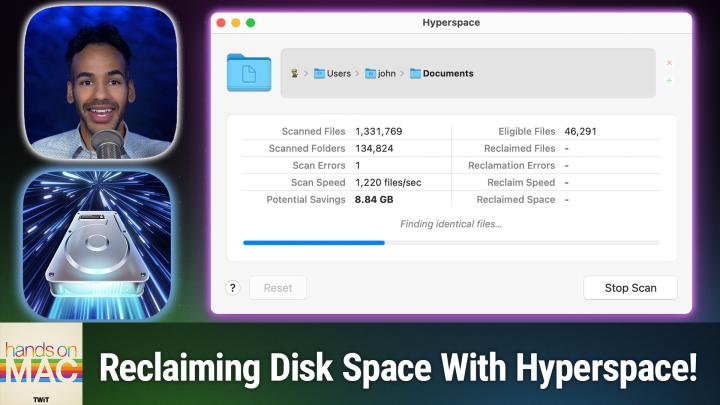
All TWiT.tv Shows (Audio)
Hands-On Mac 171: Apple File System & Hyperspace
00:15:01
Using APFS Space-Saving Clones
Loading summary
Transcript7 lines
- [00:00]
Micah Sargent
Coming up on Hands on Mac, let's take a look at a way to reclaim disk space without getting rid of any of your files. Stay tuned. Podcasts you love from people you trust.
- [00:16]
Leo Laporte
This is Twit.
- [00:26]
Micah Sargent
Welcome back to Hands on Mac. I am Micah Sargent, and today we are taking a look at a really cool app that will help you reclaim disk space on your Mac. And this isn't your classic Mac app where you are like a cleaning app where you're looking through the different files that you have and you're sorting to find the largest files and seeing if you still need those or the ones that haven't been modified in a long time. No, instead, this is going to make use of an interesting quirk or feature, depending on how you see it in Mac macOS that gives the ability for the operating system to kind of refer to the same file in different places at the same time. So before we can actually take a look at the app, which I'm going to go ahead and tell you is called Hyperspace, I want to tell you a little bit about how the macOS file system actually works. The macOS file system default file system, I should say is APFS, Apple protected file System. And one of the features of this operating system, or rather file system, is to create multiple versions of the same file without creating multiple files. So it's kind of hard to understand. And the way that I want to explain this is by thinking about you being a person and waking up in the morning and putting on an outfit. Okay, maybe you wear pajamas to bed. You wake up in the morning, you switch out of those pajamas into what you're going to wear for the day. You underneath that are still you. But you in pajamas looks one way and you in your morning attire look another way, right? But you beneath those things is still the same. Think of the thing beneath the clothes as data. This is the information that makes up the base file. You, in this case, in this metaphor that we're doing, and the clothes that you are putting on that kind of refer to you with some changes. That's metadata. That's the stuff that is happening to you, right? That's the thing that's being changed about you by putting on clothes. The same thing sort of applies to files in macOS in the sense that you have a base file that is the data, and then the changes that get made to that file or to that data, rather is called metadata. That's the idea that it's referring to the base data and making changes to it. So in a sort of other file system, I should say, I could say a classic file system, but there are some instances where that's not the case in other file systems. What happens when you put clothes on the file, whenever you add that metadata is the operating system will create a new file for it. So you will have Micah in pajamas, Micah wearing a coat, Mica in shorts, right? And each of those is each its own file and its own bit of data with metadata added on top. So that ends up adding up to a lot of information that's getting stored on your disk. What APFS does, what Apple Protected File System does, is it says, look, I know that's mica underneath there. So I really only need secretly, behind the scenes, without us realizing as users, one version of Mica and then each of the files that we're creating, Mica in pajamas, Micah in a coat, and Micah wearing shorts. It's just the part of the data, a very much smaller part, the metadata that says, here's how that file has changed. So it's just the pajamas, it's just the shorts, it's just the coat. But whenever we go to access that, the file system refers to that metadata and adds it to that file, that data itself, to create the file. I keep saying file, but really we want to think about it as data and metadata together they make the file. So then you get Mica with shorts, Micah with a coat, Micah in pajamas, without needing to have three different micas, just one of them, because I am just one. Right? And that's all that it takes. So if you've had your system for a long time, if you've had your Mac for a long time, so you come from a time when Apple Protected File System wasn't part of what you've done, what you're using, or if you are using kind of mixed systems where maybe occasionally you work with Windows or There are a bunch of different reasons why Apple Protected file system on your Mac might not be doing that proper clever behind the scenes feature of making one bit of data and tying it to these different metadata versions, thereby getting rid of all that extra stuff. And so as you go forth, as you continue to make things, once APFS is set up, then it's not going to be an issue because in almost every case it will use this method. So what does one do if one wants to reclaim space on one's machine making use of this very cool feature of apfs? Well, one uses a little app called Hyperspace that you can get in the App Store. This app is a really cool app that is created by hypercritical and it lets you look at the files on your system and find those instances where we can instead of having three different micas, we compress it down to one and just have the metadata that is linked in multiple places. So let's take a look at what this is like on the Mac listeners.
- [06:50]
C
Are you looking for a shortcut to better auto insurance for you? Something that takes all the research off your plate. Something that's easy, Something that matches you with lower rates? Something genius. That's where NerdWallet comes in. Their nerds already did the work for you. Just answer a few questions and ta da, you'll be matched with top insurance providers in your area. Find the right rate for you@nerdwallet.com after all, using NerdWallet is more than smart. It's genius. Not all applicants will qualify for the lowest monthly payments. NerdWallet Insurance Services Inc. California resident license number OK 92033 ready to level up?
- [07:20]
D
Jumbo Casino is your playbook to fun. It's free to play with no purchase necessary. Enjoy hundreds of casino style games like bingo, slots and Solitaire anytime, anywhere with fresh releases whether you're at home or on the go. Let Shumba Casino bring the excitement to you. Plus get free daily login bonuses and a free welcome bonus. Join now for your chance to redeem some serious prizes. Play Chumba Casino today. No purchase necessary. VGW Group void we're prohibited by law. 18/TNC supply when you first get the.
- [07:51]
Micah Sargent
App, you'll see that you open it up and it shows hyperspace and it tells you exactly what it does. You can actually click to learn more about kind of the behind the scenes. It's how I was able to describe the metaphor that I came up with for this in understanding it. And you start by choosing a folder. Now in this case I'm going to choose the home folder for this machine and I want you to understand that there isn't going to be this hyperspace is not going to find an app. Excuse me, is not going to find any files on this machine because this machine and the user has only ever had APFS as the file system. So there won't be any instances of being able to save files. But if you've had your machine for a long time, that's where this is going to really be handy. On top of that, I want you to note that I am able to do the scan without needing to pay and we'll talk about the prices for this and I think that that's very important because that lets you at least see if it's something that would be of use to you, that you would want to use. So I chose my home folder. Importantly, when it comes to cloud storage, this is not a system that's going to work with cloud storage. So you want to be using kind of local storage means. And so I've clicked on my home folder here on the left and I just click open. Then it says it's ready to scan. So I can go ahead and scan the folder. I can also add more folders to scan. You could in theory have, you know, maybe you want to scan your photos library or whatever it happens to be that is like a local version. You would be able to do that as well. And so I can choose Scan folder. And what it does is it goes through and it looks and it says I scanned 195 files, I scanned 32 folders, I didn't have any errors. The scan time is 0 seconds. That's because it remembers that it did the scan before the and hasn't noticed any changes to that folder. The potential savings, of course, are none. Eligible files are none. And then you get to go and reclaim space. Now, what the app will do whenever it comes to reclaiming space is it actually gives you a couple of options. One option is to have the things inside that are not needed thrown into the trash can and replaced with the space saving clones, as they're called. Another option is to, and I shouldn't say replace because it's basically putting it there and moving the other thing away. And that's a little less permanent because it's in the trash. So you can always go and reclaim it. The other option is a little more permanent, which is it will just replace what's there with those space saving clones. The way that this is going to do it if it finds files is for everyone that it finds. It gives you the option to determine what of the files it found that are the exact same data with just different metadata that you want to make the source file or the source data and then it finds the target versions, those other versions. So you know, Mica with a hat on is the one that is kind of the original and then those other ones, currently there are actual physical files there instead of it being the space saving option. So what it does is it looks to those and it will go and remove the file in whatever way you choose, whether into the trash can or just by replacing it and then puts the space saving clone there instead. The thing that APFS uses to go, oh, I know that I need to take the metadata that's here and tie that to that original file. At which point then you can say, go ahead and do that and it'll show you the space that you've saved. I know it's a little complicated and the ultimate point is Apple's new file system. Newer file system has a way for you to save space without technically getting rid of any files. And what happens behind the scenes is not necessarily something that you need to know, but I think it's cool and definitely something that I wanted to tell you all about when it comes to using this. The developer of the app said, look, I knew about this kind of interesting feature that is part of APFS and I wanted to make it available to the end user to be able to kind of go and find the different versions that are out there and save some space. In the meantime, this app is available again to download for free in the App Store. It has some different options for in app purchases. There's a 19. Well actually let's just take a look because we can go to the purchase options here and we'll swing back over to macOS and you've got some one time purchase options. You can unlock the app for a month. So maybe you just want to clean things up once a month at 9 99. Pretty good. You'll use it, then you're done. If you decide to use it six months from now, pay 9.99 again, you'll get it again, you can unlock it for one year, meaning that it'll charge you once, 20 bucks, $19.99 and then you can use it for that year. And then maybe there are a couple years where you don't use it. You go back later and you get it again. These are one time purchases and then last is the lifetime unlock, which of course gives you the ability to just always have this. It's basically paying for the app and that's 49.99. There are also subscription options, $9.99 a month and $19.99 a year. So essentially if you want to keep using it, you're not just wanting to do it month by month and you want to make sure that you're, that you don't have to worry about going back in and paying again. That's what you would use the subscriptions for. And of course also that's a way to help support the developer over the long term, which is also a great thing to do. So yes, shout out to this really cool kind of niche app that I think is helpful to people who maybe made the transition from the older versions of file systems into the new ones or into the new versions, or who end up using multiple file systems and multiple files across different physical hardware. Really neat app. And again, right there in the Mac App Store. Folks, thank you so much for tuning in to this episode of Hands On Mac. Of course, I'll be back next week with another episode for you, but until then, it's time to say goodbye and thank you for all your support.
- [14:41]
Leo Laporte
Hey buddy, are you a geek? Are you a tech enthusiast? Then I would love to invite you to join a tech community like no other. You can gain exclusive access to our incomparable quality tech content for just $7 a month. With Club Twit as a member, you'll Enjoy all twit TV shows ad free plus access private video feeds for insider shows like iOS today, home theater geeks and so much more. Dive into the members only Twit plus bonus feed for behind the scenes content, club discussions and special events events. But here's the best Join our incredible Discord community to watch live show productions, chat with hosts and participate in exclusive members only activities. It's your backstage pass to the world of twit. Whether you're a tech enthusiast or a lifelong learner, Club Twit elevates your knowledge while entertaining your interests. Get two weeks free when you sign up now for $7 a month and unlock un unparalleled access at Twit TV Club Twit. That's Twit TV Club Twit. And from the bottom of my heart, thank you and welcome to the.