← All TWiT.tv Shows (Audio)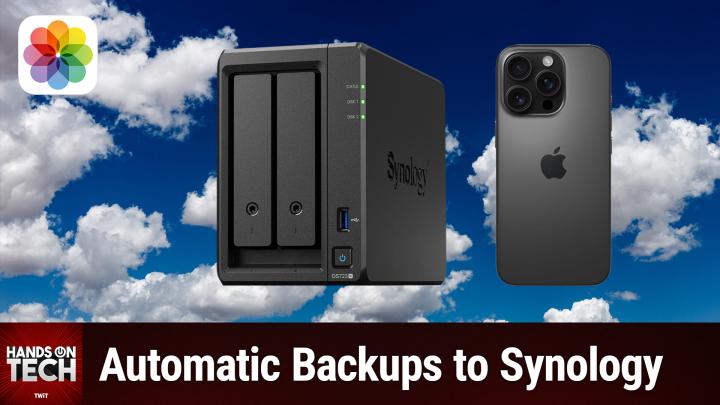
All TWiT.tv Shows (Audio)
Hands-On Tech 209: iPhone Backups to Synology NAS
00:15:00
Getting Your Synology To Back Up Plugged in Devices Automatically
Loading summary
Transcript6 lines
- [00:00]
Micah Sargent
Coming up on Hands on Tech, let's take a look at backing up your mobile device to your network attached storage. Stay tuned. This is Twit.
- [00:17]
NerdWallet Ad
Listeners. Are you looking for a shortcut to better auto insurance for you? Something that takes all the research off your plate? Something that's easy, Something that matches you with lower rates? Something genius. The that's where NerdWallet comes in. Their nerds already did the work for you. Just answer a few questions and ta da, you'll be matched with top insurance providers in your area. Find the right rate for you@nerdwallet.com after all, using NerdWallet is more than smart, it's genius. Not all applicants will qualify for the lowest monthly payments. NerdWallet Insurance Services Inc. California resident license number OK 92033 trading shouldn't have Barriers When Robinhood started, it was built to make trading more accessible. Now Robinhood offers more sophisticated trading tools. Experience the future of trading on Robinhood Legend, the all new desktop platform that harnesses intuitive design to deliver a seamless experience for traders. Free to use with a Robinhood account, Robinhood Legend is designed for how you trade with powerful charts including custom intervals down to the tick and over 80 indicators and drawing tools. Trade all your favorite assets including popular stocks and ETFs all in one place. Take your trading to the next level by customizing your layout in seconds and even enter and exit positions in one tap right from the chart. With up to 8 charts per layout, the future of trading is fast, powerful and precise. Experience it now on Robinhood Legend Sign up today. Investing is Risky. Robinhood Financial LLC Member SIPC is a registered broker dealer. Other fees may apply. Hey prime members, are you tired of ads interfering with your favorite podcasts? Good news. With Amazon Music you have access to the largest catalog of ad free top podcasts included with your prime membership. To start listening, download the Amazon Music app for free or go to Amazon.com ADFreePodcasts that's Amazon.com ADFreeP Podcasts to catch up on the latest episodes without the ads.
- [02:12]
Micah Sargent
Hello and welcome to Hands On Tech. I am Micah Sargent and today, as we have been doing, we will continue to take a look at the wonderful questions you all have written in. Of course you can email me hottwit TV is how you get in touch with your questions. This week's question comes in from Juan who writes I own a Synology DS 1522 NAS. That's Network Attached Storage. NAS and I had a few questions if you might be able to enlighten me with some answers. First, how can I set up my Synology so when I plug in my iPhone, my iPad, et cetera, into the nas that it can create backups of my devices on the nas? So this is a really good question that makes me think, Juan, maybe, maybe you come from the Android ecosystem. Some Android devices, I should say, many Android devices have a feature that basically says, pretend my iPhone is a hard drive or a flash drive, whatever you want to say that it is, it's a storage location. And when I plug it into my computer, then I can, you know, simply drag and drop files to it or from it as if it was just a little plugged in hard drive. The iPhone does not have that feature. And so if you take your iPhone and you plug it into your nas, your synology, it's not going to be able to look at the file system on the iPhone and automatically pull things from there and back it up to your network attached storage. It's just not a feature of the iPhone. The iPhone requires either a Mac or a PC. We just talked about it using Apple devices on the PC. In our last episode, we talked about this on the Mac, using the finder to back up locally to a location. And so because of that, you can't just plug it in and have that back up. You can, however, again use the Mac or the Windows machine in between to do those backups and then have them be stored on your network attached storage. So there's one thing that I want to suggest before I talk about the solutions that are available to you that involve using kind of the built in backup functionality of your phone, your iPhone, and that thing is the Synology Drive mobile app. So the Synology Drive mobile app is an app for your phone that you install and you give it permission to access different files and photos and other content on your phone and then back that stuff up to your network attached storage, your Synology NAS specifically. So this is the best way to kind of do things from the Synology side with your and your wife's phone or iPad or whatever device it happens to be, to not only see the content that's on your network attached storage, but also to back up your content on your phone to your Synology disk station. So that is the way to do it from the Synology side of things, if you want to do it from the iPhone side of things with iOS and iPados kind of running the show. The easiest way to do this if you're not super versed in some of the more complicated aspects of using macOS in particular, which I will talk about in a minute. Then I recommend an app called imazing. I've talked a lot about imazing on this show and on other shows. It is a tool that I use regularly because it does one. I mean, it does many things, but the one thing that it does that is very important is it lets you choose where you want your local iPhone and iPad backups to be stored. So with imazing, I can say backup my iPhone regularly when I plug it in and put it in X location. So for you, you would say I want my icloud or my, excuse me, my iPhone backup and my iPad backup to be on my network attached storage. And then when you plug in your phone to imazing, it handles the rest. It goes ahead and does that. But what's even better is that imazing understands the iOS and iPados, those operating systems, and so it has access to the wireless syncing functionality that is included with icloud and local device backups. What I mean by that is you talk about plugging in your iPhone, your iPad, et cetera, to do that. And for the initial backup, I absolutely recommend that with imazing, go ahead and plug in your phone to your Mac and then set the location to iPhone backup or whatever you want it to be on your network attached storage and do it wired the first time. But after that you can enable in imazing a schedule every day over my local network, my local wi fi network, back up my phone and it will do that without you needing to plug it in. So your device is going to stay backed up even if you're trying to avoid icloud, which it maybe sounds like you're trying to do. Or maybe you want icloud backup as well as this as a backup, in which case then it can service that as well. So that's the way to do it. With imazing. There is a way without needing to install imazing, to tell macOS to store your local iPhone iPad backups on your network attached storage. But it does use the terminal and involves some symbolic linking. And occasionally that means you can run into issues because of different networking problems that you might have or what have you, if that's something that you want to do. I'm not going to go into detail about that option here, but you can look up change iPhone backup location and you'll. You'll find plenty of walkthroughs on how to go about that. Also, if you just email me and ask me that that's what you want to do. I can give you more information on how to do that and kind of go through the process. But essential, essentially the place where these local backups will be stored. You replace that directory with a symbolic link to a location on your network attached storage. And so macOS puts it in that spot, but that spot is actually linked to a spot on your network attached storage. So it just automatically gets dragged and dropped over to your network attached storage. Sort of. The pedants among us will have issues with that. But that's basically it's putting it in. It's making the system almost believe that it's supposed to go here, when actually it goes here. And so it can do what it knows it's supposed to do, but then the files can go where you actually want them to go instead. So I really recommend imazing for the simplicity, but also because it means that you don't need to be plugged in to do that syncing after the first time. And then Imazing has a bunch of other functionality as well. That makes it pretty doggone cool for being able to pull stuff off of your phone, your iPad, out of apps, even. So that's my recommendation there.
- [10:42]
Grainger Ad
If you're a maintenance supervisor for a commercial property, you've had to deal with everything from leaky faucets to flickering light bulbs. But nothing's worse than that ancient boiler that's lived in the building since the day it was built 50 years ago. It's enough to make anyone lose their cool. That's where Grainger comes in. With industrial grade products and dependable, fast delivery, Grainger can help with any challenge, from worn out components to everyday necessities. Call clickgrainger.com or just stop by Granger for the ones who get it done.
- [11:13]
Geico Ad
All you homeowners have unique needs. Some feel the need to paint their door a vibrant shade of blue. Others have the need to decorate their bathroom with fish anchors and other nautical items. And because each homeowner has unique needs, Geico helps you get the right coverage for your home and what's in it. That way you get exactly what's right for you, even if your needs are unique. Get more with Geico.
- [11:40]
Micah Sargent
All right, your second question, Juan. You say, how do I set it up so when my idevices are backed up? And by idevices, Juan means like iPhone, iPad, my photos are backed up and sent to icloud photos. I would like to be able to plug in my wife's idevices and mine and create a shared photo library. Is this possible? So it sounds like what you're saying here is a little bit more of what the first one was, right? That your photos automatically get brought over to the Synology and then also that they're backed up as they are in the Photos app and into your icloud account. But you specifically say a three word phrase shared photo library. And so that is where I want to point you to a support article that is everything you need to know about the shared photo library from Apple. Because it turns out that many a family has wanted a feature like this, a place where you and another person or you know, more people who are all together a family or whatever it happens to be, can share a not just an album but an entire library of photos. So that article will walk you through creating a shared library and giving your family, in this case, I think your wife access to that shared photo library. It's this like I wouldn't call it the simplest way to go about doing this. I would call it the most integrated way to go about doing this for what you're asking, for what you want. And because it's iPhone and iPad, use the tool that Apple provides for the sake of of it just working right across devices. Your wife will see the photo library that's shared, you will see the photo library that's shared. It's in the place where you expect it. The camera app is going to integrate with it so that when you're taking photos, you know if it's going to the shared photo library or to your personal photo libraries, it just makes sense from the point of two or more people who are using Apple devices to be able to do share. Scooter X always coming through with like the perfect little gifs anyway. So snap out of it with one. Your second thing there with the shared photo library if you want to do it again on the Synology side of things instead of on the Apple side of things. Well, Synology has a feature called a shared space. A shared space and so on your synology. And we'll include a link in the show notes to the support guide that walks you through this. But it's specifically sort of part of the photo sharing area of your Synology. You can enable a shared space that gives you and other people to whom you've invited to the shared space access to those photos and those albums. So all of that will be available in the shared space and will give you and another person the ability to manage and organize those photos in the shared space. So again, I am going to suggest the other way of things using Apple Shared Photo Library because I think that it's the most intuitive and easy to use. But I don't know, you know, your specific situation and the situation you know that your that your wife has and knowledge of Synology. You know, if she's as much of a Synology nerd as you, then maybe the shared space and doing everything from the Synology side makes sense. But if she's not, I think that the onboarding of a shared photo library from Apple is going to be a lot more doable than trying to make all of this work by way of your Synology network attached storage. So a little brief summary there. You can't just plug in an iPhone into the Synology NAS and have it do a backup. You need something in between to kind of handle that backup. And then when it comes to the shared photo library, I recommend using Apple's feature that is literally called that. But there is a way to do it with Synology as well and we'll have links to all of that stuff in the show. Notes I have one more thing to tell all of you who are tuning in about, which is that you should consider joining Club twit at Twit TV. Club Twit. When you join the club for $7 a month, you gain access to some awesome, awesome features. You gain access to the Twit plus bonus feed that has extra content you won't find anywhere else that's behind the scenes. Before the show. After the show, special Club Twitt events. You gain access to the Members Only Discord Server, a fun place to go to chat with your fellow Club Twit members and also those of us here at TWIT and and the big one which is access to all of our content ad free because you are supporting the show. So you gain access to just the stuff we're putting out there for you. We do have a two week free trial going on, so now's the time to see if Club Twit is for you. I think you'll find it is. And so after those two weeks are up, then you could join the club for $7 a month. We'd love to see you join us in the Discord and have some fun there. Thank you to those of you who are considering joining the club, that is the end of this episode. Hot at Twit TV is how you get in touch with me and appreciate it. Thank you all for tuning in this week to watch the show. I'll be back next week with another episode. Holy moly It'll be April and we'll have lots more for you. Thanks so much. And it is now time to say goodbye.