← All TWiT.tv Shows (Audio)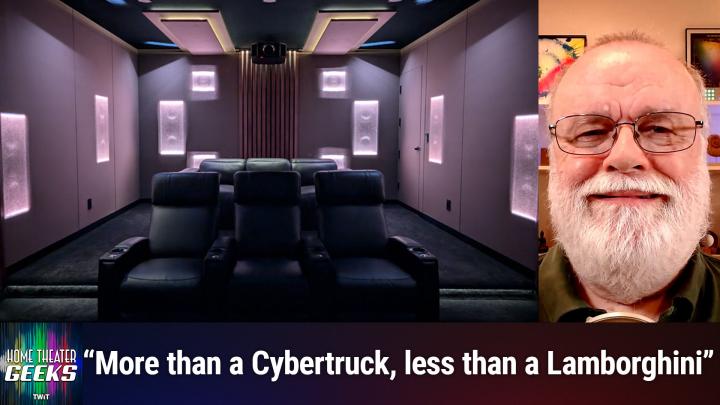
All TWiT.tv Shows (Audio)
Home Theater Geeks 463: No Compromise Home Theater
00:17:11
Home Theater of the Month
Loading summary
Transcript1 lines
- [00:00]
Scott Wilkinson
In this episode of Home Theater Geeks, I feature another great Home Theater of the Month from AVS Forum. So stay tuned. Podcasts you love from people you trust. This is Twit. Hey there, Scott Wilkinson here, the home theater geek. In this episode, I decided to feature a Home Theater of the month from AVS forum that I only very recently posted. It's the November 2024 Home Theater of the Month. We'll put a link in the show notes to that article, which has more detail than I'll cover here, but I wanted to share it with you because it's so cool. Now, I was really impressed with the owner, whose name is Ryan, because he took a real no compromise approach. He's been a home theater buff for a long time, and when he and his wife bought their first house that he put a home theater in the basement. But he had to do a bunch of compromising. And he spent 14 years trying to work out all those compromises and make it the best it could be. But in 2020. I'm sorry, in 2017, he and his wife bought some undeveloped property, lakeshore property in Shoreview, Minnesota, and they built a house from the ground up. And the plans included a basement home theater that would not require any compromise. No sight line issues, no windows, no structural problems, things to get in the way. And they even lowered the floor by a foot so that the entrance door at the back of the theater would be at riser level. So everything was done very, very carefully and thoughtfully. So I'm going to show share with you a few pictures, those of you who are watching video. The first one shows the construction in process and what's cool about this, what I wanted to show you here are these metal channels, these metal bars that are going back and forth along the side walls and across the ceiling. These are called channels or sometimes called hat channels or clip channels. And basically you put the clips on the drywall and you essentially attach the drywall to these channels. And that really helps in sound isolation. It decouples the drywall from the framing. You can also see in this picture all the insulation that is in between the framing, the framing timbers, which also helps greatly with sound isolation and also temperature control because it's in the basement and it's in Minnesota. So you know it's going to get cold in the winter and so you want, you want the heat to stay in there. So that's another advantage of that insulation. But primarily he was interested in sound isolation and the insulation there. And the clip channels both help a great deal in that regard. Now the system, the audio system that he's installed in there is 11.8.6. What that means is 11 speakers along the, what's called the bed, the ear height level and six overhead speakers. Now that includes three in the front, your typical left, center, right, two front width speakers, I.e. they're wider than the front, left, right and center, four side surrounds, two pairs, one pair in the back and eight subwoofers. Now that requires a lot of cabling as you can see in this picture here. This is what I call techno spaghetti and it is a lot of cabling. But his system requires it because it's got a lot of channels and a lot of other stuff going on too. So he's. Ryan is a software developer who co owns his own software company and so he did a lot of his own custom programming and automation in this theater which is really quite amazing. Also wanted to show you the equipment racks which are truly impressive. He's got a Trinov Altitude 32 preamp processor in there which is really really expensive. Really good, but really expensive. A bunch of crown power amps, A custom PC for automation. He uses as one of his sources an Nvidia Shield which is a streamer and a game console and another streamer I'd never heard of called Ugoos U G O O S. That's the company. The model is the AM6B Plus. Now he went so far as to update the OS, the operating system with something called Coralec, which is a Kodi os, which is supposed to have the best support for Dolby Vision. So once again no compromise, he is taking things to the limit here. The picture of his front speakers is quite remarkable. He's using speakers from a company called James Loudspeakers. Not a common consumer brand, but very high end. The three front speakers, front left, center, right are BE808 and the four subs you see there at subwoofers are from a company called GSG Audio Design. They have ported enclosures and 21 inch drivers. Those are big subwoofers. Now there's also four subwoofers in the back of the room and they work in conjunction with these four subs. You can see here in what's called a Trinov waveforming configuration. The back subwoofers actually operate out of phase and delayed from the front subs to minimize the effect of reflections from the back wall, which gives you a much cleaner, tighter base in the room. So let's take a look at the finished room which I find elegant. And understated. The black walls in the front of the room around the screen and the ceiling as well are meant to minimize light reflections. So that's common practice in home theater design and that increases perceived contrast. Now we covered the entire ceiling with 4 inch fiberglass insulation board which she then covered with black fabric. And that was for acoustic treatment. And the front wall behind the screen has the same thing, but 2 inches, 2 inches of fiberglass board. So the, then you have, you see these, these wood slat structures here. Those are actually diffusers, acoustic diffusers, but they're beautiful in my opinion. We're going to see another picture of those. And then behind those is this tan fabric which completely hides the side and rear surround speakers and back subwoofers which we're going to see a picture of here. Now, one thing I want to point out about the seats. You see the seats here in this picture, Ryan did something I've never seen before. He put recliners in the front row and a three place sofa in the second row. And each seat position have tactile transducers to add to the rumble of low frequency sounds. This is not unique. There are many theaters that have this. What is unique is that each seat also has an occupancy sensor that activates the transducer in that seat if it's occupied. If someone's sitting there. That's brilliant. Really, really interesting. Not only that, the seat sensor, the occupancy sensor is also being used. Ryan's currently working on programming this so that if say someone's sitting in the back row, only the masking on the screen will change so that the active image area is moved up. The screen itself is a 2.0 to 1 aspect ratio, the maximum it can be, which is not the aspect ratio of any content. Content is either 1.78 to 1, HDTV or UHD TV or 2.35 or 2.4 to 1, which is widescreen movies. And he has in his theater a four way masking system that masks the screen from the top, from the bottom and from each side. And they can be completely independently controlled. And so the seat, the occupancy sensors, if someone's sitting in the back and he thinks that the image should be higher up than if only people in the front row are there, the system will automatically mask to that. Really, really amazing. Very interesting. I don't know any commercial cinemas that have seed occupancy sensors, shall we say? On the other hand, not many commercial cinemas have tactile transducers either. A few do, I think, but if they do, I don't go to them because I don't like tactile transducers vibrating things under the seat that shake you around when large low frequency events happen. But a lot of people love them and Ryan is one of them. Okay, we have a better picture of the slatted acoustic, wooden acoustic diffusers here from the front of the theater. And you can see that they're sort of curved and there's also one in the back. So it's a very unifying design element, which I love. I think it's just great. Also notice in this picture that the front seats are full recliners, whereas the sofa in the back has very low backs to the, to the sofa. And what that means is that the sound from the rear surround speakers can get to the front pretty easily. There have been some comments in the, in this article at, on AVS forum that said, well, maybe you should have put low back seats in the front. And you know, maybe this was an aesthetic choice that, that Ryan made. But the, it's, in any case, it's, it's really, really good. Now in the next graphic we can see from the front to the back and you see these walls again that are completely, they look just like tan walls. They're covered with fabric and they hide the surround speakers and the rear subwoofers. But in the next graphic you can see what Ryan did. He installed LED lights in the speaker niches or niches, depending on how you want to say it. So you can see them if you want. If you turn on those lights, you can see exactly where those speakers are. These surround speakers are all also from James loudspeaker. They're be 800 6s. The four rear subwoofers are 12 inch drivers in custom in wall enclosures. But I just love how he did this with the lighting so that you can turn it on and see where the speakers are or turn it off and they're completely invisible. Let's see. Oh, and there's, he also did that to the front wide speakers. So the next picture shows that you can see the front width speakers that are outside the boundary of the screen. But if you turn those LED lights off, they disappear entirely. So that's, that's another unique feature of this home theater that I found really, really cool. So the question always is how much, how much did he spend on this incredible room? A lot of it was contracted out. He didn't do everything himself. You know, he had contractors building the Whole house. And they, you know, they basically built the theater as well. He did a lot of the, of his own. He did the calibration, he set up all the equipment. But the actual construction of the room he left to the contractor. So I asked him, how much did you spend? His answer, more than a cyber truck, less than a Lamborghini. Okay, well, that, that puts it in, in my estimation. I looked up how much a cybertruck is and they started, I think like 75 grand and go up from there. So I'm going to put this in the neighborhood of $100,000, maybe a little north of that, but still. That ain't cheap. That's a lot of money, but it was not wasted, in my opinion. This room, I'm sure, performs spectacularly. And it's really great looking too, if you walk into it. He said that one of his greatest moments was walking into the room for the first time after the dual communicating doors, that is the kind of doors that they use in recording studios. He closed the outer one, he closed the inner one, and he sat there in the, as he called it, you know, almost disturbing silence. It's very, very quiet in there with all the sound isolation that he, that he had installed. So that means that the sound that he gets from the system is going to be super clean, super accurate. It's, it's really stunning. I'm sure if I ever get to Minnesota, I hope to visit. Anyway, that was a. It's a great home theater. I encourage you to go look at More detail on AVS forum.com the link again is in the show notes and on that article there's a link to his build thread. Most of these home theaters on AVS Forum, the owners start a thread and report on their progress. And so that's a fun read as well. It's a lot more detail than I put into the Home Theater of the Month article, but I encourage you to go check it out. So I hope you've enjoyed it. Now, if you have a question for me, I love answering them on this show and all you have to do is send it along to htgtwit tv. And as always, we thank you for your support of the Twit Network with your membership in Club Twit, which gives you access to all the Twitch shows in their video format, which means you can see all the great pictures that, that I just showed you. So I hope you'll enjoy, I hope you'll enjoy your membership there. And if you're not a member, I hope you'll consider joining. Until next time, geek out.