← All TWiT.tv Shows (Audio)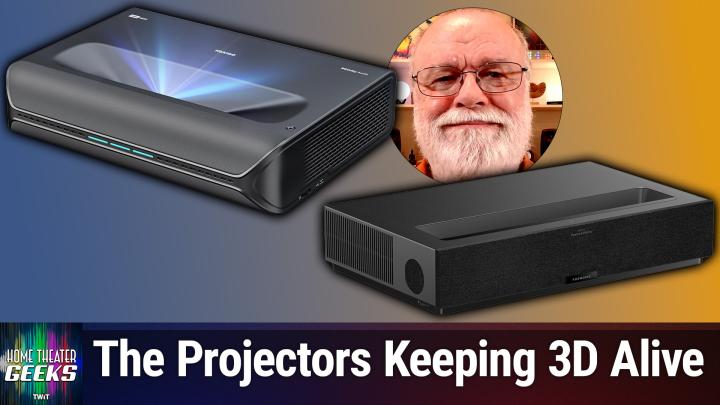
All TWiT.tv Shows (Audio)
Home Theater Geeks 464: 3D TV is Not Dead
00:12:18
Will we get new 3D TVs in 2025?
Loading summary
Transcript11 lines
- [00:00]
Scott Wilkinson
In this episode of Home Theater Geeks, I answer a listener question about 3D TV. Is it gone for good? Stick around.
- [00:12]
Unknown Host
Podcasts you love from people you trust.
- [00:17]
Unknown Announcer
This is twit.
- [00:29]
Scott Wilkinson
Hey there, Scott Wilkinson here, the home theater geek. In this episode, I answer a question from Robba Sandilin from Helsinki, Finland, who asks I'm a movie collector and film buff and I have a lot of classic 3D movies in my collection. To me, 3D is just as interesting and important as early color, early sound, and different aspect ratios. Definitely not just a gimmick. Unfortunately, my LG TV is getting a little long in the tooth and I would also like to buy a bigger TV. However, there are no new TVs with 3D capabilities and the manufacturer's websites make no mention of 3D, like it never even existed. Some projectors do have this capability, but that kind of setup is not possible for me at the moment. Have you heard anything about new 3D models perhaps coming out in your discussions at trade shows or with other industry insiders? Well Robby, that's a great question. The bad news is that I know of no plan to bring 3D back to flat panel TVs. It was all the rage, as you remember, and you have an example of it, but then it disappeared and it was gone. That Features Time has come and gone, I'm afraid. At least in flat panel TVs, if history is any indication, it might come back. It has come and gone several times over the last 50 years, but I have no idea when that might happen. The good news is I do have a solution for you. You're right that some projectors still have 3D capabilities. And it's not just conventional long throw projectors that you mount on the other side of the room. Some of the newer UST or Ultra Short Throw projectors, otherwise known as laser TVs, also offer 3D. Now one of these might well suit you because they are designed to replace a tv, a flat panel tv, and they have much larger screens. So I'm going to start by giving you a little explanation of UST projectors. They're projectors like a long throw projector from across the room, but they're designed to be placed very close to the wall where the screen is and they shoot up at a steep angle and put the put the image on the screen. Now some people would say, oh, I don't even need a screen. I could just paint my wall white and shoot it up there. Bad idea, bad idea, I'm afraid, because the light is coming up at such a steep angle, it needs to be reflected back out straight across the room to the viewer area. That requires a special screen. And not only that, that special screen will most often be what's called ambient light rejecting, which means that other lights on in the room or windows in the room, they bring in a lot of extra light. That light hits the screen, it doesn't, most of it does not get reflected back to the viewer. So this is one reason why they're called TV replacements, because they behave like a tv. You can watch TV in a brightly lit room and you still see a good picture. In most cases with a front projector, that's often not the case. It's more difficult to do. You have to really dim the lights. But with one of these UST projectors you can, you can have it on in a bright room and it still looks great. Now I have a graphic to show you that illustrates one concept about ultra short throw projectors. This shows you a short throw projector gives you the dimensions of the projector itself and how far away from the wall it needs to be in order to produce a picture of a given height. It also tells you how high the bottom of the screen must be from the level of the projector in order to have the screen filled with the image. And as you can see here, these ultra short throw projectors can go from 80 inches all the way up to 150 inches, which is way more than any flat panel TV. Now you can get an 80 inch flat panel TV no problem. 90 inch. Yeah, you can. 100 inch, close to 120. No, that's only going to be with a projector. So you have choices here, which is really cool and you can make the, the image as large as you want almost. Now you have to buy a screen and that adds to the cost. It's going to be more expensive than a flat panel tv, no question. But it solves two of your problems. The two problems you have identified. One is some of them, many of them are 3D capable and it can produce, produce a much larger picture than what you've got now. So you said you wanted a bigger picture, this will give it to you. You said you want 3D, this will give it to you. So I think it's, it's the way to go really, for what you want.
- [06:24]
Unknown Advertiser
If you love your phone but not your carrier, just switch to T Mobile. You can keep your phone, keep your number and we'll help pay it off. Up to $800 per line. You can also use Our savings calculator to compare our plans and streaming benefits against Verizon and AT&T. So switch and keep your phone, keep your number and keep more of your moolah. @t mobile.com up to 4 lines via virtual prepaid card.
- [06:46]
Unknown Announcer
Allow 15 days qualifying unlock device credit service ported 90 plus days with device and eligible carrier and timely redemption required card has no cash access and expires in six months.
- [06:55]
Unknown Advertiser
I'm no tech genius, but I know if I want my business to crush it, I need a website. Now. Thankfully, Bluehost makes it easy. I customized, optimized and monetized everything exactly how I wanted with AI. Within minutes my site was up. I couldn't believe it. Plus Bluehost keeps me protected 24. 7. No more worrying about hackers. I just relax and focus on my customers. So whatever your hustle may be, secure your online presence in 2025 with Bluehost. Head to bluehost.com to start now.
- [07:30]
Scott Wilkinson
Now in episode 461 just a couple of episodes ago I spoke with Phil Jones who is the lead reviewer of projectorreviews.com and he had just completed a showdown of eight different UST projectors and some of those contestants offer 3D capabilities. I don't think they tested the 3D capability specifically, but I would take a careful look at the top ranked models and here we see the results of that showdown. We can see that the Hisense PX3 Pro ranked one in three out of the four ways of measuring and second in one of them. And the Hisense PL2, the step down version or model from Hisense also got third place in three categories and second place in the other. And if you look all the way down to the two columns here under the Psych, the PX3 Pro and the PL2, you'll see notable features and the first notable feature you see there is 3D and you'll see that both Hisense projectors have a little green check which means that they support 3D. They have 3D capabilities. The other one that I wanted to point out is the four Movie, which is the name of the company, their model called the Theater Premium. It tied for second place in the judges rankings and it was in second place for the total point rankings and first place for standard dynamic range. And you go down that column and you see 3D and it says pending update. Okay, well I'd be a little suspicious of that. 4 movie has gotten a lot of rave reviews on their ultra short throw projectors. So you know, I guess I'M fairly confident that it'll come in a pending update, but there's no guarantee. You can't know that for sure. So let me, let me just tell you a little bit more about these three projectors. The Hisense PX3 Pro was at the top of the rankings, more or less ports 3D. Here's a picture of it up next to a wall producing a really big image. It's MSRP manufacturer Suggested retail price 3500 bucks. So not terribly cheap. The 4 movie theater premium was mostly in the second place in the rankings. Its support for 3D. As I said, they say to be coming in a firmware update, its MSRP is $3000 and like I said before, I'm not sure I'd trust that 3D will definitely be added in a firmware update. We can certainly hope. Okay, so then the Hisense PL2, generally third in the rankings, it supports 3D. Right now its MSRP is 2800 bucks and as of this episode it's on sale on the Hisense website for 2500 bucks. So that's good. The only other one I'll mention is the Nexigo Aurora Pro. That made it into the rankings a bit and it supports 3D and its MSRP is $2,700. So in all these cases you need to add the cost of a screen which can be up to 150 inches diagonal. You might not want one that big. At this showdown that Phil and Projector reviews did, they tested all the projectors on a 100 inch spectra projection Vantage screen which is specific to these ultra short throw projectors. It sells for $1200 on projectorscreen.com which was the other host of the showdown. They are a retailer, an online retailer. You can buy all these projectors from them as well as the screen. So the total budget for One of these UST projectors plus 100 inch screen is going to be around 37 to $4,700 and ain't cheap. But it gets you exactly what you're looking for. So I hope that that is helpful to you because you're not going to get 3D on a new flat panel TV, LCD, LED, OLED and it's not going to happen, at least not that I know of anytime soon. These items will do it, so I hope that helps. Now if you have a question for me, send it along to HTG TWIT TV and I will answer as many as I can right here on the show. And as always, we thank you for your support of the Twit network with your membership in Club Twit, which gives you access to all the Twitch shows in their video format. So we thank you for considering that. Until next time, geek out.
- [13:24]
Unknown Advertiser
AT T Mobile. We'll give you four free 5G phones and four lines for only $25 per line per month with eligible trade ins. And no, it's not a contest. It's every day for a limited time. Everyone's a winner on America's largest 5G network.
- [13:37]
Unknown Announcer
Minimum of 4 lines for $25 per line per month with autopay discount using debit or account. $5 more per line without autopay. Up to $830 off each phone via 24 monthly bill credits plus taxes, fees and $10 device connection charge for well qualified customers. Contact us before canceling entire account to continue bill credits or credit stop and balance on required finance agreement too. Bill credits end if you pay off devices early.
- [13:53]
Unknown Host
CT mobile.com and now a next level moment from ATT Business. Say you've sent out a gigantic shipment of pillows and they need to be there in time for International Sleep Day. You've got at and T5G so you're fully confident, but the vendor isn't responding and International Sleep Day is tomorrow. Luckily, AT&T5G lets you deal with any issues with ease, so the pillows will get delivered and everyone can sleep soundly, especially you. ATT 5G requires a compatible plan and device. 5G is not available everywhere. See att.com 5G for you for details.