← All TWiT.tv Shows (Audio)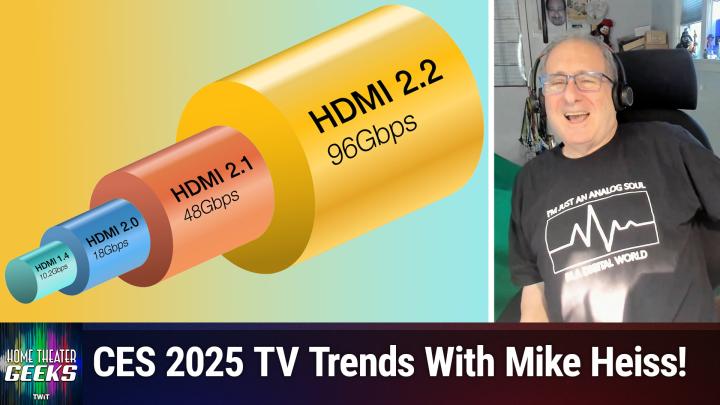
Loading summary
Transcript234 lines
- [00:00]
Scott Wilkinson
In this episode of Home Theater Geeks, I chat with Mike Heiss, industry journalist and consultant, about his trip to CES 2025. It's the first of three parts, so stay tuned.
- [00:16]
Unknown
Podcasts you love from people you trust.
- [00:21]
Mike Heiss
This is tw.
- [00:33]
Scott Wilkinson
Hey there. Scott Wilkinson here, the home theater geek. Now, I didn't make it to CES 2025 this year, but my good friend, industry journalist and consultant Mike Heiss did. So I've had him. I've asked him to come on the show here to talk about what he saw and heard in the first of three parts. Hey, Mike. Welcome back to the show.
- [00:58]
Mike Heiss
Hey, Scott. Thanks. Yep. I figured I'd take one for the team, and I haven't done a COVID test yet, but, you know, I avoid. This wasn't a super spreader, but I've spoken to a number of people that got the obligatory CES cold.
- [01:15]
Scott Wilkinson
Yeah, yeah. Well, that's one reason. One reason I didn't go is I'm somewhat respiratory compromised these days. I really want to be careful.
- [01:24]
Mike Heiss
Yep. Well, well meant. Good idea.
- [01:27]
Scott Wilkinson
Yes. Well, first of all. First of all, before we get into the show, I want to mention that, Mike, you live in the San Fernando Valley area of Los Angeles.
- [01:36]
Mike Heiss
Yes, I do.
- [01:37]
Scott Wilkinson
Which is experiencing unprecedented fires as we speak. I hope you're safe, and I hope your home is safe.
- [01:45]
Mike Heiss
Yes, thank you, Scott. I appreciate. My home is safe. I'm in a sort of little. You know, if you didn't know that I live in California, you'd think this was suburban anywhere, USA and like the Brady Bunch, which was actually filmed. Which was actually filmed about, you know, five miles.
- [02:03]
Unknown
Right, right, right.
- [02:04]
Mike Heiss
But no, it's a typical little neighborhood, and. And I appreciate when people ask me if they have floods or fires and you hear me being unsafe. It's an apocalypse, then.
- [02:18]
Scott Wilkinson
It's a real apocalypse. Well, this is more of an apocalypse than I think L. A. Has ever seen.
- [02:22]
Mike Heiss
Oh, no, for certain. I mean, I know people, as I think you said we're speaking earlier in the day. I know people that have lost their homes. In fact, I actually came home from the show a day early. Thank you, technology. Yeah. My wife was without power for three days while I was at the show. And the power came back, thankfully, and we had lots of battery banks. You know, you got to have those. No Internet. And they sent out a false alert pack. Get ready to go. And after three days without power, my wife sort of said, enough of this. You got to come home. And I did. And thankfully, it was a false alarm. But what a pain in the batude.
- [03:10]
Scott Wilkinson
Well, I'm really glad you're safe and your wife is safe and family is safe and your house is not burned down.
- [03:16]
Mike Heiss
Yeah.
- [03:17]
Scott Wilkinson
May it remain so.
- [03:20]
Mike Heiss
Make it so.
- [03:21]
Scott Wilkinson
Make it so. That's right. Exactly right. Okay, so we're here to talk about ces. You were there for several days.
- [03:30]
Mike Heiss
More than enough.
- [03:31]
Scott Wilkinson
It wasn't enough. No. I know you missed some stuff, especially because you had to come home a day early, but you probably would have anyway.
- [03:37]
Mike Heiss
Well, no, I would have stayed. The one thing I missed was Eureka park, which is always cool as an indicator of what's kind of coming. But I did see, if anybody says AI and a TV to me one more time, I will puke. So I went to all the press conferences, visited all the booths, visited the secret booths.
- [04:02]
Scott Wilkinson
The secret.
- [04:03]
Mike Heiss
The secret booths. So I had more than my fill. I think this is somewhere close to my 50th CES.
- [04:11]
Scott Wilkinson
Yeah. Yeah. I'm not surprised. I'm not surprised. Well, let us start with what I'm calling the biggest story, slash non story of CES, which is HDMI 2.2. Now, we know HDMI. It's been around for.
- [04:31]
Mike Heiss
You know it, you love it, you.
- [04:33]
Scott Wilkinson
Can'T live without it, and yet you also hate it.
- [04:38]
Mike Heiss
That's true. But in fairness to hdmi, and actually had an interview with Rob Tobias, who's the head of the HDMI licensing group. I said I've been saying for years, it's a shame that a lot of the stuff that Stevenuti, if you remember who used to have.
- [04:56]
Scott Wilkinson
I do, yeah, sure.
- [04:57]
Mike Heiss
Was always pilloried about, they get blamed for stuff that HDCP is really the cause.
- [05:05]
Unknown
Right, Right.
- [05:06]
Scott Wilkinson
Which is the copy protection embedded within hdmi.
- [05:11]
Mike Heiss
And not to jump ahead, I did ask Rob. HDMI is now at 2.1 B and HDCP is at 2.3 there. They're unparalleled tracks, but independent of one another. And there will not, as best we know as of now, not be a new HDCP standard that's sort of staying as is.
- [05:37]
Scott Wilkinson
Wow. Okay. Well, that's interesting to know.
- [05:40]
Mike Heiss
That must mean the suits over in the Black Tower are happy.
- [05:43]
Scott Wilkinson
Right? So here's the first graphic I wanted to show. Keith's 5. 21 in the chat room is saying that has a modest bit faster than DP2.1B. And that is true. And Thunderpants 5 and Thunderpants 5. Thunderbolt. We're jokingly calling it HDMI 2.1. What we have had up for the last year or two has A maximum bandwidth of 48 gigabits per second. HDMI 2.2 doubles that to 96 gigabits per second which is in fact faster than DisplayPort and Thunderbolt currently at 80 gigabits per second. So, so that's, that's quite a bump up in speed.
- [06:29]
Mike Heiss
It is. And the big question is why? Well, in the consumer, in the consumer electronics world.
- [06:40]
Scott Wilkinson
Yeah.
- [06:41]
Mike Heiss
If you're talking About Whiz Bang $750 Nvidia cards and things of that nature. Yes. You're fine. If you're talking about medical imaging or things of that nature, sure.
- [06:57]
Scott Wilkinson
Yeah.
- [06:57]
Mike Heiss
Is it going to make. If you're, and I saw Joe Kane, you know, if you're Joe Kane and you. Oh yeah, you know, 1632 bit blah to Blata. But there's no content so it doesn't, it doesn't matter for the consumer. It's just not going to make any.
- [07:16]
Scott Wilkinson
Difference in consumer video, consumer television and movies.
- [07:20]
Mike Heiss
Yes, yes, yes, yes.
- [07:21]
Scott Wilkinson
It's not going to make any difference difference. Now it does allow higher resolutions and frame rates and we have a graphic here, sample and sample rate.
- [07:31]
Mike Heiss
So there you go. So if you want. There's the eye chart. Let me see. This is an eye or that eye, your right eye. And read this. If you want 12K 60 frames per second, 444. Yeah. You're going to need this. But who's, what are you?
- [07:52]
Scott Wilkinson
Who needs. Yeah, who needs that?
- [07:54]
Mike Heiss
Well, if you've got, if you're an esports person and you've got a fancy schmancy Nvidia card or, or similar, it is important to those folks and I, I get it but I think for the average consumer it's, it's just not, it just. There's, there's nothing there.
- [08:16]
Scott Wilkinson
Well, this is why I call it the biggest story slash non story of CES. I mean it will allow you to do 4k at 480 frames per second.
- [08:27]
Mike Heiss
Well.
- [08:27]
Scott Wilkinson
Or you know, 8k at 240 or 12k at 120.
- [08:32]
Mike Heiss
And again if you're in a military, you know, near to eye kind of thing, that's cool. If they're. Well, the requirement is if you need to get a lot of data from here to there really, really, really quickly and a lot of it. Here's the way to do it. But do we want to talk about the buts?
- [08:57]
Scott Wilkinson
Always.
- [08:58]
Mike Heiss
Okay, so first of all, they announced it. The standard isn't done yet.
- [09:05]
Unknown
Right.
- [09:05]
Mike Heiss
The standard will not be done till sometime in the next couple of months. So until the Standard is done. You can't make chips.
- [09:17]
Unknown
Right.
- [09:18]
Mike Heiss
So not only is there no standard, there's a standard, but there really isn't a standard.
- [09:21]
Scott Wilkinson
Well, it's probably a preliminary standard, right?
- [09:24]
Mike Heiss
And. And you could start making chips, but.
- [09:28]
Scott Wilkinson
You wouldn't want to. You wouldn't want to until you knew for sure, every last detail.
- [09:32]
Mike Heiss
Well, because you can only go. And I went through, over the years, I've gone through this from 1.1 to 1.1.0 to 1.1 to 1.3 to 1.4. And it's, it's terrible because with the increased bandwidth, you can't monkey around with this stuff. And once you start cutting the. You know, when you get the die that makes the chips, you just can't be fooling. Oops, we changed the standards. Well, kiss that $15 million goodbye and pretend that you're somebody in the division that is in charge of these chips or one of the chip guys. Would you. And I've done this. Would you like to go up to the suits at the top floor and say, hey, guys, I need about $50 million?
- [10:23]
Scott Wilkinson
Yeah.
- [10:24]
Mike Heiss
Well, like, why? For the new HDMI. But we did that a couple of years ago. What do you want to do it again? Why are we going to make money? There's the key right there, you know, so it's gonna happen where you will probably see it first. Because these guys cut new dies more frequently are in the SOCs, the all in one system on chips from companies like mtk or when we get to the TV section, all those processors. My processor is better than your processor.
- [10:59]
Scott Wilkinson
We're gonna get there in part two.
- [11:00]
Mike Heiss
Yeah, that's where you'll see it first. So you may well see it in TV's way before. Cool your jets, folks. Before you see it in AVRs and surround processors. It's going to be easily, easily 18 to as many as 36 months. Remember 2.0?
- [11:22]
Scott Wilkinson
Yeah, it took a while.
- [11:23]
Mike Heiss
Remember 2.1?
- [11:25]
Scott Wilkinson
It took a while.
- [11:26]
Mike Heiss
Took a while. So use that as, you know, the kind of expectation that you should have.
- [11:33]
Scott Wilkinson
Yep.
- [11:33]
Mike Heiss
But they showed a prototype of the cable. Oh, wait, what am I going to.
- [11:36]
Scott Wilkinson
Connect it to now? It's a new cable. It's a different cable.
- [11:41]
Mike Heiss
Same connector.
- [11:42]
Scott Wilkinson
Same connector.
- [11:44]
Mike Heiss
And I know I'll be very disappointed because you've got a pretty educated group of folk watching this. And no, they will not add a locking mechanism. And somebody asked Rob, somebody asked Rob Tobias about this at the press conference. And having a locking mechanism, as long as it doesn't get in the way of interchangeability is okay, but HDMI will not mandate any change to the connector. And it's like, where are my notes? It's like, remember they used to have the signs over McDonald's a billion served.
- [12:23]
Scott Wilkinson
Yeah, sure.
- [12:24]
Mike Heiss
So they said to date There have been 14 billion with a B HDMI devices shipped.
- [12:33]
Scott Wilkinson
Wow.
- [12:34]
Mike Heiss
So they don't want, you know that there's a big legacy issue. So there will be new cables. The cables will be backwards compatible, but clearly not front compatible. Cable that you just bought last week for 48 ain't gonna work for 96. Yep. And. And the increased speed and bandwidth will mean that it's going to be harder to go longer distances.
- [13:02]
Unknown
Right, exactly.
- [13:04]
Scott Wilkinson
Somebody. Keith's 512 in the chat room made that exact point. So if you go with a longer cable, it might reduce the bandwidth, but.
- [13:15]
Mike Heiss
You can use active cables. And they said, yeah, you want to use active cables, but you'll need new chips for the active cable. Yeah, you'll need new chips if you're going HD based T, which I don't think could probably do 2.1 in many cases now anyway. So you've got to look at what you need and what you're going to get out of this.
- [13:37]
Scott Wilkinson
Yeah.
- [13:37]
Mike Heiss
If you're going to hold off as a, for somebody who is involved in this market in other, other parts of my, my life, don't be waiting.
- [13:47]
Scott Wilkinson
Yeah, don't be waiting.
- [13:50]
Mike Heiss
Yeah, don't be waiting. Because I was speaking to another longtime industry buddy of mine and he said I was working at retail when 2.0 was announced and sales dropped for 18 months of a major, not, not one of the brands that I work for, but another, another major brand.
- [14:08]
Unknown
Right.
- [14:09]
Mike Heiss
And he, and he said, you know, why did, why did they do this now?
- [14:13]
Unknown
Right, right.
- [14:15]
Scott Wilkinson
I do want to mention two things. Two feature things in HDMI 2.2. One is called Latency Indication Protocol, or LIP.
- [14:25]
Mike Heiss
As in sync.
- [14:26]
Scott Wilkinson
As in LIP sync.
- [14:27]
Mike Heiss
Oh, that's. Yeah, that's the graphic. So the best way to describe this is for those who know what EDID.
- [14:35]
Scott Wilkinson
Is, which stands for Extended Display identification. It indicates it's metadata that show that reveals what the capabilities of a display are.
- [14:46]
Mike Heiss
The device at the source, the device at the start and the sync, the device at the end. Talk to each other. Yo, Mr. Source, what can you do? Me? Well, Mr. TV or Ms. TV, I can do this. What can you do? And they kind of talk to each other and figure out what the best way to communicate and what's the best quality they can deliver. So picture that for audio and not just for the type of audio. But this is also meant to reduce latency.
- [15:22]
Unknown
Right?
- [15:23]
Scott Wilkinson
The dreaded lip sync issue, where, you know, you see somebody say something and then you hear what they're saying, you know, milliseconds later, 200 milliseconds later, this will reduce that. And that's a good thing, I'd say.
- [15:36]
Mike Heiss
Yes. And I mean, and the funny thing, because I can't help myself is I asked Rob Tobias, did they come up with a name and then realize, hey, this has a cool acronym, lip, or did they come up with the acronym and find the words to make it fit? And he's a little bit too serious.
- [15:55]
Scott Wilkinson
Yeah, yeah, yeah. Now the other thing you mentioned to me that I didn't realize that 2.2 will not have what's called alt mode.
- [16:05]
Mike Heiss
Yes. Well, let me just one thing on lip. LIP is metadata, right? Which is data about the data for those who aren't that deep into that stuff. So I asked him a couple of key questions. Can you, will you be able to upgrade from 2.1 to 2.2? And the answer is no way. The only time that was done was when 1.4 came out. The circuits that were in the PlayStation 3 were designed to have 1.4 blown in. That was a one time only. That will never ever, ever happen again. However, since WIP is metadata, as long as the system can pass it, that is a thing that is being introduced with 2.2. But if the source and the sink both talk lip, I guess you're giving me lip.
- [17:01]
Scott Wilkinson
Give me lip.
- [17:04]
Mike Heiss
That if they both talk lip, the fact that your AVR processor or sound bar in the middle are not 2.2, that's okay as long as the devices out at the other ends can, can listen and sense the metadata. So that's, that's good. So can be carried through lip. No updates. Alt mode. Now I've got my little Dell xps, the second one that I've been using it and I use it when I do presentations or work on the road. And it has a USB C on either, either side. And to make the computers thinner, they take away the U and some of the ultras, they take away the HDMI port, right? So how do I get hdmi? I'm going to Barcelona. I'm going to Barcelona to do isc. That'll be cool with home theater geek. And they're going to be beaucoup, they big displays. Because if Avixa, which is like the cedia of the institutional and commercial world. If Avixa and Cedia had a love child, it would be this show ise. And in fact both of those two groups own it. So I'm going to do my Mikey shows there. And that is famous for much more emphasis on large displays. So we'll see if there's anything to report. Right, But I digress. I totally forgot what the heck I was talking about.
- [18:35]
Scott Wilkinson
Alt Mode.
- [18:36]
Mike Heiss
Alt Mode. So when I take my computer on the road and I want to hook it up to a connect a projector.
- [18:41]
Scott Wilkinson
TV or a projector.
- [18:43]
Mike Heiss
Projector, sure. You plug your USB C in and you've got a little widget or your phone, I can, you know, as a backup. I store my presentations on the cloud and I've got a Pixel with a usb and the Pixel eights and nines now support Alt mode, which it didn't at first. So I hook up a little thing connected the projector and bingo, I'm done.
- [19:06]
Scott Wilkinson
Basically what Alt mode does is it lets you send HDMI data out USB C directly to a projector or a display or a TV or a display or whatever.
- [19:16]
Mike Heiss
And I asked Rob about that and he said no or certainly they got other to go other stuff to get to first. Other excrement, yes, deal with first. Oh man, no Alt Mode. But again, it's a question of use case people get caught up in the technology as much as you and I both kind of live by that.
- [19:39]
Scott Wilkinson
Hey man, we're home theater geeks.
- [19:41]
Mike Heiss
But I'm not going to buy. Well, but there are people with home HTC 8 HD PCs, which is something different. But you can hook up your HD HTPC to the display of your choice if the video cards got an HDMI adapter or a jack or via Alt mode. But when I take my XPS and throw it in my briefcase and I get to wear Barcelona, I'm gonna hook it up. What do you call it? Using Alt mode. Good enough. I don't need. I don't need 96 to do the Mikey show.
- [20:23]
Unknown
Right, right.
- [20:24]
Attention taxpayers. The IRS is intensifying collections in 2025. If you owe $10,000 or more or have unfiled tax returns, it's time to take action. Tax Network USA's experienced lawyers have saved clients over a billion dollars. They're ready to negotiate with with the IRS on your behalf. Don't risk wage garnishment, property seizure or losing your home. Call 1-800-958-1000 today. Get the help you need at 1-800-958-1-000 or visit tnusa.com if you love your.
- [20:55]
Phone but not your carrier, just switch to T Mobile. You can keep your phone, keep your number and we'll help pay it off up to $800 per line. You can also use our savings calculator to compare our plans and stream streaming benefits against Verizon and AT T. So switch and keep your phone, keep your number and keep more of your moolah. @t mobile.com up to 4 lines via virtual prepaid card.
- [21:16]
Allow 15 days qualifying unlock device credit service port in 90 plus days with device and eligible carrier and timely redemption required. Card has no cash access and expires in six months.
- [21:25]
Scott Wilkinson
Okay, well, so HDMI 2.2, big story @ the show. Not important for consumers of TV content at this time.
- [21:37]
Mike Heiss
At this time, it'll come to monitors. Clearly, it will come to monitors first. But then there's the crossover between, as somebody in the chat room asked about smaller size TVs before we started, there are people using 32 inch or 42 inch or 48 inch standard TVs as monitors.
- [21:59]
Unknown
Right.
- [21:59]
Mike Heiss
And so it'll be necessary there particularly. And then, you know, here's a tease. Particularly when the TV sets are going to 144, 160, and the sky's the limit.
- [22:12]
Unknown
Right, Right.
- [22:13]
Scott Wilkinson
Well, we're going to get into that next to the end, part two. But for this part, the second area that I want to cover with you is sort of a bigger picture. Look at the TV industry as you saw at ces.
- [22:28]
Mike Heiss
Yep.
- [22:30]
Scott Wilkinson
And in particular, you, you mentioned to me before we, before we were on the air that manufacturers don't make any.
- [22:37]
Mike Heiss
Money selling TVs, and many of them never did.
- [22:43]
Scott Wilkinson
The margins are razor thin.
- [22:46]
Mike Heiss
Yes. And to some extent for the retailers as well, that's great. For the consumers, unless they have tariffs, Great. For the consumer. Another subject, but it's something to watch out. I don't want to get into the politics.
- [23:00]
Scott Wilkinson
No, no, no, no, no, no, no.
- [23:02]
Mike Heiss
But, but, but, but I simply want to say that, be aware of that because it will have an impact if they increase the tariffs on the price.
- [23:12]
Scott Wilkinson
Of TVs from China or wherever. Yeah.
- [23:14]
Mike Heiss
Even for Mexico. TVs are made in Mexico.
- [23:16]
Scott Wilkinson
Yeah, that's true. That's true.
- [23:18]
Mike Heiss
Assembled in Mexico.
- [23:19]
Unknown
Right.
- [23:20]
Scott Wilkinson
Okay. So as you said, I think before we. If you hear the word AI one more time in regards to your gonna puke. It was the huge buzz at CES all over the TV market.
- [23:37]
Mike Heiss
And it was. And I've been sort of saying for the past year or so. I am clearly old and I'm old enough to remember digital ready speakers. Did the speaker know that the content that was being fed was digital? And the answer is digital no. Has anybody seen. When you. If you're shopping for an antenna, an HDTV or next gen ready antenna. Antenna is kind of stupid. It doesn't know.
- [24:07]
Unknown
Right.
- [24:07]
Mike Heiss
It knows that there's RF and it, you know when you want to hope that there's enough, but it doesn't care what's in it.
- [24:13]
Unknown
Right.
- [24:13]
Mike Heiss
And that is sort of a similar thing. I can do a lot of things, it can do a lot of good things, but I think it's being overused. Perhaps after this CES maybe people will come to their senses and perhaps describe what it is that AI is doing in a particular product. So we don't have AI ready TVs.
- [24:40]
Scott Wilkinson
Well, but we sort of do. I mean, AI is being applied in two everything primary areas, I would say content recommendation and user interface being one of them.
- [24:52]
Mike Heiss
Right.
- [24:52]
Scott Wilkinson
And picture and sound quality optimization being the other.
- [24:57]
Mike Heiss
Correct. With sort of a sidebar, if you will, of the increased use of the TV once again. And they've been saying this for the last three or four years, but this year it's really going to happen with home control and telehealth and pet health and exercise and. And yeah, yeah, yeah, yeah, yeah.
- [25:22]
Scott Wilkinson
To the point where they are. The TV manufacturers are now adopting these AI large language model algorithms. LG and Samsung are going with Microsoft Copilot.
- [25:35]
Mike Heiss
Yep.
- [25:36]
Scott Wilkinson
And Hisense and TCL are going with Google Gemini.
- [25:40]
Mike Heiss
Yep. And they're adding more far field mics.
- [25:45]
Scott Wilkinson
Yep.
- [25:46]
Mike Heiss
And they're adding sensors. And not just sensors like a webcam, but sensors that are IR kind of IR cameras, where it's not so much to see a webcam, of course, to say, oh yeah, hi grandma, but a sensor to determine if there's anybody in the room or in the case of hell, telehealth is the person who's in the room moving.
- [26:12]
Unknown
Right. Right.
- [26:15]
Scott Wilkinson
And this is just going to keep getting more and more and the implication is clearly that apps and content are what are important to TV makers, not the hardware itself.
- [26:29]
Mike Heiss
Right. But you're tying that in, particularly in the content recommendation. If we want to watch some streaming show.
- [26:38]
Unknown
Right.
- [26:39]
Mike Heiss
Severance. Weird.
- [26:41]
Scott Wilkinson
But haven't watched it yet.
- [26:43]
Mike Heiss
It's really weird. And it's on. Which by the way, there's something in one of the groups that I'm, you know, involved in where they hired some guy that is fitting new TVs or new LCD panels into old CRT monitors because, because first of all, it's hard to get the old CRT monitors to work. But it's set pieces.
- [27:12]
Scott Wilkinson
In the, in the production of these.
- [27:14]
Mike Heiss
You've got your old, you can't get an old NEC Multi Sync monitor anymore.
- [27:20]
Scott Wilkinson
Right.
- [27:20]
Mike Heiss
Or even an old MacBook or Maca smacker.
- [27:24]
Scott Wilkinson
Right. Or a Sony Vega TV.
- [27:27]
Mike Heiss
Well. Or an old, you know, 27 inches. The old Zenith. Yeah, right. And there are people that restore those. But, you know, so there's a lot of that going on. The content recommendation is, Michael, you know all about this stuff. We want to watch severance. Okay, what device do I use in? Is it on Apple tv? Is it platform? Is it on, Is it on Netflix? Is it on one of so many of these things? And that's where the combination of voice control, AI and contact recognition and recommendation is really, really where this will come into play.
- [28:16]
Scott Wilkinson
Now one interesting thing you told me was that some of the manufacturers, they're operating system, their OS is now being adopted on other manufacturers. This is new. I had never heard of this. Normally manufacturers take their software and they guard it closely and they say we're the only ones that have this.
- [28:38]
Mike Heiss
And this is, this is an eye chart to see how old the people in the chat room are. Pro Scan, formerly a subject high brand of RCA in the days when RCA was rca.
- [28:54]
Unknown
Right.
- [28:54]
Mike Heiss
And now it's just a licensed brand that the people who are doing RCA TV sets are using. So Pro Skin makes you want a Roku. I got a Roku. You want to Google it. Not all, by the way. Not all in the same set. There's only one. But there are people that prefer, like a lot of people prefer Roku because although it's getting more so now, they're kind of, they've got the most stuff and they're kind of the Swiss army knife. Right, but. And they're somewhat into home control, but only for their own devices. If you like that, you like Roku. I've got a Roku TV here. If you like more of the Google infrastructure, you've got Google.
- [29:34]
Scott Wilkinson
But what was important in that graphic though was WebOS. Yes, WebOS. They have, they offer, you can see there on the left, it says powered by WebOS, which is an LG operating system and used to be exclusive to lg.
- [29:51]
Mike Heiss
Whoops. So yes, and, and LG is licensing just as Samsung is licensing Tizen, which is their system. So you're going to need, not that you're going to need part of this is what also makes the case. If you were to say, and somebody like you or like the audience here would say, I want an LG or a Samsung set because I like the display technology and boy, is that picture really good. So you buy the set because you like the video quality and some of the other features, but you abhor the os. And that's the reason why people will still buy roku streamers, Apple TV 4Ks.
- [30:38]
Scott Wilkinson
Or the external streamer boxes, or the.
- [30:41]
Mike Heiss
Google, if you like. If you like the LG or Samsung sets, but you want the Google interface, you buy a Google TV with Chromecast. A little white occupant things.
- [30:56]
Scott Wilkinson
Right.
- [30:56]
Mike Heiss
So there still is a need for those devices, but it's all being driven by the, you know, by the ad people. They're not selling TVs, they're selling eyeballs.
- [31:09]
Unknown
Right, right, exactly.
- [31:11]
Mike Heiss
So they're all in the ad sales business. And that's the reason. That's the reason why they're doing it. Why ask me? Did you see the new Vizio sets at ces?
- [31:23]
Scott Wilkinson
Hey, Mike, did you see the new Vizio sets at ces?
- [31:25]
Mike Heiss
Gee, Scott, I'm glad you asked. No. And they haven't exhibited a CES on the floor actually ever. But they used to have a huge. In past years, I think you may have used to have them at the Win. They'd have a big display of all.
- [31:39]
Scott Wilkinson
The sets, a big ballroom full of.
- [31:41]
Mike Heiss
Stuff, because they were selling them to lots of dealers. Yeah, they now have one dealer, Walmart, because Walmart owns Vizio now. I know that they had a suite in a different area in the C space, which was over at the Aria, where they had all the ad sales people. But they're interested in selling TV sets because they're interested in selling eyeballs. And that's, you know, that's why they weren't there.
- [32:10]
Scott Wilkinson
Yeah, yeah. I wanted to point out an interesting article I found on Ars Technica, which is titled why I'm disappointed with the TVs at CES 2025.
- [32:24]
Mike Heiss
Did you know that there's a pirate version of our Technica?
- [32:28]
Scott Wilkinson
No.
- [32:30]
Mike Heiss
Technica.
- [32:31]
Scott Wilkinson
All right, all right. This article is by Sharon Harding and we're going to put the. The link in the show notes. She makes the argument that TV makers focus is on software and AI. Their business model is collecting user data and providing content, which is what we've been talking about here all this whole time. She. She particularly rails. One thing she rails against is the LG that has a new remote. It used to be Called the Magic Remote. It's now called the AI Magic Remote. And it has no input select button, which I would rail against too.
- [33:07]
Mike Heiss
That would make me nuts.
- [33:08]
Scott Wilkinson
Nuts, absolutely. And she points out, as you pointed out earlier, that more TVs are adding far field microphones to hear voice commands from across the room, which raises concerns about privacy.
- [33:24]
Mike Heiss
Yep. Did you say AI?
- [33:28]
Scott Wilkinson
Yes.
- [33:33]
Mike Heiss
I'm sorry, Keith. Sorry, sorry.
- [33:36]
Scott Wilkinson
Okay. And you had to puke. I apologize.
- [33:38]
Mike Heiss
That was, that was what the wrestling was about.
- [33:41]
Scott Wilkinson
Okay, all right, all right.
- [33:42]
Mike Heiss
Okay. So yeah, it's the privacy is a concern and some of the large language model stuff. Just as you clearly will have the same concerns about phones and what they brought up. Samsung promoted Knox K and ox, which is not a radio station or it may be, that's their security system. And LG said the same. And a lot of the LLM stuff, the large language model is on device. So that's not all of it. But that's one of the ways that they're trying to assuage the concerns about privacy. But you know, or the answer is you can, you know, put a piece of tape over the webcam and you can or you cannot connect the TV to the, to the Internet. I mean that's the, you know, but.
- [34:39]
Scott Wilkinson
Then that defeats the purpose of a lot of what they're trying to sell.
- [34:43]
Mike Heiss
Then get this, then get the Zenith out of the closet. I mean, but get a next gen TV adapter. But we'll talk about that later. Right. But I mean, no, there's no, there's no perfect solution to this.
- [34:56]
Scott Wilkinson
There isn't, there isn't.
- [34:57]
Mike Heiss
The manufacturers. I, I will say in fairness, the manufacturers are aware of it and in fact there's one. Can I answer a chat room question?
- [35:07]
Scott Wilkinson
Sure.
- [35:09]
Mike Heiss
Keith's 512 says the UI can be important. The UI can be important. That is why I picked Panasonic for my TVs in the. Here in the UK as the, as the new LG TV is sometimes a bit slow on its UI. The Panasonics which looked spectacular that they showed a CES had Fire TV at the OS. Are you kidding me? Oh, what are you kidding? Oh good. Because I love to see new things about what Amazon is doing. Give me a break. But that's why you still might want to have an Apple TV or a Roku or a whatever.
- [35:48]
Unknown
Right.
- [35:49]
Mike Heiss
So. But I think that that's something that got overlooked in a lot of the coverage. But that's why the people watch this are smart.
- [35:56]
Unknown
Right.
- [35:57]
If you have a locked at and T phone. We're here with bolt cutters. T Mobile will help pay off your locked phone and give you a new 5G phone for free. All on America's largest 5G network. Visit t mobile.com carrier freedom via virtual.
- [36:11]
Prepaid MasterCard in 15 days. Free phone up to $830 via 24 monthly bill credits plus tax and a $10 device connection charge. Qualifying port in trade in service on Go5G next and credit required. Contact us before canceling entire account to continue bill credits or credit stop and balance on required finance agreements. Do you have bill credits and if you pay off devices early.
- [36:27]
I'm no tech genius, but I know if I want my business to crush it, I need a website. Now. Thankfully, bluehost makes it easy. I customized, optimized and monetized everything exactly how I wanted with AI. Within minutes my site was up. I couldn't believe it. Plus, Bluehost keeps me protected 24 7. No more worrying about hackers. I just relax and focus on my customers. So whatever your hustle may be, secure your online presence in 2025 with Bluehost. Head to bluehost.com to start now.
- [37:03]
Scott Wilkinson
So the author of this article thinks that AI used to improve picture and sound quality is a good thing. And I do too.
- [37:10]
Mike Heiss
And it is.
- [37:11]
Scott Wilkinson
And in fact you saw she also mentioned she'd prefer manufacturers work on improving picture and sound quality. And you saw some examples of exactly that.
- [37:22]
Mike Heiss
Yes. And Panasonic, if that's where you're trying to go here.
- [37:26]
Scott Wilkinson
Yep.
- [37:27]
Mike Heiss
Was one of the examples in terms of TV panel technology for the last year or two, LG just LG display, which is a separate division of the larger corporation that makes the panels that are used by many TV brands, including Sony and LG. And for the OLEDs, Samsung, that's LG display as opposed to LG. LG electronics, that's the brand.
- [37:57]
Unknown
Right.
- [37:57]
Mike Heiss
LG display has a new type of OLED that is beautiful. The sets are beautiful, but each company uses different improvements. Their own secret sauce. You know, do you want your burgers flame broiled or do you want the Big Mac sauce? That's why you might buy a Burger king or.
- [38:22]
Scott Wilkinson
Or McDonald's. Yeah.
- [38:24]
Mike Heiss
So the Panasonic. Excuse me, The Panasonic not only uses this new technology which is replaced for the time being, the mla, the micro lens array, but they have another thermal cooling and some other processing advancements. And that's why they think that their sets look better and they really did look good than the LGs, which by the way also look very good. But the one disadvantage of CES is you can't see them side by side. So.
- [38:56]
Unknown
Right.
- [38:56]
Mike Heiss
Ask me which one look better. Show me both of them side by side, both calibrated and both playing the same material, which we'll see at the.
- [39:04]
Scott Wilkinson
Flat panel shootout later this year.
- [39:06]
Mike Heiss
One presumes.
- [39:06]
Scott Wilkinson
Yeah, one presumes. Now, you did mention to me that, you know, you did see improvements in picture quality which you've been mentioning, dramatic even, which is surprising to me. I mean, usually it's incremental, but you're, you're talking about dramatic improvements. And you said that a number of booths had their last year's model side by side with this year's model and maybe even a few years ago.
- [39:31]
Mike Heiss
Yes. Well, LG in the secret room showed this year's versus last year's. And there was a very significance in the picture quality. It was pretty good. What TCL showed in their booth where they were talking about the backlighting technology. They didn't show the TVs, they showed the backlights. So lots of, you know, few zones, bigger LEDs, more zones, smaller LEDs, way more zones, way smaller LEDs. And it is those technologies that deliver the better picture quality. Like TCL was claiming smaller L mini LEDs closer to the screen.
- [40:29]
Scott Wilkinson
Yes.
- [40:30]
Mike Heiss
And that makes them brighter because. And they said you and I would always in these discussions talk about how many dimming zones.
- [40:37]
Unknown
Right.
- [40:38]
Mike Heiss
People weren't talking about dimming zone. Well, I've got 8,342 dimming zones. You didn't hear that this year. But they were talking about the overall brightness and quality or what TCL was saying, less haloing, which is important. So that's the technology behind it that each of the brands is trying to promote to say that ours is better. At the end of the day, it's these guys.
- [41:08]
Unknown
Right, Right.
- [41:11]
Scott Wilkinson
Well, we're going to take a deeper look at those new technologies next time. And so I think now is the time to say goodbye. Now's the time to say goodbye until next time. When we get into part two, when we will discuss more specific. The TV manufacturer, the TV models and technologies that were introduced. And I hope you will stay tuned for that. Mike, where can folks find your stuff?
- [41:43]
Mike Heiss
You can find my stuff for residential tech today, restechtoday.com or hidden wires, which is mostly European based publication, but if you want to see some houses that you wish you could afford. Ford and. And they do cover the, the technology scene as well, because I write for them and that's hiddenwires.co.uk and oh, thank you for the plug there.
- [42:10]
Scott Wilkinson
There we go. We have, we have a little, they have the homepage on the screen there now and that's, that's a lot of great stuff in those publications contributed to by my guest Mike Heiss. Thanks so much for being here, Mike.
- [42:23]
Mike Heiss
Thanks a lot, Scott.
- [42:24]
Scott Wilkinson
All right, we will see you in part two. Now if you have a question for me, you can send it right along to htgwit tv. I love answering the questions on the air here, so I look forward to getting your questions. And as always, we thank you for your support of the Twit network with your membership in Club Twit, which gives you access to all the Twitch shows in their video format. So you can see all the great graphics and stuff that we show you. And thanks so much for considering that. Until next time, geek out.
- [43:12]
Unknown
If you have a locked AT and T phone, we're here with both bolt cutters. T Mobile will help pay off your locked phone and give you a new 5G phone for free. All on America's largest 5G network. Visit t mobile.com Carrier Freedom via virtual.
- [43:27]
Prepaid MasterCard in 15 days. Free phone up to 830 via 24 monthly bill credits plus tax and a 10 device connection charge. Qualifying port and trade in service on Go5G next and credit required. Contact us before canceling entire account to continue build credits or credit stop and balance on required finance agreement is due, no credits and if you pay off.
- [43:41]
The bill, devices early and now a next level moment from @t business. Say you've sent out a gigantic shipment of pillows and they need to be there in time for International Sleep day. You've got AT and T5G so you're fully confident, but the vendor isn't responding and International Sleep Day is tomorrow. Luckily, AT&T5G lets you deal with any issues with ease, so the pillows will get delivered and everyone can sleep soundly. Especially you. AT&T 5G requires a compatible plan and device. 5G is not available everywhere. See att.com 5g4u for details.
- [44:13]
This podcast is sponsored by Talkspace. You know when you're really stressed or not feeling so great about your life or about yourself, talking to someone who understands can really help. But who is that person? How do you find them? Where do you even start? Talkspace. Talkspace makes it easy to get the support you need. With Talkspace, you can go online, answer a few questions about your preferences, and be matched with a therapist. And because you'll meet your therapist online. You don't have to take time off work or arrange childcare. You'll meet on your schedule wherever you feel most at ease. If you're depressed, stressed, struggling with a relationship, or if you want some counseling for you and your partner or just need a little extra one on one support, Talkspace is here for you. Plus Talkspace works with most major insurers and most Insured members have a zero dollar copay. No insurance, no problem. Now get $80 off of your first month with promo code SPACE80 when you go to talkspace.com Match with a licensed therapist today at talkspace.com Save $80 with code SPACE80@.