← All TWiT.tv Shows (Audio)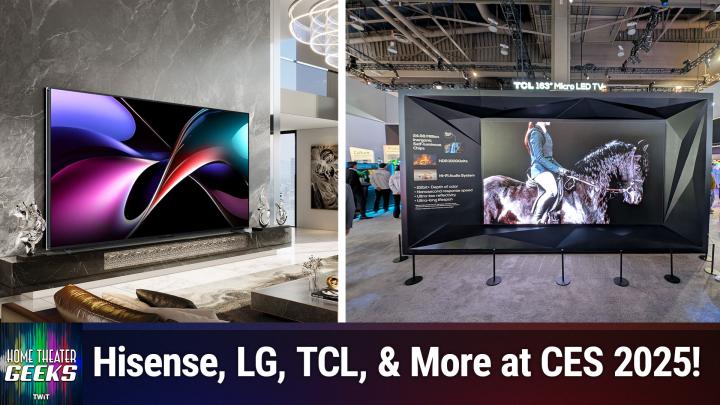
All TWiT.tv Shows (Audio)
Home Theater Geeks 466: CES 2025 Part 2: TVs
00:43:50
New models & technologies
Loading summary
Transcript297 lines
- [00:00]
Scott Wilkinson
In this episode of Home Theater Geeks, I continue my discussion with Mike Heiss about what he saw at CES 2025. So stick around.
- [00:13]
Podcast Promo
Podcasts you love from people you trust.
- [00:17]
TWIT Promo
This is tw.
- [00:29]
Scott Wilkinson
Hey there, Scott Wilkinson here, the home theater geek. In this episode I continue my conversation with Mike Heiss, industry journalist and consultant who just got back from CES 2025. This time we're going to focus on TVs. Hey, Mike, welcome back.
- [00:48]
Mike Heiss
How you doing, Scott?
- [00:49]
Scott Wilkinson
Hey, doing good. So let's get deep in the weeds here, shall we? The geeky weeds.
- [01:00]
Mike Heiss
First of all, not geeking out.
- [01:02]
Scott Wilkinson
Yeah, we're geeking in. Yeah, exactly. First of all, I want to mention we have basically four major brands of TV that are. That are at CES 5 if you count Sony, but they didn't show any new TVs at CES.
- [01:21]
Mike Heiss
But they had a cool car.
- [01:22]
Scott Wilkinson
But they had a cool car. And Hisense, lg, Samsung and tcl. Correct. And many people would say Hisense and TCL are second tier brands.
- [01:34]
Mike Heiss
Not anymore.
- [01:35]
Scott Wilkinson
I don't. I agree with you. I don't think so. I think they have become first tier brands.
- [01:40]
Mike Heiss
And if you look at the market share which they did not hesitate. They did not hesitate to point out. I'm looking in my notes here. There, there are months or quarters when they're number one. They're number one.
- [01:58]
Scott Wilkinson
Yeah.
- [01:59]
Mike Heiss
I mean they're really, they're pushing the envelope both in terms of features and technology. And they're not a cheapo. Yes, you can still buy them at what do you call it? You can buy them at the warehouse at Costco and Sam's Club. But as an example, TCL was at Cedia for the first time this year. And well, with 115 set as set as you might imagine. But no, these are real serious TV sets.
- [02:28]
Scott Wilkinson
Yeah. And still at prices that are somewhat less than lg, Samsung and Sony.
- [02:34]
Mike Heiss
Well, I mean you have to compare feature set and technology to feature set and technology.
- [02:39]
Scott Wilkinson
True enough.
- [02:40]
Mike Heiss
The answer is they are real value for the price and they're going to give some of the other legacy brands a run for their money.
- [02:55]
Scott Wilkinson
So let's start with Hisense. They showed a number of really cool things. One was the 136mx136 inch microled display, direct view microled display, 4K Dolby Vision and HDR10 HDMI 2.1. We're not going to see any 2.2 sets this year, please. With, with gaming features like VRR and Allm, variable refresh rate. And automatic. I forget what Allm stands for.
- [03:27]
Mike Heiss
Automatic. Whoa, wait and see. Mishikas.
- [03:29]
Scott Wilkinson
Yeah. And those are for Gamers. It covers 95% of BT 2020 color gamut and it goes up to 10,000 nits of peak brightness. Holy smokes.
- [03:42]
Mike Heiss
Them's a lot of nits.
- [03:43]
Scott Wilkinson
Them's a lot of nits.
- [03:45]
Mike Heiss
Picking them nits.
- [03:46]
Scott Wilkinson
Now, did you see it? I know that I'm showing you.
- [03:49]
Mike Heiss
Yes, I did. Yes. And I mean and I had taken some pictures but it would, what you just saw is actually better because it's a, you know, sort of a studio shot. And as we said in part one, it's really hard to say which was better because the one downside of a trade show is you don't see them side by side.
- [04:08]
Scott Wilkinson
Right.
- [04:08]
Mike Heiss
Everybody shows theirs in a booth and you have to rely on your visual memory. Such as, such as it is, they all look good and everybody always is playing separate, you know, demo material. So it's not like the old days where everybody was, you know, playing Top Gun for goodness sakes.
- [04:28]
Scott Wilkinson
Right. Now they have all, now they all have custom made demo material in, in.
- [04:33]
Mike Heiss
Very, very high resolution.
- [04:35]
Scott Wilkinson
Yeah.
- [04:35]
Mike Heiss
And clearly tailored to showcase, you know, underwater scenes and the jellyfish and what we used to, I show my age. We used to call these Japanese demo reels when the Japanese sets brands were, you know, were the big ones and the LG and Samsung were the up and commerce.
- [04:56]
Scott Wilkinson
Right.
- [04:57]
Mike Heiss
Now it's the reverse, right, that LG and Samsung become the legacy brands and the TCOs and Hisenses are the, they're not the up and comers anymore. They're. They have already come up.
- [05:09]
Scott Wilkinson
Yeah. Right. And that's another interesting point you make. The, the, the high end TVs were made in Japan and the Koreans were the up and comers. Now the Koreans are the legacy brands and the Chinese are the up and comers or have already arrived.
- [05:25]
Mike Heiss
Although I say advisedly designed in Korea, not necessarily made in Korea.
- [05:31]
Scott Wilkinson
Understood.
- [05:32]
Mike Heiss
And that's going to be important.
- [05:34]
Scott Wilkinson
Right. HiSense also showed 163 inch micro LED TV, same as the 136 and has basically the same specs.
- [05:45]
Mike Heiss
There wasn't as much attention on any of the manufacturers. LG kind of not at all. I guess I'll wait for ISC and a Vixo which are more on the commercial side. Samsung a little bit. They didn't show the wall as the wall. I don't know if they've retired that moniker as a brand. They did have some direct view LEDs, but they didn't make a big deal out of it. Both hisense and TCL did. Not necessarily as much because they're for sale, but of course they can.
- [06:20]
Scott Wilkinson
Right, well. And you can buy them if you have six or seven figures, probably. Yeah.
- [06:26]
Mike Heiss
And. And you know, and you know, good for you if you can.
- [06:29]
Scott Wilkinson
Yeah.
- [06:30]
Mike Heiss
But it's the attention this year was not so much as much on direct view led. And although LG showed transparent this year and I just want to kind of slide that in. Yeah, they did have a very interesting art display using the transparent sets, but. What? Okay, fine. And they had the one they introduced last year that's now available for sale in their demo suite and on the floor. Excuse me. If that's your thing. Fine. Samsung had them, but not as a display, but more for retail applications.
- [07:07]
Scott Wilkinson
Right.
- [07:07]
Mike Heiss
Which is fine, but they've kind of gone back to basics in terms of what makes the image on a standard TV, whether it's an OLED or an LED. LED LCD look better.
- [07:22]
Scott Wilkinson
Right. And Hisense made a pretty big announcement in that regard. 116 inch, 116 UX, RGB mini LED LCD TV. Yep. That's a mouthful. Yep. But the important part is it the mini LEDs in the backlight instead of being white or blue or blue passing through a quantum dot film, are now, they are now directly red, green and blue LEDs.
- [07:57]
Mike Heiss
And that is not a firsty first. That is the first since wow. Sharp criminalis that had to have been 10, maybe even 15 years ago at the very beginning of LED backlight. And I think Sony had one back in the. Back in the day.
- [08:16]
Scott Wilkinson
Yeah.
- [08:16]
Mike Heiss
But this is the first time this technology has reappeared. And the advantage, the advancements between now and then is that they're small, they're mini LEDs and they're really bright.
- [08:28]
Scott Wilkinson
Really bright.
- [08:29]
Mike Heiss
Really, really bright.
- [08:30]
Scott Wilkinson
I mean again, this TV is, is specked to. To have a peak brightness of 10,000 nits. Yep.
- [08:36]
Mike Heiss
And you know, if I had the box and I had the wall space and I could fit it through the damn door, you know. Sure, why not?
- [08:43]
Scott Wilkinson
Sure. It's 4K, it's 97% of the BT 2020 color gamut. And here is a slide, a photo you took of a, of a display there.
- [08:53]
Mike Heiss
Yeah, this was at the press conference.
- [08:54]
Scott Wilkinson
The press conference that shows the advantages of RGB LED backlights.
- [09:02]
Mike Heiss
And if you look over at the side where it says color control precision, that is also due to the processor.
- [09:11]
Scott Wilkinson
Yes.
- [09:11]
Mike Heiss
And one of the things that. And this is not new, this has been going on for the past many years that each brand highlights the capabilities of their processor.
- [09:22]
Scott Wilkinson
Yes.
- [09:23]
Mike Heiss
And that's what is the secret sauce.
- [09:26]
Scott Wilkinson
Yep.
- [09:27]
Mike Heiss
And that's like as in the case of the LG panels. That's why the same panel might look, I wouldn't say better or worse because I didn't see them side by side, but perhaps different from one brand to another because there's also not just the panel, but the actual processor that's driving it, which is.
- [09:48]
Scott Wilkinson
Makes a big, big difference.
- [09:50]
Mike Heiss
Yes.
- [09:50]
Scott Wilkinson
No question. So this is what Hisense said was the advantage of RGB, micro LED or mini LEDs. And they weren't the only company talking about it. Which we'll get to in a minute. Yep. The last thing I wanted. Well, two things more about Hisense. One was the LQ9ust projector. Ultra short throw. Yeah. Which is a three laser projector. 5,000 lumens output, 110% of BT 2020 color space, which is wider than even the HDR spec says. And it can fill up to 150 inch screen.
- [10:32]
Mike Heiss
I did not ask them, by the way, if that was an ALR screen. That's my bet.
- [10:37]
Scott Wilkinson
Oh, it had to be ambient light rejecting. I mean, I would be shocked if they weren't using an ALR screen in the demo.
- [10:47]
Mike Heiss
Right.
- [10:48]
Scott Wilkinson
Because it's on a show floor.
- [10:49]
Mike Heiss
Sure. Well. But they had them sort of in these dark alcoholics.
- [10:54]
Scott Wilkinson
Yeah. Okay. Still.
- [10:56]
Mike Heiss
Yeah.
- [10:58]
Scott Wilkinson
And then one thing you pointed out to me that I thought was really cool was an ultra short throw projector with a rollable screen integrated into the case.
- [11:07]
Mike Heiss
Yep.
- [11:08]
Scott Wilkinson
So this was. This is very cool. So it's an ultra short throw projector sitting there right in front of the screen, right below it. And the screen, motorized. Rolls up when you want to watch the TV and rolls down when you're done. This isn't new.
- [11:20]
Mike Heiss
The projector kind of pops out where you see, there's actually, I didn't crop this. I left the hisense in, so I'd remember whose it was. A little door opens up and oh my goodness, there's a projector there.
- [11:32]
Scott Wilkinson
Ah, okay. So that's pretty cool too.
- [11:35]
Mike Heiss
Yeah. I mean, there's a company called awol, which I've always thought was sort of a strange name for anybody that's been around the military. But AWOL has had sets like that at Cedia for quite a while. This is the first time one of the main brands has shown that.
- [11:51]
Scott Wilkinson
Yeah.
- [11:52]
Mike Heiss
Oh, Samsung. I'm sorry, Hisense claims. Let me flip my notes back here.
- [11:58]
Scott Wilkinson
Yes.
- [12:00]
Mike Heiss
Hisense claims 63% of the hundred inch TVs that are sold regardless of brands are USTs. Which kind of makes sense.
- [12:13]
Scott Wilkinson
It makes total sense.
- [12:14]
Mike Heiss
You look at the cost and the ease of installation.
- [12:18]
Scott Wilkinson
Yes.
- [12:18]
Mike Heiss
Good luck getting that 116 inch set through the door.
- [12:22]
Scott Wilkinson
Yeah, yeah, very good point. Very.
- [12:26]
Mike Heiss
Folds in the middle once.
- [12:29]
Scott Wilkinson
Once. Only once.
- [12:30]
Mike Heiss
Only once.
- [12:31]
T-Mobile Promo
If you love your phone but not your carrier, just switch to T Mobile. You can keep your phone, keep your number and we'll help pay it off. Up $800 per line. You can also use our savings calculator to compare our plans and streaming benefits against Verizon and AT&T. So switch and keep your phone, keep your number and keep more of your moolah. @t mobile.com up to 4 lines via virtual prepaid card.
- [12:53]
TWIT Promo
Allow 15 days qualifying unlock device, credit service port in 90 plus days with device into eligible carrier and timely redemption required card has no cash access and expires in six months.
- [13:01]
Bluehost Promo
I'm no tech genius, but I know if I want my business to crush it, I need a website. Now. Thankfully, Bluehost makes it easy. I customized, optimized and monetized everything exactly how I wanted with AI. Within minutes, my site was up. I couldn't believe it. Plus, Bluehost keeps me protected 24 7. No more worrying about hackers. I just relax and focus on my customers. So whatever your hustle may be, secure your online presence in 2025 with Bluehost. Head to bluehost.com to start now.
- [13:37]
Scott Wilkinson
Okay, let's move on to LG. They had their 2025 lineup.
- [13:42]
Mike Heiss
Yep.
- [13:42]
Scott Wilkinson
Which you can tell in their model numbers because they end in a five.
- [13:49]
Mike Heiss
Five is better than four.
- [13:50]
Scott Wilkinson
Indeed. So they had their M5, which is. Which is a pretty high end.
- [13:58]
Mike Heiss
That one also looked very, very good.
- [14:00]
Scott Wilkinson
Very good. And. And the step down, if you want to call it that, G5. Both of which are in their EVO OLED line. Brighter than last year, faster refresh rates. We've been talking about gaming and a lot of these TVs are up to 144, 165Hz refresh rate and G sync and FreeSync. Right. From Nvidia. And I forget who the other one is.
- [14:29]
Mike Heiss
Those guys, those amd.
- [14:32]
Scott Wilkinson
Yeah, yeah. Variable refresh rate. They have this new remote, we talked about it in part one that recognizes different voices, allows more conversational commands, and.
- [14:46]
Mike Heiss
Of course it's tied into the, dare I say it, the AI thing.
- [14:51]
Scott Wilkinson
Yes, exactly, exactly. They also introduced the C5 and the B5, which are their step down models. I often recommend the C series of LG OLEDs because they're not, I mean, they're more expensive than most LCD TVs, but not astronomical.
- [15:12]
Mike Heiss
And. And again, it reaches a point of diminishing returns.
- [15:17]
Scott Wilkinson
Exactly.
- [15:17]
Mike Heiss
You almost have to convince yourself that it's better.
- [15:20]
Scott Wilkinson
Yeah.
- [15:21]
Mike Heiss
Because if you put them side by side, you know, unless you're, you know, a colorist or Joe Kane or whomever, would you really be able to tell which is which? And I would gather that. Or did I clean my glasses off within the last hour? Because I'm always, you know, doing that when I take off my reading glasses, which I'm wearing now are my, my non reading glasses. And you know, how many people can really tell the difference? I mean, it's, you know, true.
- [15:51]
Scott Wilkinson
Yeah. One thing I want, I will say about the M5 is that they have, they now have something new from LG called the zero connect box which transmits.
- [16:01]
Mike Heiss
Samsung has their version.
- [16:03]
Scott Wilkinson
Samsung has their version. We'll talk about that in a minute. But this transmits audio, video signals wirelessly.
- [16:11]
Mike Heiss
Yep.
- [16:12]
Scott Wilkinson
To the tv, which means a wall mounted TV won't have as many wires. It still have power, but it won't have hdmi, for example.
- [16:22]
Mike Heiss
And they were, they were so meticulous about that that the wires that are there or for the power, there's a recess in the back of the, of the set so that you can mount it as close to the wall as possible.
- [16:36]
Scott Wilkinson
Ah, okay. Very good.
- [16:38]
Mike Heiss
But they're really very design aware.
- [16:41]
Scott Wilkinson
Yeah. Okay, Next up, Panasonic. They were back big time.
- [16:46]
Mike Heiss
They used to be big, big time. And in fact we've been talking about the legacy brands and there's a legacy brand that is returning big time. And one of the hallmarks that LG has been using is that a lot of the colorists here in Hollywood and, and elsewhere have been using those in, in their mastering applications. Mark Wheelosh, who I think, you know, is a longtime, you know, journalist and big colorist, does a lot of restorations.
- [17:18]
Scott Wilkinson
Yeah.
- [17:18]
Mike Heiss
In his studio he's got a big LG that's his master monitor. But a lot of the post houses have been using Panasonics and now they're going back. They had a full line of both OLEDs and LCD LEDs.
- [17:34]
Scott Wilkinson
Amazing. They showed for example the Z95B OLED which has this new LG four layer panel which we talked about. Yep. And you said it was really outstanding picture quality.
- [17:50]
Mike Heiss
Yep. And it really, really was. And they had it in the dark. You Know, back room where it looked good, but more importantly, they had it out on the show floor and it looked really good. Even on the show floor with.
- [18:04]
Scott Wilkinson
With all that ambient light. Yep. Now, interestingly, it's based on the fire TV platform.
- [18:12]
Mike Heiss
Okay.
- [18:14]
Scott Wilkinson
With what?
- [18:15]
Mike Heiss
That's why God invented Roku, you know, and again, it. As we've said before, they're selling eyeballs as much as they're selling TVs. The, you know, this is razors and blade. This is as old as King Gillette King Nobel Prize for thinking up selling razors and blades. And that's what this is. This is sets and eyeballs and the years.
- [18:44]
Scott Wilkinson
Right, right. I think we didn't mention when we were talking about lg, and I can put it in here, because Panasonic's doing the same thing using this new four layer OLED structure.
- [18:57]
Mike Heiss
Yes. And.
- [18:59]
Scott Wilkinson
And doing away with Microlens Array, or mla, which was their big technological feature of the last couple of years.
- [19:07]
Mike Heiss
Right. And this is. Whatever it does, however it does it, it does it really, really well. It's brighter, there's more contrast. But then you go into the secret sauce. LG has theirs, Panasonic has theirs. And in fact, a lot of the press people, myself included, were sort of confused as to whether they were actually using the same panel. And it is the same panel, but driven by a different process.
- [19:39]
Scott Wilkinson
Right. It was interesting that LG didn't seem to tout this four layer structure as much as Panasonic.
- [19:48]
Mike Heiss
They were. I wouldn't put words in their mouth. They were a little apologetic when in some of the press briefings and people say, well, where's moa? Well, we got something new. But it was sort of odd that they did not make a big deal out of it. But it's. But the picture, trust me, the pictures are good.
- [20:11]
Scott Wilkinson
Yeah, I'm sure that's true. Panasonic also showed the W95B, which is a mini LED LCD TV, which they said had two and a half times the number of dimming zones from last year's W95A, although I read in one of the reports from the show that it's still below a thousand dimming zones. You said people weren't talking about dimming zones this year.
- [20:37]
Mike Heiss
And.
- [20:37]
Scott Wilkinson
Okay.
- [20:38]
Mike Heiss
And in fact, not only were they not talking about dimming zones. I know you'll get to it in a bit. TCL was saying, enough with the dimming zones. It's about, it's, it's not just about the dimming zones, which is true. And it's about how does the picture look? And if you're a home theater geek, you want to know how it got there, but your partner or significant other doesn't care.
- [21:03]
Scott Wilkinson
Right.
- [21:03]
Mike Heiss
They just. Damn, that's a good picture. Gee, that's a crappy picture. Well, why not? Well, it doesn't have enough dimming zones. I didn't ask you that. And I think that that's a very correct marketing approach. And TCL mentioned that more than once in their presentation.
- [21:20]
Scott Wilkinson
Yeah. I was amazed to read in the Panasonic press materials that this mini LED LCD TV does not use quantum dots. They're using phosphorus. And again, this is a. This is home theater geek. So I can get geeky.
- [21:36]
Mike Heiss
I didn't see that whilst I was at the show, so I wasn't able to ask them. Yeah, but you know, you have to say they had a reason. Reason number one could have been cost. Reason number two could have been because.
- [21:48]
Scott Wilkinson
Right.
- [21:51]
Mike Heiss
By the oled. That's why. That's why the oled.
- [21:53]
Scott Wilkinson
By the oled. Right. Well, that's what I would say anyway.
- [21:56]
Mike Heiss
Sure.
- [21:57]
Scott Wilkinson
Okay. Samsung. Moving on to Samsung. They have OLED TVs. These are quantum. OLED, QD. OLED. Yep. At least their top one, the S95F which I only found this kind of semi boring picture of. They also have the S90F. S85F. These are all OLEDs. The S95F is QD OLED. The 90 and 85 are regular OLED or W OLED you caught. And the S95F has a refresh rate up to 165Hz. So again we're. And the QDO gaming is clearly an.
- [22:40]
Mike Heiss
Important marketing point for all of the brands. Yes, they touted VRR and they touted the 144, 160 and. And onward.
- [22:52]
Scott Wilkinson
Yep. Yep. Now here was a really interesting spec I found. The QD OLED. The S95F can get up to 4,000 nits of peak brightness, which I've never heard an OLED could do to do that before, you know.
- [23:07]
Mike Heiss
But again, you go back to what some of my colorist friends say when Dolby first came out with their master monitor for Dolby Vision. Yeah, that was some ridiculous amount of nits at the time. And some of the colorists were saying I have to take a break every 15 minutes because they're too bloody bright.
- [23:29]
Scott Wilkinson
Yeah.
- [23:30]
Mike Heiss
So it's not just about the brightness.
- [23:33]
Scott Wilkinson
True.
- [23:33]
Mike Heiss
It's not true. And again, I mean, I kid him. He's a very good friend of Mine, Joe Kane would say it's not about the brightness, is about the contrast. And he's right.
- [23:44]
Scott Wilkinson
And he's right.
- [23:45]
Mike Heiss
And you know, people have to really look at the picture in totality to really see is this the right picture that I want and is it better than the other one?
- [23:59]
Scott Wilkinson
Right.
- [24:00]
Mike Heiss
I hate to say it in this forum. Sometimes you got to put the specs aside.
- [24:06]
Scott Wilkinson
True, true. But at the moment, specs are all I got.
- [24:10]
Mike Heiss
So spec slip.
- [24:12]
Scott Wilkinson
Okay. They also had some mini LEDs. Mini LED.
- [24:18]
Mike Heiss
We're back to Samsung.
- [24:19]
Scott Wilkinson
We're back to Samsung.
- [24:20]
Mike Heiss
Yes. The one thing that they did have, which was in the secret room, which is not available yet, but tagging on to what Hisense is doing with mini LED, RGBs, Samsung, this is not available. Now. This was in the secret room and not on the floor. But they did show and they wouldn't let me take a picture of it. So I apologize, but they didn't want to take a picture of it. A. A micro LED backlight. That was rgb. Now micro LED is what is the, like the wall. It's that same, right.
- [24:56]
Scott Wilkinson
It's normally used in direct view.
- [24:58]
Mike Heiss
Teeny weeny, teeny tiny, teeny weeny tiny LEDs that were RGBs in the same dome. And the advantage there, as Hisense pointed out, excuse me, by having individual RGB LEDs, you can not only get better contrast by turning the cell on and off, you can turn the color on.
- [25:22]
Scott Wilkinson
And off or change it.
- [25:25]
Mike Heiss
Right. And when you combine that with the advanced processing, that's where you really start to get good pictures. And again I asked the folks from, from Samsung, like micro led, you're going to confuse the damn daylights out of people. And he said it's not available yet. That will change.
- [25:44]
Scott Wilkinson
Right?
- [25:44]
Mike Heiss
But that's something that's coming. But they wouldn't, they wouldn't even say when and they sure as heck wouldn't say at what price. Yeah, but damn, was the picture good?
- [25:53]
Scott Wilkinson
Now the picture I'm sure was really, really good. So they did have two 8k mini LED backlit TVs, QN990F and QN900F. This is a picture.
- [26:03]
Mike Heiss
They were the ones pushing 8k the most.
- [26:06]
Scott Wilkinson
They were Samsung and they have always.
- [26:09]
Mike Heiss
Been and continue to.
- [26:11]
Scott Wilkinson
Yep. How, how important it is. I still don't think it's that important.
- [26:16]
Mike Heiss
No. And in fact, As I recall, LG did not introduce a new 8K set. The car, the AK sets carryover.
- [26:23]
Scott Wilkinson
Right. And Samsung introduced like LG, a wireless connection box. They call it Wireless One Connect. Yeah.
- [26:35]
Mike Heiss
And you know, it's a thing.
- [26:37]
Scott Wilkinson
It's a thing.
- [26:37]
Mike Heiss
And you know, is it. It's worth. Worth something to those to whom it's worth it. If that's necessary for the installation and you don't want to snake wires back behind the wall, put something over them, you know, if you can, then it's worth something. I've had it.
- [26:58]
Scott Wilkinson
Yeah, yeah, yeah. They also introduced a bunch of new 4K TVs.
- [27:02]
Mike Heiss
Yep.
- [27:03]
Scott Wilkinson
Again with refresh rates up to 165 sizes up to 115 inches. So once again, we're getting into the really big TVs.
- [27:11]
Mike Heiss
Yep.
- [27:11]
Scott Wilkinson
Yep. I also thought it was interesting, they introduced their second generation of the frame, which is this art tv.
- [27:21]
Mike Heiss
Took a little bit of heat for the picture quality, did they? When it wasn't. No. Of the original, of the community. And they, they, you know, stepped up the bar on that and the quality was good. And, you know, they talked about, you know, art from the muse to something or other. And the Art Basel. Art Basel, I think I went to school with him. And, you know, and so again, it's not particularly something that's of interest to me, but I'm one person. And to this lady here, she's clearly got a much nicer house than I do real art. So, you know, good for her. And back at cd, they showed speakers that matched the frame display. So they're all into that concept and apparently are doing very well because TCL has a similar concept.
- [28:19]
Scott Wilkinson
Ah, okay. I didn't know that.
- [28:21]
Mike Heiss
Yep.
- [28:21]
Scott Wilkinson
Although that leads us right into tcl, which is interesting in that they have a lab in China where they develop mini LED technology. So. And they make their own mini LEDs for their backlights. So they're totally full, vertically integrated.
- [28:38]
Mike Heiss
They are the vertical integrated company.
- [28:41]
Scott Wilkinson
Right.
- [28:42]
Mike Heiss
And the company, the division that makes the displays is called csot, China Star Optical. Something that starts with the T. And they claim to be the largest manufacturer of LCD panels. And. Excuse me, that gives them the expertise. And then when you combine that with the lab, they cook up a lot of stuff and then they get to use it in their sets and sell some, but not all of it to their customers.
- [29:09]
Scott Wilkinson
Right. So the main product that they showed was the QM6K, the only really new.
- [29:16]
Mike Heiss
Set that they showed. And they were very forthwith about that during their pre show event. And they said more is coming.
- [29:28]
Scott Wilkinson
Okay. So this is a quantum dot based mini LED backlight TV. LCD TV increased. They claim to have increased brightness by over 50%. 500 dimming zones, 98% of DCI P3 color gamut. They even gave prices. They start at 50 inches for 750 bucks.
- [29:49]
Mike Heiss
That's not bad.
- [29:50]
Scott Wilkinson
Which is not bad for this.
- [29:51]
Mike Heiss
For a high end. For a high end set.
- [29:53]
Scott Wilkinson
Yeah, exactly. The 65 is 1000 bucks. 75, 1300 85, 200098 inches for 3500 bucks.
- [30:02]
Mike Heiss
And you look at what those used to cost.
- [30:05]
Scott Wilkinson
Yes.
- [30:06]
Mike Heiss
If you remember back. And it wasn't in the grand scheme of things that long ago.
- [30:10]
Scott Wilkinson
Yep.
- [30:11]
Mike Heiss
The original Panasonic 103 inch plasma. Remember that?
- [30:16]
Scott Wilkinson
I remember that one.
- [30:18]
Mike Heiss
Six figures.
- [30:20]
Scott Wilkinson
Six figures. Yep. And you had to build your house to get it into the house. You had to build the house around it.
- [30:26]
Mike Heiss
Bill Gates did.
- [30:27]
Scott Wilkinson
Yes. Well, as you pointed out, they hinted at some stuff, including the QM7K.
- [30:35]
Mike Heiss
Right.
- [30:37]
Scott Wilkinson
And they showed another 115incher, the QM891G which you have a picture of the.
- [30:45]
Mike Heiss
World'S largest QD mini LED TV.
- [30:48]
Scott Wilkinson
There it is.
- [30:49]
Mike Heiss
And, and again, with apologies for. It's time to buy a new dslr. But yes, this is. They're all really good and I, I hate to be repetitive, but they all look really good. And it was just really hard to say what was the best one at the show.
- [31:13]
Scott Wilkinson
Very hard to say. You also got a picture. Sorry, go ahead.
- [31:16]
Mike Heiss
That they. And you know, and along with it, you could see in the, in the back where that fella's standing, where it says world's leading technology. That they were showcasing all of the different aspects of their technology from the lab and from CSOP that really, you know, have them get the advantages that they're able to offer.
- [31:41]
Scott Wilkinson
You also got a picture of the 163 inch micro LED direct view.
- [31:47]
Mike Heiss
Yep. And I had to stand far back enough in order to get people out of the way. Certainly get out of the way. For goodness sakes. I have to take a picture of Scott Wilkinson and I should have cropped that down. I apologize.
- [32:05]
Scott Wilkinson
I wanted to get it in context. I could have cropped it, but I actually wanted to see it.
- [32:10]
Mike Heiss
It was really hard to take pictures of all these 100 plus inch sets. I was shooing people away like crazy.
- [32:17]
Scott Wilkinson
And I think you mentioned that TCL or there were some rumors that some high, high end TCL sets would be using RGB mini LEDs in their backlights. Later, later, later.
- [32:31]
Mike Heiss
Not. They were not. They were not saying that to the extent that the others were. Yeah, they were focused on other aspects that are coming now in their mini LED backlighting right at T Mobile we'll.
- [32:49]
T-Mobile Promo
Give you four free 5G phones and four lines for only $25 per line per month with eligible trade ins. And no, it's not a contest, it's every day for a limited time. Everyone's a winner on America's largest 5G network.
- [33:01]
TWIT Promo
Minimum of 4 lines for $25 per line per month with autopay discount using debit or bank account. $5 more per line without autopay up to $830 off each phone via 24 monthly bill credit plus taxes, fees and $10 device connection charge for well qualified customers. Contact us before canceling entire account to continue bill credits or credit. Stop and balance on required finance agreement too bill credits and if you pay UP devices early ct mobile.com people are.
- [33:19]
Podcast Promo
Driven by the search for better but when it comes to hiring, the best way to search for a candidate isn't to search at all. Don't search Match with Indeed. The hiring process can be slow and overwhelming. Simplify hiring with Indeed Indeed is your matching and hiring platform with over 350 million global monthly visitors, according to Indee Data and a matching engine that helps you find quality candidates fast. Ditch the busywork. Use Indeed for scheduling, screening and messaging so you can connect with candidates faster. Join more than 3.5 million businesses worldwide that use Indeed to hire great talent fast. Listeners of this show will get a $75 sponsored job credit to get your jobs more visibility at indeed.com p o d k a t z 12 that's indeed.com p o d k A t z 12. Terms and conditions apply.
- [34:19]
Scott Wilkinson
So a couple other pieces of TV news before we wrap this part up. Sharp was back.
- [34:26]
Mike Heiss
Sharp, remember them?
- [34:27]
Scott Wilkinson
They used to have huge press conferences. I remember one where they were they.
- [34:32]
Mike Heiss
Were a main brand. They made their own sets. I believe they in a recent years they've had some financial difficulties. They were a primary LCD panel manufacturers. Yep, they were the first gen 7, gen 8 Camiyama. They had a huge I. I've been to their factory, not to the panel factory, I've been to the assembly factories in Japan and they're huge. But they had financial difficulties and they're now, I believe, owned by Foxconn. Like if you've got an iPhone, you know what Foxconn is right?
- [35:05]
Scott Wilkinson
Exactly. But they are back and powered by TiVo. I thought TiVo had more or less disappeared as well.
- [35:12]
Mike Heiss
Well, TiVo I got one right over there and you can take that TiVo from my cold dead ass. But that's a topic for another, another show perhaps. But it is that when we talked about OS earlier and in part one, some of the manufacturers that don't have the wherewithal or the desire as Tizen does at Samsung or WebOS does at LG to develop their own OS. That's why TCL doesn't have their own OS. It was Roku and it just still is to some extent. Or it's Google tv.
- [35:53]
Scott Wilkinson
Yeah.
- [35:54]
Mike Heiss
Excuse me, I got to take a drink here.
- [35:56]
Scott Wilkinson
Yeah, go right ahead. You, you're, you're, you're sitting in the middle of very bad air quality.
- [36:01]
Mike Heiss
Don't go out without a. Don't go out. I dug out all those masks, let me tell you.
- [36:05]
Scott Wilkinson
Good, good.
- [36:06]
Mike Heiss
In fact they, they, they're saying don't even use KNS. I've got to see if I can find some N95 or you see people on the news with the respirator type.
- [36:15]
Scott Wilkinson
Yeah.
- [36:16]
Mike Heiss
And it was really bad.
- [36:18]
Scott Wilkinson
But anyway, Sharp TV and TiVo OS.
- [36:23]
Mike Heiss
Lets them say, let somebody else do the ad sales. We'll just take a piece of it. Let somebody else take the time and expense to develop it, do the ad sales and then we'll wrap our video processing around it. And for a brand like Sharp, that's coming back into the market. That makes sense. Panasonic. There's no Panasonic os. They're using the Fakta Fire tv.
- [36:52]
Scott Wilkinson
Yeah.
- [36:53]
Mike Heiss
Sony. Sony clearly could make their own OS if they wanted to, but they use Google, they don't have to. Right?
- [37:00]
Scott Wilkinson
Yeah.
- [37:01]
Mike Heiss
And so that's a brand decision. But by the way, I also saw, not at Cesar, I didn't see it because I had to leave early.
- [37:08]
Scott Wilkinson
Yeah.
- [37:09]
Mike Heiss
But Sharp is also going to introduce sets with Zumo X U M O which is a joint venture between Charter and Comcast or Content, the two largest cable companies. Comcast also happens to own NBC and Universal. And Charter, which is Spectrum is actually now I think is as big with some of the fall off in subscriptions in terms of cable. So they have their own OS and their own TVs which are a little bit more tightly integrated into if you're a Comcast or Charter cable subscriber. But again, which one is better? There are ones that I like. There are ones that you like. But do you like a carousel or do you like tiles? Roku is tiles where you see the little blocks. Google and Fire are carousel where you run them across the screen. Apple TV is tiles. So which OS do you as a consumer prefer? And again, you can either do it and let that guide your TV technology choice. I wouldn't do it and I don't think many of the people here would do it. They'd rather have a better looking TV and if they don't like the os, buy a Roku.
- [38:37]
Scott Wilkinson
Right, right.
- [38:39]
Mike Heiss
Or a Zoomo or a Fire TV or an Nvidia Shield still around and still the best for video people.
- [38:46]
Scott Wilkinson
Yeah, so.
- [38:47]
Mike Heiss
But that's, you know, that's what makes it a ballgame.
- [38:49]
Scott Wilkinson
Yeah, yeah. ATSC 3.0 otherwise known as Next Gen TV.
- [38:55]
Mike Heiss
Indeed. And they were there and they announced again we're talking about RCA before RCA and a company that I have to confess I'm not familiar with. Slyvox I think.
- [39:09]
Scott Wilkinson
Yeah, Silvox I would cop them too.
- [39:12]
Mike Heiss
Yeah, well I guess Y box doesn't sound right. And they're big on outdoor TVs and if you think about it, that actually makes sense because it was an outdoor tv. You just stick a coat hanger on the back.
- [39:27]
Scott Wilkinson
May not be quite that simple.
- [39:29]
Mike Heiss
Well, you know, but I. And there are more set. Now would I buy a new TV just to get ATSC 3.0 next gen? No. And I'm a big fan and proponent of it. But I'm not going to buy a new TV for it. Thus I have a Zapper box which is really good. A Zinwell which is really good even though it's got a funky name. An adth which is okay, but it's a way for, you know, anywhere from 79 a Walmart is selling one of these boxes.
- [40:04]
Scott Wilkinson
So these are. These are ATSC 3.0 receiver boxes out outboard boxes that you connect an antenna to.
- [40:11]
Mike Heiss
Just like 20 years ago you bought a box to get 1.0. This is a box that gets you 3.0. But for example here in LA where five of the stations are now next gen, the stations that were 720 are now 1080. The stations that were 1080 I are now 1080p. I can get HDR or Dolby Vision over the air. I don't need a Pano stinking cable. And there are more things, games and other auxiliary services that are coming and the some of the NBC stations, KNBC here in LA has got an app. So if you're a true cord cutter as long as you don't cut the cord to the antenna I've got much of the functionality of streaming in terms of news services or they even have a play from the beginning. So what is it? It's 20 to 5 here in LA. And when we're over, if I turn on the news, just know that I wanted to see the beginning of the 4:00 news to get the press conference on the fires. I could just press the go to beginning app button and you know, and that's worth it. And they are going to have a much more advanced early warning system. So it's a thing. And the fact that it will deliver HDR is or Dolby Vision or HDR10 plus, which they also announced and I will talk about is something that I encourage everybody to at least consider.
- [41:47]
Scott Wilkinson
Right. Speaking of which, HDR10+ was continuing to gain ground at CES.
- [41:52]
Mike Heiss
Indeed they were.
- [41:53]
Scott Wilkinson
And they announced adoption for some content by Disney plus.
- [41:59]
Mike Heiss
And in Apple TV.
- [42:01]
Scott Wilkinson
Apple TV, Paramount Prime Video, YouTube, all.
- [42:04]
Mike Heiss
The Prime Video stuff is HDR10 plus or so they said. And I know the guy who runs that and I believe them. And they had sort of as an aside, there are now dual mode encoders. So if there is a sporting event and that's the big play for local TV right now, that that a broadcaster will be able to encode both HDR10+ and Dolby Vision. It's all about the metadata on the same show. How that's going to happen with these devices remains to be seen. But you know, for example, Samsung doesn't have Dolby vision. They have HDR10 plus.
- [42:51]
Scott Wilkinson
Correct.
- [42:52]
Mike Heiss
LG has Dolby Vision, but they may not. As somebody says in the chat room, Ozark cheese, there's no HDR10 plus in his LG C2. So all of this is, you know, this is all way to make it as friendly as they can for the consumer to deliver the best possible picture.
- [43:12]
Scott Wilkinson
Yep, yep. Well, that was an awful lot of stuff, wasn't it?
- [43:18]
Mike Heiss
Yep, it was, it was a good, it really was. In spite of the fact that I had to go home a day early. Yeah, it was, it was a good show. And again, I think the bottom line in terms of video, what we've been talking about for this part two is, yes, there were some significant, even without cleaning off my glasses, ability to see improvements.
- [43:47]
Scott Wilkinson
Well, I'm looking forward to 2025 in the TV world then for sure.
- [43:52]
Mike Heiss
We're looking for a better world for everybody.
- [43:54]
Scott Wilkinson
Indeed. So can you stick around for part three? We'll talk about some audio stuff.
- [43:59]
Mike Heiss
Sure. Unfortunately, I missed a lot of the audio stuff, but yeah, actually there's some of the stuff that I, I will put some 3 cents in.
- [44:08]
Scott Wilkinson
Good, good. Looking forward to it.
- [44:10]
Mike Heiss
Okay, thanks a lot, Scott.
- [44:11]
Scott Wilkinson
Sure, you bet. Before we go. Tell us again where we can find your writings.
- [44:15]
Mike Heiss
Residential Tech Today, which strangely enough has a print edition.
- [44:20]
Scott Wilkinson
What?
- [44:20]
Mike Heiss
I know. What is that about?
- [44:22]
Scott Wilkinson
That's European. I in a previous episode.
- [44:25]
Mike Heiss
No, no, no. Residential Tech is North American.
- [44:28]
Scott Wilkinson
Oh.
- [44:29]
Mike Heiss
They have a quarterly print edition and. But they have, you know, daily online things. I haven't put any of my stuff in there yet, but somebody clearly did. And that's www.reztech today.com and I have a feature in every issue about that. And then there's Hidden Wires, which is an amazing European publication.
- [44:56]
Scott Wilkinson
That's the European one.
- [44:57]
Mike Heiss
Yes. Which also covers the UK and North America and they have some interesting. I did an article about Barbenheimer and what that means to us.
- [45:07]
Scott Wilkinson
Right.
- [45:07]
Mike Heiss
And that's hiddenwires.co.uk and they have a, a bi monthly print edition and they again, four times a week. And when I get my, my button gear here, you'll see some content for me there.
- [45:23]
Scott Wilkinson
Okay, very good. Well, thanks so much for being here for part two and look forward to seeing you in part three.
- [45:30]
Mike Heiss
What's Geek In?
- [45:32]
Scott Wilkinson
What's that?
- [45:35]
Mike Heiss
Where we will geek out and then we will geek in.
- [45:37]
Scott Wilkinson
And we will geek in. Exactly right. So listen, if you as a listener or a viewer have a question for me, I sure hope you will send it along to HTGWIT TV and I will answer as many as I can right here on the show. And as always, we thank you for your support of the Twit network with your membership in Club Twit, which gives you access to all the Twitch shows in their video format and you can come into the discord and chat away. So we thank you for that. Until next time, geek out.
- [46:26]
T-Mobile Promo
If you love your phone but not your carrier, just switch to T Mobile. You can keep your phone, keep your number and we'll help pay it off up to $800 per line. You can also use our savings calculator to compare our plans and streaming benefits against Verizon and AT&T. So switch and keep your phone, keep your number and keep more of your moolah. @t mobile.com up to 4 lines via virtual prepaid card.
- [46:48]
TWIT Promo
Allow 15 days qualifying unlock device credit service port in 90 plus days with device intelligible carrier and timely redemption required. Card has no cash access and expires in six months.
- [46:56]
Podcast Promo
People are driven by the search for better but when it comes to hiring, the best way to search for a candidate is isn't to search at all. Don't search match with indeed the hiring process can be slow and overwhelming. Simplify hiring with Indeed. Indeed is your matching and hiring platform with over 350 million global monthly visitors, according to Indeed Data, and a matching engine that helps you find quality candidates fast. Ditch the busywork. Use Indeed for scheduling, screening and messaging so you can connect with candidates faster. Join more than 3.5 million businesses worldwide that use Indeed to hire great talent fast. Listeners of this show will get a $75 sponsored job credit to get your jobs More visibility at indeed.com p o d k a t z 12 that's indeed.com podkatz12 Terms and conditions apply.