← All TWiT.tv Shows (Audio)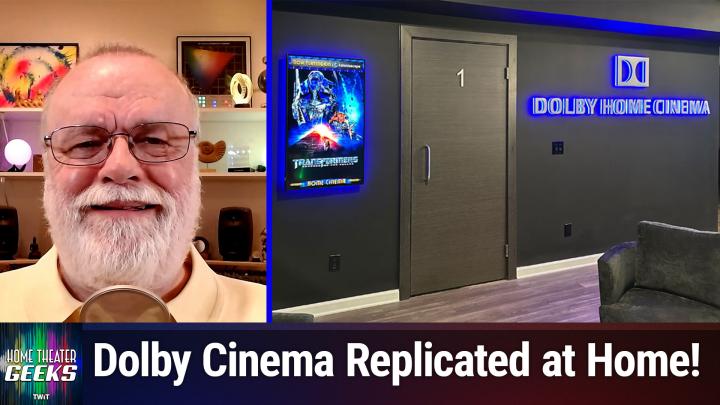
Loading summary
Transcript7 lines
- [00:01]
Scott Wilkinson
In this episode of Home Theater Geeks, I talk about the latest AVS Forum Home Theater of the Month. This one is a replication of a Dolby Cinema. Very cool. So stick around.
- [00:16]
Unknown
Podcasts you love from people you trust. This is Twit.
- [00:32]
Scott Wilkinson
Hey there, Scott Wilkinson here, the home theater geek. In this episode, I'm going to profile another Home Theater of the Month from AVS Forum. This one is the 13th of 2024, so it's the bonus Home Theater of the Month. We like to say we make it a baker's dozen, and in this case it's really very cool. Of course, they're all really cool, but. But this one seeks to replicate a Dolby Cinema in a home theater. Now, Dolby Cinema is my favorite commercial cinema format. I like it better than imax, certainly better than a conventional commercial cinema. And so does Terrence. He finds it to be the. The most enjoyable commercial cinema experience as well. And so he wanted to replicate that in his home. The. Now, he built a house in. I think it's called Brazelton, Georgia. I think that's how you pronounce it. And he built it from scratch. He had. He built the whole home. You know, he had it built and he included in the plans a basement home theater so he could start from scratch. He didn't have to work with any existing room and try to figure out how to make do with this or that or windows or obstructions. He just built it from scratch. And that's really the best way to go. So I wanted to start by showing you a picture of the final room. And we're going to show a few pictures of the installation and how it went. But check this out. The finished room uses blue LED strip lighting, just like Dolby specifies for its commercial cinemas. Now, interestingly, most Dolby cinemas are in AMC Cineplexes and they chose to use red lighting. And I don't know why that is, because I know Dolby specifies blue. And in a couple of the Dolby cinemas I've been in that aren't in AMC Cineplexes, the lighting is blue. It's this blue LED strip lighting. And so Terence went ahead and did it the way Dolby specified, and it really just looks great. Now, as I said before, he framed the room in his basement, and we can see a picture of that framing process, or at least as it. As it was in process. Here you see the riser in the back for the second row of seats. First row of seats would be between those. Those two little platforms on either side. And you can also see in particular, I want to point out the wall in the back of the seating area. You can see the framing there. That is a false wall. It's not the end of the room, but it's there for a couple of reasons. One is to provide a bass trap. So it's going to get stuffed with insulation and covered with acoustic material. Duct board actually. And that is going to act as a bass trap, which means it's going to absorb some of the base frequencies and prevent them from reflecting back into the room. We can see that in the next picture. Some progress here. We see that all the framing is filled with insulation, which serves two purposes really. One is sound isolation, keeping the sound inside from leaking out and the sounds from the outside from leaking in. And it also serves as some damping to the internal sounds. In the next one, we can see the drywall is up. And that's, that's a, that's something that I personally wouldn't tackle. I would pay somebody to do that. And I believe he did in this case. You know, his whole house is being built. So the builder went ahead and did that, although he himself specified what, how he wanted this room to be. And notice again in the back, the false wall is still. We still see the insulation. The next picture has a closer view of it and you can see the. There's an opening, a rectangular opening at the top, which is where the projector will shoot through that opening and onto the screen. And also I want you to notice the, to the right of this picture, that wall does not extend all the way to the, to the side wall. In fact, that is the entrance into the theater from the outside, which is exactly like a Dolby Cinema does it. You walk into the outer door and you have to walk around the wall to get into the actual theater. We're going to see more pictures of that in a minute. But before we do, I wanted to show you the screen wall, which is where the screen goes. And I like showing how home theater owners have set up their front, left and right and center speakers, which you can see here, along with two subwoofers. Those left, center and right LCR speakers are Triad gold in wall speakers. Triad is a very well respected maker of speakers in particular in walls. And they basically come in three levels, gold, silver and bronze. And the Gold series is the top of the line, as you might expect. And he's got three of them there behind the screen wall. They're actually in the wall. Thus he's using in wall speakers the two subwoofers that you see down there are from a company called GSG and they're called BTS subwoofers behind the screen. And those drivers are 21 inches in diameter, which is mighty big, so it makes a beautiful low bass sound along with those LCR triad speakers. So those speakers and all the ones around the room are driven by amplifiers that sit in a very tall equipment rack outside the theater. And as you can see here, that is one tall equipment rack. And there's a lot of gear in there, including a Kaleidoscape Strato C player and a Terra prime server with eight terabytes of storage. And that's where most of his movies are stored. He also has a Panasonic DP UB9000UHD Blu Ray Player so he can actually play physical discs, although the Kaleidoscape plays digital files with the same quality as a real Blu Ray. So now the Kaleidoscape is a pretty expensive system, but it stores everything on a big server and you can search for things and it starts right up. It's. It's really quite wonderful. But in case you can't get a Kaleidoscape title that you want and you have it on an actual physical disk, Terrence can play it on the Panasonic UHD Blu ray player. His surround processor is a JBL synthesis SDP55. Very high end. He has Summit and Crown power amps and a Lumigen Radiance Pro video processor. The projector is a JVC NZ9. I believe we'll see a picture of of that a little bit later, but it's very high end equipment all the way around.
- [08:47]
Unknown
Like your favorite startup's growth curve, T Mobile's coverage keeps scaling because T Mobile helps keep you connected from the heart of Portland to right where you are on America's largest 5G network switch. Now keep your phone and T Mobile will pay it off up to $800 per line via prepaid card. Visit your local T Mobile location or learn more@t mobile.com KeepAndSwitch up to 4 lines via virtual prepaid card. Allow 15 days qualified unlock device, credit service port in 90 plus days device and eligible carrier and timely redemption required. Card is no cash access and expires in six months.
- [09:18]
Dennis Black
With New Year's resolutions, many of us will make a vow to eat healthier. And that's a good thing. But what about our beloved pets and their nutrition? Greetings, I'm naturopathic doctor Dennis Black and here at Meow Greens, we're on a Mission to provide better nutrition for all cats. Because truthfully, all cat food is dead food, which is why we created Meow Greens in the first place. We bring their dead food back to life with live vitamins, minerals, probiotics, enzymes, omega oils, antioxidants and so much more, all with a tasty formula that your cat will love. You can improve your cat's coat digestion and energy and have less vet bills. Let 2025 bring a new year and a new pet. Get a Jumpstart trial bag. Normally $20. Get 100% discount with promo code MEOW. You just cover the shipping. Bring your pet's food back to life. Get your free Jumpstart trial bag. Go to Meow Greens.com use promo code MEOW Meow. So good your cat will ask for it by name.
- [10:17]
Scott Wilkinson
So in the next graphic we can see his lobby and he made it look just like a commercial Dolby Cinema lobby, including an electronic movie poster on the left which is from a company called Digital Movie Boards. And it basically shows whatever is playing in the theater or rotates around different movie posters. Very, very cool. He also custom made, he made that Dolby Home Cinema sign with the Dolby logo. And he even put a number on the entrance door as if he were in a multiplex, which he's not. It's the only movie theater in that building, his home. But you know, that kind of gives it the more of a sense of you're, you're in a commercial cinema. Now once you go in that door, you will see that the entrance leads you around the back wall and into the theater as you can see here, which is again just like a Dolby Cinema. That's exactly how they look and how they, how they are designed. That trash can in the corner I think is really cool too. So the next graphic shows you what it looks like when you enter the room and just. It's fabulous. It's just great. We'll see some other pictures here of the inside of the room as well. The next one shows the six Seatcraft Apex theater seats in two rows of three. In this particular image, the blue strip lighting is not turned on, which of course you wouldn't want it turned on during a movie, but. And you can turn it off. The front three seats in, in these two rows have Croson tactile transducers which I've talked about before. Basically they're little speaker transducers that are mounted in the seats. And when you get a low frequency rumble from an explosion or a rocket taking off or dinosaur roaring or whatever, it actually rumbles your seat and jiggles you around. Now, I personally find that to be quite unnerving, and so I don't like it, but a lot of people do. And if you do, then it's great. You should. You should go for it. I tell the story going to a CD show one time and Runco was showing their latest stuff and they had these tactile transducers in their seat in their demo room. And I sat down and it started rumbling and I immediately got up and left. And they said, what's wrong? And I said, I don't like those. So later in the show, I came back and they said, we took one out just for you. That was service. I liked that. That was very good. Okay, we have a picture of the screen which I wanted to tell you a little bit about. It's from a company called XY Screens. The material is called Soundmax 4K. It's 160 inches diagonal, or in other words, about 12ft wide in a 2.35 to 1 aspect ratio. And it's a woven, acoustically transparent material. So those speakers we saw earlier are sitting behind that screen. And that's really the best way to do front sound is to have the speakers actually behind the screen. Because then the sound as something moves from right to left or left to right, you can hear the sound coming from the object that's making that sound. And they're associated visually very closely. And that really makes a great effect. It's very important to immersiveness. Okay, the next picture, we show this blue LED lighting again. And, you know, that just is fabulous. It looks so good. And the next graphic is a close up of that back wall with an opening for the projector. And I wanted to mention that that projector is also really, really nice. It's a JVC DLA NZ 8. And you can also see the exit sign in this picture. And interestingly, somebody in the. In the comments on the article for this Home Theater of the Month said, well, I really hate exit signs in theaters because they're so bright. They throw light into the room that you don't want. And Terrence said, not to worry. This is not a normal exit sign. It's a glow in the dark exit sign. So it's not nearly as bright. But again, it lends a touch of commercial cinema to the theater, which I think is great. Okay, in the last graphic, just show you one more picture from this theater. It just looks so good. I would love to watch a movie in this room. So the next time I get to Braselton, Georgia, I will give Terrence a call and maybe go check it out. The link, the URL for the article. We'll put in the show notes so you can go read that article and get even more detail than I've given you here. But I hope you've enjoyed it, because I certainly did. I enjoyed writing it up. I enjoyed seeing all the pictures and knowing that somebody else just like me prefers Dolby Cinema over any other commercial source and went so far as to create it in his theater. Oh, and how much did it cost? Well, it wasn't cheap. He had a bunch. He had, you know, contractors do a lot of that basic work. He claims that he spent around $60,000 on this home theater, which, you know, a number of people who have commented on the article say, wow, that really isn't too bad for what it is. And I have to agree. So, you know, more power to him. And that's a lot of money. I won't, I won't pretend to think it's not. But if you've got it and you've got the opportunity to build something exactly as you want it, it's money well spent, in my opinion. So congratulations to Terence and I know you will enjoy that room for years to come. So in many episodes of Home Theater Geeks, I answer listener questions. So I hope you will send them along to HTGWIT tv. Now if you want to watch the video, that's now very easy because all of our shows are on YouTube and free to watch with advertising. Now if you want to get ad free shows, then just join the club. All you have to do is head to Twit TV Club Twit to sign up. So until next time, geeka.
- [17:50]
Unknown
Hey buddy, are you a geek? Are you a tech enthusiast? Then I would love to invite you to join a tech community like no other. You can gain exclusive access to our incomparable quality tech content for just $7 a month. With Club Twit as a member, you'll enjoy all Twitter shows ad free plus access private video feeds for insider shows like iOS today, home theater geeks and so much more. Dive into the members only Twit plus bonus feed for behind the scenes content club discussions and special events. But here's the best perk. Join our incredible Discord community to watch live show productions, chat with hosts and participate in exclusive members only activities. It's your backstage pass to the world of twit. Whether you're a tech enthusiast or a lifelong learner, Club Twit elevates your knowledge while entertaining your interests. Get two weeks free when you sign up now for $7 a month and unlock unparalleled access at Twit TV. Club Twit. That's Twit TV slash Club Twit. And from the bottom of my heart, thank you and welcome to the.