← All TWiT.tv Shows (Audio)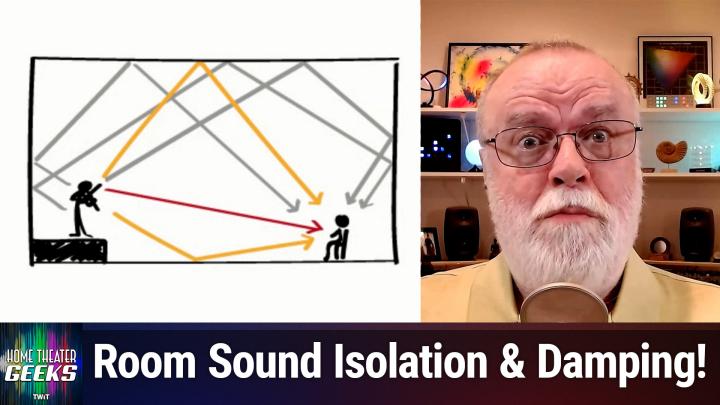
All TWiT.tv Shows (Audio)
Home Theater Geeks 471: Too Much Sound Absorption?
00:19:22
How Quiet is Too Quiet?
Loading summary
Transcript5 lines
- [00:00]
A
In this episode of Home Theater Geeks, I answer a question from Daniel, who wonders if too much sound absorption in a room is too much. Stay tuned.
- [00:14]
B
Podcasts you love from people you trust. This is twit.
- [00:30]
A
Hey there, Scott Wilkinson here, the home theater geek. In this episode, I answer a question from Daniel in New Jersey, who writes, I just listened to your episode on Ryan's Amazing Home Theater. At the end of the episode, you mentioned that Ryan sat in his theater and it was disturbingly quiet. I've been told that you don't want to do too much sound damping in a room because it will sound dead. Does that make any sense? Is there such a thing as a room that's too quiet? Well, this is a great question, Daniel, that that theater was featured in episode 463, and actually you're conflating two separate but interrelated things, sound isolation, or noise control and damping. By the way, in your original email to me, you used the word dampening, which is a very common mistake. But I, being an educator, I want to make sure that you understand that that was not the right word to use. Dampening means to make something slightly wet. Damping means to reduce the amplitude of an oscillation, like a sound wave. So just. Just wanted to clarify that point for you. So, sound isolation and damping. Sound isolation is the process of limiting sound from penetrating a barrier, like a wall in a home theater or a commercial cinema or recording studio. You want to limit that sound transmission through walls as much as possible to keep external sounds out so you're not distracted by noises like traffic or kids playing or something like that, and internal sounds inside the room. So people in other parts of the house or the facility, whatever it is, are not bothered by those big explosions and those fight scenes that can really raise a ruckus. Now, damping seeks to reduce the level of sound reflections within a room, which is mainly accomplished using absorption panels on the walls and the ceiling. Let's start with damping. Now, you don't want to completely eliminate reflections. You are right about that. What you heard is correct. It sounds very unnatural. Our brains are programmed to expect some reflections and reverberations within a room. If we look around and we see walls, we expect to hear that. And our brain from birth, has been programmed to recognize what are called early reflections first. First you get the direct sound. You get whatever's making a sound. That direct sound gets to you first. Then it's reflected on the walls and the ceiling and the floor, and off of other stuff and Those reflections reach you at different times, depending on how many times they've been reflected. So the early reflections, your brain detects those and learns to ignore them. And it also learns to ignore the late reflections, the ones that have arrived later. It gives us the ability to localize where sounds have come from. And this was an evolutionary advantage because if you're in a cave, a reverberant cave, and there's an animal snarling about, ready to pounce on you, you want to know which direction it's coming from so that you can run in the opposite direction. And you can demonstrate this by recording a conversation in a room. So put a little recorder down in a room, record yourself conversing with somebody. When you play that back, it sounds very echoey. You hear a lot of the room because the microphone and recording device don't have the brains processing of the echoes and reverberation within the room. The early reflections occur within the first 50 or 80 milliseconds of the original sound. After that, the reflections sort of turn into this reverb mush that the brain really can't cancel out. And we, we can see a classic example, a classic depiction of that in the first graphic. Here we have a little violin player and we have a person sitting in a chair. The red line is the direct sound that gets to you first, always. The yellow lines are the early reflections that bounce maybe once before they reach you. And the gray lines are the late reflections, which happen later because they bounce around more than the early reflections. And the early reflections are what we really pay pay attention to. Late reflections just are reverb. So that is how reverb and reflections in a room work. If you deaden all the reflections, the brain freaks out. The room is too dead. Your brain says, I see walls, I hear no reflections, something's wrong. So how dead is too dead? You don't want a cathedral like reverb either, because as I said, the brain can't ignore that. And it sounds very, very well. If you've ever been in a cathedral, you know what that sounds like. So what acoustic engineers aim for is an RT60, which is the reverb time, the time it takes for the reverb to drop by 60 decibels, which is a lot. You want that to be about on the order of a third of a second, 0.3 second for a typical room in the 300 to 400 square foot area. So here you can see a picture, steady state sound source making a sound. Sound turns off, the sound decays. Now how long does it take for it to decay by 60 decibels is a parameter known as RT60, and you want that RT60 to be about a third of a second. To get there, you want to cover no more than 15 or 20% of the surface area of the walls with absorption panels or it'll sound too dead. Now, this RT60 rating of about a third of a second is based on extensive human listening trials that were done by the eureka project some 40 years ago, which was an international consortium to determine the ideal listening room for speaker manufacturers. Interestingly enough.
- [08:11]
B
Hey prime members, Are you tired of ads interfering with your favorite podcasts? Good news, with Amazon Music, you have access to the largest catalog of ad free top podcasts included with your prime membership. To start listening, download the Amazon Music app for free or go to Amazon.com ADFreePodcasts that's Amazon.com ADFreeP Podcasts to catch up on the latest episodes without the ads. I'm no tech genius, but I know if I want my business to crush it, I need a website. Now. Thankfully, bluehost makes it easy. I customized, optimized and monetized everything exactly how I wanted with AI. Within minutes my site was up. I couldn't believe it. Plus, Bluehost keeps me protected 24 7. No more worrying about hackers. I just relax and focus on my customers. So whatever your hustle may be, secure your online presence in 2025 with Bluehost. Head to bluehost.com to start now.
- [09:13]
A
Now, I'm getting a lot of this information from my friend Anthony Grimani, who is an acoustician, an acoustical engineer and really, really knows his stuff. So I want to thank him for providing me with all of this great background information. And according to Anthony, you can get to a third of a second RT60 using what he calls the stuff of life. So stuffed furniture, drapes, bookcases, you know, the stuff that you have in a room can pretty easily get you to a third of a second, but it's not well controlled. It doesn't work over a wide range of frequencies very well. It may work in some frequencies well and not in others. So those who are serious about their home theaters use acoustic panels to more carefully and accurately control their their absorption. Now, I've got a couple graphics to show you here. Here is the sound absorption coefficient versus frequency for different materials. These would be materials in the walls and windows of the room. And you can see concrete block, interestingly, is pretty wide band, probably because it's porous. Concrete blocks have a Lot of little holes in them, and that that helps absorb some sound. Glass, interestingly, is pretty absorptive in the low frequencies, down to 250 or so, but gets less and less so as it goes up. Plywood, not too bad. Wood, not too bad. Brick, unglazed brick is pretty bad at low frequencies. As you can see, tile is the worst. It's very reflective. So this is just helpful to know when you're building your room. The next graphic is different sound absorption coefficients for different thicknesses of foam. So as you can see, 6 millimeter thickness is not very absorptive at all. Up up to about 2002 kilohertz, and then it's more. So 12 millimeters gets pretty good. After about a thousand or one kilohertz, 25 millimeter gets good sooner, and 50 millimeter gets good even sooner. None of them are very good, down to 100 hertz. So the low frequencies foam doesn't work very well. But at high frequencies, if you can put 50 millimeter thick foam on your walls, you'll get pretty good absorption from about 500 hertz and above. And I just wanted to show you one other, which is the. This is from a company called, I think it's called Fibertex, and they make a product called fiber acoustic 450. And they recommend putting an airspace between the fiber acoustic 450, the actual absorptive material, and the wall. And if you put a 15 millimeter airspace behind it, it doesn't get very absorptive until you get to about 2K or so. 30 millimeter airspace gets effective much sooner, and a 30 millimeter and a 50 millimeter airspace get effective. And the 50 millimeter airspace, boy, it just gets super effective. Like around 500 shoots way up there. Although, interestingly, looking at this graph, somewhere around 3500, it really dips for some reason. I don't know. I don't know why, but this is what acoustic engineers think about when they're thinking about making the room sound good over a wide range of frequencies. That is a little bit about sound absorption. Now, let's talk about sound isolation. A good home theater has strong sound isolation, so it'll sound quiet when there's no sound in the room. Oh, good. You can show the gif. So here's an incoming sound. It hits an absorber, a wall, and it reflects, and some of it gets absorbed, and some of it gets transmitted to the other side of the wall. The goal is to transmit as little as possible to the other side of the wall. So that's, that's what you want, that is what you want to do. Now the amount of sound isolation that keeps outside sounds out and inside sounds in determines what's called the noise floor of the room. It's the nominal level of noise when there's no other sound in the room. Now, the absolute threshold of hearing is defined as zero db for a person with really good hearing. But achieving a noise floor of 0dB in a room is really hard. Really hard. Typical noise floor in a well designed theater is 15 to 20 decibels, which means that you're going to hear anything outside the room. You're going to hear, you know, at 15 or 20 decibels, which is quite quiet. Recording studios, if they can get down to 10 or even 5, are really quiet. Now this is specified in something called the noise coefficient or nc. And and it models hearing sensitivity at low levels. So it shows you different NR noise rating, sometimes called nc, but in this case it's called nr. It shows you the threshold of hearing and it goes down to NR10. And that would be a noise rating of 10 would be really, really quiet. And you can also see the dotted red line, which is the threshold of human hearing. That's essentially zero. And you'll notice that as the frequency drops, the threshold of hearing increases. In order to hear a sound of 31 hertz, it needs to be playing at 50 decibels. So that just reflects the fact that we as humans, our sensitivity to hearing is different at different frequencies. It's very unsensitive at very low frequencies. So those low frequencies have to be really loud in order to even perceive them. And so 10dB needs to be over 50D to the noise rating curve of 10 extends all the way past 60db at 31Hz, but at 8K, it's down there close to zero. So you want the room to the noise floor to follow one of these curves. And you want, the one reason for that is you want the room to be really quiet in order to hear the entire dynamic range of music, which theoretically is 120 decibels from the very quietest sound to the very loudest sound. CD quality audio, which is 16 bits digital audio, has a dynamic range of 96 decibels. And high resolution audio with 24 bits of resolution has a dynamic range of 144 decibels. So if a room is NC15, the loudest music that in order to represent the entire dynamic range of music would have to be 135 decibels. Which is painfully loud, no question. And it's damaging to your hearing. So even NC15 doesn't let you hear the full dynamic range of music. So you want the room to be as quiet as possible. That is to have a low noise floor, but not damped as much as possible because then it sounds very uncomfortable. It fools our brain. It tricks our brain into thinking something's really wrong. Quiet and dead feels weird. And if it's too quiet, you may not hear it's too damp. Rather, within a really quiet room, you may not hear your own movements, for example, and that feels really weird. So when Ryan, the theater owner in episode 463, when he said it felt a little disturbing, it may be that his room is over damped a little bit. And he did put up a lot of absorption as I recall. So it may be over damped. He may need to remove some of that or put in some other acoustic panels that would cause a little more reflection in the room. Not a lot, but a little. On the other hand, it could just be he wasn't familiar with it yet and once he got familiar with it, it would be fine anyway. That's a long answer to the question of how much damping is too much and can anything be too quiet. They're interrelated. Different questions, but interrelated. And when you optimize both of them, you get a killer sounding room. So thanks a lot for sending that question in. If you have one, send it along to htgwit tv. I love answering these questions right here on the show. Also want to let you know that all our videos now are on YouTube and you can watch them for free with ads. Now if you want to go ad free, join the club. All you have to do is go to Twit TV Club Twit and sign up. In addition to being ad free, you get access to the exclusive Twit plus feed and our Discord channel where you can come in and and gather around the digital water cooler with your fellow geeks. So hope you will think about it. Until next time, geek out.