← All TWiT.tv Shows (Audio)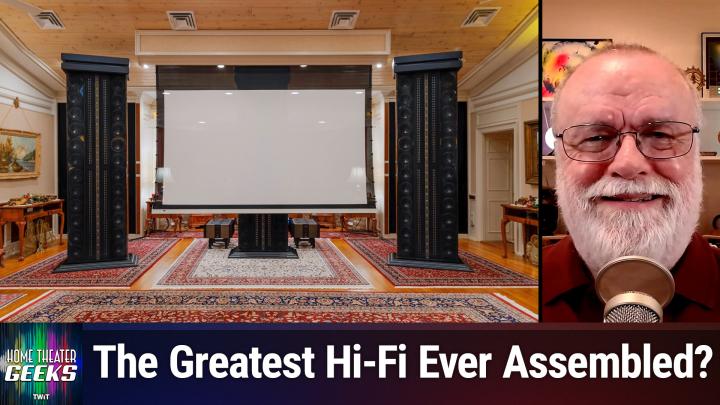
All TWiT.tv Shows (Audio)
Home Theater Geeks 472: Million Dollar Stereo
00:29:58
World's best home audio system?
Loading summary
Transcript1 lines
- [00:00]
Scott Wilkinson
In this episode of Home Theater Geeks, I talk about a stereo system that cost a million dollars. Was it worth it? Stay tuned. Podcasts you love from people you trust. This is Twit. Hey there, Scott Wilkinson here, the home theater ge Normally the first episode of the month. I like to feature a Home Theater of the month from AVS Forum. But this time I wanted to share something a little different. My wife sent me an article from the Washington Post which was written by Jeff Edgers about a man named Ken Fritz who had dedicated his entire life to building what he thought was the world's best stereo. Now, he did this in his home in the North Chesterfield neighborhood of Richmond, Virginia. And I will put a link to the Washington Post article in the show notes so that you can check it out in more detail. Now, in terms of cost, Ken claims to have spent over a million dollars on his system and he built many of the components himself. And it took decades. The story is so remarkable that Ken's son Scott and a filmmaker friend, Jeremy Bircher made a one hour documentary called One Man's Dream. And that was in 2018 and it's posted on YouTube and you can check it out there. It's really, really interesting. I recommend you do and we'll put the link to that in the show notes as well. The system was going to take up so much room that Ken expanded the living room in his house by 1650 square feet to make the floor ratio, the aspect ratio of the floor if you will, just under 2 to 1, which is the same as great concert halls of Europe like the Concert Gabao in Amsterdam. And the room also got a separate 200amp electrical circuit and its own separate H vac heating, ventilation and air conditioning system. He built the speakers himself. These are amazing. There were three of them, 10ft tall, each weighing 1400 pounds with 24 mid range drivers and 40 tweeters. Later he added two smaller speakers between the mains which I don't have much information about. That's the next graphic but you can see them here. They have somewhat larger main drivers, some smaller mid range drivers, and these things on the top are horn, low horn loaded tweeters, compression drivers in these, in this fan slotted thing. He built all this himself. I don't know much about the subwoofers. There had to be a lot of subwoofers in the room and I don't know much about them. And they this whole system was powered by Krell amps. He didn't build the amps, he bought Krel amplifiers with a total output of 35 kilowatts, 35,000 watts. Another thing that he built from scratch was the turntable, which is called the Franken Table. It cost around $50,000. It's on a 1500 pound base and equipped with three different tone arms and cartridges for different genres. Used one of them for classical, one of them for jazz, and so on. It's quite astonishing. There's one other picture of the Franken table. Here's a picture of it, of the entirety of it, not just the top. And that thing costs 50 grand and weighs 1500 pounds. Astonishing. Really amazing. Now, he had a drop down screen for watching movies, interestingly enough, but I'm sure most of it was used most of the time. He used it for, for listening to records and vinyl, obviously, on the Franken table. Now, Ken declared the System finished in 2016, which is a little bit of an anomaly because most audiophiles I know know that they're never going to be finished. It's never finished. There's always something more to do, component to add or replace, always something more to do. But Ken, he said, I'm done. And unfortunately, two years later, he was diagnosed with als, otherwise known as Lou Gehrig's disease, which Stephen Hawking, the famous physicist, also suffered from. And by 2020, he couldn't lift his arms to put records on the turntable and he ended up listening to digital files from his iPad on the system. He died in 2022 at the age of 80. So what happened to this amazing system? Well, his family tried to sell it with the house he had. He had three daughters and two sons. And when he died, they tried to sell the house with the system in it. Nobody was buying. Somebody almost did, but then they backed out. So they finally got an offer on the house, but they said, we don't want the system. So sad. His daughter sold it at ebay on an, on an auction site called ebay Local. So I guess it was specifically to, to the Richmond, Virginia area. The Franken table sold for $19,750 after 44 bids. But still it cost him 50,000 to make it. The 10 foot tall speakers, all three of them sold for just over 10 grand. And the total for the entire system, everything in that system, $156,800, about 15% of what Ken had spent on it. But that's only money. There were other costs as well. Ken had forced his kids to work on the system for decades, to pour the concrete floor of that room to build those speakers to build the Franken table. And unfortunately, he became completely estranged from his oldest son, Kurt, and he had a damaged relationship with his other son, Scott, although his three daughters maintained a relationship. And in the Washington Post article, he said he had some regrets with his style of fathering, which apparently had he had been very hard, very demanding, emotionally distant. But he had no regrets about the years and decades he spent building that system. So I think the cost to Ken was actually much higher than the million dollars. And the question is, was it worth it? Yes and no. According to the Washington Post article, he regretted having estranged relationships with his kids, but not with building the system itself. And it reminded me that it's a question we all have to ask ourselves. Those of us who are in to the hobby of audiophilia or home theater, those of us that are home theater geeks when we delve so deeply into this hobby that we love. I love it as much as anybody else, but at what point does it get too much? My advice? Enjoy the hobby, but not at the expense of your relationships and not at the expense of everything else in your life. You know, some people sink all their money into this and then wonder why they can't pay the rent. So don't get into that and don't sacrifice your relationships, which are in my opinion far more important than any audio video system. This is something of a cautionary tale, fascinating for those of us who are interested in audio video reproduction, but a a bit of a sobering tale. Anyway, go check out that documentary. It's really something. It's really, really good. I highly recommend it. So if you have a question for me, please send it along to htgwit TV and I'll answer as many as I can right here on the show. Also, you might have noticed by now that all of our videos are now posted on YouTube and available to watch for free with ads. Now if you want to go ad free all you have to do is join the club. Go to Twit TV Club Twit and sign up. This will also give you exclusive access to to the Twit plus bonus feed and our Discord channel where you can gather with like minded geeks and geek out. Totally. So until next time, geek out.