← All TWiT.tv Shows (Audio)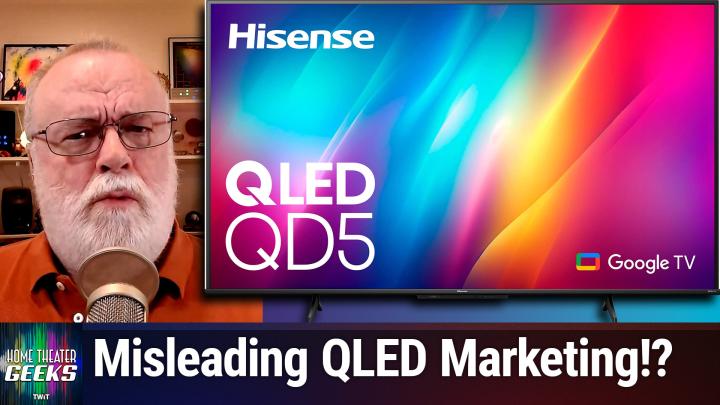
All TWiT.tv Shows (Audio)
Home Theater Geeks 473: Hisense QLED Lawsuit
00:15:31
Totally bogus litigation
Loading summary
Transcript9 lines
- [00:00]
Scott Wilkinson
In this episode of Home Theater Geeks, I talk about a lawsuit brought against Hisense from a disgruntled consumer. Does he have a case? Stick around.
- [00:15]
Podcast Announcer
Podcasts you love from people you trust.
- [00:19]
Scott Wilkinson
This is twit. Hey there, Scott. Matt Wilkinson here, the home theater geek. In this episode I'm going to talk about an article I recently saw in my news feed. One of the newsletters I get. The industry newsletters is called Display Daily. And in it last week was a story about a lawsuit that kind of piqued my interest in, tweaked my anger the law. The article is called Lawsuit alleges Hisense Misled consumers with QLED Marketing. And we're going to put a link in the show notes to that article so you can see it. The suit was filed in US District Court for the Southern District of New York and it was brought by a guy named Robert Macios or Masioche. I think I'm going to say Macios just because I don't really know. That's kind of what it looks like. He claims that Hisense USA engaged in false advertising and deceptive business practices regarding its TV products. Macios had bought a 43 inch Hisense QD5 5, which we can see in the first graphics just, just a picture of the QD5, which is a fairly low end Hisense TV. He bought it in November 2024 for 160 bucks from Best Buy. Now they market the QD5 along with the QD6, QD65, QD7U 7U 7N and other models as featuring QLED technology. Now, QLED technology, QLED stands for Quantum Dot Light Emitting Diode. And Hisense claims that it, quote, dramatically increases the color space and improves color saturation, allowing consumers to see color like you've never seen it before. Yeah, okay. Typical marketing hype. You've heard it before a million times. Now, Macios contends that these television that these televisions either do not contain QLED technology or contain it in such negligible amounts that it does not meaningfully enhance the display the performance as advertised here. He wants various forms of relief, including a permanent injunction preventing Hisense from continuing this allegedly deceptive practice. Actual and punitive damages, of course, and more. He also demands a jury trial. He wants his day in court. Now, in my opinion, this is a totally bogus lawsuit. Assuming that the QD5 and other Hisense QLEDs do in fact contain quantum dots, which I have no reason to believe they don't. Negligible amounts as he claims in his lawsuit makes no sense at all. So I want to explain how QLED TVs work. And we're going to look at a graphic and I'm going to tell you how it works. Now this looks very complicated, but I've circled the elements that are the most important for us to look at and consider. At the right, you have blue in this graphic. Mini LEDs. They don't have to be mini LEDs. They could be regular sized LEDs, but you have blue LEDs. That's the backlight. You might have a diffuser plate which diffuses the light from the LEDs and makes it more uniform. Then the, the blue light hits a qdef, otherwise known as a quantum dot enhancement film. And this is a film of plastic that is saturated, impregnated, if you will, with red and green quantum dots. The red and green quantum dots get hit by the blue light. Blue photons are absorbed, some of them, not all of them, but some of them are absorbed by the red and green quantum dots, which then re emit photons at the red or green wavelength. Now, when you combine the red and green from the quantum dots and the blue from the backlight, you get white. So the white, the white light then goes through a bunch of elements, a bunch of layers. It hits the liquid crystal display, which is the actual element that makes the image. Each sub pixel in the liquid crystal layer has a color filter, a red, green or blue color filter that displays the red, green or blue part of the image. And then that finally gets displayed and it's a full color image. The lower element, the lower picture here, the quantum dot enhancement film QDEF is combined with the diffuser plate. That's the only difference between these two graphics. So the important thing to remember is blue backlight passes through a QDEF which generates some red and green. Some of the blue gets through without being converted. That forms white, goes through the liquid crystal, just the part of the display which forms the image, then through color filters which separate out the red, green and blue parts. But that all gets combined by your eye, finally in the end, in the display. So that is how quantum dot QDEF Q qled, sorry, works. It has a QDEF in it which is saturated with quantum dots. Now, you can't have a negligible amount of quantum dots in that qdef. I know this is a bit of Alphabet soup, so forgive me, I even get a little confused myself once in a while. The quantum dots are embedded in the qdef and if it has a negligible amount of them, then too much of the blue light is going to get through and not be absorbed by the quantum dots to form red and green. And if you do that, then you're going to produce a very blue image. I'm going to show you a picture of the CIE diagram, which is how color television works. You can see the triangle is what the display can reproduce. So you see blue in the lower left, you see green at the top, and you see red at the lower right. You might hopefully you can see a point in the middle called D65. That's the ideal white point. That's the target of where the white light coming off the QD EF should be. If there are very few quantum dots in the qdef, more blue will get through than should. And pull that white point towards the blue and the picture will look blue. So hisense would have a lot more problems, a lot bigger problems than this lawsuit if that's what was happening. So it can't be happening. It just can't.
- [08:41]
Ad Announcer
Hey prime members, Are you tired of ads interfering with your favorite podcasts? Good news. With Amazon Music you have access to the largest catalog of ad free top podcasts included with your prime membership. To start listening, download the Amazon Music app for free or go to Amazon.com ADFreePodcasts that's Amazon.com ADFreeP Podcasts to catch up on the latest episodes without the ads.
- [09:06]
Podcast Announcer
Omaha Steaks Semiannual Sale is back. Save 50% site wide on Legendary Steaks, Juicy Air Chilled chicken, Beefy burgers and so much more. Plus get an extra $35 off when you use code tender during checkout@omahasteaks.com today. This sale only happens twice a year, which means it's the perfect time to stock up on the world's best steak experience with America's original butcher. With five generations of family owned experience, Omaha Steaks are hand selected from the finest grain finished beef, naturally aged at least 28 days to maximize tenderness and hand carved by master butchers with every bite backed by their 100% guarantee. Shop now to save 50% site wide on steaks and more during the semi annual sale@omahasteaks.com plus get an extra $35 off with code tender at checkout. That's 50% off@omahasteaks.com and and an extra $35 off with code TENDER. Minimum purchase may apply.
- [10:08]
Scott Wilkinson
So Hisense says that QLED dramatically increases the color space and improves color saturation, allowing consumers to see color like you've Never seen it before. Typical marketing hype. As I've said before, all TV manufacturers do this to one degree or another anyway. And is it really true? Well it's slightly true. QD's quantum dots do provide a wider color gamut and a larger color volume, but not by all that much. Now from ratings.com r t I n g s.com I went to their site and found a comparison between a regular LED TV without quantum dots and a cued LED TV with quantum dots. And I looked at their color gamut and color volume and so I'm going to show those to you now. The Sony X900H is a regular LED and a Samsung Q90 is a QLED. So here is the color gamut of the Sony which is not, does not have quantum dots and you can see it doesn't quite reach out to the ends the, the blue, the green and the red corners of the triangle. And if we look at the next picture which is the Samsung which does have QLEDs that doesn't reach out to the ends at least in the green either. It gets a little better with the blues, but not tremendously more. Now as I recall do looking at the write up that they had there, the Sony color gamut is 85.7% of what's called DCI P3 which is the color range of modern 4K TVs. And it's 63.4% of BT 2020 which is the ultimate and almost no TVs reach that the Samsung color gamut is 89.1% of DCI P3. So a little bit more and 67.2% of BT 2020 which is a little bit more, not tremendously, but a little bit. Okay, let's take a look at color volume which measures the colors of a TV at different luminance, different luminance levels. Graphic 6 shows us the normalized coverage of DC IP3 for the Sony. The wire diagram is, is sort of the target and the colored area or volume is what the TV produces. And here's the Sony and then the next one is the Samsung and you know you can see they're a little bit different. The Sony's normalized coverage of DCI P3 color volume is 76.1% and the Samsung's 85.2%. Okay, so that's more but QLED while it does increase color volume and color gamut and thus saturation, but I wouldn't call it dramatic and it shouldn't be for a good picture. These must conform to A standard that has been set like DCI P3. And so if they can get there, great. They shouldn't go beyond it because then it would be inaccurate. Is this color like you've never seen before? No. But plenty of companies make similar claims and besides, they can't possibly know what you or I or anyone else has ever seen before. Now the QD5 is probably not a very good performer. It's a, it's an entry level, low end set. Art ratings.com has not reviewed the QD5 but they did review the QD6 which is a step up model from that and it didn't score very well. It got a 6.9 overall which is in their average category and all the scores were in the mediocre range and the QD5 is even lower end. And what do you expect for 160 bucks? I mean, come on. Now I'm sure all of you know that Hisense is not alone in being hyperbolic in its ad marketing language. And if you're going to sue the company over it, you're going to have to sue all TV manufacturers and many others. I suspect that Masiosi is actually just disappointed in his purchase and he wants to blame Hisense so he's filing this BS lawsuit. I want to say that it's up to us, up to consumers, not to fall for the ubiquitous language that all companies use and do your due diligence, read reviews, listen to experts that you trust, hopefully I'm one of them and, and make your decision based on that rather than the marketing hype and then blame the company when the marketing hype doesn't meet your expectations. So that's what I wanted to say about that. Now if you have a question for me, you can send it right along to htgwit tv. I love to answer these questions and I will do so as often as I can right here on the show. Now, as you may know by now, all episodes of Home Theater Geeks are available on YouTube for free with advertising. If you want to go ad free with all the twitch shows, join the club. Just go to Twit TV Club Twit to sign up and you'll get to see them all ad free. Until next time, geek out.
- [16:57]
Ad Announcer
When the Moore family ditched cable Internet and switched to Zigly fiber, they got so much more. Mr. Moore got more upload speed for next level gaming and livestreaming to the masses with reliable service. Mrs. Moore is no longer her family's IT guru, leaving her more time to stream games into overtime. Let's go. And young Mason Moore got more done quickly uploading HD product demos and video conferencing without freezing the numbers.
- [17:19]
Scott Wilkinson
Look good. Brad, you're on mute.
- [17:21]
Ad Announcer
Switch from cable Internet to ziply fiber and get more of what you love for $65 less per month than cable@ziplyfiber.com.