← All TWiT.tv Shows (Audio)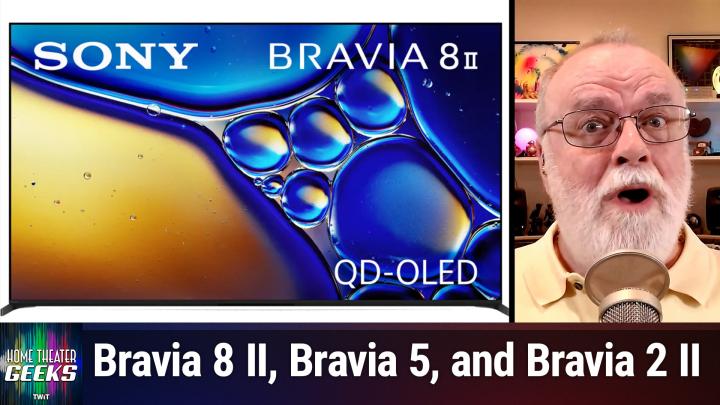
All TWiT.tv Shows (Audio)
Home Theater Geeks 477: Sony 2025 TV Lineup
00:14:28
The new models look to be awesome!
Loading summary
Transcript4 lines
- [00:01]
Scott Wilkinson
In this episode of Home Theater Geeks, I talk about Sony's 2025 TV lineup, so stick around.
- [00:09]
Amazon Music Ad
Hey prime members, are you tired of ads interfering with your favorite podcasts? Good news. With Amazon Music, you have access to the largest catalog of ad free top podcasts included with your prime membership. To start listening, download the Amazon Music app for free or go to Amazon.com ADFreePodcasts that's Amazon.com ADFreeP Podcasts to catch up on the latest episodes without the.
- [00:33]
LinkedIn Ads Ad
Ads does it ever feel like you're a marketing professional just speaking into the void? Well, with LinkedIn ads you can know you're reaching the right decision makers. You can even target buyers by job title, industry, company seniority skills. Wait, did I say job title yet? Get started today and see how you can avoid the void and reach the right buyers with LinkedIn ads. Even give you a $100 credit on your next campaign. Get started at LinkedIn.com results, terms and conditions apply. Podcasts you love from people you trust.
- [01:11]
Scott Wilkinson
This is twit. Hey there, Scott Wilkinson here, the home theater geek. In this episode, I'm going to talk about Sony's 2025 TV lineup, which they just announced at a special event in Tokyo, no less. Sadly, I didn't get to go, but many of my colleagues did and what they reported on was pretty cool. So let's check it out. Some of the 2024 models will carry over from last year and they will include the Bravia 9 which is their flagship mini LED QLED LCD TV Alphabet soup, I know, but that's what it is. The Bravia 8, which is a conventional OLED sometimes called WRGB for white, red, green, blue and the Bravia 7 which is another mini LED QLED using quantum dots. Step below the Bravia 9 and the Bravia 3, which is a standard conventional LED TV with no local dimming, so it's more of an entry level type product. But they introduced three new models that are going to slip in between those models that are continuing on from last year. The first one is called the Bravia 8 mark 2. A little bit unfortunate nomenclature there. I'll talk about that in a minute. This one is a QD OLED quantum dot OLED using the latest QD OLED panel said to have 25% more peak brightness than their previous QD OLED, the A95L and 50% more peak brightness than the Bravia 8 from last year. The old their conventional OLED. However, the Bravia 8 Mark 2 is only available in 55 and 65 inch sizes. The A95L, last year's actually 20, 23's QD OLED will be still be available at least for a while and it's available in 55, 65 and 77 Inc. Sony claims that the Bravia 8 Mark 2 will be more affordable than the A95L, but no pricing has been announced yet. Now I have to say I'm still glad I got the 77 inch A95L. I would be having some buyer's remorse right about now if the Bravia 8 Mark II came in a 77 inch size. But I really wanted a 77 so I was really happy to. I am still really happy to have that a 95L. Now as I mentioned a little bit a moment ago, the model naming convention is a little strange. Bravia8 and Bravia8 Mark 2, they're both OLED one WRGB, the other QD OLED. And I've seen a lot of online speculation that Sony still considers the Bravia 9 to be its true flagship. Which would mean that they didn't want to call their new QDO led the Bravia 10, which would have elevated it at least psychologically above the Bravia 9. And they still want the Bravia 9 to be the flagship. I disagree with this decision. The only real advantage that Bravia9 has over QD OLED is a greater peak brightness. That's. That's really the only thing. And QD OLED has the advantage over all LCDs in a wider off axis performance. Go off axis from the center of the TV picture. Still looks great with all LCDs. That's less true. Now the company has been talking about a new technology that they're going to release in a product in 2026 called RGB LED. And that will certainly be their flagship. So maybe that'll be the Bravia 10. I'll be talking about RGB LED in a future episode explaining what that is. It's pretty cool. It's still based on LCD technology and so has the inherent limitations of LCD. But it's a lot better than current flagship LCD TVs. Now I watched one video from Digital Trends. My colleague Caleb Denison there, who I respect very much, he was thinking that maybe the 2026 RGB LED model could be called the Bravia 11 in keeping with what appears to be Sony's convention to number the LEDs or the LCDs with odd numbers and the OLEDs with even numbers. Okay, but calling the new qd OLED Bravia 10, as I said before, would psychologically elevated above the nine, which they didn't want to do, I'm sure. So I'll be talking about RGB LED in a future show, so watch out for that. Okay. The second new model that they introduced is called the Bravia 5. It's a new lower cost mini LED QLED LCD using quantum dots and it uses the same processing as the more expensive models which is called XR Master backlight drive. At least the processing used to drive the backlight, which is really, really good. They Sony does an excellent job with this and so it's, it's top of the line and rightly so. If this model, Bravia 5 features Variable Refresh rate, game mode, Dolby vision up to six times the number of dimming zones as the X90L which is a couple of generations ago depending on screen size. And it comes in screen sizes of 55 up to 98 inches, which is the largest of the new models offered by Sony. They say it'll be less expensive than the Bravia 7, undoubtedly with lower peak brightness and fewer dimming zones, but still I'll bet it's going to be a really, really good performer. Okay, and finally at the very bottom of the list, shall we say, is the Bravia 2 Mark 2. Now this is an entry level Sony TV, conventional LED backlight, no local dimming, much like the Bravia 3. I didn't even know they had a Bravia 2 to tell you the truth. So I'm not sure where the Mark 2 designation comes from. Other US news outlets are not even discussing this model. So maybe it's not for the US market, but it is in Sony's press materials from that Tokyo event. So maybe it's only European or Asian, I'm not sure. It's going to be a very low end tv, an entry level into Sony. Now I put together a spreadsheet of the entire Sony lineup, so let's take a look at that. You can see I've, I've marked the new models in red here so you can distinguish them from last year. And the Bravia 8 mark 2, Bravia 5 and Bravia 2 mark 2, they haven't announced prices yet, but they did announce sizes, so we have those here and we can. The Bravia 8 Mark 2 will be less than the Bravia 9, but maybe more than the Bravia 8. I would guess. So you can kind of interpolate between these two. For example, the 65 inch Bravia 9 is 2,700 bucks, which is down from when it was introduced last year by a few hundred bucks. And the 55 inch bra, 65 inch Bravia 8 is 1700. So I'm going to guess that the Bravia 8 mark two 65 inch is going to be in the 2000 $2200 range, something like that. It's a guess. It's a guess. Similarly, the Bravia 5 is between the 7 and the 3, so it's going to be less than the 7 and more than the 3. I suspect that's going to be a real hot item. It is not Quantum dot but it is mini LED. So for example, let's take a look at the 65 inch Bravia 7 is 1500 bucks and the 65 inch Bravia 3 is 700 bucks. So the 65 inch Bravia 5 is going to maybe be in the thousand to twelve hundred dollar range, I'm guessing. So you know, that's. That I think is going to be a really good seller and it's going to. I'm going to be able to recommend that one pretty highly. I wanted to say something about the processing. Sony is the only TV company that also produces content. Sony Picture Studios and its processors for its TVs are geared toward showing you what the content creators intended, which is always my goal as well. That's what I want a TV to show me is exactly what they saw on their monitors when they were mastering and finishing up the product. And they do a really good job of it. Sony's processing is second to none in my opinion. And it's one reason why Sony TVs are more expensive than their direct competitors like LG and Samsung. Now there's something really important that Sony shared with the journalists who were in Tokyo and they in turn shared with their audiences. Caleb Denison at Digital Trans, I talked about him before. He talks about it in his video on his trip to Sony and, and the TVs that they introduced. And it's this. Sony takes the time and the effort and the money to essentially adjust or calibrate each and every TV that comes off the line, at least in terms of color uniformity, screen uniformity. So if a TV comes up, a TV comes off the line, a camera takes a picture of it. It's showing a gray test pattern, camera takes a picture of it. Areas that are not uniform, blotches that are maybe darker or lighter, the TV gets adjusted until they disappear and it's all very uniform. This is amazing. They also in their picture modes, the, at least the higher end TVs have a professional mode, which is very close to fully calibrated color wise and grayscale wise. So this is, this is a lot of effort that they go to and it's another reason why Sony TVs cost more. Caleb calls it the Sony tax. And they do this all the way down to the Bravia 3. I don't know about the Bravia 2 mark 2, but at least to the Bravia 3, we know that they do this and everything above it. And that's really, really good. It's why Sony TVs are usually rated better and why they're more expensive, as I said. So that's something to keep in mind when you're shopping. So as you can see, Sony has a pretty impressive lineup of TVs and they may cost me a bit more, but in my opinion they're definitely worth it if you can can pump up the budget to afford one. I think that Bravia 5 is, is in particular going to be in a real sweet spot. So looking forward to seeing them in person. This, this is very good. So that's it for Sony's 2025 TV lineup. Now, in some episodes I answer questions from you, the listener and the viewer. So send them along to HTGWIT TV and I'll answer as many as I can right here on the show. And as you know, all episodes of Home Theater Geeks are Now available on YouTube for free, of course, with ads. If you want to go ad free, join the club. Go to Twit TV Club Twit to join up and get all of Twits podcast programming for free. Well, for the cost of the Club Twit ad free, which is really good. I, I appreciate that very much. So until next time, geek out.