← All TWiT.tv Shows (Audio)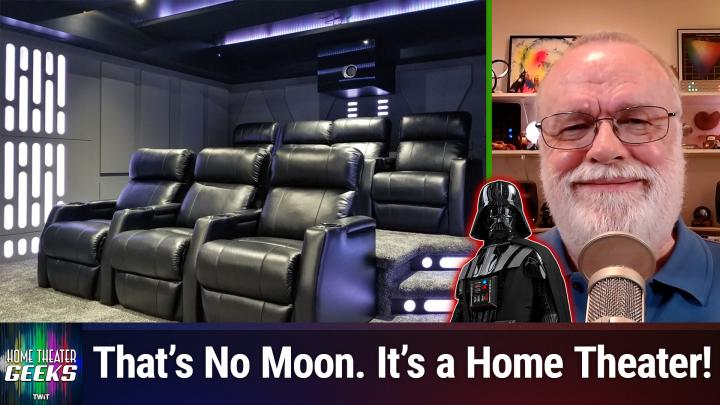
All TWiT.tv Shows (Audio)
Home Theater Geeks 481: The Force Theater
00:13:18
Home Theater of the Month!
Loading summary
Transcript25 lines
- [00:00]
Scott Wilkinson
In this episode of Home Theater Geeks, I feature a home theater based on Star wars in honor of May the fourth Star Wars Day. Stick around.
- [00:12]
Ryan Reynolds
Ryan Reynolds here from Mint Mobile with a message for everyone paying Big wireless way too much. Please, for the love of everything good in this world, stop with Mint. You can get premium wireless for just $15 a month. Of course, if you enjoy overpaying. No judgments. But that's weird. Okay, one judgment anyway, give it a try@mintmobile.com Switch upfront payment of $45 for.
- [00:35]
Scott Wilkinson
Three month plan equivalent to $15 per month required intro rate first three months.
- [00:38]
Unknown
Only, then full price plan options available, taxes and fees extra.
- [00:40]
See full terms@mintmobile.com this podcast is supported by Talkspace.
- [00:44]
When my husband came home from his military deployment, readjusting was hard for all of us. Thankfully, I found Talkspace.
- [00:53]
Talkspace provides professional support from licensed therapists and psychiatric providers online. Military members, veterans and their dependents ages 13 and older can get fast access to providers, all from the privacy of their computers or smartphones.
- [01:07]
I just answered a few questions online and Talkspace matched me with a therapist. We meet when it's convenient for me and I can message her anytime. It was so easy to set up and they accept. Tricare Therapy was going so well, my husband and I started seeing a couples therapist through Talkspace too.
- [01:25]
Talkspace works with most major insurers, including Tricare. Match with a licensed therapist today@talkspace.com military go to talkspace.com military to get started today. That's talkspace.com military what's standing between you.
- [01:42]
And your first sale on Shopify? Time Expertise Resources what if you could multiply all three product descriptions done store insights insights delivered 2am customer questions handled instantly Entrepreneurs on Shopify are reaching their first sale faster with AI that works with you. Go to shopify.com firstsale to see how entrepreneurs use AI to grow their businesses faster. That's shopify.com firstsale.
- [02:13]
Podcasts you love from people you trust.
- [02:18]
Scott Wilkinson
This is TWIT.
- [02:23]
Unknown
Foreign.
- [02:29]
Scott Wilkinson
Hey there Scott Wilkinson here, the home theater geek. In this episode, I'm going to feature a home theater that I wrote about in AVS forum in 2018. Why now? Because it's very close to May 4, Star Wars Day and this theater certainly fits. Its owner is Patrick Williams and although he no longer owns the house that this theater is featured in, it was in Nixa, Missouri and he built this theater in the house that he had constructed from the ground up and he dubbed it the Force. His new Home theater is also wonderful, but it has nothing to do with Star Wars. So we'll look at it another time. Foreign. I'll put the link to the Force in the show notes on AVS Forum. Like I said, it was featured in 2018. So as with most custom home theaters that are that start from scratch, he started with a floor plan. This one was drawn by Sean Byrne at Quest Acoustical Interiors, the company that provided all the acoustical treatments as well. And he's kind of an AVS Forum legend. And another such legend, Jeff Parkinson, also consulted on the project. As we can see in the next picture, it shows us where the Force Theater is located in the house. It's in one corner of the ground floor. Sure is nice when you can include a theater in a new house build, which can avoid many of the compromises of an existing room. Now, the walls and ceiling are insulated with a material called R13 Pink Fluffy, as we can see in the next picture. And here you can see the R13 pink fluffy. You can also see these metal channels, they're called, which are going to be used to isolate the drywall from the studs and the rest of the house to keep the sound in and also keep the interior sound in and exterior sound out. And you can see in this photo, he also built the side and rear surround speaker back boxes. These are going to be in wall speakers. And he had to build these back boxes to put them. To put them in. There are some also in the ceiling for the overhead Dolby Atmos speakers. Interestingly, in the next graphic, you can see how he minimized the sound of air flowing through the H Vac system, heating, ventilation and air conditioning. He insulated the supply and return chambers with something called Linacoustic RC duct liner. And he's going to great lengths here to really damp any sounds that aren't part of the movie in his room. Now, the next graphic we can see, the drywall is up. He used two layers of 5, 8 inch drywall sandwiched, and between them is sandwiched a layer of what's called green glue, which is a very special glue, comes out of a glue gun and it's designed specifically for its acoustic absorbent qualities. The concrete floor was covered with something called Serena MAT and 3/4 inch OSB, which stands for oriented strand board with a gap around the perimeter to avoid contact with the walls. Yet another step in isolation. Now, Patrick had some problems with the drywall installation, but he was on hand to ward off any major disasters. He says that Jeff Parkinson warned him about Several things to look out for and suggested that he be on site in that phase of construction. And he's glad he did. Everything that could happen, he said did happen. For example, there were large gaps between the first layer of drywall and the ceiling, which needed a lot of caulking. And fortunately he was there to catch that and, and correct it because it would have cost a lot more to fix later in the process. He also provided in the next graphic, a super wide angle shot of the entire room. And you can see MDF paneling designed to look like the interior of the Death Star. And it was painted, of course, later on, which we'll see. The second row riser in the next graphic is a big bass trap. It was built as one big bass trap. And the stage itself is filled with a mixture of sand and sawdust. It took about 3 tons of sand that he hauled into that room and filled, filled the riser and the front stage as well. In the next graphic, we can see the MDF paneling, which has now been painted gray and includes cutouts backed with frosted plexiglass. The LEDs behind these panels can be set to any color, which of course, I would turn off when watching a movie, but when you're in there, otherwise it's kind of cool. And also, I want you to take a look and notice the black projector box at the back of the room. It's vented with a large flex tube into. Well, I'm not sure where it's ventilated into, but it's vented somewhere so that the projector doesn't get too hot. So in the next graphic, we can see the acoustic panels, which are shaped to conform to the Death Star motif. And the. And you can see some of the acoustic panels, this yellow, those yellow material that was integrated into the paneling and all of this acoustic material was from Quest. And they are in specific locations to provide absorption, diffusion and reflection, which I've talked about on the show more than once, that you really need to have a balance of those things in order to get the right acoustical environment. The ceiling panels are from a company called Acoustic Mac and he used Guilford of Maine, Anchorage material for the wall treatments and paneling, just because he liked the texture of that material.
- [09:47]
Unknown
This podcast is supported by talkspace.
- [09:50]
When my husband came home from his military deployment, readjusting was hard for all of us. Thankfully, I found TalkSpace.
- [09:58]
TalkSpace provides professional support from licensed therapists and psychiatric providers online military members, veterans and their dependents ages 13 and older can get fast access to providers, all from the privacy of their computers or smartphones.
- [10:12]
I just answered a few questions online and Talkspace matched me with a therapist. We meet when it's convenient for me and I can message her anytime. It was so easy to set up and they accept Tricare. Therapy was going so well, my husband and I started seeing a couples therapist through Talkspace too.
- [10:30]
Talkspace works with most major insurers, including Tricare. Match with a licensed therapist today@talkspace.com military go to talkspace.com military to get started today. That's talkspace.com military.
- [10:48]
Scott Wilkinson
Now in the next picture we can see the speakers that he used, which he had from the pre from a previous theater there I aperian grand versus Towers. And interestingly, only the center channel is behind the screen. The right and left channels are actually outside the screen area. Not far, but a little bit. So that widens the sound stage. You don't see in this photo two subwoofers from a company called Rhythmic. They're the FV15HP subs and they ended up flanking the center tower. And there's a layer of linacoustic rc, that same stuff that he lined the H vac duct with behind the speakers as well to limit the reflection of any sound from the speakers from that wall behind them. So in the next graphic we can see the LED lighting above the finished screen, which can be set to any color. But of course, as I said before, it's turned off when the movie's playing or it better be. In the next graphic we can see the door to the Force, which is integrated into the motif beautifully, I think. Now in the next graphic, he sent me with a little joke. He said, when I sense conflict between the good and dark sides of the Force and my visitors, I'll set the lighting to represent both. Blue for good, red for dark. I thought that was hilarious. And you can see in this picture and in the next one, the home theater seats that he chose are from HT design. They're the Warwick black leather motorized recliners with lighted cup holders and USB ports. Pretty cool. And they look really comfy. That's that. It's a beautiful looking theater. I imagine he probably misses it. Although as I said, his new theater is really good too. Really good. Now, Patrick has some great gear and it had some great gear in that theater. An Oppo UDP 203UHD Blu Ray player, same one I have. Universal Disc player, Wonderful player. Sony PlayStation 4 probably has a 5 by now Denon receiver which I'm sure he's upgraded by now with Outlaw power amps. He had an Epson 5040ub projector in there and I'm sure he's upgraded that as well. The screen was a Sievertson Cinema white screen, 117 inches wide, 2.35 to 1, acoustically transparent so so that the subwoofers and the center channel speaker could could shine through, no problem. In addition to the Aperion versus Grand towers in the front, he also had triad in wall and in ceiling speakers for the surrounds and the overheads, which triad makes wonderful in wall speakers. So I'm sure it sounded fantastic along with those two rhythmic subwoofers. Now when all is said and done, Patrick says He spent about $70,000 on the force Theater and he, he wrote me and he said, as my wife says, there's your Corvette. I don't know about you, but I'd be more happy with a home theater than a Corvette. He says he was able to save about $10,000 by laying the Serena mat and the OSB board on the floor himself, building the speaker lighting and H vac back boxes caulking around the seams of the drywall, which he really had to be careful with because of a problem there that I mentioned earlier, and installing the the acoustic paneling and fabric on the walls. So that's, that's not chump change. That's a lot of money. But look what he got for it. It's amazing and particularly appropriate for this week since we just saw a few days ago May 4, which is known as Star Wars Day. And what could be better than taking a look at a Star wars themed theater? So clearly the home theater force is strong with Patrick and may it also be with you. Now, if you have a question, you can send it along to htgwit TV and I'll answer as many as I can right here on the show. And all of Twitch shows, including Home Theater Geeks are available on YouTube for free but with ads. If you want to go ad free, join the club, go to TWiT TV club TWiT to join and get all of TWiT's programming ad free. Until next time. Geek out.
- [16:18]
Unknown
This podcast is supported by Talkspace.
- [16:20]
When my husband came home from his military deployment, readjusting was hard for all of us. Thankfully, I found talk space.
- [16:29]
Talkspace provides professional support from licensed therapists and psychiatric providers online. Military members, veterans and their dependents ages 13 and older can get fast access to providers, all from the privacy of their computers or smartphones I just answered.
- [16:44]
A few questions online and Talkspace matched me with a therapist. We meet when it's convenient for me and I can message her anytime. It was so easy to set up and they accept Tricare. Therapy was going so well, my husband and I started seeing a couples therapist through Talkspace too.
- [17:01]
Talkspace works with most major insurers, including Tricare. Match with a licensed therapist today@talkspace.com military go to talkspace.com military to get started today. That's talkspace.com military.