← All TWiT.tv Shows (Audio)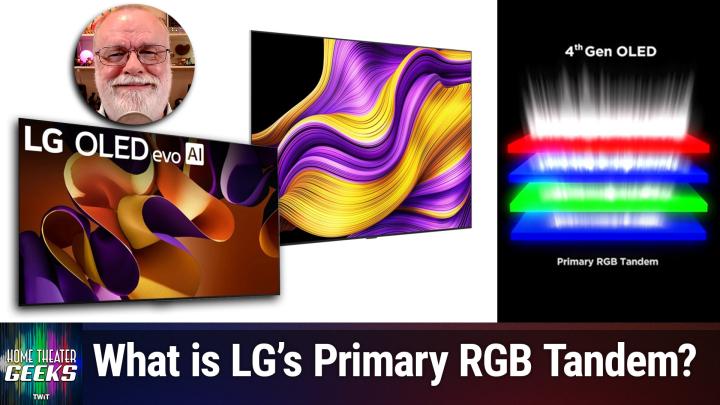
All TWiT.tv Shows (Audio)
Home Theater Geeks 483: LG G4 vs G5
00:14:03
WRGB, MLA, META Technology, & more
Loading summary
Transcript3 lines
- [00:00]
Scott Wilkinson
In this episode of Home Theater Geeks, I answer a listener question about the LG G4 versus G5 models. Stick around.
- [00:11]
Ryan Reynolds
Ryan Reynolds here from Mint Mobile. I don't know if you knew this, but anyone can get the same Premium Wireless for $15 a month plan that I've been enjoying. It's not just for celebrities. So do like I did and have one of your assistant's assistants switch you to Mint Mobile today. I'm told it's super easy to do@mintmobile.com.
- [00:29]
Scott Wilkinson
Switch upfront payment of $45 for 3 month plan equivalent to $15 per month required intro rate first 3 months only, then full price plan options available, taxes and fees extra. See full terms@mintmobile.com podcasts you love from people you trust this is hey there Scott Wilkinson here, the Home Theater geek In this episode I answer a question from Charles Simmons who writes I currently have a 5 year old 77 inch LG C series OLED TV. We are ready to move up to an 83 incher and we're looking at the G4 which has a significant discount right now. Pre orders for the G5 are being taken now as well. I'm wondering if it's worth it to wait until later this year when the G5 will be reduced in price to get the newest screen technology. My viewing room has a lot of ambient light during the day. You can see reflections at times. Nighttime viewing is not a problem. Great question Charles. LG's 2025 OLED TV lineup has at least some of them have implemented a new technology, a new OLED structure compared to the 2024 models and before including the G4. Let's take a look. The G4 basically uses the same OLED structure as previous years. Two layers of blue OLED sandwiching a layer of yellow or a combo of red, yellow, green and green between them. As you can see in this graphic, it's called a white OLED layer. It's got two layers of blue and a layer sandwiched between it. In this graphic it's kind of a nondescript beige, but it's it's either yellow or it's a combination of red, yellow, green and green. And when you combine that with the two blue layers, you get white, white, then the white layer. The white light I should say goes through a red filter, a green filter, a blue filter, and a clear filter which is called a white filter, which doesn't filter the light, it just lets the white get through and those four sub pixels form a complete color pixel. Now the Reason that they have the white subpixel. This is often called WRGB or W OLED because it has a white sub pixel. And the reason for that is to enhance or increase the brightness of the picture. And it does that, it increases the brightness, but it also causes color desaturation at high brightness levels. So, so as the picture gets brighter and brighter and brighter, color saturation decreases. Now the G4 also implements LG's microlens array or MLA, which they introduced in 2023. It places tiny lenses in front of each pixel which we can see in the next graphic. So here we have the W OLED panel passing through an MLA layer of teeny tiny lenses and then finally through the glass. And that is, is a technology that's a couple of years old. LG claims 5,000 or more lenses per pixel, which means around 42 billion lenses on a 77 inch 4K screen, which they show. They have a little graphic in the next graphic. I wanted to show you 42.4 billion microlenses on a 77 inch screen. These lenses direct more light toward the viewer, increasing brightness and efficiency over previous models. LG in fact claims 22% greater energy efficiency compared to a standard OLED panel. And also increased lifespan. So they say. Also important is LG's meta brightness boosting software. This is not the company that, that owns Facebook. It's their technology that they also call Meta. It's, it's a software, but it's part of the panel itself. It's not in the video processor. And with Meta and MLA, LG claims 50% higher brightness than previous models. Now I must admit I, when I first learned about this, I was a bit concerned that about viewing angles with mla, because if they, if mla, these little micro lenses direct light more forward, straight ahead, maybe the off axis viewing would not be as good as it typically is with oled. One of the reasons OLED is so good. But LG claims these TVs have even more viewing angle than the than the standard oled. And they also have a new polarizer which reduces reflections, which would be important in your room. According to Tech Radar, one of the articles I read for this, it cuts the brightness of reflections roughly in half compared to previous model. Now the G5 which was introduced this year, 2025 introduces a new OLED panel struct which they call Primary RGB Tandem. And that's in the next graphic. Here we see it and you can see on the left the conventional W OLED which has two blue layers and in the middle of them, a red plus yellow, green plus green and that forms white. The new OLED cell primary RGB tandem has two blue blue OLED layers, but in between them is a straight green layer and a straight red layer. So there are four layers now instead of three. And among the differences you can see in the lower corners of this graphic, the power spectrum, the, the wavelength spectrum of each of these panels. And they have a strong blue peak and a green peak and a red peak. And then the oled, the woled, the red peak in particular is not very high. And in the new, our primary RGB tandem it's quite a bit higher and more and narrower as is the green, which gives you a better, a better color gamut and well, better color gamut in this case. It's also going to give you a better color volume as well. Now this structure does not use mla, these little micro lenses. They've decided to get rid of that in favor of this new structure. Now LG claims that it doubles the brightness even of the G4. G4 claimed 2000 nits of peak brightness. If you display a tiny 3% window on a black field, real world measurements are less than that. But they, that's what they claimed as the up to the G5. They claim 4,000 nits. Good grief, that's really bright. That's competing with LED TVs and of course measurements, real world measurements are going to be less than that. And you know, but it is brighter, there's no question. It's also, they claim, more efficient. This new, this new primary RGB tandem, it's a long name, it's more efficient. LG claims that the 65 inch version is 20% more efficient than the equivalent 2024 model which we can see in this graphic here. Third generation OLED, they call this primary RGB tandem fourth generation. And as you can see in the little bar graph in the middle, the fourth generation take consumes 20% less power. So that's good. The G5 also has a new anti reflection technology which is said to reduce reflections by 99%. That's like holy smokes if that's true. That's, that's going to be great in your room. No question about it. So should you get the G4 or the G5, either one will produce a fine picture. No question about that. The G5 is likely to be at least a little better, maybe a lot better. It's hard to say. You can read. Reviews are ratings. R-T-I-N-G-S.com has a review of the G5. I'm pretty sure, in fact we'll put a review of it, a link to it in the show notes. If you watch a lot during the day with a lot of ambient light, which you seem to imply in your letter, then the G5 is likely to do a better job of rejecting reflections as well as being brighter. But the G4 is no slouch. So you know that's it's, it's going to come down to cost more than anything else. I think the 83 inch G5 is $6500 which is the same as the G4 when it was introduced and the 83 inch G4 is now at $5000. So that's a significant difference. 1500 bucks. As I said. Ratings posted their review of the G5. We'll put a link in the show notes. They rate the G5 at an 8.9 overall and they re rated the G4 at 8.6. Both of those are great scores, very high. And the G5, you know, edges it out a little bit as one would probably expect. Now one problem they found with the G5 was its handling of HDR10 content. They said it had unusual contouring in dark scenes. And they, and I hope that LG releases a firmware update that addresses this issue. You know, this is a new technology, a new product likely to have bugs in it when it starts. So hopefully they'll correct it. They often do. LG is good about that, as are the other major TV brands. So if you have the budget for it and your current TV is working well enough, I'd probably wait for the G5 at least see if they fix the, that HDR10 contouring problem. Now you mentioned waiting until the G5 comes down in price, but I don't think that's going to happen till next year when they, when the G6 comes out, presumably that's what they'll call it. They don't normally they sometimes lower the price a little bit later in the year, but not significantly until the next model year is introduced. So, you know, I don't think you're going to see a big price drop this year for the G5, but if money's tight, you know, and, or your current TV is starting to fail, the G4 will serve you perfectly well. It's, it's a fine TV. So if you can wait and you got the money, if you don't need to get a TV right now and you want to wait a little While till the G5 is available, or pre order it. I'd say go for that, but if you can't G5 G4 is perfectly fine. So thanks for writing in. If you have a question for me, please send it along to htgwit TV and I'll be happy to answer as many as I can right here on the show. And now all Twitch shows are on YouTube for free, but with ads. If you want to go ad free, join the club, go over to TWIT TV Club Twit and join today. You'll get access to all the Twitch shows with no ads, so I hope you'll do it. Until next time, geek out.